How to Move a Treadmill Safely
The short answer: read the moving section of the exact manual, stop and unplug the treadmill, secure the power cord and safety key, fold and latch the deck only if the model is designed to fold, then roll it on its transport wheels over a clear, level route. Use at least one helper when the manual, machine weight, route, or balance calls for one.
Built-in wheels are usually intended for short moves on one level. Stairs, loading into a vehicle, a narrow turn, a non-folding frame, or any move that requires lifting the machine calls for the manufacturer’s transport procedure or professional movers.
Choose the Moving Method Before You Lift
Find the product weight, folded dimensions, approved grip points, folding-latch instructions, and any transport warnings in the manual. Do not estimate from appearance: home treadmills can weigh well over 150 pounds, and the console makes the load top-heavy.
| Move | Usually appropriate | Get more help when |
|---|---|---|
| A few feet on the same level | Built-in transport wheels and the model’s folding procedure | The machine does not roll freely, rocks, or has no approved moving position |
| Through doors or around corners | Measured route, protected walls and floor, one spotter | The folded dimensions leave little turning clearance |
| Across carpet or a threshold | A helper and an equipment-rated floor protector or dolly approved for the machine | The wheels sink, catch, or require force |
| Up or down stairs | Professional equipment movers | Always; stairs add drop, crush, and loss-of-balance risk |
| Into a truck or another home | Manufacturer transport configuration, rated moving equipment, and trained help | Disassembly, ramp loading, or securing the treadmill is unclear |
Prepare the Treadmill and Route
- Measure the machine and route. Check the folded height, width, and depth against doorways, halls, elevators, and turns. Remove rugs, pets, children, cords, and loose objects.
- Set the required incline. Some manuals require the lowest incline before folding; skipping this can damage the machine.
- Power down. Stop the belt, switch off, unplug from the wall, remove the safety key, and secure the cord to the frame without tight bends.
- Remove only approved loose items. Take off bottles, tablets, trays, and accessories. Do not use the console or accessory rack as a handle.
- Fold according to the manual. Lift only at the stated points, use your legs, and confirm the storage latch is fully engaged. Never assume a deck is locked because it stays upright.
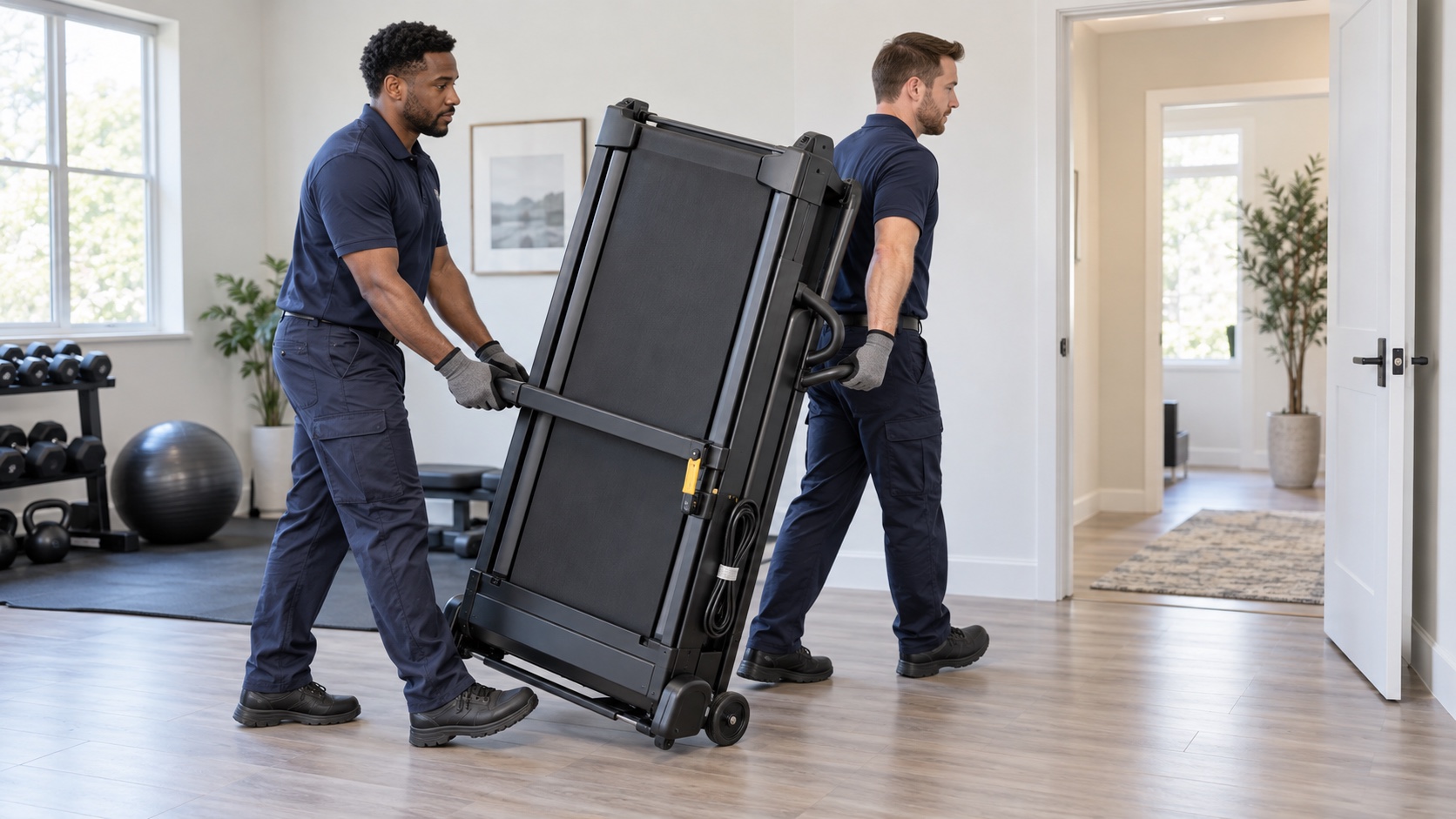
How to Move a Folding Treadmill on One Level
- Test the latch. Hold the deck and confirm the latch cannot release unintentionally.
- Position a helper. One person controls the machine; the other watches the latch, cord, wheels, doorway, and floor.
- Use the approved grip points. Manuals commonly specify the handlebars or base. Never pull by the console, screen, bottle holder, or handrail trim.
- Tilt only as directed. Place a foot at the base if the manual shows that method, then tilt until the transport wheels carry the load. Keep the machine balanced rather than pulling it toward your body.
- Roll slowly. Push or pull in the direction allowed by the wheel layout. Stop before thresholds and turns; do not build momentum.
- Lower under control. Keep fingers and feet away from the base, then place the treadmill fully on the floor.
- Do not release the deck yet. Confirm the final location, outlet clearance, and floor stability first.
A NordicTrack/ProForm manual illustrates why model instructions matter: it specifies the lowest incline before folding, a fully inserted latch pin, front-wheel transport, and a 45-pound lifting ability for that particular model. Those details are examples, not universal specifications.
Stairs, Vehicles, and Disassembly
Do not treat stairs as an extension of rolling across a room. The treadmill can rotate, the folding latch can carry unexpected load, and the person below can be trapped. Use movers experienced with fitness equipment and give them the manual, product weight, stair dimensions, and destination layout.
Disassemble only to the level the manufacturer permits. Label hardware, photograph cable routing, protect the console separately, and use any original shipping braces or transport cables specified for the frame. Never turn the treadmill on its side or upside down unless the exact transport instructions allow it.
Set Up and Inspect After the Move
- Place the treadmill on a stable, level surface with the clearances required by its manual.
- Inspect the power cord, plug, folding latch, console mast, covers, and visible fasteners.
- Confirm the belt remains centered and no object is trapped underneath.
- Lower the deck using the controlled-release procedure; do not stand beneath or on it while it descends.
- Reconnect power only after the machine is fully assembled and dry.
- Start unloaded at the lowest approved speed and stop for rubbing, rapid belt drift, new noise, an error code, or a burning smell.
If the belt moved during transport, use our treadmill belt adjustment guide rather than making large corrective turns.
Common Moving Mistakes
- Folding before returning the incline to the required position.
- Rolling before confirming the deck latch is fully engaged.
- Lifting by the console or accessory tray.
- Dragging locked wheels across flooring.
- Leaving the power cord loose where a wheel can crush it.
- Trying to manage stairs with an untrained friend instead of equipment movers.
- Removing bolts without the disassembly and reassembly procedure.
- Plugging in immediately without checking the belt, cord, frame, and floor.
Sources and Manufacturer Guidance
Requirements can vary by product, model, and situation. These primary sources informed this guide; official instructions for your exact product and current authoritative guidance take priority.
Frequently Asked Questions
-
Only when the manual explicitly supports a one-person move, the treadmill is in its approved transport position, and the route is flat and clear. Weight alone does not describe balance or crush risk; use a helper whenever control is uncertain.
-
Some non-folding treadmills have transport wheels, but the approved method varies. Do not lift or tilt a non-folding model by copying instructions for a folding treadmill.
-
Only as described by the manufacturer. Unapproved disassembly can release a spring-loaded frame, damage wiring, or complicate safe reassembly.
-
Use a helper and an equipment-rated method that keeps the transport wheels from digging in. Do not drag the frame or use a soft furniture slider that makes the machine unstable.
-
It can, especially if the frame twists, the machine is placed on an uneven floor, or it is transported incorrectly. Check level and observe the unloaded belt at low speed after the move.