How to Make a Treadmill Quieter: Find the Noise First
The short answer: put the treadmill on a stable, level floor, use a dense equipment mat when the manufacturer permits it, remove debris, tighten only the user-serviceable fasteners, and keep the walking belt correctly centered, tensioned, and maintained. These steps reduce vibration and prevent rubbing; they cannot safely hide a failing roller, motor, bearing, deck, or controller.
Identify when the sound occurs before changing anything: unloaded or underfoot, at one speed or every speed, with incline or without it, and from the belt, frame, motor hood, or floor. A new grinding, scraping, knocking, electrical buzz, or burning smell needs diagnosis—not extra padding.
Match the Noise to the Likely System
Run only a brief, low-speed test while standing beside the treadmill. Then repeat with a normal walking load if the unloaded test is smooth. Record a short video from a safe distance; the difference between the two tests is useful to a technician.
| Noise pattern | Check first | Stop when |
|---|---|---|
| Thump that repeats once per belt revolution | Belt seam, surface damage, trapped debris, and belt/deck condition | The belt is torn, folded, or the thump is worsening |
| Scrape or rub near one side | Belt alignment, side-rail contact, and debris | The belt edge is fraying or riding under a rail |
| Squeak only under a person | Floor level, frame contact, fasteners, deck system, and model-approved lubrication status | The sound is paired with belt hesitation, heat, or structural movement |
| Rattle from console or frame | Accessible assembly bolts, accessory trays, safety key, and items touching the machine | A cracked part, loose mast, or inaccessible internal fastener is involved |
| Hum or buzz from motor area | Normal baseline, power connection, load, belt/deck friction, and error codes | The sound is new, loud, paired with heat, shutdown, smoke, or odor |
| Knock, grind, or metal-on-metal sound | Roller, bearing, pulley, motor, or broken hardware | Immediately; arrange service |
| Booming footfall heard downstairs | Structure-borne vibration, mat, floor stiffness, placement, speed, and running form | The floor or treadmill visibly flexes or moves |
Seven Safe Ways to Reduce Treadmill Noise
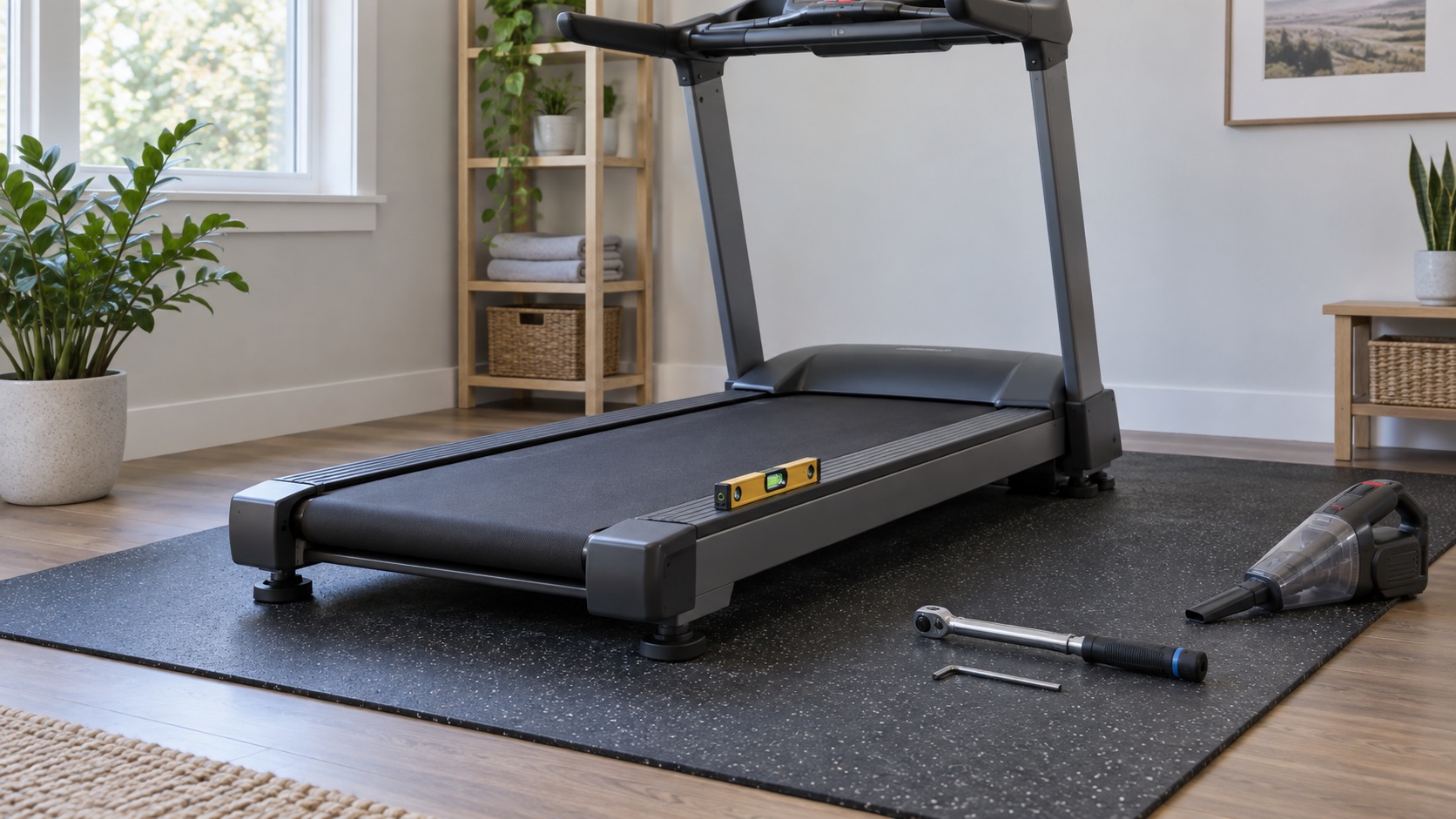
- Level and stabilize the treadmill. Check side-to-side and front-to-back level, then adjust only the approved leveling feet. Precor’s home manual emphasizes that the machine must sit evenly; an uneven floor can also affect belt tracking.
- Use the right mat. A dense, flat treadmill mat can reduce vibration transfer and protect flooring. It must support the full machine without bunching, compressing unevenly, or blocking ventilation.
- Create clearance. Keep the treadmill from touching walls, furniture, baseboards, and loose objects that can amplify vibration.
- Remove debris. Unplug the machine and clean the belt surface, rails, base, and floor. Life Fitness troubleshooting notes that foreign objects beneath the belt or machine can cause rubbing sounds.
- Check accessible fasteners. Use the assembly diagram and correct tool. Tighten to the published specification; do not keep turning a bolt that is stripped, inaccessible, or attached to a cracked part.
- Correct belt maintenance. A belt rubbing a rail needs model-specific centering. A slipping or overtightened belt needs diagnosis. Lubricate only if the exact model requires it.
- Reduce impact noise realistically. Clean athletic shoes, a slightly shorter stride, and a lower speed can reduce footfall. Do not alter natural running form solely to make the machine silent.
When the Belt Is the Noise Source
If the sound follows belt rotation, inspect the entire top surface and both edges with the treadmill unplugged. Look for a folded edge, fraying, glossy wear, trapped grit, a raised seam, or contact with a side rail.
Do not tighten the belt simply because it is loud. Too much tension can increase load and wear. Follow the model-specific diagnostic steps in our belt adjustment guide and confirm lubrication requirements in our lubrication guide.
Reduce Noise Transmitted to the Room Below
- Place the treadmill near a structurally supported area rather than the center of a springy floor, when the building layout and manual permit it.
- Use one continuous equipment mat; do not stack foam tiles, towels, or furniture pads under individual feet.
- Keep the frame level after adding the mat.
- Close doors and move rattling wall decor or furniture away from the machine.
- Schedule running sessions considerately when impact noise cannot be eliminated.
A mat can reduce some high-frequency vibration and protect the floor, but it cannot guarantee apartment-level sound isolation. Significant structure-borne noise may require a building or acoustic professional rather than a thicker pad.
Fixes to Avoid
- Do not spray household lubricant into rollers, bearings, or the motor area.
- Do not place towels, folded mats, or loose foam under the feet.
- Do not overtighten the walking belt or assembly bolts.
- Do not remove protective covers unless the manual or authorized support instructs you.
- Do not keep running to “wear in” a scrape, grind, knock, or electrical buzz.
- Do not assume every squeak means the belt needs silicone; some treadmills prohibit added lubricant.
Sources and Manufacturer Guidance
Requirements can vary by product, model, and situation. These primary sources informed this guide; official instructions for your exact product and current authoritative guidance take priority.
Frequently Asked Questions
-
A dense, flat mat can reduce some vibration transfer and prevent the frame from contacting hard flooring. It will not eliminate motor noise, footfall, a worn bearing, or serious structure-borne vibration.
-
Footfall and load increase both airborne sound and vibration. Load can also reveal an unstable foot, loose frame connection, high belt/deck friction, slipping belt, or worn component that is quiet when unloaded.
-
Only when the model requires lubrication and friction is the actual cause. The wrong lubricant can damage a belt or create slip, so check the exact maintenance instructions first.
-
A mild seam sound may be normal on some belts, especially when new, but a strong or worsening thump can indicate a raised seam, damage, debris, or roller problem. Stop if the belt surface or edge is damaged.
-
Arrange service for grinding, knocking, metal contact, repeated shutdown, rapid belt damage, electrical buzzing with heat, a burning smell, smoke, or any sound coming from a component the manual does not allow you to access.