How Accurate Are Smart Scales? Weight vs. Body Fat
Smart scales are usually much better at measuring weight than estimating body composition. In one study comparing three consumer smart scales with DXA, median weight error was about 0–0.3 kg, while fat-mass estimates differed by several kilograms and varied by the person being measured. A smart scale can therefore be useful for weight trends, but its body-fat, muscle, water, bone, and visceral-fat outputs should not be treated as clinical measurements.
The useful question is not whether one morning’s body-fat number is ‘true.’ It is whether the scale gives repeatable readings under standardized conditions and whether a multi-week trend is large enough to rise above normal hydration and measurement noise.
What Smart Scales Measure Well—and What They Estimate
The load cells under the platform measure force and convert it to body weight. The metal electrodes measure electrical impedance, which is combined with height, age, sex, weight, and a proprietary equation to estimate body composition. The app may display many outputs, but that does not mean each one was independently measured.
| Reading | What it really represents | Best use |
|---|---|---|
| Body weight | Direct force measurement through load cells | Daily or weekly weight trend on a hard, level floor |
| Body-fat percentage | Equation-based estimate from impedance and profile data | Rough same-device trend under consistent conditions |
| Fat mass | Body weight multiplied by estimated fat percentage | Trend only; error in body-fat percentage carries into the result |
| Muscle or fat-free mass | Estimated non-fat compartment, not a direct muscle scan | Long-term context, not proof of muscle gained in a week |
| Body water | Estimated from impedance and the device model | Hydration context; not a fluid-balance diagnosis |
| Bone mass | Algorithmic estimate, not a bone-density test | Do not use for osteoporosis screening |
| Visceral fat or metabolic age | Proprietary score derived from other estimates | At most, an app trend; not a clinical measurement |
What Validation Studies Show
A 2021 observational study tested three consumer smart scales immediately after DXA in roughly 50 people per scale. Weight readings were close, with median absolute errors of 0, 0.25, and 0.3 kg. Fat-mass estimates showed much larger errors, with median differences ranging from about −2.2 to −4.4 kg and wide individual variation. The authors concluded that the devices should not replace DXA for patient care.
A separate study of 15 bioimpedance devices found high repeatability but widely different agreement with a four-compartment body-composition model. That distinction matters: a device can produce nearly the same number twice and still be systematically high or low. Repeatability makes a trend easier to follow; it does not prove accuracy.
Run a 10-Minute Repeatability Test
- Place the scale correctly. Use the same hard, level, dry floor location. Avoid carpet and uneven grout lines.
- Check zero. Wake the scale as directed, step off, and confirm it returns to zero before the test.
- Take five weight readings. Step off fully between readings and wait for the display to reset. Keep foot placement and clothing unchanged.
- Record the range. Subtract the lowest weight from the highest. A wide range means the setup is not repeatable enough for small day-to-day interpretation.
- Repeat with a stable object. A dumbbell or sealed water container can reveal repeatability, but its printed label is not a certified calibration standard and cannot prove absolute accuracy.
- Repeat the body-composition reading. Use bare, dry feet in the same position. Large swings within minutes are measurement noise, not real tissue change.
Standardize the Trend Before You Trust It
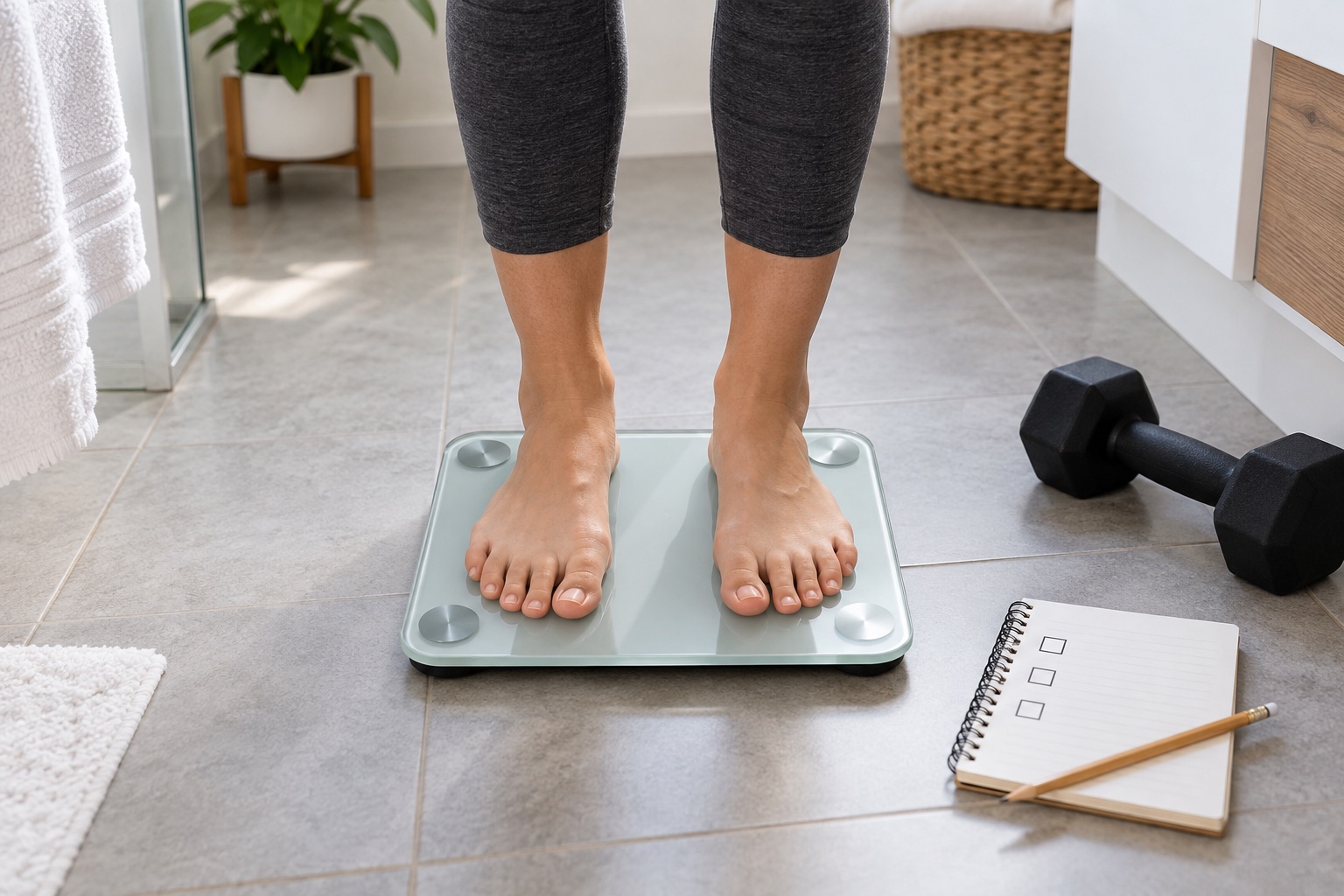
For the cleanest personal trend, measure under the same routine: after using the bathroom, before eating or training, with similar clothing, and at approximately the same time of day. Keep profile fields accurate and use the same user account and device mode.
Hydration, a recent meal, alcohol, exercise, skin temperature, foot contact, menstruation, edema, and changes in glycogen can alter impedance without representing a matching change in body fat. Do not compare a post-workout evening measurement with a rested morning baseline. Use a seven-day weight average and review body-composition estimates over several weeks, not day to day.
Do Not Compare Percentages Across Devices
Two scales can use different current frequencies, electrode paths, population equations, and software. A DXA scan is also a model with its own error and is not numerically interchangeable with BIA. When switching scales, record an overlap period rather than splicing the new body-fat percentage directly onto the old chart.
- Use both devices under the same morning conditions for 7–14 days.
- Record each device’s average and normal day-to-day range.
- Start a new baseline for the replacement scale.
- Keep body weight as the more portable metric; label body-composition trends by device.
When a Smart Scale Is the Wrong Tool
Do not use a consumer smart scale to diagnose dehydration, sarcopenia, osteoporosis, edema, or a rapid body-composition change. People with implanted electronic medical devices, pregnancy, significant fluid shifts, or a condition affecting hydration should follow the scale manufacturer’s restrictions and their clinician’s advice; some products provide a weight-only mode or advise against impedance measurement.
If a body-composition result affects treatment, medication, or a clinical decision, use an appropriate professional assessment. For the measurement mechanism and why foot-to-foot current cannot directly see every tissue compartment, read how a smart scale measures body fat.
Sources and Manufacturer Guidance
Requirements can vary by product, model, and situation. These primary sources informed this guide; official instructions for your exact product and current authoritative guidance take priority.
Frequently Asked Questions
-
Many consumer models can measure weight closely on a hard, level floor, but placement and setup still matter. Check five consecutive readings and compare with a recently calibrated professional scale if absolute accuracy is important.
-
Not at the level implied by a decimal-place display. Individual error can be several percentage points and varies by device and person. Use the same scale under standardized conditions for a rough long-term trend.
-
Hydration, food, exercise, skin temperature, foot contact, and timing can change impedance. A large overnight swing is measurement or fluid variation, not a matching gain or loss of fat tissue.
-
No. Consumer foot-to-foot bioimpedance estimates should not replace DXA or a clinical multi-compartment assessment when an individual body-composition value matters.
-
Daily measurement can work if you focus on a rolling average rather than individual readings. Weekly measurement under a consistent morning routine is simpler for people who find daily fluctuations distracting.