How Does a Smart Scale Measure Body Fat?
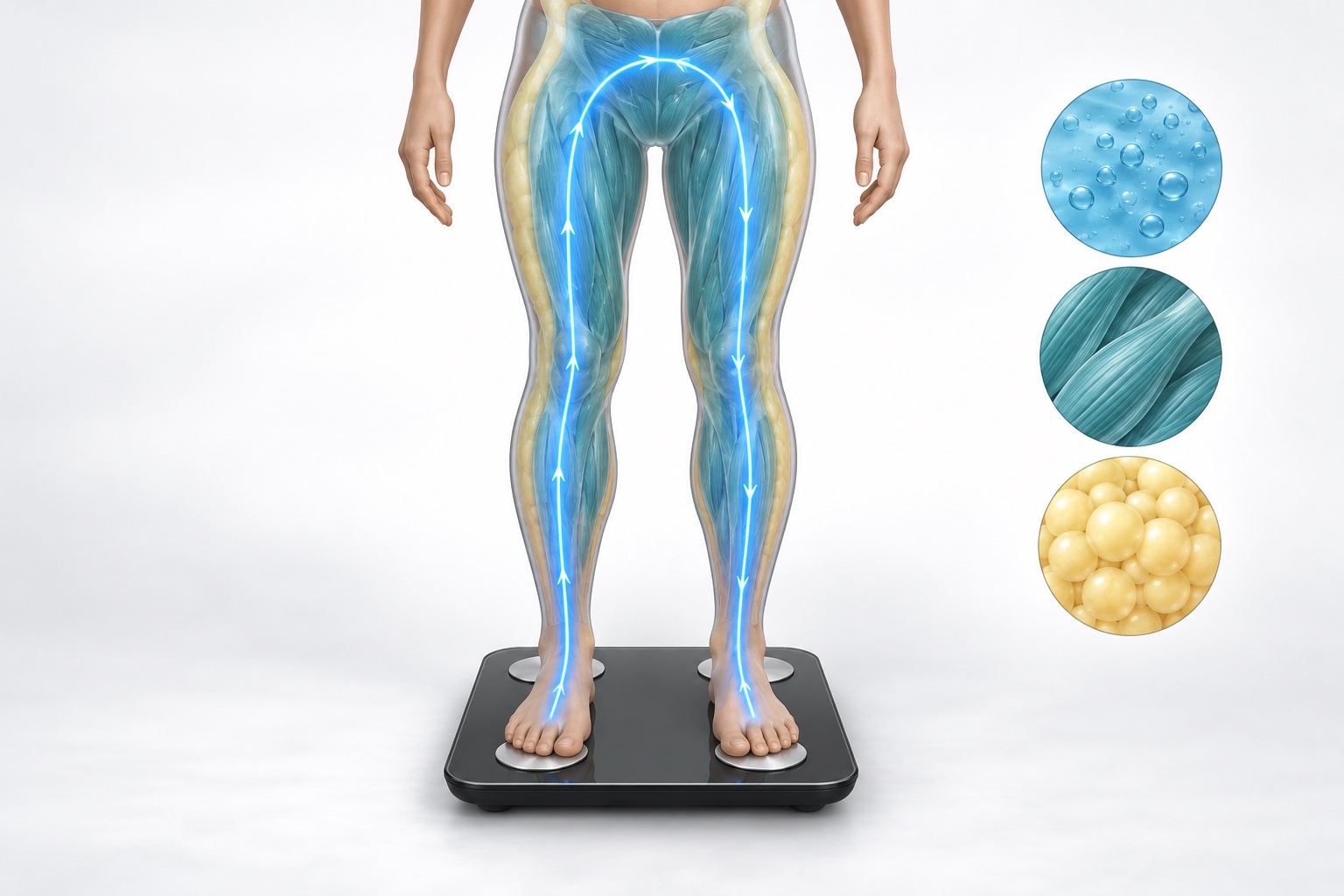
A smart scale does not directly scan or weigh your fat. It measures body weight and electrical impedance, estimates total body water and fat-free mass with a prediction equation, then subtracts estimated fat-free mass from body weight to calculate fat mass and body-fat percentage.
The electrical measurement is real; the body-composition result is modeled. Foot-to-foot scales mainly sample an electrical path through the legs and lower trunk, then use your height, weight, age, sex, and the manufacturer’s training data to estimate the rest of the body.
The Measurement, Step by Step
- Load cells measure weight. Sensors under the platform convert the force applied to the scale into a weight value.
- Electrodes make contact. Bare feet touch metal pads, creating a path for a very small alternating current.
- The scale measures impedance. Conductive, electrolyte-rich water and lean tissue impede current differently from relatively low-water fat tissue.
- The algorithm estimates body water. The device combines impedance with body geometry and profile information.
- Body water becomes estimated fat-free mass. The model assumes relationships among hydration, lean tissue, and the population used to build the equation.
- Fat mass is calculated by subtraction. Estimated fat mass equals measured body weight minus estimated fat-free mass; body-fat percentage is then calculated from those values.
Resistance Is Only Part of Impedance
Bioelectrical impedance includes resistance, opposition to current flow, and reactance, which relates to the capacitive behavior of cell membranes. Consumer single-frequency scales may rely mostly on resistance, while more advanced multi-frequency and phase-sensitive devices can collect additional information about fluid distribution and phase angle.
Lower-frequency current travels primarily through extracellular water, while higher frequencies can provide information influenced by both extracellular and intracellular water. More frequencies and more electrodes can improve the measurement model, but they do not turn a bathroom scale into a direct tissue-imaging system.
Why Four Feet Electrodes Differ From Hand-to-Foot Systems
A common bathroom scale uses a bipolar foot-to-foot path. The legs contribute heavily to the measured impedance, while the upper body is inferred. Hand-to-foot and eight-electrode systems sample more segments and can reduce some assumptions about how tissue is distributed.
| Configuration | Current path | Practical limitation |
|---|---|---|
| Foot-to-foot scale | One foot through lower body to the other foot | Upper-body composition is largely inferred |
| Hand-to-hand device | Across the upper body and arms | Lower-body composition is largely inferred |
| Hand-to-foot or tetrapolar | Longer whole-body path with separate sensing electrodes | Still depends on prediction equations and standardized conditions |
| Eight-electrode segmental | Both hands and feet, with segment estimates | More data points, but accuracy still varies by device, software, and population |
One Measurement Produces Many App Metrics
Muscle mass, protein, bone mass, visceral fat, basal metabolic rate, body age, and physique type may look like independent tests. In most consumer scales they are downstream calculations from the same weight, impedance, and profile inputs.
- Fat-free mass includes water, muscle, organs, connective tissue, and bone—not muscle alone.
- Skeletal muscle is estimated from a model; the scale does not identify individual muscles.
- Bone mass is not bone-mineral density and cannot screen for osteoporosis.
- Visceral fat is usually a proprietary score, not an imaging measurement of abdominal fat.
- Basal metabolic rate is an equation-based estimate, often driven strongly by body size and estimated lean mass.
What Changes the Electrical Reading
Bioimpedance assumes a predictable relationship between water and fat-free tissue. Anything that changes fluid amount, distribution, skin contact, or temperature can change the result.
- Drinking, eating, alcohol, and recent bathroom use
- Exercise, sweating, and post-exercise fluid shifts
- Time of day and standing versus lying down
- Cold or very dry feet and incomplete electrode contact
- Menstrual-cycle-related fluid changes
- Edema, illness, medications, or other altered hydration states
- Incorrect height, age, sex, or athlete-mode settings
Standardization improves comparison with your own previous readings; it does not remove equation bias.
Use the Estimate Without Overinterpreting It
- Measure under the same morning routine.
- Use the same scale, profile, floor position, and foot placement.
- Review multi-week direction rather than decimal-place changes.
- Track waist, performance, clothing fit, and body weight alongside the estimate.
- Start a new baseline when you replace the scale or change modes.
For a repeatability protocol and the evidence separating weight accuracy from composition accuracy, see how accurate smart scales are.
Sources and Manufacturer Guidance
Requirements can vary by product, model, and situation. These primary sources informed this guide; official instructions for your exact product and current authoritative guidance take priority.
Frequently Asked Questions
-
It detects electrical impedance and measures weight. Body fat is calculated from those readings plus profile data and a prediction equation; fat tissue is not directly scanned.
-
A very small alternating current passes between electrodes. The scale measures how the body impedes that current, which provides information related to conductive body water and lean tissue.
-
They sample more body segments and may reduce some foot-to-foot assumptions, but accuracy still depends on electrode design, frequency, software, prediction equations, and the person being measured. More electrodes do not guarantee clinical accuracy.
-
Water with electrolytes conducts current well. A change in water amount or distribution changes impedance, and the algorithm can interpret that change as a difference in fat-free mass or body fat.
-
Consumer scales generally provide an algorithmic visceral-fat score based on impedance and profile data. They do not directly image or quantify abdominal fat the way clinical imaging can.