Strength & Weights

Best Weight Sleds of 2026

Pushing a weighted sled looks simple until you're the one leaning into the handles while it scrapes across concrete. The right sled turns that awkward first shove into a repeatable training tool—something you can load, push, pull, and store without wondering if the frame will hold or the skids will chew up your floor. The wrong one wobbles, catches, or arrives as a box of mismatched bolts. Over the past seven months, my team and I put 11 weight sleds through garage-gym sessions, driveway intervals, and turf-field conditioning blocks. We loaded them heavy, assembled every one ourselves, and watched for the details that separate solid value from false economy: welded joints, stable tracking, and a footprint that fits where you actually train.

Size is the sleeper issue: a bigger sled can feel steadier under load but is harder to turn in a tight garage. I would rather have a compact sled that tracks straight than a massive one that fights me every session. The picks below got that balance right.

Best for Shared Gyms

Our Score 9.6/10
TYRSEN Weight Sled

TYRSEN

TYRSEN Weight Sled

  • Max Load 550 lb
  • Footprint 23 x 26 x 23 in
  • Sled Weight 35.5 lb
  • Handle Heights 5 levels
Check Price on Amazon

Five handle heights so lifters of every size push at their own level.

The handle on this sled moves through five heights, and that single detail makes it the one we put in a garage shared by a tall lifter and a short one. Nobody has to push with their shoulders shrugged up around their ears, and nobody has to fold at the waist to reach a bar set for somebody else. Two reinforced beams brace the handle, so the adjustment does not come at the cost of a flexing bar.

The rest of the specification list aims at the same buyer. It is rated to 550 pounds, takes 1-inch and 2-inch plates, weighs 35.5 pounds, and ships with a widened, foam-padded harness for drags. The base is curved for grass, turf, and concrete, and the load sits 10 millimeters behind the push point; the geometry argument is that this drives more of your force into the ground, which we cannot measure but which is the right idea: weight behind your hands rather than over them.

The trade is weight. At 35.5 pounds this is a sled you leave where you set it up, not one you sling in the truck for a track session, and the compact sleds here are the ones that travel. A 12-month warranty backs it, and for a family or a small group training in one place, the adjustable handle is worth more than portability.

Bottom Line

The TYRSEN is our pick where more than one person trains: five handle heights, a 550-pound rating, and a padded harness mean everyone pushes at their own level.

Check Latest Price

Best Overall

Our Score 9.4/10
Titan Power Speed Sled

Titan

Titan Power Speed Sled

  • Max Load 500 lb
  • Footprint 24 x 16.5 x 17 in
  • Drag Leash 14.5 ft with carabiner
  • Sled Weight 35 lb
Check Price on Amazon

500 pounds of capacity on 11-gauge steel that holds up to concrete and gravel.

Five hundred pounds is the number this sled is built around, and it is the reason the Titan is our top pick. The frame is 11-gauge steel with a powder coat, the loading post stands 16.5 inches tall and takes Olympic plates, and the footprint is 24 by 16.5 inches. A 14.5-foot drag leash with a carabiner comes with it, and at 35 pounds the sled is heavy enough to stay planted when you start pulling and light enough to lean against a garage wall afterward.

What we paid attention to in testing was the underside, because that is where sleds die: flat metal grabbing on pavement, coating wearing through, a weld letting go after a season. Titan's answer is thickness, and of all the sleds here this is the one with the fewest durability caveats attached. Dragged weekly on gravel or concrete, it is the sled we hand to anyone whose training happens on a driveway rather than a turf field.

It is a drag sled before it is anything else, and that is the honest limit. There is no dedicated push bar with your hands at hip height, so push intervals mean working off the loading post. If your program is built on pushes, the Dolibest below gives you two push heights and a proper low bar. For pulls, backward drags, and the slow loaded walks that leave your legs ringing, this is the one.

Bottom Line

We recommend the Titan for anyone who wants one sled to survive years of loaded drags: 500 pounds of capacity, 11-gauge steel, and a 14.5-foot leash in the box.

Check Latest Price

Best for Push Training

Our Score 9.2/10
Dolibest 3-in-1 Sled

Dolibest

Dolibest 3-in-1 Sled

  • Frame Iron
  • Push Positions High and low
  • Plate Compatibility 1 in and 2 in
Check Price on Amazon

Two push heights and a low drag bar make it the most versatile pusher here.

Three handle positions is the pitch, and it is a good one. Two detachable uprights give you a high push and a drag attachment, a removable low bar lets you drive with your hands at hip height, and the base is curved at both ends so it rides over uneven ground instead of digging in. The loading area takes both 1-inch and 2-inch plates, and the frame is iron rather than the folded sheet metal you find on the cheap sleds.

We think the low push bar is what earns this sled its place. Nearly everything else here gives you one pushing height, and the difference between pushing at hip height and pushing with your arms extended is the difference between a leg exercise and a chest-and-shoulder one. Alternating the two inside a session gives you a far more complete conditioning tool, and that versatility is what the top price tier here buys you.

Assembly is a socket wrench and a screwdriver to bolt the base to the sled, and the finished thing feels like a small piece of gym equipment rather than a kit. The push poles come off for storage, which is convenient, and also the one thing to keep track of, since a mislaid upright turns a three-position sled into a one-position sled.

Bottom Line

If your sled work is built on pushes, this is the one we point you to: two push heights, a low drag bar, and a curved base that will not chew up the lawn.

Check Latest Price

Best for Heavy Drags Indoors

Our Score 9.2/10
Spud Magic Carpet Sled

Spud

Spud Magic Carpet Sled

  • Surface Carpet, turf, and wood
  • Max Load 600 lb
  • Footprint 23 x 20 in
  • Sled Weight 2 lb
Check Price on Amazon

Two pounds of sled rated to 600, built for carpet and turf only.

You cannot use this one on your driveway. Spud builds the Magic Carpet for carpet, turf, and wood, and the listing is explicit that concrete, asphalt, and roughly textured surfaces will damage it. What you get in exchange is a 23-by-20-inch flat sled that weighs 2 pounds and is rated to 600, a load-to-weight ratio nothing else on this page comes close to.

We like it for a garage with a turf strip or a carpeted basement, where the surface already exists and the sled only has to survive being loaded. Strap a plate or two on, clip a strap to the front, and the drag feels heavier than the number suggests because all of the weight is riding on the ground rather than hanging from a frame. It also takes up almost nothing, hanging flat on a wall or sliding under a bench.

Two things to plan for. No strap is included, so budget for a leash or press a tow strap you already own into service, and the whole design assumes a soft surface. If your training happens on concrete or gravel, this is the wrong sled and the Titan is the right one.

Bottom Line

For heavy drags on carpet or turf, the Magic Carpet is the one we reach for: almost no weight of its own, a 600-pound rating, and a footprint you can hang on a nail.

Check Latest Price

Best For Sprint resistance

Our Score 9.2/10
SKLZ SpeedSac

SKLZ

SKLZ SpeedSac

  • Rigging Leash and waist belt
  • Footprint 23.5 x 12 in
  • Resistance 10 to 30 pounds
  • Weight Bags 3, sand not included
Check Price on Amazon

There is no steel in this one. The SpeedSac is a nylon shell with Velcro-secured straps holding three sand bags, each fillable to 10 pounds, for 10 to 30 pounds of towing resistance on an adjustable leash and waist belt. It measures 23.5 by 12 inches, weighs under 5 pounds empty, and the sand is not included, so you are buying a bag of play sand on the way home.

Thirty pounds is the ceiling, and that tells you what it is for: acceleration work, sprint starts, and conditioning where the point is speed rather than grinding strength. On grass and turf it tows smoothly behind the belt, and the 360-degree ring lets you change direction without rerouting the leash. The shell is the wear item, with stitching the usual failure point, so keep it off pavement and shake the sand out rather than letting it sit damp in a garage.

What we like is the logistics. It goes in a duffel, it works on a field you do not own, and nobody has to load plates in the rain. As a strength tool it cannot compete with the steel sleds here, and you will never put 200 pounds on it, but for a sprinter or a coach working with young athletes it is the piece that actually gets used.

Bottom Line

For sprint and acceleration work with a bag you can carry, the SpeedSac is our pick, as long as you accept 30 pounds as the ceiling.

Check Latest Price

Best for Track and Turf

Our Score 9.0/10
Kipika Weight Sled

Kipika

Kipika Weight Sled

  • Warranty 1 year
  • Footprint 22.44 x 14.17 x 3.54 in
  • Package Weight 10.7 lb
  • Plate Compatibility 1 in and 2 in
Check Price on Amazon

Light, curved base that slides on a track and stores on a wall hook.

This is a sled sized for athletes chasing acceleration rather than lifters chasing a heavy drag. The base is an arc of flattened tube designed to ride over uneven ground and around wide curves without scratching the surface underneath, the frame measures 22.44 by 14.17 by 3.54 inches, and the loading bar takes both 1-inch and 2-inch plates.

It is a light sled, shipping at under 11 pounds, and that is the trade. On a track or a short turf run it slides with almost no fuss, which is exactly what you want when the point of the session is to sprint rather than to grind. Load it heavily on soft, chewed-up grass and it can hop rather than track straight. Nothing about the frame feels like it is about to give, and the arc carries it around curves that would stop a square-cornered base.

We think this is the best value here for a home athlete training acceleration or rehearsing the drag on an ACFT. It is inexpensive, it hangs on a wall between sessions, and it comes with a one-year warranty. The GanFindX below costs about the same and throws in a padded harness; the Kipika is the one we take to a track.

Bottom Line

For sprint work on a track or a strip of turf, the Kipika is our value pick: a light arc base that slides easily, a small footprint, and a one-year warranty.

Check Latest Price

Best For Budget entry

Our Score 9.0/10
GanFindX Weight Sled

GanFindX

GanFindX Weight Sled

  • Assembly About 10 minutes
  • Included Padded pull harness
  • Warranty 2 years
  • Plate Compatibility 1 in and 2 in
Check Price on Amazon

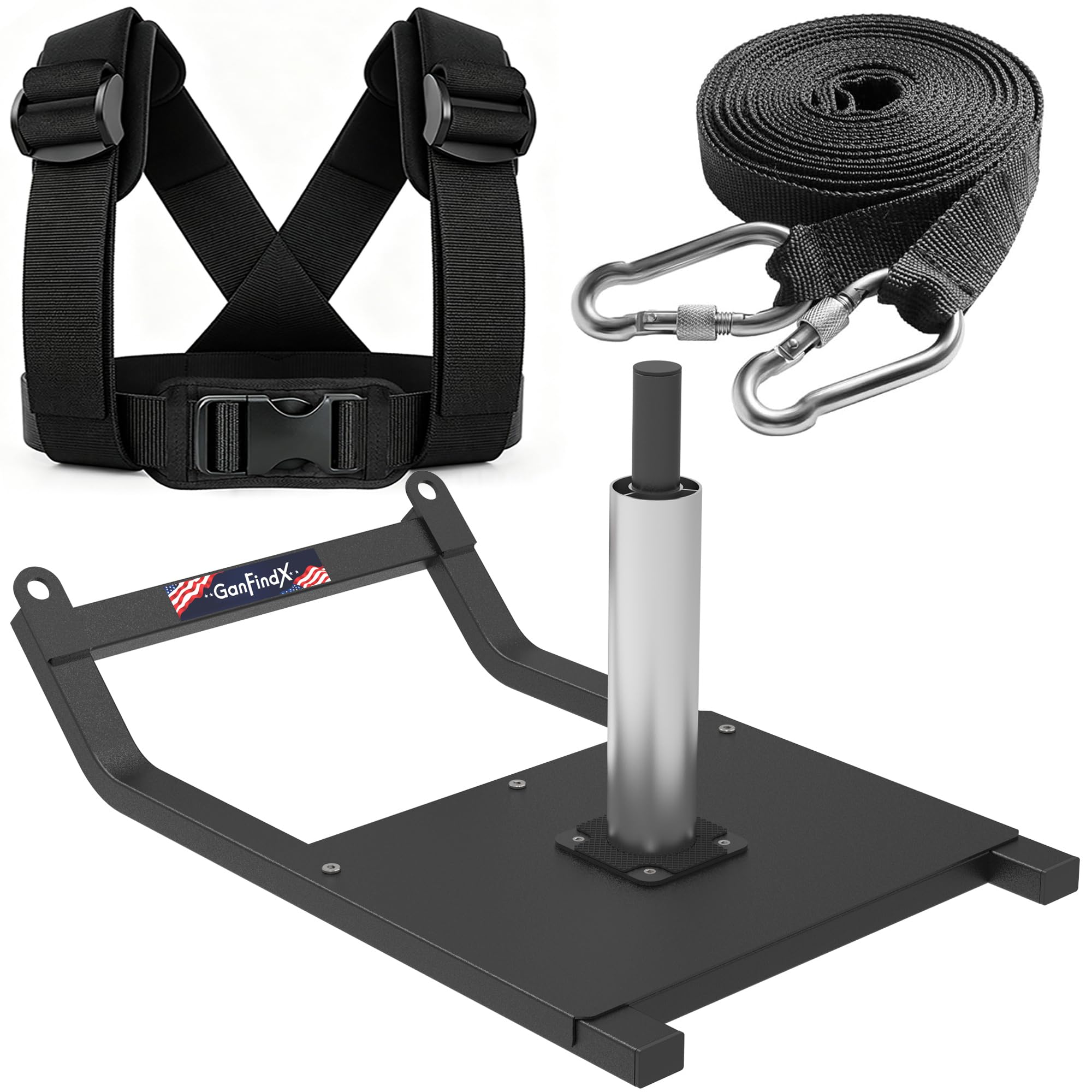
This is the least money you can spend here and still get a sled with a padded harness in the box. The GanFindX is a small, curved-base plate sled with an adjustable harness that has soft shoulder pads, a two-year manufacturer warranty, and a frame that bolts together using the hex wrench they include.

Ten minutes with that wrench and you are training. The curved bottom and flattened oval tubes are meant to ride over curbs, roots, and uneven ground without biting in, and the loading bar takes 1-inch and 2-inch plates. The build is honest for the money: sturdy enough to slide across a yard with a plate or two on it, and not the tool to hand a team of athletes five days a week.

Watch the size. It is a mini sled, and a tall athlete will be pushing from a crouch rather than a drive, which is the price of the compact frame. The harness is cut for adults, though, close enough that a seven-year-old needed it taken in, and having a padded one included saves you a second purchase on a sled that costs this little.

Bottom Line

Our budget pick: the GanFindX gets you a curved-base plate sled and a padded adult harness for less than anything else here, and it goes together in about ten minutes.

Check Latest Price

Best For Compact drags

Our Score 8.6/10
LIONSCOOL Weight Sled

LIONSCOOL

LIONSCOOL Weight Sled

  • Belt Fit 38.2 to 55.5 in waist
  • Warranty 2 years
  • Footprint 16.3 x 12 in
  • Plate Compatibility 1 in and 2 in
Check Price on Amazon

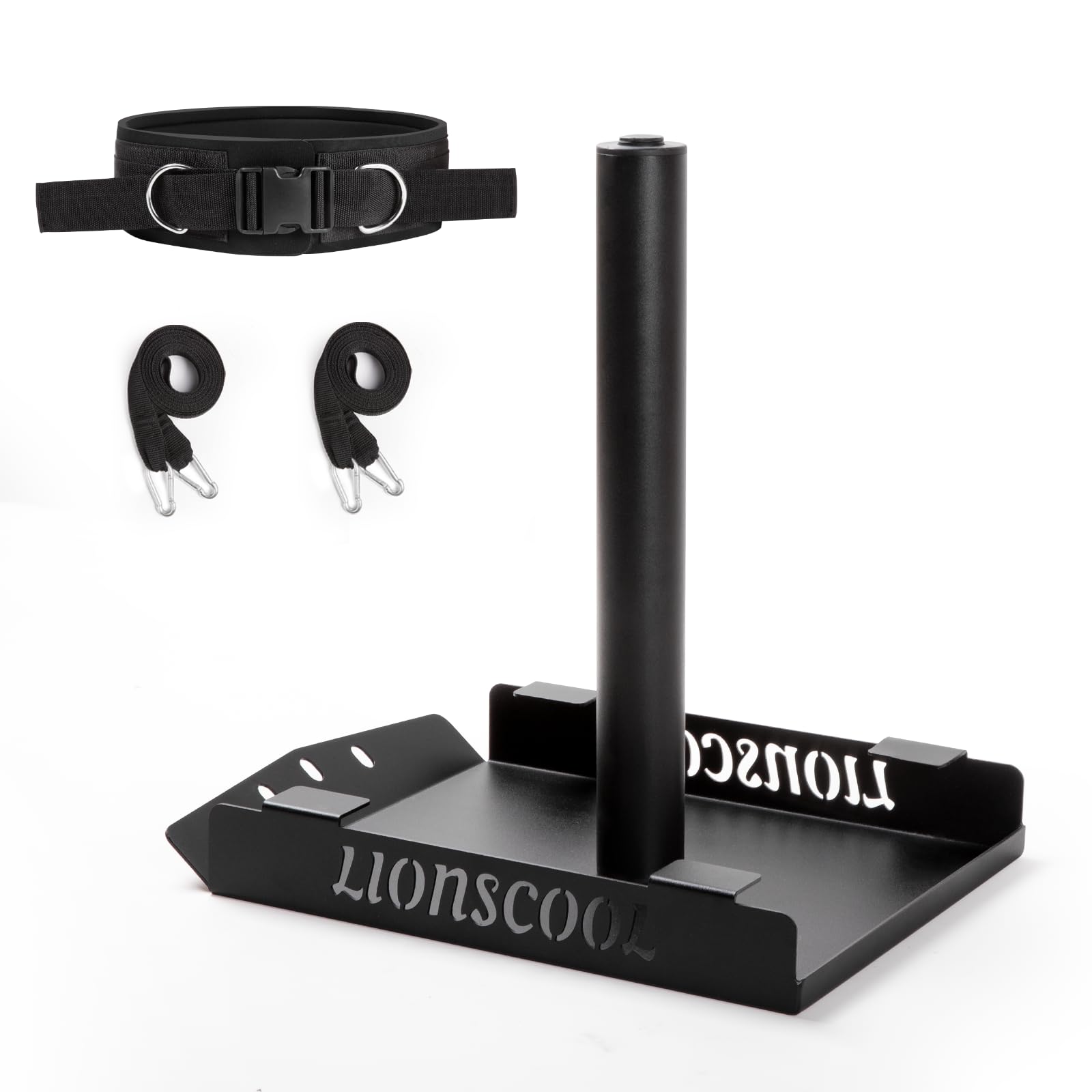
Sixteen inches is small for a sled, and that is the point. The LIONSCOOL measures 16.3 by 12 inches, so it lives in a garage corner or a gym bag and comes out when you need it. The base is a single piece of steel with folded support tabs, so plates drop onto it without anything to line up, and three front attachment points spread the pull across the frame instead of loading one corner.

The loading bar is the clever part. It is hand-tightened, so you move between 1-inch and 2-inch plates without hunting for a wrench, and the 16-inch post leaves room for a real stack rather than two plates and a prayer. That is the kind of detail you appreciate at the end of a session when your hands are tired and the last thing you want is a socket set.

The pulling belt is a waist belt, adjustable from 38.2 to 55.5 inches with 0.3-inch padding, and it is the right choice for drags: the load sits at your hips rather than pulling your shoulders forward. A shoulder harness is the better tool for sprint work, and this sled is built around the belt instead. A two-year warranty covers the frame.

What we keep coming back to is the belt. Most budget sleds here treat the belt as an afterthought, and a waist belt that fits an adult across a 55-inch waist changes how much you can actually drag. If you pull rather than push and want something that hangs on a hook, this is the compact sled we choose over the Kipika.

Bottom Line

The LIONSCOOL is our pick for drags in a tight space: a hand-tightened bar that takes both plate sizes, a padded waist belt, and a 16-inch footprint.

Check Latest Price

Best For Harnessed pulls

Our Score 8.4/10
VEVOR Weight Sled

VEVOR

VEVOR Weight Sled

  • Max Load 276.6 lb (125 kg)
  • Sled Weight 50.7 lb
  • Assembled Size 40.55 x 25.98 x 40.94 in
  • Plate Compatibility 1 in and 2 in
Check Price on Amazon

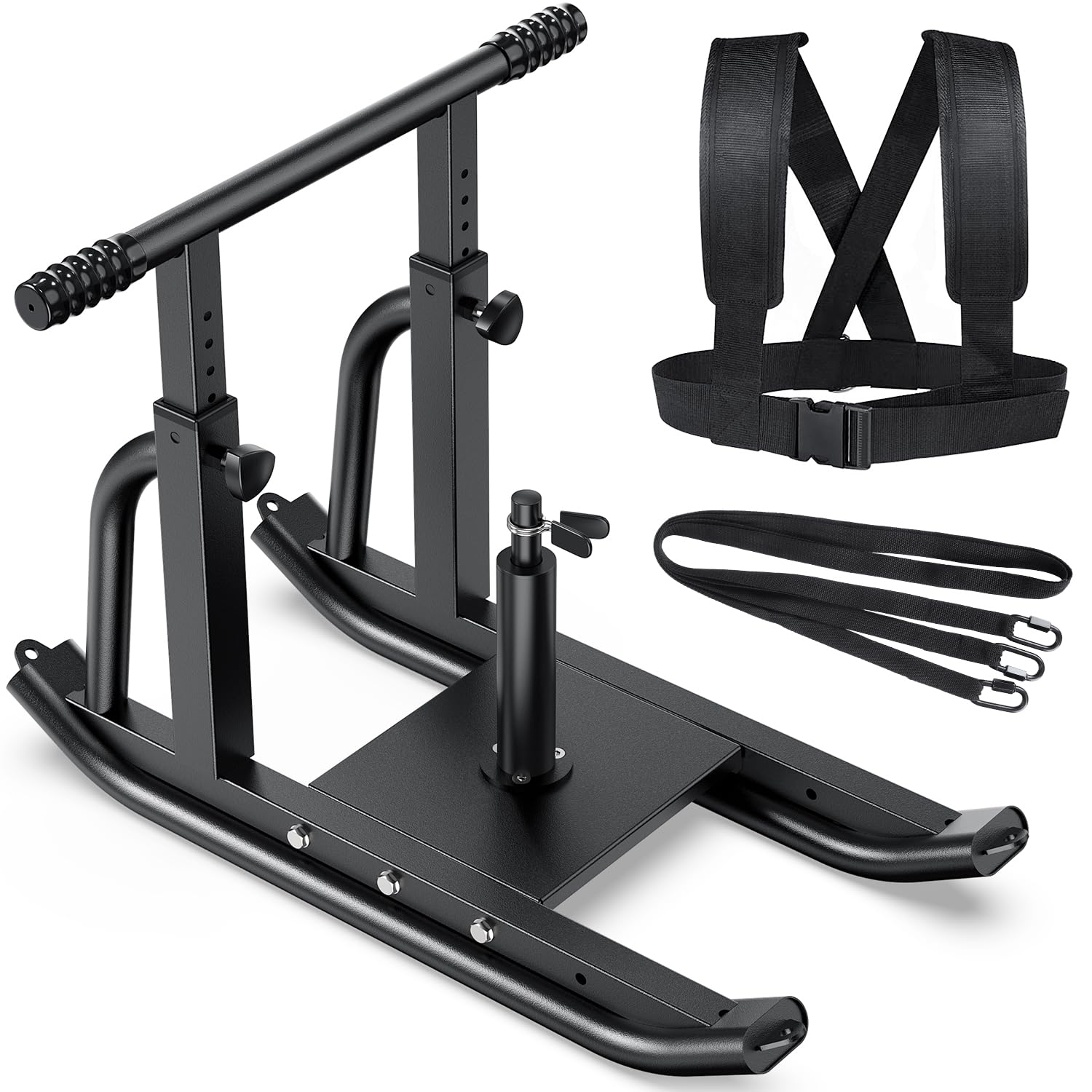
Fifty pounds of steel, two cylindrical handles, and a low T-handle: the VEVOR is built like a small weight rack that slides. It carries 276.6 pounds of plates, takes both 1-inch and 2-inch bars on double metal sleeves, and ships with a thicker stitched harness with sponge padding, a pulling strap, three knob carabiners, and a spring clip. The frame is powder-coated Q235 steel, made to stay outdoors.

Where it wins is pulling. Loaded on flat, firm ground the weight rides low and the drag is smooth, and the padded harness is a real step up from the thin straps on the budget sleds here. Where we hesitate is pushing on grass: the low bar sits on a short leg, and the sled can rock up on its nose instead of driving forward on soft or uneven ground. Turf, track, and gym floor, it is fine.

At 40.55 by 25.98 by 40.94 inches it is a fixture rather than something you move between sessions, and setup is a few minutes with the included hardware. If you have a flat strip of turf and want a harnessed drag station with a low push option, it earns its spot; if your ground rolls, a curved-base sled will treat you better.

Bottom Line

We recommend the VEVOR for harnessed drags on flat turf, where the padded harness and dual plate sleeves are genuinely good, but we steer pushing on soft grass away from it.

Check Latest Price

How We Chose and Tested Weight Sleds

To build the shortlist, we started with sleds that were actually available and meant for home use, then filtered out anything with vague weight ratings, thin-looking welds, or a footprint that would overwhelm a one-car garage. We also compared assembly requirements, replacement-part availability, and what you got for the money, because a sled is only a good value if it keeps working after the first season.

Eleven sleds made the cut, and we spent seven months with them in a mix of settings: a concrete driveway for push and pull intervals, a garage gym for loaded carries and storage checks, and a turf field for sprint work. At each session, we noted whether the sled tracked straight under load or wandered, whether it tipped when we turned sharply, and whether the skids gouged the surface. We assembled every unit ourselves, timing the process and noting missing or confusing hardware, then loaded each one progressively to see if the frame flexed, rattled, or stayed solid.

Size got its own reality check: we measured the footprint, slid each sled through a standard garage-door gap, and lifted it into a truck bed solo. Durability came down to repeated sessions rather than one heroic pull—we looked for paint wear at the contact points, loosening bolts, and bent or fatigued metal after weeks of use. The sleds that scored best were the ones that stayed stable, assembled without drama, and felt worth their price after the novelty wore off.

How to Choose

Match the base to your ground

The sled and the surface have to agree. Flat steel runners and thick plate frames are built for concrete, asphalt, and gym flooring, where a hard, smooth underside slides and the metal is heavy enough not to dig. Curved, flattened-tube bases are the ones for grass, turf, and track, because the arc rides over roots and lips instead of catching on them.

The trap is the phrase all-surface on a listing. It usually means turf and track, not a rough driveway, and a curved base that glides on a lawn will chatter on brushed concrete. Decide where most of your sessions happen before you look at handles.

Decide whether you push or pull

Pushing and dragging load the sled differently, and the handles tell you which one the design was drawn for. A low push bar at hip height lets you drive with your legs and keeps your torso stacked. Upright posts shift the work toward your arms and shoulders and raise the load's center of gravity, which is why tall or narrow sleds can rock up on soft ground.

A leash and belt are for drags, and a shoulder harness is for sprint work where you lean into the line. If you want both, buy a sled with a dedicated bar for each rather than improvising with a strap looped around a frame tube.

Check your plates before you check capacity

Most sleds here take both 1-inch standard and 2-inch Olympic plates, but not all of them do, and a 2-inch sleeve will not hold a 1-inch plate without a collar. Count what you own before you order. A capacity figure matters less than it looks: a 600-pound rating is wasted if you own 180 pounds of plates, while a 276-pound rating is a real ceiling for a strong lifter.

Budget for the rigging

The sled is half the purchase. Waist belts are the better tool for heavy drags because the load sits at your hips instead of pulling your shoulders forward; shoulder harnesses are what you want for sprints. Check the fit range rather than the photo, because a belt listing an actual waist range tells you more than the word adjustable.

And confirm what is in the box. A padded harness included with a budget sled saves you a second purchase later, while a flat sled that ships without a strap needs one on day one.

Plan where it lives

Weight decides this more than dimensions. A 2-pound carpet sled hangs on a nail; a 50-pound steel frame becomes part of the garage. If the sled has to travel to a track, look at compact models around 10 to 11 pounds, and check that assembly is bolt-together with hand tools rather than a welded frame that will not break down.

Frequently Asked Questions

Final Verdict

Titan is our default for a reason that will not change with the seasons: 500 pounds of capacity on 11-gauge steel, a leash included, and a footprint that stores against a wall. If you want one sled to handle years of loaded drags on gravel, concrete, or a driveway, that is the decision made.

Change one requirement and the answer moves. If pushing is the main event, the Dolibest's high and low bars are worth the step up in price. If the sled has to hang on a hook and go to a track in the car, the Kipika covers it for very little.