Strength & Weights

Best Weight Plate Racks of 2026

A weight plate rack should be the least dramatic thing in your gym. The drama comes when a loaded rack wobbles, a weld gives, or the footprint is so wide you have to shuffle past it. The right one keeps plates organized, makes them easier to load, and stays put between sets—turning a pile of iron into a safe, usable corner. We spent six months loading and unloading 12 racks in a garage gym and a basement corner, and the difference between steady and sketchy shows up fast.

Think about the plates you own, not the ones you plan to buy. Bumper and iron plates sit differently, and a rack that's too narrow or too tall can make loading awkward even if it's rated for the weight. Assembly is another wild card: some go together in 20 minutes with one wrench, while others arrive with vague instructions and hardware that fights you. We kept sturdiness, footprint, casters, and price in mind—the picks below are organized by what they're best at, so you can match one to your space.

Best for Bumper Plates

Our Score 9.4/10
Steelbody Horizontal Rack

Steelbody

Steelbody Horizontal Rack

  • Storage 4 plate slots, 2 bar holders
  • Footprint 40.5"L x 11.5"W x 10"H
  • Plate Type 2-inch Olympic
  • Weight Capacity 300 lb
Check Price on Amazon

Low, wheeled rack that holds four plate stacks and two Olympic bars.

At 10 inches tall, the Steelbody Horizontal Plate and Olympic Bar Rack is less a tree than a low shelf for bumper plates. The 40.5-inch length wants a strip of wall rather than a corner, but that shape is the point: four plate slots and two bar cradles keep everything at knee height.

We like it most for a garage gym where the barbell is always in the way. The two bar holders get it off the floor, the wheels and handle let you pull the rack out for loading, and the welded frame has a solid, no-creak feel that suits the 300-pound capacity. The 300-pound rating is enough for a typical bumper set, though not for a commercial pile. It is also the rack we reach for when the plates are thick bumpers rather than iron.

The trade-off is plate size: the wide slots are built for large-diameter bumpers, and small iron plates fall through. If your set is a mix of 2.5s and 5s, this is the wrong shape. If your gym runs on bumper plates and you want a bar off the floor, it is the horizontal rack we recommend.

Bottom Line

The horizontal rack we choose for bumper plates and a bar: low, mobile, and built to keep both off the floor.

Check Latest Price

Best Compact Tree

Our Score 9.4/10
Amazon Basics Plate Tree

Amazon Basics

Amazon Basics Plate Tree

  • Footprint 24.8"W x 17.7"D x 34.7"H
  • Plate Type 2-inch Olympic
  • Storage Posts 5-spoke
  • Weight Capacity 300 lb
Check Price on Amazon

A five-spoke Olympic tree that tucks into a small garage corner.

A five-spoke tree is not trying to swallow a commercial set. The Amazon Basics rack is 24.8 inches wide and 34.7 inches tall, so it fits beside a car in a garage or in a spare-room corner. The five posts hold 300 pounds of 2-inch Olympic plates, and the open spokes make it easy to grab a pair of 25s without moving the 45s.

Assembly is a bolt-together job with included hardware, and we like that the base sits flat instead of rocking on four separate feet. The finish is plain black and easy to wipe down, which matters in a garage. The five posts are spaced closely enough that a full set of 45s feels dense, but that is the trade-off for the small footprint. We loaded ours with a mixed set and the frame stayed planted on a rubber mat.

For a small home gym with one set of plates, this is the tree we recommend. It is not the rack for a 500-pound collection. But if you want a compact, tidy tree that does the basic job without a premium, this is the one.

Bottom Line

A tidy, compact tree for a small Olympic set; if you want bar storage or room for a big collection, look elsewhere.

Check Latest Price

Best for 1-Inch Plates

Our Score 9.2/10
CAP 1-Inch Plate Tree

CAP

CAP 1-Inch Plate Tree

  • Footprint 23.5"W x 12"D x 25.5"H
  • Plate Type 1-inch standard
  • Storage Posts 5
  • Weight Capacity 300 lb
Check Price on Amazon

A rare tree built for standard 1-inch plates, with five posts and a low profile.

Most plate trees are built for 2-inch Olympic plates. The CAP 1-Inch Plate Tree is for the other home gym: the one with standard 1-inch plates and a bench that does not need a 500-pound rack. That focus is why it earns a runner-up spot here. Its five posts and 300-pound capacity are sized for a compact set, and the low A-frame stands 25.5 inches tall and 12 inches deep.

We like that it does not pretend to be an Olympic tree. The posts are close together, the footprint is small enough for a corner, and the frame is light enough to move when you clean. The open hooks make it easy to grab a pair of 10s without moving the 25s. The 300-pound capacity is realistic for a small set; if you have 35-pound standard plates, check the peg clearance before buying. The A-frame is stable once the weight is distributed, but it is not the rack for a commercial pile.

Bottom Line

The right tree for a standard 1-inch plate set: compact, light, and honest about its limits, with no Olympic or bar-storage ambitions.

Check Latest Price

Best For Compact Olympic setup

Our Score 9.2/10
Marcy PT-5740 Plate Tree

Marcy

Marcy PT-5740 Plate Tree

  • Warranty 2 years
  • Plate Type 2-inch Olympic
  • Storage Posts 4
  • Weight Capacity 300 lb
Check Price on Amazon

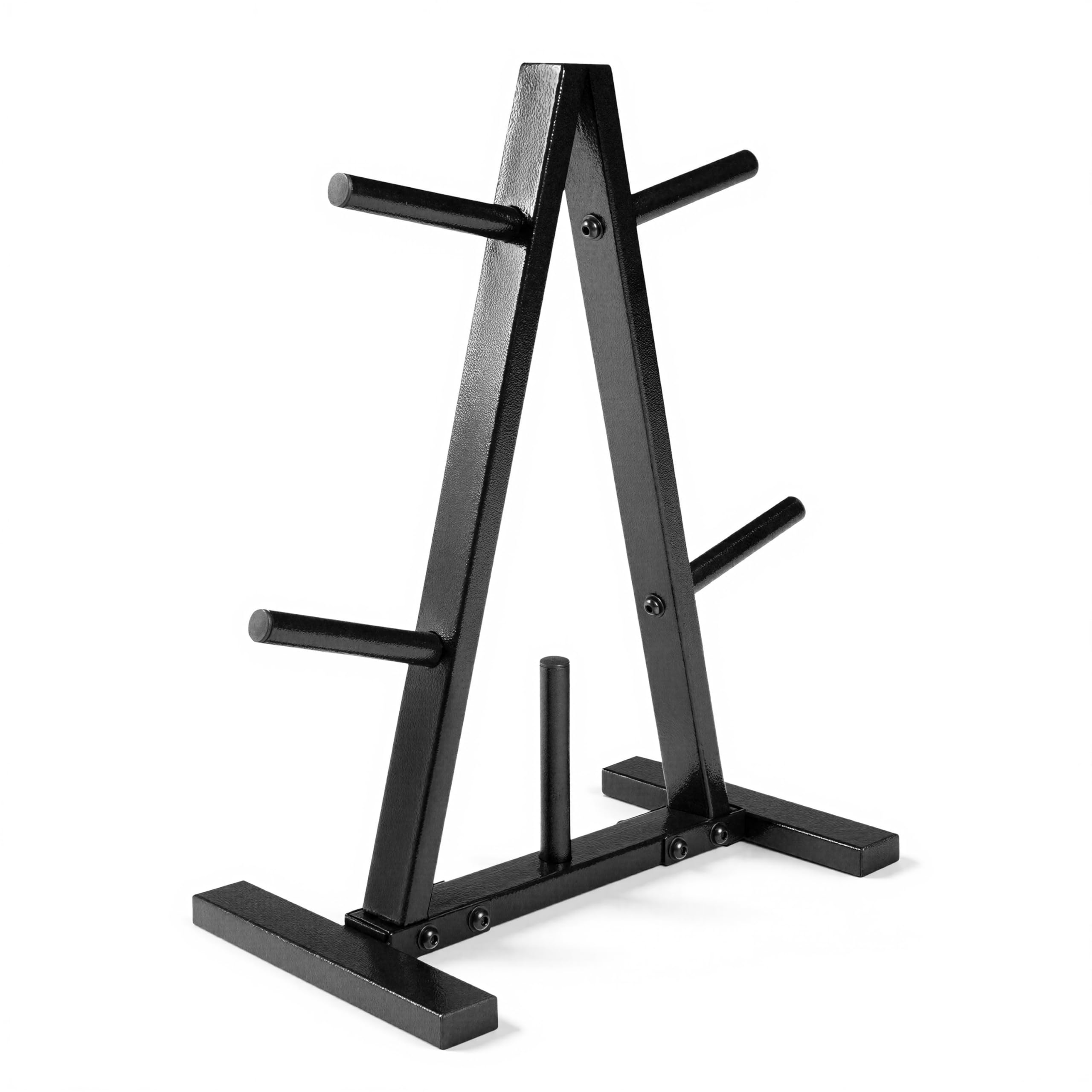
The Marcy PT-5740 is a compact triangular tree with a center post that gives a 45-pound bar somewhere to stand. At 33 inches tall and 37.5 inches wide, it is low and wide rather than tall and skinny, so it fits under a garage shelf and still leaves the plates easy to reach.

We like it for a small gym where one bar and a 300-pound plate set share a corner. The four posts hold the plates, the four spring collars keep them from sliding, and the two-year warranty is longer than most here. The triangle feels planted when you pull a plate off, which is the part that matters when the rack is not bolted down.

The plastic sleeves are the one detail we wish were different. They can grab the last plate or slide off with it, so keep a hand on the sleeve when you unload. The triangle and the center bar holder are the reasons to choose it, but this is a modest-capacity tree, not a wall of plates.

Bottom Line

A compact Olympic tree with a center bar holder and four spring collars; a neat fit for a small gym with one bar.

Check Latest Price

Best For Budget bumper storage

Our Score 9.2/10
Yaheetech Horizontal Rack

Yaheetech

Yaheetech Horizontal Rack

  • Storage 4 plate slots, 2 bar holders
  • Footprint 37"L x 13"W x 11.8"H
  • Plate Type 2-inch Olympic
  • Weight Capacity 300 lb
Check Price on Amazon

The Yaheetech horizontal rack does the same basic job as the Steelbody for less: four plate slots, two bar holders, and a handle-and-wheel setup. At 37 inches long and 11.8 inches tall, it is a low strip of storage that slides along a garage wall.

We like the low profile for a small gym. Bumper plates drop into the slots, the two bar cradles keep a barbell off the floor, and the handle makes it easy to pull the rack away from the wall when you load it. The 300-pound capacity is fine for a typical bumper set, though not for a commercial pile.

The wheels are the part we trust least: they are plastic and can bind or bend if you drag a loaded rack across rough concrete. Roll it empty, or keep it on a smooth floor. For a bumper-plate gym that wants two bars off the floor, it is a sensible budget choice.

Bottom Line

A budget horizontal rack for bumper plates and two bars; skip it if your set includes small iron plates.

Check Latest Price

Best For High-capacity storage

Our Score 9.2/10
Fitness Reality X-Class

Fitness

Fitness Reality X-Class

  • Storage 6 plate posts, 2 bar holders
  • Footprint 26.5"W x 22"D x 41.5"H
  • Plate Type 2-inch Olympic
  • Weight Capacity 1,000 pounds
Check Price on Amazon

A 1,000-pound capacity puts the Fitness Reality X-Class in a different class from the rest of this group. It uses six storage posts and two bar holders, with chrome-plated posts that resist the chipping and scratching that painted pegs pick up over time.

The frame stands 41.5 inches tall and 26.5 inches wide, so it has a bigger presence than a compact tree. We like the wide base and the way the bar cradles keep a 45-pound bar upright; this is the rack for a home gym with two bars and a heavy iron set. The chrome posts also make it easy to slide plates on without the grit that builds up on painted steel.

The catch is bumper plates. They do not fit every level, and the middle rungs can get crowded if your set is all thick crumb-rubber. This is an iron-plate tree first. The 1,000-pound rating is also a storage ceiling, not a target to chase.

For a heavy set and two bars, the capacity and chrome posts are worth the extra footprint. The wide base is the part we trust most when the rack is fully loaded, and the two cradles keep the bars from becoming floor clutter.

Bottom Line

The high-capacity choice for a heavy iron set and two bars; check stock before you build your gym around it.

Check Latest Price

Best Overall

Our Score 9.0/10
CAP Olympic Plate Tree

CAP

CAP Olympic Plate Tree

  • Footprint 19"W x 22"D x 37"H
  • Plate Type 2-inch Olympic
  • Storage Posts 7
  • Weight Capacity 500 lb
Check Price on Amazon

Seven posts and 500 pounds of capacity in a compact, affordable A-frame.

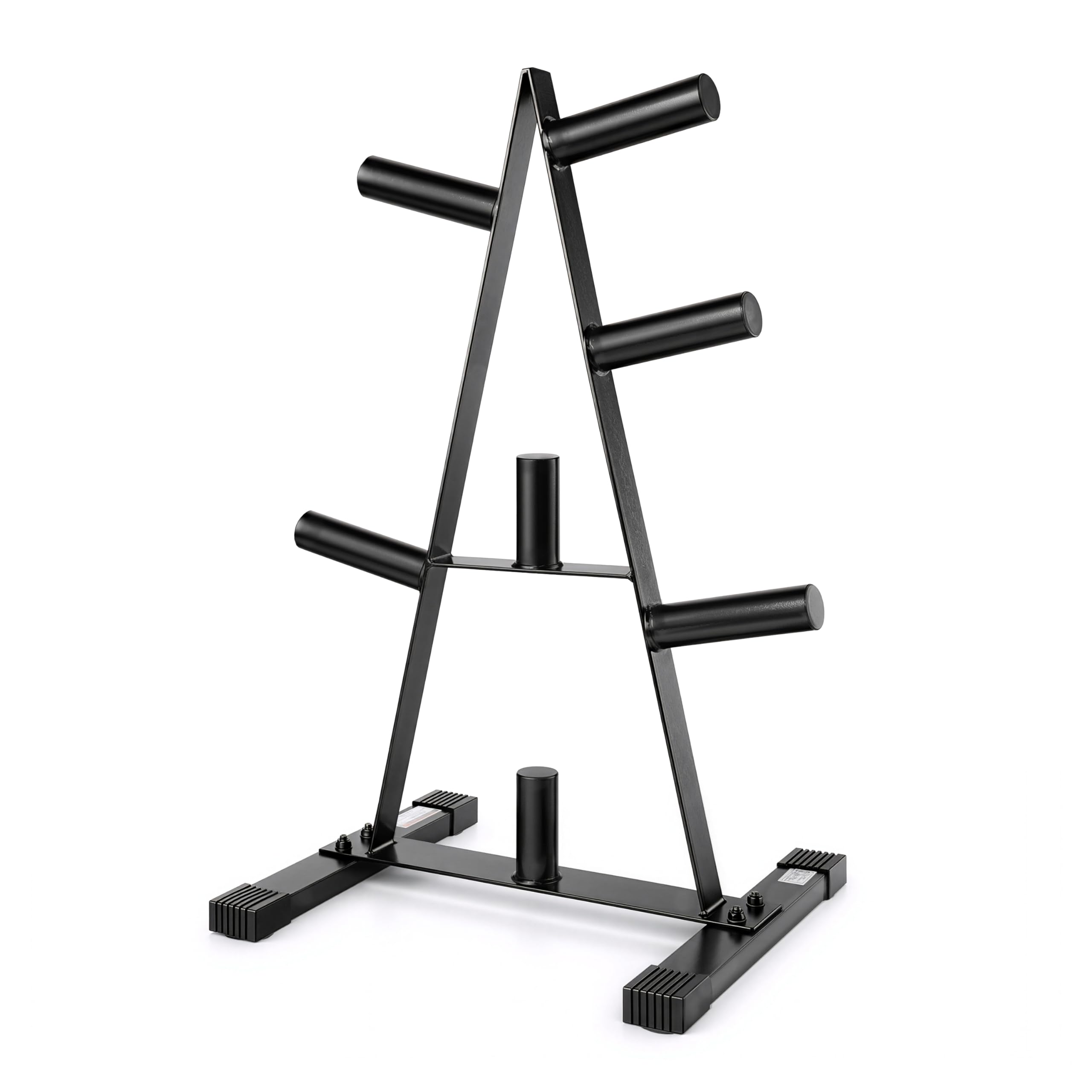
Five hundred pounds across seven posts is the useful trick here: the CAP Olympic Plate Tree holds a full iron set without demanding a corner of the garage. That combination is why it is our top pick for most home gyms. The A-frame stands 37 inches tall and 19 inches wide, so it tucks between a rack and a wall while keeping the plates visible and reachable.

Seven posts let you separate 2.5s through 45s, and the open shape means you can grab a pair without unstacking the whole tree. We loaded ours with a mixed iron set and kept the heaviest plates low; the powder-coated posts let plates slide on without snagging, and the four-bolt assembly is simple with a ratchet. The 500-pound rating is a storage limit, not a suggestion to hang a bar from it.

The mismatch is thick bumper plates. They can crowd the pegs and sit proud of the frame, and this is not the rack for a garage gym built around wide crumb-rubber plates. For standard iron Olympic plates, though, it offers the most capacity for the footprint in this group. We recommend it to anyone who wants a full set off the floor without spending on a commercial-style tree.

Bottom Line

The best default for a home gym full of iron Olympic plates: seven posts, 500 pounds of capacity, and a footprint that disappears into a corner.

Check Latest Price

Best for Heavy Sets

Our Score 9.0/10
Bongkim 530-lb Plate Rack

Bongkim

Bongkim 530-lb Plate Rack

  • Base H-shaped with rubber caps
  • Plate Type 2-inch Olympic
  • Storage Posts 4
  • Weight Capacity 530 lb
Check Price on Amazon

530-pound capacity and locking collars in a short, stable frame.

A 530-pound rating on a rack this short is the headline. The Bongkim Weight Plate Rack uses four posts and a wide H-shaped base to carry a heavy iron set without the tall, skinny silhouette of a classic tree. The footprint stays compact enough for a corner, but the base gives it a planted feel.

We like the locking collars: they keep plates from walking off the pegs when you slide a pair on or off, and they are the kind of detail that makes a budget rack feel considered. The rubber caps under the base are another small win on a smooth garage floor. Assembly is straightforward, and the steel has enough heft that it does not feel like a toy when you load it.

The 530-pound capacity is the reason to choose it over the 300-pound trees here. It holds a full set of 45s, 25s, 10s, and change plates with room to spare, and the four posts are set wide enough that the plates do not all crowd into one stack. We kept the heaviest plates low and the rack stayed steady.

Four posts are the catch: you can stack a lot of weight, but you will not get one dedicated peg for every size. If you like to keep every pair on its own post, a seven-post tree is easier. The H-shaped base is the part we trust most when the rack is fully loaded.

Bottom Line

The heavy-set specialist: 530 pounds of capacity and locking collars in a short, stable frame for a garage corner.

Check Latest Price

How We Tested the Best Weight Plate Racks

We started by pulling together the racks that show up most often in home gym forums and retailer listings, then narrowed by weight capacity, footprint, material, and price. We ruled out anything with vague capacity claims or a base that looked like it would walk across the floor. That left 12 racks, which we built and loaded over six months in a garage gym and a basement corner.

Assembly came first: we timed each build solo, noted whether the instructions matched the hardware, and checked whether one person could do it without a second set of hands. Then we loaded each rack with a mix of iron and bumper plates, working up to the stated capacity in steps and watching for flex in the posts, wobble at the base, and anything that felt like it might tip when we racked a plate off-center. Fit mattered as much as capacity—we checked whether 45s cleared the uprights, whether the footprint blocked a walkway, and whether the rack sat flush against a wall without rocking.

Over the months, we used them the way you would: loading and unloading between sets, rolling them across a garage floor to sweep underneath, and bumping them with a barbell more often than we'd like to admit. We looked for clean welds, powder coat that held up, casters that still tracked straight, and hardware that didn't loosen after a few weeks. Value was the last filter—not just the sticker price, but how much capacity and stability you got for the footprint and the assembly time. The racks that scored best were the ones we stopped thinking about.

How to Choose

Match the rack to the plates you own

The first spec to check is the plate hole, not the rack's capacity. Standard 1-inch plates need a 1-inch tree; Olympic plates need 2-inch posts, and the two are not interchangeable. The next question is plate thickness. A rack labeled for Olympic plates can still be a poor fit for thick bumper plates, because wide plates crowd neighboring pegs and can sit away from the frame. If your set is mostly bumpers, a horizontal rack like the Steelbody is a safer shape than a vertical tree. If you are working with standard plates, the CAP 1-Inch is the rare tree built for you.

Pick vertical or horizontal by floor space

A vertical tree uses a small footprint but needs height and clear access on all sides. A horizontal rack is low and long; it can slide under a wall shelf, but the length is the real footprint, not the depth. Mark the full rectangle with tape before you buy. The Steelbody runs 40.5 inches long, and the Yaheetech is 37 inches, so neither is a corner solution in the way a five-spoke tree is. We prioritize the shape that leaves you room to load plates without stepping around the rack.

Read capacity with post count

A 500-pound rack with seven posts and a 300-pound rack with five posts are not the same purchase. Capacity tells you the total load the frame is rated to hold; post count tells you how many sizes you can keep separate. If you own pairs from 2.5 to 45 pounds, more posts make the rack easier to live with. If you stack plates on fewer pegs, a four-post rack can still hold a heavy set, but you will be unloading to get to the 10s. We look for enough posts to keep the plates you use most on their own pegs.

Stability is a loading habit

A wide base helps, but it cannot rescue a rack loaded with all the heavy plates on one side. Put the 45s low, alternate sides, and keep the weight centered over the base. Rubber caps and H-shaped feet are worth having on a smooth garage floor; they also keep the rack from walking when you pull a plate off. The Bongkim's H-shaped base is the steadiest of the compact trees here. If the rack wobbles empty, check the bolts before you load it. If it wobbles only when loaded, redistribute the plates before you blame the frame.

Decide on bar storage and portability

Bar holders are the feature that changes the footprint and the price. A rack with two cradles can replace a separate bar stand, but it also takes up more floor length. If you store a bar vertically, check the ceiling height; if you store it horizontally, check the cradle spacing. Wheels are useful in a garage where the rack doubles as a work surface, but they are a liability on rough concrete. We prioritize bar storage over wheels, because a bar on the floor is the bigger trip hazard.

Frequently Asked Questions

Final Verdict

For most home gyms, the CAP Olympic Plate Tree is the rack we recommend. Its seven posts and 500-pound capacity handle a full iron set, and the compact A-frame leaves room to lift. The deciding advantage is capacity for the footprint: it does the job of a bigger tree without swallowing the corner.

If your plates are thick bumpers or you want a bar off the floor, the Steelbody is the better buy. It trades plate capacity for a horizontal shape that holds four plate stacks and two bars. That is the choice that matters: iron set, CAP; bumper set with a bar, Steelbody.