Strength & Weights

Best Adjustable Weight Benches of 2026

An adjustable bench makes one promise and one threat: more angles for pressing, and more places for a wobble to hide. Every extra notch, pop pin, and hinge is another joint that has to stay put while you're flat on your back with a loaded bar overhead — and the benches that fold flattest or climb steepest are often the ones that rock. A good one fixes that quietly: it locks into a position you trust, sits low enough that your feet can drive into the floor, and disappears from your mind mid-set.

I've owned a bench that felt rock solid right up until the first heavy dumbbell press, so I check the pad gap, the back pad width, and the slop in the hinge before anything else. Over the past six months, my team and I worked through 12 adjustable benches in garages, basements, and one genuinely cramped spare room. Price turned out to be a weak predictor of sturdiness — steel gauge and how the ladder locks told us far more. Here's where each one landed.

Best for Easy Moving

Our Score 9.4/10
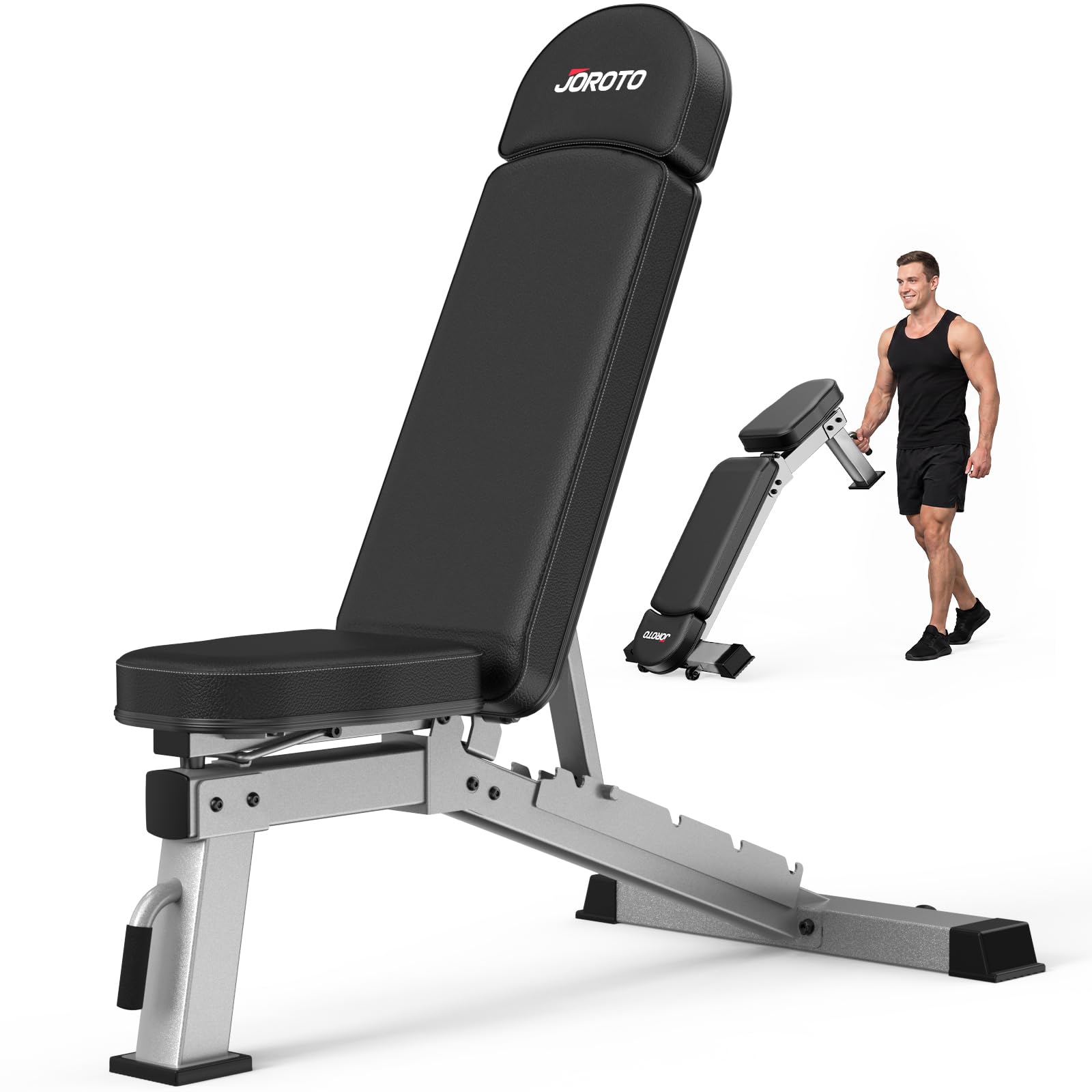
JOROTO MD80 Adjustable Bench

JOROTO

JOROTO MD80 Adjustable Bench

  • Positions 7 backrest, 2 seat
  • Item Weight 42 lb
  • Backrest Length 34 in
  • Weight Capacity 1,300 lb
Check Price on Amazon

Same heavy-duty class as our top pick, on wheels and 17 pounds lighter.

Our top pick is 59 pounds of steel that doesn't move. The JOROTO does most of the same job at 42 pounds, with transport wheels and handles, and that's the difference between a bench you reposition and a bench you walk around. Capacity is rated at 1,300 pounds on a reinforced triangular frame, and the backrest runs 34 inches, the longest pad in this group.

Seven backrest angles and two seat adjustments won't match the Keppi's 36 combinations, and we felt the gaps at the shallow end of the incline range. What you get instead is a bench that behaves like a piece of commercial equipment: welded alloy steel, dense foam under sweat-resistant leather, and hardware that arrives needing only a handful of bolts.

It's also one of the two priciest benches here, and in a permanent gym corner you're paying for wheels you won't use. Where they earn their keep is a garage that doubles as a parking space, or a living room you'd rather not surrender. Decline is the one setting we treat as a bonus rather than a reason to choose this bench.

Bottom Line

For a bench that gets wheeled out of the way between sessions, this is the one: 1,300 pounds of capacity and a 34-inch backrest on a 42-pound frame.

Check Latest Price

Best Overall

Our Score 9.2/10
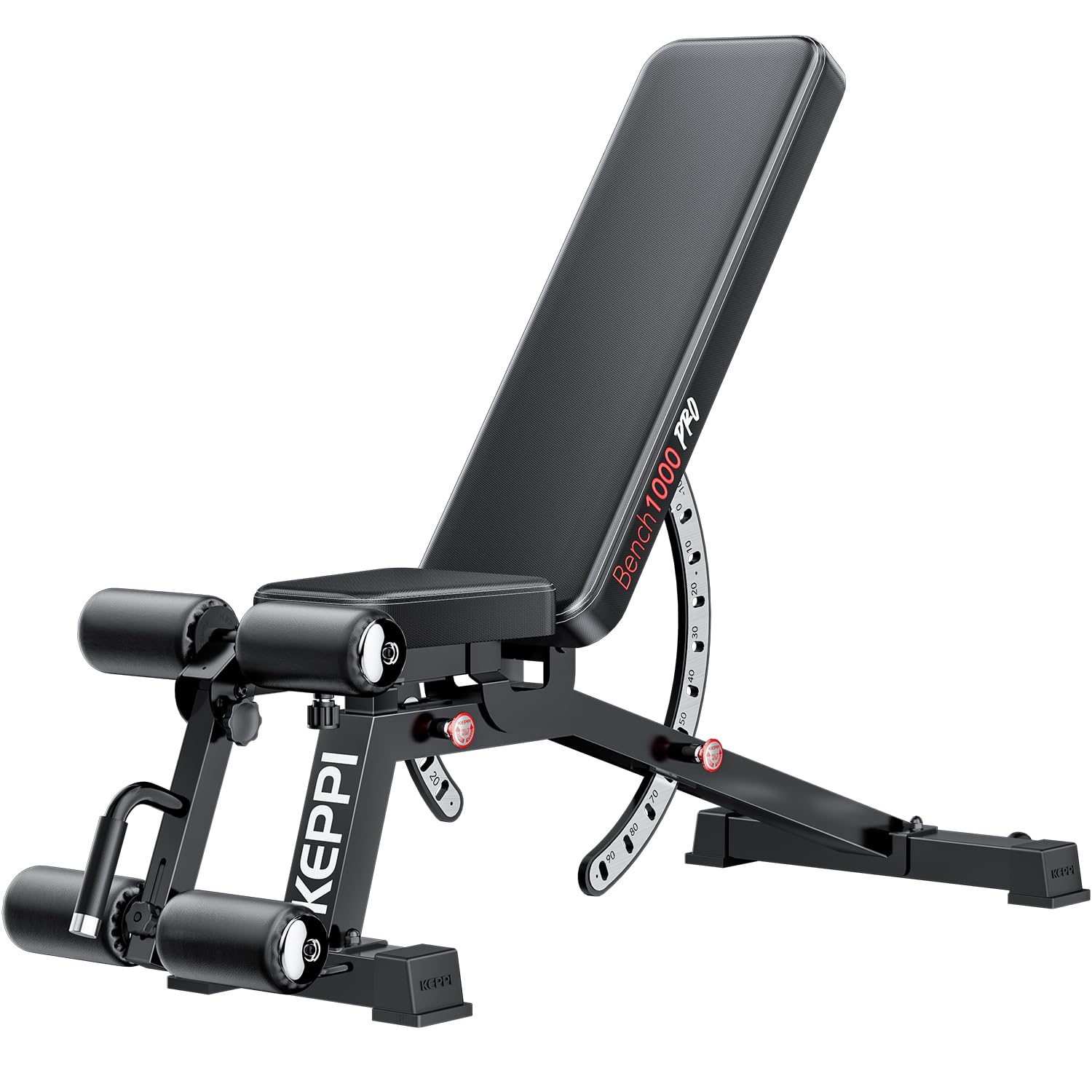
Keppi Adjustable Weight Bench

Keppi

Keppi Adjustable Weight Bench

  • Positions 12 backrest, 3 seat
  • Foot Catch 3 positions
  • Item Weight 59 lb
  • Weight Capacity 1,200 lb
Check Price on Amazon

Welded steel, 36 angle combinations, and the most planted frame under a loaded bar.

If your training is built around a loaded barbell rather than a pair of dumbbells, this is the bench in this group that was designed for it. The frame is fully welded 2-by-3-inch carbon steel, rated to 1,200 pounds and ASTM-certified, and it weighs 59 pounds on its own. That last number is the one we keep coming back to, because nothing else here is built on that much steel.

Twelve backrest positions and three seat adjustments give you 36 combinations, and they move in 10-degree steps rather than the 15- and 20-degree jumps most benches in this group make. We noticed that most at the shallow inclines, where a big jump either leaves you too flat or too upright for dumbbell press. The three-position foot catch is the other detail we appreciate: it adapts to shin length, so decline work doesn't become a fight to stay on the pad.

What you trade for that is portability. At 59 pounds with no folding mechanism, this bench stays exactly where you set it down, so plan a permanent spot before it arrives. Changing angles takes a pulled pin and a moment of wrestling, which is the price of a heavier, more secure lock.

Think of it as the anchor of a home gym rather than a piece you tuck away. With a rack and a bar in the same room, it keeps up with them; if your training is dumbbells in a spare bedroom, one of the lighter folders on this list makes more sense.

Bottom Line

Our pick for a home gym built around a barbell: welded 2-by-3 steel, 1,200 pounds of capacity, and 36 positions, including a decline your legs stay locked into.

Check Latest Price

Best Budget

Our Score 9.2/10
YOLEO Adjustable Weight Bench

YOLEO

YOLEO Adjustable Weight Bench

  • Positions 7 back, 4 seat, 3 leg
  • Seat Width 13 in
  • Folded Size 31.5 x 12.6 x 13 in
  • Weight Capacity 827 lb
Check Price on Amazon

Two pins and it is ready, folding to a 13-inch stack for small spaces.

Two pins. That's the whole assembly. The bench arrives essentially built, and you're training on it minutes after opening the box, which anyone who has spent an evening with an Allen wrench and a bag of bolts will recognize as unusual at this end of the market.

The rest of the package is more than the setup. Seven backrest angles, four seat positions and three leg settings give you 84 combinations, and the four seat adjustments are the part that matters: they let you close the step between seat and backrest on incline, which is where cheaper benches leave a gap under your lower back. It's rated to 827 pounds, ASTM-certified, and folds to 31.5 by 12.6 by 13 inches.

Sizing is where it gives ground. The 28-inch backrest is the shortest here, so if you're much over six feet your head will hang off the top on a flat press, and the 23-pound frame can shift on carpet or an uneven garage slab. Neither matters much in a small apartment, where the entire point is a bench that disappears into a closet between sessions.

Bottom Line

The budget pick we don't hesitate on: 827 certified pounds, four seat positions, and a two-pin setup that folds into a closet.

Check Latest Price

Best For Apartment gyms

Our Score 9.2/10
NICEPEOPLE Adjustable Weight Bench

NICEPEOPLE

NICEPEOPLE Adjustable Weight Bench

  • Item Weight 17 lb
  • Backrest Angles 8
  • Backrest Length 29.3 in
  • Weight Capacity 660 lb
Check Price on Amazon

Seventeen pounds is the first thing you notice when you pick up the box, and it tells you what this bench is for: a full-length adjustable bench that a small apartment can absorb. The frame is 46 inches long and 16.7 wide, so you get a real bench footprint rather than a stool, and it folds down to something you can stand in a closet.

Eight backrest angles cover flat through decline, and the 29.3-inch backrest is longer than the YOLEO's despite the lower price. That's the number we looked at first, because it's the difference between a bench that supports your shoulders and one that leaves them hanging. Setup is two bolts and two spring pins, the pad sits 17.2 inches off the floor, and the rating is 660 pounds.

The trade-off is mass. A 17-pound bench is easy to move and easy to shift under a fast set, so keep it on a mat on a hard floor. For dumbbells in a bedroom it's plenty of bench; for a barbell and a rack, step up to the steel picks. What it asks in return is small: a wall hook, a closet corner, and thirty seconds to fold.

Bottom Line

For a first bench in a small apartment, this is it: 29.3 inches of backrest, eight angles, and 17 pounds you can hang on a wall hook.

Check Latest Price

Best For First home bench

Our Score 9.2/10
Teclor Adjustable Weight Bench

Teclor

Teclor Adjustable Weight Bench

  • Folded Size 34 x 13 x 8 in
  • Item Weight 21 lb
  • Backrest Size 30 x 13 in
  • Backrest Positions 10
Check Price on Amazon

Thirty inches of backrest and a 13-inch seat, both with 2.4-inch pads, at the bottom of the price range. That's the pitch, and it holds up: we found the padding thicker than on several benches that cost more, and the backrest longer than the YOLEO's.

Assembly is two screws, two safety pins and the foam roller, and the backrest runs through ten positions on a serrated bracket. That bracket is quicker than hunting for a pin hole when you're switching from flat to incline between sets. At 21 pounds it moves easily and folds to roughly 34 by 13 by 8 inches.

What you give up is long-term tightness. The hardware on this one wants re-checking every few weeks, and the light steel suits dumbbell work rather than a loaded barbell. It's also the least refined of the budget picks: the serrated adjustment is fast, but it isn't as positive as a pin dropping through a deep slot.

For a first bench, a teenager's setup, or a second bench in front of the television, that's a fair trade, and you're getting full-length padding for the least money on this list. Past moderate dumbbell weight, spend up.

Bottom Line

The least expensive full-length bench here, and a comfortable one: 30 inches of backrest, thick pads, and ten quick-change positions.

Check Latest Price

Best Pad Height for Pressing

Our Score 9.0/10
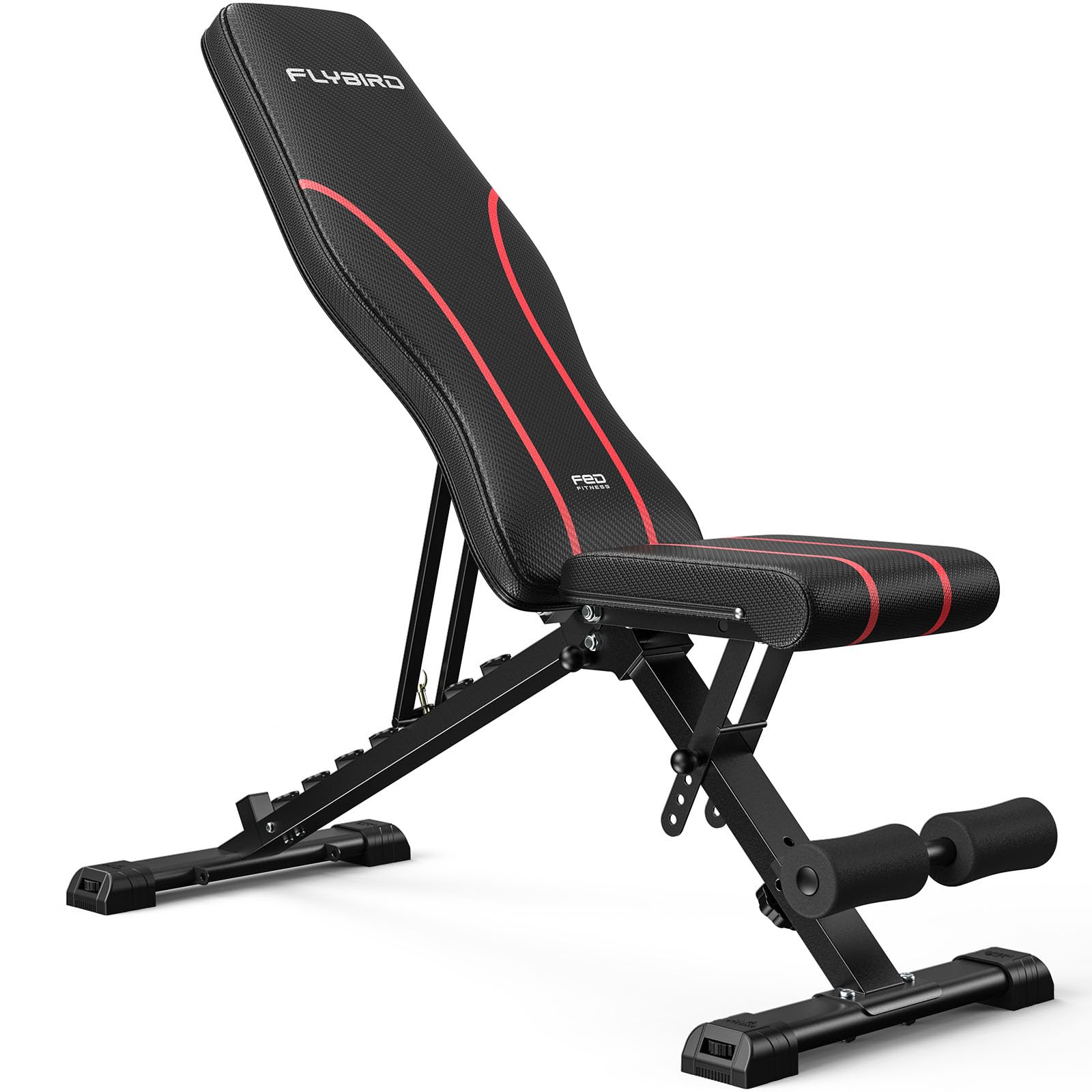
FLYBIRD Adjustable Weight Bench

FLYBIRD

FLYBIRD Adjustable Weight Bench

  • Pad Height 17.38 in
  • Item Weight 23 lb
  • Weight Capacity 750 lb
  • Adjustment Combos 96
Check Price on Amazon

A 17.38-inch pad puts your feet where they belong for leg drive.

Seventeen-point-three-eight inches is an odd number to print on a spec sheet, and it's the most useful thing about this bench. That's the IPF competition height for a flat bench, and it puts your feet on the floor in a position where you can actually drive through them instead of reaching for the ground.

The rest of the frame follows the same thinking. The backrest locks into a deep slot with a safety pull pin rather than resting on a serrated bracket, the base is 15 inches wide, and the leather has a textured, sweat-proof finish so you aren't sliding toward the head end mid-set. At 23 pounds it folds and stows easily, and 96 adjustment combinations cover everything from decline to upright.

The compromise is size: this is a compact bench, and taller lifters will find their shoulders pushing at the top of the pad. The incline seat pad also sits in its slot rather than locking into it, so it's worth checking it's seated before you load up. Both are the kind of thing you notice once and then work around.

Bottom Line

For a bench-press-first home gym we point people here: competition pad height, a lock that won't budge, and 23 pounds you can fold away.

Check Latest Price

Best Multi-Functional

Our Score 9.0/10
Finer Form Multi-Functional Bench

Finer

Finer Form Multi-Functional Bench

  • Footprint 62 x 20 x 30.25 in
  • Item Weight 46.3 lb
  • Total Settings 23
  • Weight Capacity 1,000 lb
Check Price on Amazon

A bench, roman chair, and back-extension station for one corner of the room.

Most benches on this page do one job. This one is also a roman chair, a back-extension station and a sit-up bench, which is why it looks less like a bench and more like a piece of gym equipment that happens to lie flat. Eight backrest positions, three seat positions, eight support-pad heights and four calf settings add up to 23 adjustments, and it's rated to 1,000 pounds.

If back extensions are part of your program, this replaces two purchases. The support pads adjust for height and the calf rollers for shin length, so a shorter lifter and a six-footer can both set up properly on the same frame, and the transport wheels mean a 21 kg bench isn't welded to one corner of the room.

What we like most is the range of bodies it fits. The height adjustments are the sort of thing you normally find on a dedicated hyperextension bench, not on something that also does flat press. What we like less is the footprint: 62 inches long and 20 wide is furniture, and assembly is more of a project than the two-pin benches here, with more parts to line up before the first set.

Buy it if you want one frame to cover pressing, decline work and lower-back training in a spare room. If you only press, you're paying for stations you won't use and giving up floor space a bench half this length would leave you.

Bottom Line

For a home gym that includes back extensions and decline work, this is the one frame that covers all of it: 23 settings, a 1,000-pound rating, and wheels to move it.

Check Latest Price

How We Tested Adjustable Weight Benches

We started by pulling every adjustable bench we could find from brands that actually publish weight capacities and pad dimensions, then cut anything rated under 600 pounds or built with a back pad narrower than 10 inches. That left a shortlist of 12, spread across flat/incline/decline ladders, folding frames, and a couple of heavier benches meant to live inside a rack. Price varied a lot, but we didn't weight it at the outset — we wanted to see whether the extra money bought anything you could feel.

Assembly happened on a garage floor using only the tools in the box, and we timed it. Most took between 30 and 90 minutes, and the benches that shipped with a usable wrench and labeled hardware separated themselves in the first ten minutes. Then we trained on them: flat barbell press, incline dumbbell press at 30 and 45 degrees, decline sit-ups, step-ups, and a lot of sitting on the end of the pad between sets. We noted how much the frame shifted when we racked a loaded bar, whether the pop pin dropped in on the first try or needed a wiggle, and whether the pad gap caught a shirt during position changes.

Because these end up in garages and spare rooms, we measured each bench's footprint and folded height, then carried them around to see how close to a two-person job the move was. Stability got checked from the side, not just the front — a bench can feel planted under a vertical load and still rock when you shift your hips. Across six months of twice-weekly use we watched for pad compression, paint flaking at the joints, and any play developing in the hinges; two benches had a noticeable shimmy by month five. Value came down to how much of that held up against what each bench cost, not the sticker on its own.

How to Choose

Stability Matters More Than the Capacity Sticker

Every bench here advertises a rating in the hundreds of pounds, and those figures are static-load claims, not a description of how the frame behaves under a moving bar. What you actually feel is mass, base width, and whether the hinge rocks when you press. Our 59-pound Keppi sits still in a way a 17-pound folder can't, and that's a design consequence rather than a flaw in the light benches, which are built for dumbbells and small rooms.

Match the frame to the load. A barbell and a rack want the steel benches in this group; dumbbells up to a moderate weight are fine on anything here.

Pad Height and Backrest Length Decide Fit

Seat height sets your feet, backrest length sets your shoulders. The benches in this group sit around 17 inches off the floor, the FLYBIRD at 17.38 and the NICEPEOPLE at 17.2, which is high enough that your feet reach the floor flat for leg drive and low enough that you aren't climbing onto the pad. Backrests run from 28 inches on the YOLEO to 34 on the JOROTO.

If you're over six feet, measure from your hip bone to the top of your shoulder before ordering. A pad shorter than that leaves your head hanging off mid-set, which is the single most common fit complaint in this category.

Look at the Lock, Not the Angle Count

How a bench holds its angle matters more than how many angles it lists. The better ones here lock the backrest with a pull pin through a deep slot, and the best lock the seat as well. Cheaper designs use a serrated bracket, quicker to change but less positive, or let the seat pad rest in a notch where it can shift during incline work with dumbbells.

Check both pads before you buy, and check whether the foot rollers adjust. A fixed roller is uncomfortable if your shins don't match it.

Folding Only Helps If the Folded Size Fits

The folders here collapse to somewhere between 8 and 13 inches tall and roughly 32 to 34 inches long: under-bed territory, not behind-the-sofa territory unless you measure the gap first. A hinge is also where flex shows up, so a folding bench is always a compromise on rigidity. If your bench has a permanent corner, put the money into a fixed frame instead of a fold you'll never use.

Frequently Asked Questions

Final Verdict

If you're building a home gym around a barbell, the Keppi is the bench to start with: welded 2-by-3-inch steel, 1,200 certified pounds, and 36 positions that include a decline your legs stay locked into. It's 59 pounds of equipment that lives where you put it, which is exactly what you want underneath a loaded bar.

If the bench has to move, the JOROTO's wheels and 42-pound frame make it the easier roommate. And if the whole setup is a pair of dumbbells in a spare room, the YOLEO gets you a genuine FID bench, assembled in two pins, that folds into a closet.