Strength & Weights

Best Dumbbell Racks of 2026

For a year, my dumbbells lived in a heap in the corner of the garage — fine until I crossed it in the dark and went down over a 30-pounder. A rack is a dull purchase right up until it isn't. What it actually buys you is floor you can walk on, pairs that stay paired so you reach for them mid-set, and hex heads that stop chewing up the concrete and each other. I've spent the past six months with a dozen racks, and the differences show up fast.

Here's what I'd tell a first-time buyer: the capacity figure on the box covers the whole rack, not each shelf, and the top tier is almost always the weakest point. Footprint is the other number people get wrong — a loaded rack sits several inches further into the room than the empty frame suggests. Of the twelve I've assembled and loaded, the ones below are the ones I'd fill again without a second thought.

Best Overall

Our Score 9.6/10
Marcy DBR-86 Dumbbell Rack

Marcy

Marcy DBR-86 Dumbbell Rack

  • Tiers 3
  • Footprint 37" W x 24.75" D
  • Weight Capacity 1,000 lb
  • Assembled Height 33"
Check Price on Amazon

A 1,000-pound rack that holds a full 5-to-45 set against one wall.

A thousand pounds of capacity is the headline, but the number that made this our default pick is 37 — the inches of wall it needs. Most home gyms run out of floor long before they run out of steel, and a three-tier rack that holds a full set of hex pairs in roughly the space of a stroller is a far easier thing to live with than a 51-inch frame.

The angled shelves do more work than they get credit for. Because the lower tiers tip forward, the end-cap labels face up toward you, so grabbing the 30s mid-set doesn't become a crouch-and-squint exercise. Rubberized feet keep the frame from skating across concrete and keep a finished floor unmarked, and ours went together in an evening with a socket set — the holes lined up and the hardware was bagged in assembly order.

The one thing to check before ordering is slot depth. Tall 50-pound hex heads can sit proud of the openings instead of nestling in, and the smallest 2- and 3-pound dumbbells are too short to span the gap, so they drop through. For a set that runs 5 to 45, neither matters — and what's left is the most solid piece of storage in this group.

Bottom Line

If your set runs from 5 to about 45 pounds, buy this one: it's the strongest-built rack of the group, and it disappears against a single 37-inch strip of wall.

Check Latest Price

Best for Mixed Sets

Our Score 9.2/10
YOLEO Adjustable Dumbbell Rack

YOLEO

YOLEO Adjustable Dumbbell Rack

  • Tiers 3
  • Footprint 37.8" W x 19.7" D
  • Weight Capacity 1,100 lb
  • Adjustable Bar Width 2"–5.1"
Check Price on Amazon

Sliding spacers widen or narrow each tier to fit mismatched dumbbells.

Most racks assume a matched set — same brand, same shape, 5-pound steps, bought together. Plenty of home gyms aren't like that: a pair of 20s from a yard sale, rubber hex 35s from a closing gym, a couple of neoprene 8s. This is the rack that expects it.

Each tier carries four screw holes and two sliding spacers, so the gap between bars moves anywhere from 2 inches to 5.1. We set the bottom tier wide for fat hex heads and the top narrow for the small stuff, and the whole collection stopped being a puzzle. No other rack here adapts to a pair that was never meant to match.

The triangle base with rubber end caps is steady once it's loaded, and the 1,100-pound rating leaves more headroom than most of us will ever use. Assembly runs about 20 minutes, but bring a second wrench — the stamped tool in the box gets you there slowly, and the top tier is easier with someone holding the frame while you start the bolts.

Bottom Line

Buy this if your dumbbells came from three different places: the sliding spacers let you widen one tier for chunky hex heads and narrow the next for the small ones.

Check Latest Price

Best for Dumbbells and Kettlebells

Our Score 9.2/10
Jusgym 3-Tier Adjustable Rack

Jusgym

Jusgym 3-Tier Adjustable Rack

  • Tiers 3
  • Footprint 48" W x 18.78" D
  • Weight Capacity 1,100 lb
  • Adjustable Bar Width 2.6"–7.5"
Check Price on Amazon

Adjustable height, angle, and width hold dumbbells, kettlebells, and plates together.

Three tiers that tilt, rise, and widen independently is the pitch, and it holds up if your gym isn't dumbbells-only. The bars move between 2.6 and 7.5 inches apart, each shelf can sit flat or on an incline, and the whole frame is rated to 1,100 pounds — enough for a dumbbell run plus the kettlebells and plates that usually end up leaning against the wall.

We like it best for the awkward middle of a home gym. A 35-pound pair with fat hex heads goes on a wide bottom tier, a kettlebell handle fits a gap no fixed dumbbell rack would offer, and a couple of 2-inch plates finally get a home. Setting the angle also means you can tip a shelf so the small weights sit forward, where you can reach them.

The trade-off is width: 48 inches of wall for three tiers, more than the Marcy needs to do the same job if your set is all dumbbells. Build it loose, square it on the floor, then tighten, and the H-frame sits flat without shimming.

Bottom Line

The pick for a mixed gym — dumbbells, a couple of kettlebells, and a few plates all sit on bars you can tilt, raise, and widen.

Check Latest Price

Best If You Need to Move It

Our Score 9.2/10
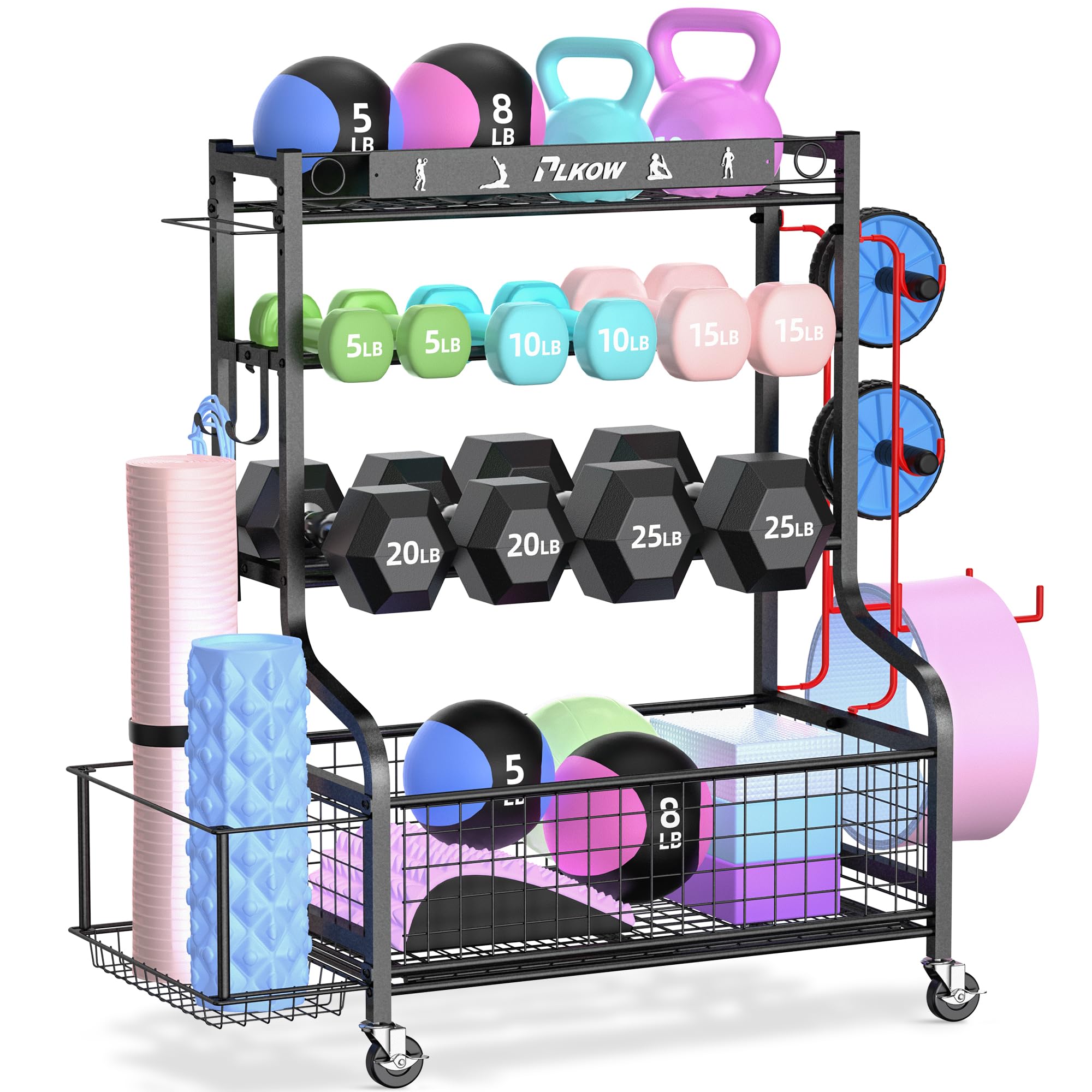
PLKOW Dumbbell Rack with Wheels

PLKOW

PLKOW Dumbbell Rack with Wheels

  • Tiers 3
  • Casters 4, two lockable
  • Footprint 41.5" W x 15.8" D
  • Weight Capacity 350 lb
Check Price on Amazon

Casters and locks let a loaded rack roll back out of the garage.

Wheels change where a rack can live. This one has four casters with two locks, so it rolls against the wall between sessions and comes back out when the car needs the bay. It's the only genuinely mobile rack in this group once it's loaded, and that alone earns it a place.

Because the frame is built around shelves rather than cradles, it carries more than weights. Three tiers take the dumbbells, a side basket swallows a yoga mat and a foam roller, and the hooks hold bands, a towel, a jump rope. In a small apartment gym that consolidation is the whole point: everything you'd otherwise trip over lives on one rolling footprint of about 41 by 16 inches.

One person can assemble it with the instructions in hand, and the powder coat has shrugged off a garage's worth of knocks without marking. Empty, it's light enough to tip onto its casters and steer with one hand.

Bottom Line

We recommend this to anyone whose garage has to become a garage again: it rolls, it locks, and it carries a mat and bands as well as your dumbbells.

Check Latest Price

Best for Light Dumbbells

Our Score 9.2/10
Josmimic 5-Tier Dumbbell Rack

Josmimic

Josmimic 5-Tier Dumbbell Rack

  • Tiers 5
  • Cradle Lining Silicone
  • Assembled Height 22.8"
  • Stated Dumbbell Range 3–30 lb
Check Price on Amazon

The cheapest good option for a 3-to-25-pound set in a small room.

This is the least expensive rack in the group, and for a set that stops around 25 pounds it's the one we hand a friend first: five tiers, 15 inches of width, and a footprint small enough to slide between a dresser and a wall.

The cradles are lined with silicone, which does two useful things — it keeps rubber hex dumbbells from squeaking in and out, and it keeps painted or neoprene finishes from scuffing on bare metal. There's a handle across the top, so you can drag the whole thing into the middle of the room for a workout and push it back after. Small thing, real difference in a room that isn't a gym.

Two things to accept. Spacing tightens at the top: 20- and 25-pound pairs are a squeeze on the upper tiers, so load the heaviest low and work upward. And it assembles in about five minutes with the included tool, which is the least demanding build of anything we've covered here.

Bottom Line

The least expensive good rack here, and the right one for a 5-to-25-pound set in a bedroom or a small apartment.

Check Latest Price

Best for Small Spaces

Our Score 9.0/10
AKYEN 5-Tier Dumbbell Rack

AKYEN

AKYEN 5-Tier Dumbbell Rack

  • Tiers 5
  • Footprint 15" W x 13" D
  • Weight Capacity 480 lb
  • Stated Dumbbell Range 1–35 lb
Check Price on Amazon

Fifteen inches wide, five tiers, built for dumbbells up to about 35 pounds.

Where the big three-tier racks claim a wall, this one claims a corner. Fifteen inches wide and 13 deep, it stands about knee-high and stacks five tiers of dumbbells in less floor than a nightstand takes. If your gym is a bedroom, a balcony, or the strip of floor beside a couch, that is the entire argument.

Five tiers in that footprint works because the spacing is progressive — tight at the top, wider at the bottom — so an 8-pound pair doesn't rattle around in a slot cut for a 30. It's the rack we reach for when a set runs from 5s to 25s: the tiers sit at an angle that lets you pull a pair straight out, and the holes line up, which is more than we can say for every rack here.

Assembly is the least fussy of the lot. The tools are in the box, one person can have it standing in under half an hour, and 13 pounds of empty frame is easy to shift between rooms — light enough, though, that deep carpet lets it rock, so a hard floor (or a board under it) is the better home.

Bottom Line

We point anyone with a corner and a set of light-to-mid dumbbells here: 15 inches wide, five tiers, and it stands steady once the bolts are snug.

Check Latest Price

Best for a Full Set

Our Score 9.0/10
CAP 3-Tier Dumbbell Rack RK-14A

CAP

CAP 3-Tier Dumbbell Rack RK-14A

  • Tiers 3
  • Footprint 51.57" W x 25.6" D
  • Weight Capacity 1,000 lb
  • Storage Per Shelf 51"
Check Price on Amazon

Fifty-one-inch shelves hold a complete 5-to-50-pound run in one place.

Fifty-one inches is a real commitment, and this rack spends every one of them: three shelves with 51 inches of run each, 1,000 pounds of capacity, and room left over after a full 5-to-50-pound set in 5-pound steps. If you already own the whole run, it's the tidiest way of the racks here to get all of it onto one piece of furniture.

The lower two shelves tilt, which matters once the rack is full. You can see what you're grabbing without crouching to read end caps, and a 45 slides out toward you instead of scraping the shelf above. Assembly takes two people mostly because of the length; the frame goes together with hand tools, and the instruction that decides whether it sits flat is to leave every bolt loose until it's square on the floor, then tighten in stages.

It's also 45 pounds of steel before you load a single dumbbell, so pick its spot first — once it's full, this is furniture. If your collection is mostly 5s through 25s, the AKYEN does the job in a fifth of the floor and you will not miss the extra width.

Bottom Line

For a complete 5-to-50-pound run in one place, this is the rack to buy — just measure the wall first, because it needs 51 inches.

Check Latest Price

Best For Budget starter rack

Our Score 8.8/10
CAP A-Frame Dumbbell Rack

CAP

CAP A-Frame Dumbbell Rack

  • Footprint 14.5" W x 13" D
  • Pairs Stored 5
  • Weight Capacity 200 lb
  • Assembled Height 26"
Check Price on Amazon

It costs less than most of the dumbbells you'll put on it, and for five pairs of light-to-mid weights it does the job. Two things greet you on day one: it's genuinely compact at 14.5 inches wide and 26 tall, and it smells like a tire store until it airs out. Build it in the garage and give it a few days.

Five tiers hold five pairs, angled so the ends face you when you reach. The frame is light, which cuts both ways — easy to move into place, and willing to rock if you tighten the bolts while it's sitting crooked. Assemble it on the level spot where it will live, snug everything in stages, and it settles down. There are no rubber feet, so felt pads are worth adding on hardwood.

What it won't do is grow with you. When a light rack gets outgrown — and this one will — the AKYEN is the same idea with more steel, and the price gap isn't large.

Bottom Line

A cheap, compact five-pair rack that does the job for light dumbbells — just plan on airing it out and tightening it on level ground.

Check Latest Price

Best For Mid-size budget

Our Score 8.8/10
pickpiff 3-Tier Dumbbell Rack

pickpiff

pickpiff 3-Tier Dumbbell Rack

  • Tiers 3
  • Footprint 31.5" W x 9.8" D
  • Weight Capacity 390 lb
  • Per-Shelf Capacity 130 lb
Check Price on Amazon

Between the cheap five-pair A-frames and the big three-tier steel racks sits a size plenty of home gyms actually need: 31.5 inches of wall, three tiers, 390 pounds of capacity — a run of 5s through 35s with room left for a kettlebell or two.

The adjustable bars are why we'd take it over the CAP A-frame. Each crossbar slides and re-bolts, so you can open the gaps for fat hex heads or close them for neoprene, and the frame takes the change without complaint. Assembly is 20 minutes with the tools in the box, and once it's loaded it feels steadier than the lightest A-frames here.

It's a plain rack, though: three tiers, no basket, no hooks, no wheels. If you want one piece of furniture to hold mats and bands as well, the PLKOW is the better spend. For pure dumbbell storage in a mid-size space, this is the quiet value pick.

Bottom Line

A sensible middle: 390 pounds of capacity in 31.5 inches of wall, with adjustable bars that take whatever mismatched set you already own.

Check Latest Price

How We Tested a Dozen Dumbbell Racks

To build the shortlist, I read spec sheets for every rack I could find with a published weight capacity and dropped anything that wouldn't name one — in this category, a missing number is an answer. That left 12 racks across three-tier, two-tier, and wall-mounted styles, which we've lived with for six months. They went where racks actually go: a garage gym with one clear wall, a spare-bedroom corner behind the door, and a low-ceilinged basement. Each was loaded with the same hex pairs, from 5 pounds up to 50, and used for real training rather than a photo shoot.

Assembly came first. I built every rack alone with whatever tools shipped in the box and timed it, noting whether the holes lined up, whether the hardware bag had spares, and how much skin the stamped edges took off my knuckles. Once it was up, I shook it empty, then shook it with a few hundred pounds on the shelves and watched the uprights. We also dragged each loaded rack a foot across a rubber mat to see whether the feet dug in or skated, and checked for wobble on a slab that is never perfectly flat.

Capacity turned out to be more than a box number. We counted how many pairs fit before one pair's plates fouled the next, whether trays were deep enough to keep a 5-pounder from rolling out, and whether the saddles held hex heads at an angle instead of letting them spin. Then we loaded the heaviest pairs on the top shelf to see what swayed or tipped — the fastest way to spot a rack that's only stable when it's stacked the way the manufacturer drew it. Odor got a check too, a sniff right after unboxing and again a week later in a closed garage, since rubber-coated steel and some finishes off-gas. Finally, we measured the footprint with the rack fully loaded, because the dumbbells add inches the spec sheet doesn't mention, and weighed what came in the box — spare hardware, casters, gauge — against the floor space and assembly time each rack demanded.

How to Choose

Start With Your Heaviest Pair

A rack rarely fails in the middle of the range. It fails at the extremes. A 50-pound hex head is tall and long, and it can sit proud of a cradle cut for a 25; a 3-pound dumbbell is short enough to drop straight through a gap built for a 20. Measure the length of one dumbbell head, add an inch, and compare that with the tray depth of the rack you're considering.

If you own both ends of the range, plan on the smallest pairs living in a bin under the bottom shelf. That one decision keeps a five-tier rack useful instead of turning it into a display stand for the weights that happen to fit.

Measure the Floor Before the Tiers

Three-tier steel racks run roughly 37 to 51 inches wide and 20 to 26 inches deep. A-frame racks do the opposite: 13 to 15 inches square, going up instead of out, and they suit lighter pairs because the tiers sit closer together.

Buying by tier count alone is how people end up with a five-tier rack that holds everything except their 45s, or a 51-inch frame in a 40-inch gap. Walk the spot with a tape measure before a capacity rating talks you into anything.

Fixed Cradles or Adjustable Bars

Fixed slots are cut for standard rubber hex dumbbells and work beautifully until your set stops being standard. Adjustable racks — the YOLEO opens from 2 to 5.1 inches, the Jusgym from 2.6 to 7.5 — let you widen a tier for fat heads, kettlebells, or plates, then narrow the next for neoprene.

It's the difference between a rack that fits the collection you have and one that fits the collection you'll have in two years. Expect to use a wrench: this is a set-once adjustment, not a dial.

Stability Is Mostly Assembly

Almost everything here is steel tube bolted together, and most wobble traces back to two mistakes: tightening the bolts before the frame is square, and building the rack on carpet when it will live on concrete. Start every bolt finger-tight, put the rack where it's going, then tighten in stages.

Leveling feet earn their keep on an uneven garage slab, and loading the heavy pairs low keeps the center of gravity down so the frame doesn't walk when you rack a pair one-handed.

Decide Whether It Needs to Move

If the rack shares a room with a car or a washer, casters or a carry handle are worth paying for: the PLKOW rolls loaded and locks in place, and the small A-frames lift with one hand. A 45-pound three-tier rack is furniture — once it's full of dumbbells it isn't going anywhere, so site it before you build it.

The test is simple. If you can't picture lifting it, put it where it's staying.

Frequently Asked Questions

Final Verdict

The Marcy DBR-86 is the rack we recommend to most home gyms: 1,000 pounds of capacity, angled shelves you can read at a glance, and a 37-inch footprint that fits a garage wall without eating the floor. For a set that runs from 5s to about 45s, nothing else here makes the decision easier.

Two changes move the answer. If your dumbbells run past 50 pounds, the CAP three-tier takes the whole run and asks for 51 inches of wall in return. If the set stops at 25 or 30 and space is tight, the AKYEN does the same job in a corner.