Strength & Weights

Best Squat Racks of 2026

A squat rack has one job, and it's the one thing no product photo can show you: staying put. I once watched a bargain rack shuffle an inch across a garage floor mid-set, and that little slide told me everything about the steel, the bracing, and how the thing was put together. A good rack fixes that. It gives you a stable place to squat, press, and pull at home, and it keeps up as your lifts get heavier.

Over the past six months my team and I worked through eight racks, from bolt-together starter frames to welded two-post setups, living with them the way you would — in a low-ceilinged garage, in a spare room where the footprint got measured twice, through a full training block of squats, bench presses, and pull-ups. Assembly time swung wildly, from a solo afternoon to about ninety minutes. And the real money question turned out to be less about steel gauge than about whether the rack fits your space, your bar, and your ceiling.

Best Overall

Our Score 9.4/10
Sunny Health & Fitness SF-XF9931 Power Rack

Sunny

Sunny Health & Fitness SF-XF9931 Power Rack

  • Frame Alloy steel
  • Footprint 38 x 53 x 87 in
  • Pull-Up Bar 8-position angled
  • J-Hook Positions 18
Check Price on Amazon

The best all-around rack for most home gyms, with a compact frame and spotter arms.

The Sunny SF-XF9931 earns its place as our default because it puts a useful full-size rack in a footprint that doesn't take over a spare room. At 38 by 53 by 87 inches, it leaves enough room to load a bar and still lets the space do another job when you're not training. The 83-pound frame is manageable to shift into position before you load it, so it can live against a wall rather than becoming a permanent gym.

The adjustment scheme is the practical part. Eighteen J-hook positions and the safety spotter arms let you set up squats, bench presses, and overhead work without hunting for a setting. The angled pull-up bar adds eight grip positions, and assembly is straightforward enough for one person with the included tools and numbered steps. We came away thinking this is the rare budget-minded rack that doesn't feel like a compromise every session.

The main caution is capacity: Sunny doesn't publish a maximum load for this frame, so it is the wrong choice if your squat and bench numbers are already high. For a beginner-to-intermediate home gym, the trade is sensible—you get spotter arms, a pull-up bar, and a compact footprint without the bulk of a full cage.

Bottom Line

The Sunny SF-XF9931 is our default for most home gyms: compact, stable, and fitted with spotter arms and a pull-up bar.

Check Latest Price

Best Full Cage Capacity

Our Score 9.4/10
Sunny Health & Fitness SF-XF9925 Power Cage

Sunny

Sunny Health & Fitness SF-XF9925 Power Cage

  • Frame 14-gauge steel
  • Storage Plate pegs and 6 band pegs
  • Capacity 2,130 lb
  • Footprint 50.4 x 65.1 x 82.9 in
Check Price on Amazon

A full cage with a 2,130-pound capacity for heavier barbell training at home.

The Sunny SF-XF9925 is the pick for the lifter who already knows a 500-pound rack will feel limiting. Its 2,130-pound total capacity and 14-gauge steel frame give it the heaviest stated ceiling in this group, and the full-cage shape adds safety arms, a reversible pull-up bar, plate storage, and six band pegs.

The footprint is 50.4 by 65.1 by 82.9 inches, so it wants a garage bay or a dedicated basement corner rather than a spare bedroom. The plate storage is useful for ballast, and the six band pegs add resistance work without extra clutter. The pull-up bar is reversible and centralized, and the numbered heights make the uprights easy to set.

We treat it as a garage rack first. It is narrower inside than the outside dimensions suggest, so a wide bench setup can feel tight, and that is the measurement to take before ordering. For a lifter who wants a full cage and does not want to wonder about capacity, the extra steel and the 2,130-pound ceiling are worth the floor space.

Bottom Line

We point heavy lifters to the Sunny SF-XF9925, a 2,130-pound full cage with plate storage and a reversible pull-up bar.

Check Latest Price

Best All-In-One

Our Score 9.2/10
ULTRA FUEGO UF-896 Power Cage

ULTRA FUEGO

ULTRA FUEGO UF-896 Power Cage

  • Capacity 1,000 lb
  • Uprights 50 x 50 mm, 1.5 mm steel
  • Footprint 63 x 47 x 82.7 in
  • Cable System Included
Check Price on Amazon

A rack and cable machine in one for lifters who want lat work at home.

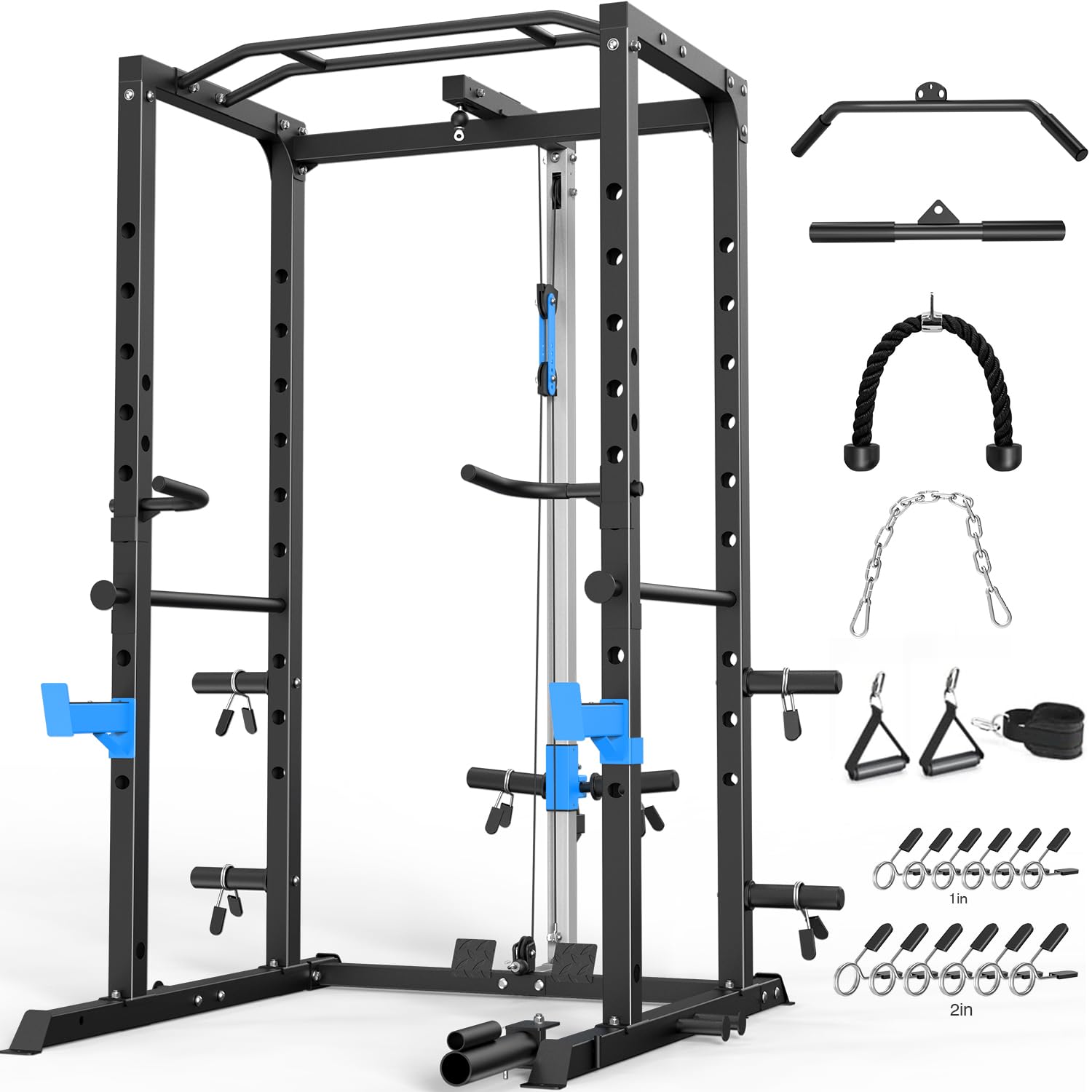
If your home gym has to cover barbell work and cable work, the Ultra Fuego UF-896 is the closest thing here to two machines in one. It is built around 50-by-50-millimeter uprights with 1.5-millimeter steel and a 1,000-pound capacity, and the included pulley system adds lat pulldowns, rows, triceps work, and landmine exercises without a second machine's footprint.

What makes it more than a bare frame is the walk-in space and the way the attachments are already there: lat bar, tricep rope, dip handles, landmine, J-hooks, and safety bars. We like that the cable path turns a squat rack into a place to train your back and arms without a separate lat tower. The 47-inch width keeps it from swallowing a one-car garage.

Stability is the one thing to plan for. The cage can move a little on pull-ups until you load the plate storage or bolt the base down, and the fix is simple if you have the floor space for it. The cable system is not a commercial lat pulldown, but it adds exercise range that a bare cage cannot match.

Bottom Line

Our all-in-one pick is the Ultra Fuego UF-896, which puts a 1,000-pound cage and cable pulley in one footprint.

Check Latest Price

Best Adjustable Width

Our Score 9.2/10
FLYBIRD SR1 Squat Rack

FLYBIRD

FLYBIRD SR1 Squat Rack

  • Capacity 950 lb
  • Footprint 42 x 51 x 83 in
  • Barbell Fit 6 ft and 7 ft
  • Height Settings 22
Check Price on Amazon

Adjusts to fit 6- and 7-foot bars, making it a smart choice for tight rooms.

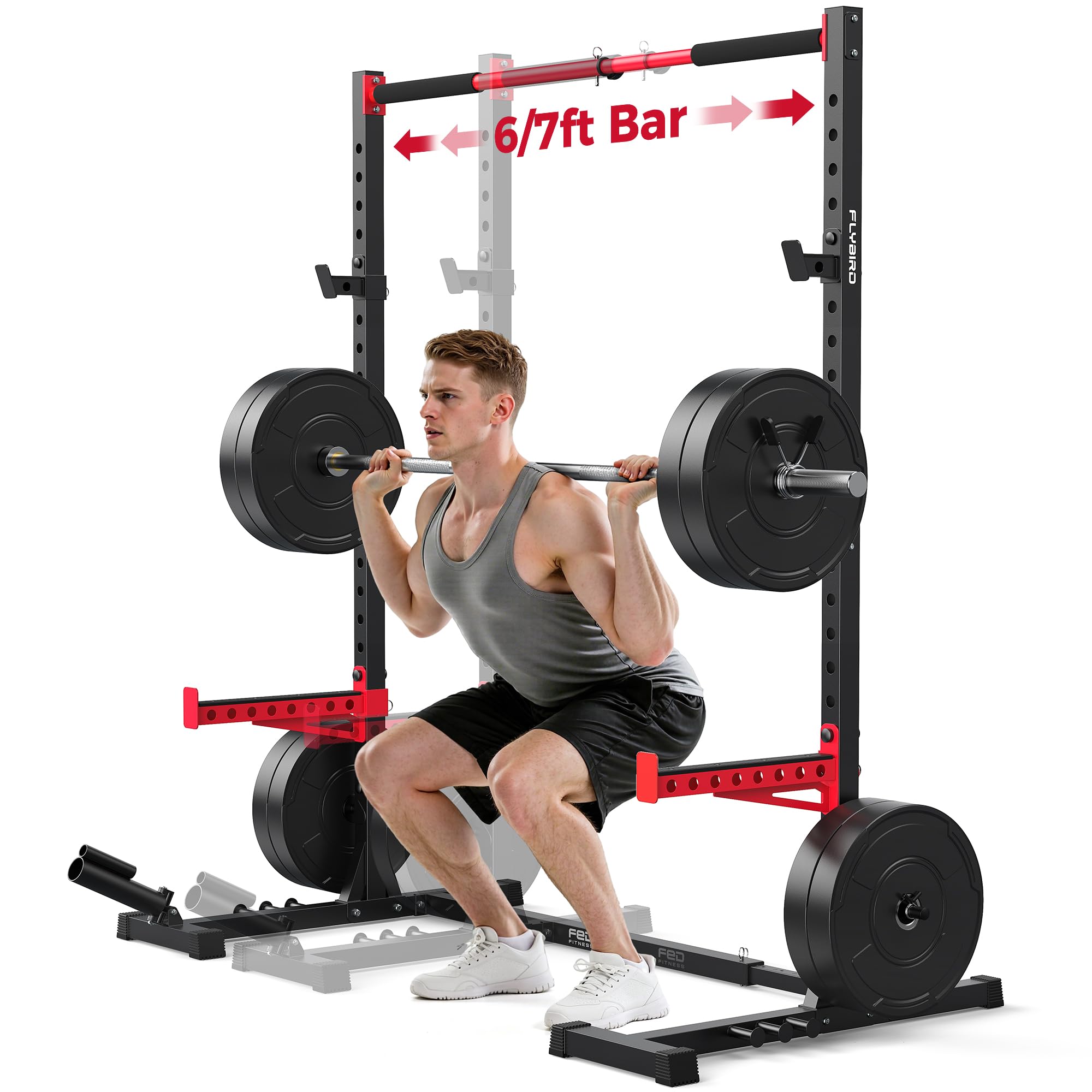
A 6-foot barbell in a fixed-width cage leaves a lot of empty sleeve and not much room to load plates. The FLYBIRD SR1 is built around that mismatch: its width adjusts for 6-foot and 7-foot bars, so you can keep the bar you already own and still center the load. The frame is 2-inch steel and rated to 950 pounds, and the whole rack stands 83 inches tall.

What won us over is the adjustable width. The 22 height settings use 1-inch holes, so the J-hooks and 16.7-inch safety arms can sit close to the right catch height. At 42 by 51 inches, it fits a small room, and 68 pounds makes it easy to shift before loading. The landmine, band pegs, and padded pull-up bar add useful variety without turning the rack into a machine.

The flip side of the adjustable width is setup: set both uprights evenly before you tighten everything, because a rack that is out of square is a rack that walks. Once it is square, the footprint is easy to live with.

Bottom Line

The FLYBIRD SR1 is our choice for small rooms and 6-foot bars, thanks to an adjustable width that keeps your existing bar usable.

Check Latest Price

Best For Tight garages

Our Score 9.2/10
papababe 800 lb Power Cage

papababe

papababe 800 lb Power Cage

  • Capacity 800 lb
  • Footprint 47 x 48 x 82 in
  • Pull-Up Bar Multi-grip
  • J-Hook Positions 26
Check Price on Amazon

The papababe 800-pound cage is a small-space option that doesn't look like a toy. Its footprint is 47 by 48 by 82 inches, and the 2-by-2-inch 13-gauge frame is rated to 800 pounds, so it covers squats, bench, and pull-ups without the footprint of a full-size competition rack.

The 26 J-hook positions give you plenty of height choices, and the multi-grip pull-up bar adds wide, neutral, and close grips without another attachment. The J-hooks and safety catches are included, and the uprights are drilled at the base so you can bolt it down if you want a permanent setup.

The first thing we checked was the two-piece upright joints; they have to seat fully before the rack takes weight, and that is the one assembly step to slow down for. The base has bolt holes, and the pull-up bar sits near the top of the 82-inch frame.

The appeal for a tight garage or basement is clear: it keeps the basic barbell work and the pull-up bar in a footprint that still leaves space for a bench. It gives up some interior room and some safety-arm reach, but not the essentials.

Bottom Line

For a tight garage, we reach for the papababe cage when a 65-inch rack will not fit but a pull-up bar still matters.

Check Latest Price

Best Budget

Our Score 9.0/10
CAP FM-CS7000F Power Rack

CAP

CAP FM-CS7000F Power Rack

  • Capacity 500 lb
  • Footprint 45.7 x 50.8 x 85.4 in
  • Pull-Up Bar Built-in
  • Weight Storage Built-in
Check Price on Amazon

A low-cost first rack for moderate loads and simple garage workouts.

The CAP FM-CS7000F is the rack we recommend when the budget is tight and the weights are moderate. It is a full stand with a built-in pull-up bar and weight storage, sized at 45.7 by 50.8 by 85.4 inches, and the H-shaped base gives it a planted feel on a flat floor.

The frame uses 11- and 12-gauge steel with double-gusseted uprights. Assembly is simple enough to handle with basic tools, and the powder coat and zinc hardware should stand up to a garage. The J-cup catches hold a standard bar securely, and the pull-up bar adds a second use without another machine.

The welds at the upright joints are the thing to inspect when the boxes arrive; a poor weld is a return, not a repair project. The rack also moves a little when you rack a loaded bar unless it is weighted or bolted, which is normal for a rack at this capacity but worth planning for. We think it is a fair first rack for a lifter who is not chasing a heavy squat number.

Bottom Line

For a first home gym on a tight budget, the CAP FM-CS7000F is the rack we trust with moderate loads.

Check Latest Price

Best Compact Cage

Our Score 9.0/10
CANPA Multifunction Power Rack

CANPA

CANPA Multifunction Power Rack

  • Capacity 800 lb
  • Footprint 43 x 40.75 x 85.71 in
  • Pull-Up Bar Multi-grip
  • Support Arms 17 holes per side
Check Price on Amazon

A compact cage with a multi-grip pull-up bar and plate storage built in.

The CANPA Multifunction Power Rack is a full cage for a room that can't spare a full cage's width. Its footprint is 43 by 40.75 by 85.71 inches, and the 800-pound frame includes a multi-grip pull-up bar, plate storage, and 17-hole support arms on each side.

The main frame has six height settings, while the support arms give you the finer adjustment for squats and presses. The multi-grip bar is more useful than a single straight bar, and the plate storage adds ballast where a narrow cage needs it. Assembly is manageable, and the H-shaped base helps it sit flat on a basement floor.

We see the CANPA at its best in a low-ceiling basement with a short barbell and a lifter who values floor space over room to move side to side. The 17-hole support arms do the fine adjustment, so the frame height is a set-and-forget choice. That is a small compromise for a cage that fits where a 65-inch model will not.

Bottom Line

We like the CANPA for a basement gym where floor space is tight and you still want a full cage.

Check Latest Price

Best For Bench and press

Our Score 8.8/10
BangTong&Li HD-01-P Squat Stand

BangTong&Li

BangTong&Li HD-01-P Squat Stand

  • Base H-shaped
  • Frame 2 x 2 in steel
  • Capacity 550 lb
  • Barbell Storage 2 racks
Check Price on Amazon

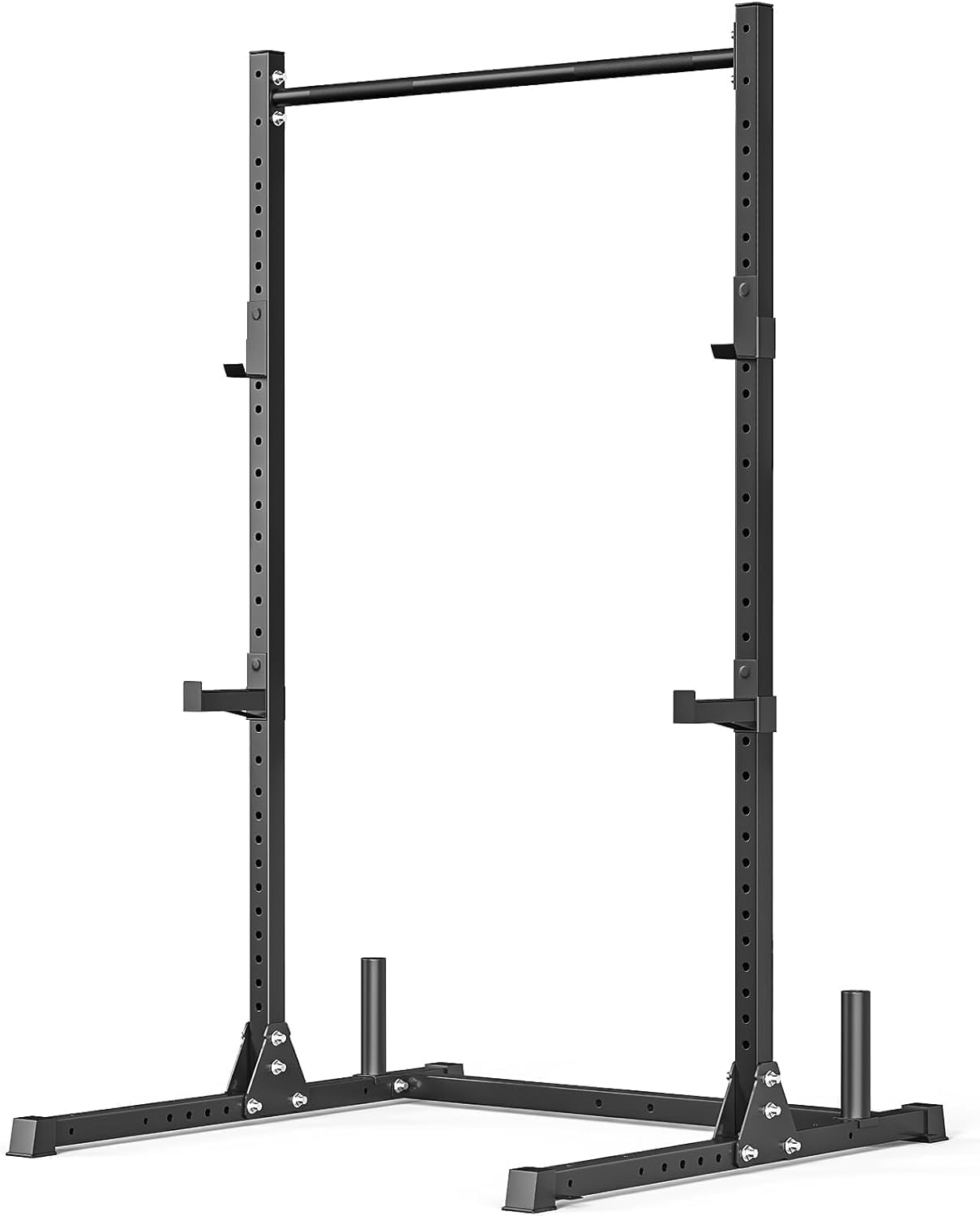
The BangTong&Li HD-01-P is a squat stand, not a cage, and the central crossbar under the rack is the detail that decides whether it suits you. That bar ties the two uprights together, but it also sits where your feet want to go during a squat, so this is a rack to choose for bench and press work first.

The frame uses 2-by-2-inch square steel, the base is H-shaped, and the rack is rated to 550 pounds. The brackets adjust through a useful range for bench work, and there are two barbell storage racks on the uprights. The H base and rubber pads keep it from skating on a concrete floor, and the footprint is small enough for an apartment corner.

The two barbell storage racks keep the bar off the floor, and the H base gives it a wider stance than a simple A-frame. Assembly is straightforward, and the whole thing is light enough to move out of the way between sessions.

We keep it in the bench-and-press lane for a low-ceiling room, not as a heavy-lifting cage. The crossbar is the compromise—it stiffens the stand and gets in the way of a natural squat stance. If your training is mostly bench and press, that trade is easy to live with.

Bottom Line

The BangTong&Li HD-01-P is our pick for bench and press work in a low-ceiling room, not as a replacement for a cage.

Check Latest Price

What Six Months Under Eight Squat Racks Taught Us

We started by gathering every rack a home lifter could realistically buy, then filtered that list by footprint, ceiling clearance, steel gauge, hole spacing, and price. That cut the field to eight, which we bought ourselves and assembled in garages, basements, and spare rooms. Each one stayed standing for the full six months — nobody tested a rack for a weekend and called it done.

Assembly was timed with one person working alone, and we noted where the instructions went vague, which steps genuinely needed a second pair of hands, and how much hardware needed re-torquing after the first week. Stability got checked two ways: a slow, heavy squat with the bar loaded near the rack's stated weight capacity, and a deliberate shoulder bump into the uprights to see how far the frame swayed before it settled.

We squatted in every rack weekly, and also used them for bench, overhead press, and pull-ups. That's where the smaller differences showed up — whether the J-cups cradled the bar or let it roll, whether the hole spacing let us pin safeties at an honest depth, whether the pull-up bar flexed under a kip. Fit was measured, not assumed: actual footprint and required ceiling height against the manufacturer's numbers. At the end we weighed what each rack cost against what it actually did, since value is where these eight diverged most.

How to Choose

Start With the Shape: Stand, Half Rack, or Full Cage

A pair of stands is the least expensive way into barbell training, and it can be the right one if your ceiling is low and your lifts are moderate. We treat a stand as a bench-and-press tool first: a connecting crossbar can get in the way of a natural squat stance. A half rack adds uprights, J-hooks, and often a pull-up bar without enclosing you. A full cage gives you safety arms on both sides and the most room for attachments, but it also takes the most floor space. Choose the smallest shape that still lets you fail a rep safely.

Measure Height and Footprint Before You Compare Capacity

The ceiling is the measurement people forget. The racks here stand between about 82 and 87 inches, and a pull-up bar needs clearance above your head as well. A rack that fits the floor but not the ceiling is a return. Depth matters too: a 50-inch half rack fits a spare room, while a 63-inch cage wants a garage bay. Compact in a product name usually means the footprint, not the height, so check both numbers against the room and the bar path before you fall for a smaller-looking rack.

Read Weight Capacity as a Ceiling, Not a Promise

A 500-pound rack and a 2,130-pound rack are not the same tool, even if both hold a bar for a light squat. We treat the stated capacity as the upper boundary for controlled lifts, not a license to drop a loaded bar from the top. Steel gauge, upright size, and the base matter as much as the number; so does the floor. A rack with plate storage can gain stability from the plates, and a bolt-down base is more secure if pull-ups are part of your routine. Leave margin between your heaviest lift and the rack's rating.

Spend Your Attention on J-Hooks and Safety Arms

The J-hooks hold the bar between sets, and the safety arms catch a failed rep, so their adjustment range matters more than a long attachment list. A rack with 22 closely spaced holes is easier to dial in than one with a coarse range. Check that the safety arms are long enough to catch the bar across your bench path, and that the J-hooks clear your hands when you unrack. If you own aftermarket attachments, check the hole size before ordering; a great rack with the wrong holes is a closed ecosystem.

Decide Whether a Cable System Belongs on the Rack

A cable pulley turns a cage into a lat pulldown and row station, which is why the all-in-one designs are tempting. It also adds assembly, a cable path to maintain, and depth to the frame. We like the concept when the alternative is a second machine and you have the floor space for a deep cage. If you mostly squat and bench, put the money into a sturdier frame and longer safety arms instead. If back and arm work is a real part of your training, a rack with a pulley can replace a separate tower.

Frequently Asked Questions

Final Verdict

Start with the Sunny SF-XF9931 if you want the best balance of footprint, everyday usability, and sensible assembly for a beginner-to-intermediate home gym. It is not the rack for a very heavy squat; for that, move to the Sunny SF-XF9925 and its 2,130-pound capacity.

If you want cable work in the same footprint, the Ultra Fuego UF-896 is the stronger choice, and the FLYBIRD SR1 is the one to choose when a 6-foot bar has to fit.