Strength & Weights

Best Dip Stands of 2026

A dip stand is the compact answer to a gym's dip station—until the wrong one turns every rep into a balance test. I learned that the hard way with a hand-me-down stand that shifted every time I lowered myself; the right one, by contrast, gives you a stable platform for dips, leg raises, and push-ups without taking over the room. It's a simple piece of equipment, but the differences in stability, assembly, and adjustability are anything but small.

Over the past eight months, we've assembled and used 12 dip stands, paying close attention to how they feel under load, how long they take to put together, and whether the bars are actually comfortable on your palms. One thing I've learned: a heavier frame isn't always better—some stands use thicker steel where it counts and skip the extra bulk elsewhere. And while a dip stand isn't a huge investment, the price should reflect the steel and welds, not just the paint job—so think about where you'll store it and which exercises you actually do, because a great dip bar for triceps might not be the best for leg raises. We've got picks for tight spaces, tall users, and anyone who wants a stand that won't budge.

Best Portable

Our Score 9.4/10
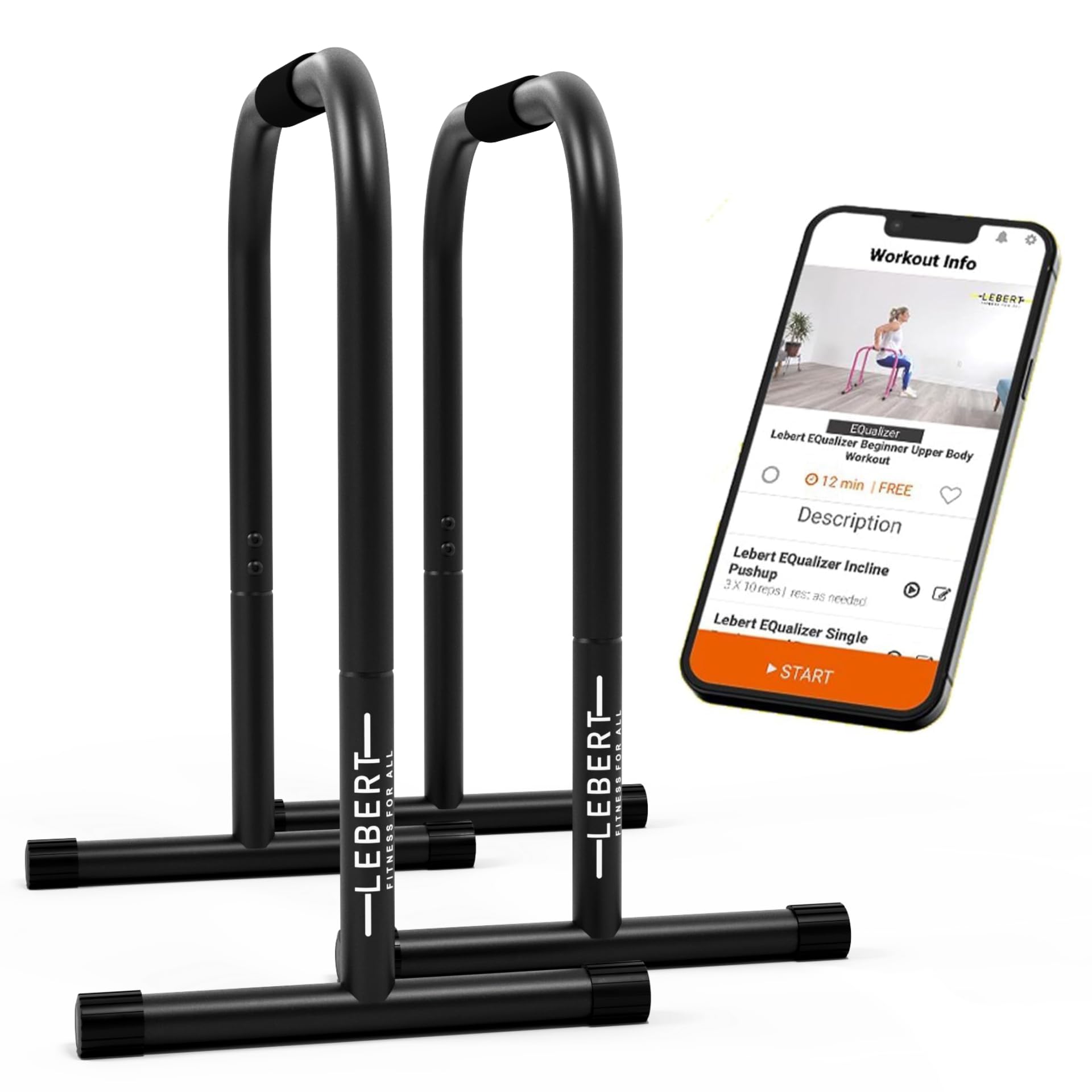
Lebert EQualizer

Lebert

Lebert EQualizer

  • Bar Height 28 in
  • Base Width 21 in
  • Weight Per Bar 7.5 lb
  • Weight Capacity 400 lb
Check Price on Amazon

Two 7.5-pound bars you can carry outside or stand in a closet.

A dip stand doesn't have to be a stand. The EQualizer is two independent bars, 28 inches tall on 21-inch bases and 7.5 pounds each, and you set them down at whatever width you want — no pins, no holes, no knobs. That freedom is the whole idea: shoulder width, a little wider, or offset for a one-arm progression, all in the time it takes to move two light objects.

They're also the pair that travels, and that's the reason to choose them over a station. Fifteen pounds for the set, short enough to stand in a closet, and easy to carry outside, to a park, or in a trunk. The package includes a hip resistance band and access to the company's video coaching, which is worth more than it sounds if you're new to bodyweight training and short on ideas.

The trade is height. At 28 inches these are bent-knee dip bars — your feet clear the floor only if you tuck your legs, and taller lifters will feel cramped. There's an XL in the same line for exactly that, but the standard size is better understood as a portable training tool than a station you load with a belt. What we loved most is how many jobs they take on: dips, rows, L-sits, balance and step-up work, all from the same two pieces.

Bottom Line

The pick for lifters who train in more than one place: two light bars, any grip width you like, and a shape that packs into a car.

Check Latest Price

Best Heavy-Duty

Our Score 9.4/10
KAKICLAY Dip Bars

KAKICLAY

KAKICLAY Dip Bars

  • Bar Height 35.4 in
  • Grip Width 6 settings
  • Grip Diameter 40 mm
  • Weight Capacity 880 lb
Check Price on Amazon

An 880-pound-rated pair with six grip-width settings and a lifetime warranty.

Grip tape instead of foam is the first hint that these bars were designed by someone who trains on them. The 40mm handles are wrapped rather than padded, the connecting piece is drilled with six width holes, and the pair is rated to 880 pounds — the stoutest frame in this group.

That's what the premium buys, and we think it's justified for a specific lifter: someone doing weighted dips and rows who wants the frame to stop being part of the question. Six width holes mean you set the handles to your shoulders and repeat the position exactly rather than eyeballing it. The tape is the detail to weigh — it grips far better than foam and it's rougher on bare hands, so if your palms are already sore from a knurled bar, foam is the kinder choice.

The fixed 35.4-inch height is the compromise, and it's a real one: a good working height for average lifters, low for tall ones, with no adjustment to fix it. Assembly takes minutes with the tools in the box, the non-slip feet hold on a hard floor, and the lifetime warranty covers a design the company patents. Set it up once on something flat, and there's very little to think about afterward.

Bottom Line

Choose these if you train weighted dips and want the frame to stop being the question; the width settings and 880-pound build justify the premium.

Check Latest Price

Best for Tall Lifters

Our Score 9.2/10
Bongkim Dip Bar

Bongkim

Bongkim Dip Bar

  • Grip Span About 48 in
  • Height Range 37–48 in (7 levels)
  • Weight Capacity 800 lb
Check Price on Amazon

Seven height stops up to 48 inches, so tall lifters dip without folding up.

Forty-eight inches at the top setting, dropping in seven two-inch steps to 37. That's the tallest range on this list, and for a lifter over six feet it changes the exercise: you dip with your legs hanging instead of folded up under you, and knee raises stop being a crouch.

The rest of the frame is serious — an 800-pound rating, triangular bracing at each base, rubber feet that hold a hard floor. What it doesn't do is change width. The grip span is fixed and it runs wide, which suits broad frames and asks narrower ones to adapt; measure across your shoulders before you commit, and if you need a narrower handle position, this is the wrong stand however good the height range is.

It's also the most expensive pick here, and that money goes into the height adjustment rather than into features you won't use. Assembly is straightforward, the hardware is good, and once everything is tight the frame doesn't shift under load.

What settles it for us is the range. Two-inch steps mean you find a setting rather than settling for the nearest one, and nothing else in this group gets you that high. If you're tall and tired of tucking your knees through every set, that's the entire argument; if you're average height, you can spend less and get a stand that adjusts in the direction that actually matters to you.

Bottom Line

The tall lifter's answer: seven height stops up to 48 inches, so dips and leg raises stop being a folding exercise.

Check Latest Price

Best Overall

Our Score 9.0/10
ProsourceFit Power Dip Station

ProsourceFit

ProsourceFit Power Dip Station

  • Grip Width 19.5–26.5 in (7 settings)
  • Item Weight 23.5 lb
  • Height Range 31–35 in
  • Weight Capacity 400 lb
Check Price on Amazon

Seven grip widths and four heights make it fit almost any lifter.

Most dip stands ask you to adapt to them: one fixed handle spacing, and if it misses your shoulders, every rep feels slightly wrong. The ProsourceFit goes the other way, with seven grip widths between 19½ and 26½ inches and four heights between 31 and 35 inches. That's why it's our top pick — narrow-shouldered lifters and broad ones can both put the handles where a dip feels natural, and the one-inch width steps mean you land on the right setting rather than the nearest one.

Stability on this frame comes down to one detail. The two uprights are joined by a safety connector at the base, and once that bar is locked in, the pair acts like a single unit instead of two legs with room to splay. We paid close attention to that connector, because it's the difference between a stand that feels planted and one that shifts under you at the bottom of a rep. Set it on a hard, level surface, snug the connector properly, and check it again after the first few sessions.

The rest is honest mid-range equipment: coated iron rated to 400 pounds, padded grips, non-slip rubber feet, and a 23.5-pound frame that breaks into manageable pieces when the floor needs to come back. The limited lifetime warranty is a welcome thing to have on a bolted frame you'll be re-tightening for years. Nothing about it is luxurious, and it doesn't need to be — it's the most adjustable, best-value station in this group and the one we keep coming back to as the sensible default.

Bottom Line

If you want one dip stand that fits nearly any lifter, this is it: seven grip widths, four heights, and a connector that makes the frame behave as a single piece.

Check Latest Price

Best Budget

Our Score 9.0/10
Amazon Basics Dip Bar Station

Amazon Basics

Amazon Basics Dip Bar Station

  • Grips Foam, fixed
  • Item Weight 22 lb
  • Weight Capacity 661 lb
  • Assembled Dimensions 34 x 32 x 38 in
Check Price on Amazon

The most capacity for the least money, with nothing to adjust or fuss over.

Six hundred and sixty-one pounds is the number that matters here: a rating far above what bodyweight dips ask of it, on a steel station that undercuts nearly every adjustable stand in this guide. Foam grips and foam floor pads come fitted, so it won't skate on a smooth floor or mark it. The frame bolts together in a few minutes with the hardware in the box, and there's no adjustment mechanism to work loose afterward.

The fixed handle spacing is the thing to check before ordering. Measure across your shoulders and think about the 32-inch frame: if a wide grip suits you, the rigidity of a station with nothing to adjust is a genuine advantage, and if it doesn't, no amount of re-tightening will change the geometry. We rate it the budget pick for exactly that reason — it's the most stand you can get without paying for adjustment you may never use.

Twenty-two pounds of steel, a 38-inch working height, and a base wide enough to stay planted through knee raises and inverted rows. It's a station you assemble once and leave in place, and the plainness is the appeal: nothing to check, nothing to drift, nothing between you and the set. If your gym is a permanent garage corner rather than a shared room, that simplicity is most of what a dip stand needs to deliver.

Bottom Line

Buy it if your shoulders suit a fixed grip and you want a heavily rated station that never needs adjusting; there's nothing to fiddle with and nothing to drift.

Check Latest Price

Best for Small Spaces

Our Score 8.8/10
Ultimate Body Press Dip Station

Ultimate Body

Ultimate Body Press Dip Station

  • Folding Tool-free, no tools needed
  • Bar Height 36 in
  • Grip Width 2 positions
  • Weight Capacity 350 lb
Check Price on Amazon

Folds without tools into a closet and levels out on an uneven garage floor.

The party trick is the spring tabs. Colored dots on each section line up, the legs pop in, and the frame comes apart without a tool in your hand — which makes this the stand for the apartment version of a home gym, the one where the floor has to be clear again by the time anyone else gets home. Set up, it's a 36-inch station with two grip widths and angled handles that put your wrists at a friendlier angle than a straight bar.

Two details earn their keep. Each foot has a leveling adjuster, and in a garage or basement where the slab isn't flat, that's the difference between a stand that rocks and one that sits. We also like the angled grips more than we expected: they let your hands fall into a natural position at the bottom of a dip, which matters more as the reps pile up.

What you trade for the folding joints is some rigidity. The frame has movement in it before your weight settles onto the handles, and you notice it getting into position rather than mid-set. For a stand that lives in a closet, that's an easy trade; if yours will stand in one place for years, a fixed frame like the ProsourceFit is the steadier buy. The 10-year warranty is unusually generous for something with moving joints, and it says the maker expects them to hold.

Bottom Line

For an apartment or a shared room, this is the stand we point to: it folds without tools, levels on an uneven floor, and stores in a closet.

Check Latest Price

Best For Budget adjustability

Our Score 8.8/10
Sportsroyals Adjustable Dip Bar

Sportsroyals

Sportsroyals Adjustable Dip Bar

  • Width Settings 4
  • Height Settings 4
  • Steel Thickness 2 mm
  • Weight Capacity 400 lb
Check Price on Amazon

The piece that matters on this stand is the bar running between the two uprights at the base. It's adjustable, and it ties the left and right sides together — which is the job a dip station's frame has to do: keep the uprights from walking apart while your weight is on the handles. Height and width both adjust in four steps, so this is the least expensive route here to a stand that fits your shoulders and your height.

Two-millimeter steel and a 400-pound rating put it mid-pack for mass, and the padded grips and non-slip sleeves are comfortable in bare hands. Assembly is a short bolt-together job. Check the hardware bag against the parts list before you start — a short bag is the one thing that stops this stand dead, and it's easier to catch before the legs are half on.

The knobs are the part we keep an eye on. The ones that lock height and the connector can work loose over a few sessions, so the first week is a matter of checking and re-tightening until everything seats. Do that and it's a stable, adjustable stand for less than most of this list; skip it and the bars feel shiftier than they are. As a first dip stand in a small gym, that's a fair trade.

Bottom Line

The least expensive way here to get adjustable width and height, provided you spend the first week checking the knobs.

Check Latest Price

Best For Assisted dips

Our Score 8.8/10
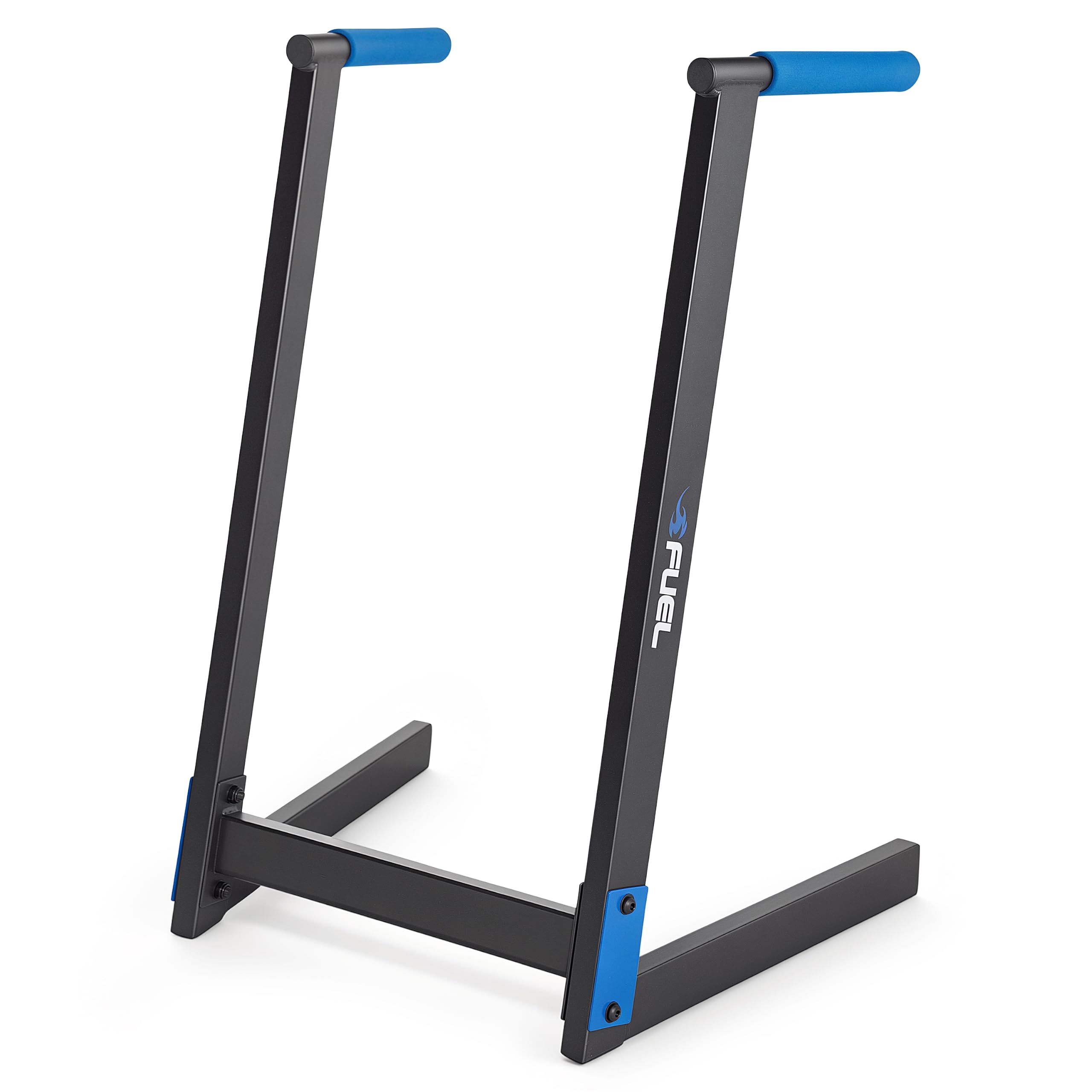
Fuel Pureformance Dip Station

Fuel

Fuel Pureformance Dip Station

  • Bar Height 35.6 in
  • Item Weight 17 lb
  • Weight Capacity 300 lb
  • Assembled Dimensions 26.8 x 22 x 35.6 in
Check Price on Amazon

There's a version of home training that starts with a toe still on the floor. This stand is short enough — 35.6 inches — that you can step between the bars, keep a foot down for assistance, and build toward a full dip, which the tall stations here don't let you do comfortably. The open pass-through frame adds to that: you stand inside it rather than behind it, and knee raises don't put a bar in your face.

Height is also the trade. At 35.6 inches it's a bent-knee stand, and anyone much past six feet will find their knees close to the floor at the bottom of a rep. For average-height lifters working on volume, that's a non-issue.

Seventeen pounds of 14-gauge steel with a powder coat, angled padded grips, and a footprint of roughly two feet by two. It's light enough to shift with one hand — we did exactly that more than once while finding it a home — and short enough to slide under a shelf, so it works in a room that has to be a living room the rest of the time.

Set against that, it's the smallest way into a station that stores like a suitcase and lets a beginner keep a toe down. If bodyweight dips are the whole plan and the floor space is contested, it earns its place — and it's honest about being an entry point rather than the last stand you'll buy.

Bottom Line

A short, light, open frame for assisted dips and knee raises in a small space, as long as bodyweight work is all you need.

Check Latest Price

How We Tested Dip Stands for Stability, Comfort, and Real-Life Use

We started by pulling together a shortlist of 12 dip stands from brands we've used before and newer models that kept showing up in customer reviews. We filtered out anything with vague weight capacities or a footprint too wide for a typical apartment, then ordered the rest. Over eight months, we assembled each stand in a garage and a spare bedroom, timing solo setup with a stopwatch and noting whether the instructions were clear enough to follow without a second person.

Once built, each stand went through the same routine: three sets of dips, leg raises, and push-ups, plus a set of static holds at the top. We watched for wobble at the joints, whether the bars flexed under weight, and if the feet slid on concrete or carpet. Comfort got checked by doing reps bare-handed and with gloves, noting pressure points and bar diameter. Adjustability was tested by changing height and width settings between users of different heights, and we measured the footprint both set up and folded to see how much floor space each one really ate.

We also judged design and durability by inspecting welds, powder coating, and hardware after repeated use, and compared each stand's price against its build and features to see which ones offered honest value. Assembly difficulty counted against a stand if it took more than 30 minutes or required tools that weren't included. Versatility mattered too: we tried using each one for elevated push-ups and inverted rows where the design allowed, and noted whether the dip bar itself was wide enough for comfortable shoulder positioning. The stands that earned a spot in this list are the ones that stayed solid, felt good in the hands, and didn't make us dread moving them.

How to Choose

Fit the grip width to your shoulders

Grip width decides how a dip feels. Set too wide, your range of motion shortens and the front of the shoulder takes more of the load; too narrow, and your hands crowd your ribs at the bottom. Measure across the bony points of your shoulders and expect the handles to sit at or slightly outside that span. Adjustable stands — the ProsourceFit, the Sportsroyals, the KAKICLAY — let you dial it in, and the Lebert's two loose bars let you place them anywhere. The fixed-width stands here, including the Bongkim and the Amazon Basics, only suit you if the number already matches. A great weight rating on a grip that doesn't fit is the most common bad purchase in this category.

Match bar height to your legs, not the spec sheet

Bar height decides how much room your knees have at the bottom of a rep. On a short station — the Lebert bars at 28 inches, the Fuel at 35.6 — you tuck your legs, and anyone much past six feet runs out of clearance quickly. Stations in the high thirties and forties, like the Bongkim, let your legs hang and leave room for a weight belt. Short bars have their own advantage: with your feet still able to reach the floor, you can assist yourself into a rep and build toward a full dip. Measure your own leg length before you trust a headline number.

Stability lives in the frame, not the rating

A weight rating tells you what the steel will hold, not how still it will sit. The stands that feel planted share a few things: a connector tying the two uprights together, joints bolted tight rather than finger-tight, and feet that actually grip. Two separate bars with no connector, like the Lebert's, rely on careful placement and a wide base instead. Whatever you buy, set it up on a hard, level surface, snug every bolt after assembly, and check them again after the first few sessions. Grit under a rubber foot will rock a stand and a slick floor lets one walk; a mat solves both.

Decide whether it stays out or gets put away

A station takes roughly two to three feet of floor in each direction, so the real question is whether it stays there. Folding designs like the Ultimate Body Press collapse without tools and disappear into a closet. Bolted stations like the ProsourceFit break down into flat pieces that store easily but take a few minutes to rebuild. Two loose bars are the easiest to move and the easiest to lose behind the sofa. If the floor has to be clear every evening, buy for that — a stand that's a nuisance to set up is a stand that stops getting used.

Frequently Asked Questions

Final Verdict

Buy the ProsourceFit Power Dip Station. Seven grip widths and four heights cover nearly every lifter, and the base connector makes the frame behave like one piece — the two things that decide whether a dip feels right. If your floor has to be clear between sessions, the Ultimate Body Press folds without tools and levels on an uneven slab.

And if you're tall enough that a 35-inch bar leaves your knees scraping the floor, pay for the Bongkim and its 48-inch top setting. Anything else is a stand you'll adapt to rather than one that adapts to you.