Rubber Gym Flooring Rolls vs Tiles: Choose by Room, Seams, and Installation
Choose rolls for larger rectangular rooms when fewer seams and a continuous appearance matter. Choose tiles for smaller, irregular, rented, phased, or damage-prone spaces where handling and individual replacement matter more.
Format alone does not determine impact protection, odor, slip resistance, emissions, or quality. Compare rolls and tiles of similar thickness, density, construction, test data, and intended use.
Rolls vs Tiles at a Glance
The practical tradeoff is continuity versus modularity. Product-specific installation instructions can override every generalization in this table.
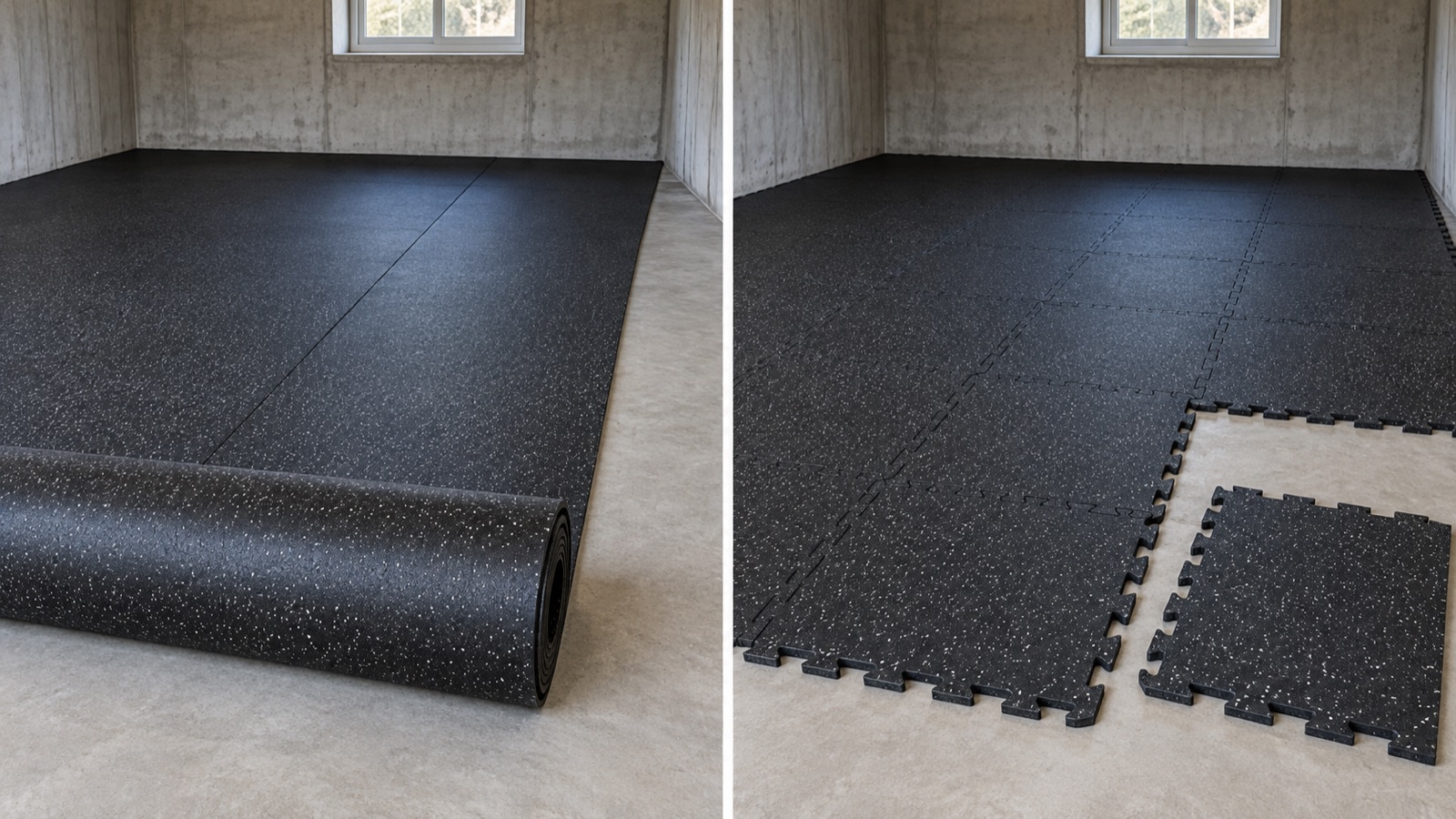
| Decision factor | Rubber rolls | Rubber tiles |
|---|---|---|
| Seams | Long runs create fewer seams in a large rectangular room | More seams; interlocks or square edges must stay aligned |
| Handling | A full roll can be heavy and difficult to position or recut | Smaller pieces are easier to carry and dry-fit |
| Irregular rooms | More templating and large offcuts may be required | Easier to fit around columns, alcoves, and partial zones |
| Removal | A glued installation is a major commitment | Some products are designed for removable, loose-laid installation |
| Repairs | A patch can remain visible and may require seam work | A damaged tile can often be replaced individually if spares match |
| Cleaning | Fewer seams can simplify liquid recovery | More joints require closer inspection for gaps and trapped moisture |
| Visual result | Continuous field with long, straight seams | Modular grid or interlocking pattern |
| Best common fit | Wall-to-wall commercial or dedicated rooms | Home gyms, rentals, phased builds, and targeted impact zones |
Use These Five Questions to Decide
- Is the room permanent? A glued roll system suits a long-term dedicated gym; a documented loose-lay tile may suit a rental or room that changes.
- Can material reach the room? Measure doors, turns, stairs, elevators, and the weight of each piece—not only floor area.
- Where will weights land? A general floor and a high-impact lifting zone may need different products or thicknesses.
- Who will install it? Large rolls, adhesive open time, seam alignment, and substrate preparation often favor an experienced installer. Some interlocking tiles are designed for DIY work.
- What happens after damage? Keep labeled spares from the same production run when color matching and fast tile replacement matter.
Estimate Material Before Comparing Price
Draw the room to scale and divide it into rectangles. For each rectangle:
length × width = square feet
Add the areas, subtract only permanent openings that will not be covered, then lay the actual roll widths or tile dimensions over the drawing. Price the order quantity—not only the net room area.
| Format | Waste usually comes from | Better estimate method |
|---|---|---|
| Rolls | End cuts, matching direction, crooked walls, columns, and unusable narrow strips | Sketch each full roll strip at the seller's published width and length |
| Square tiles | Perimeter cuts, staggered layout, diagonal walls, and damaged pieces | Count full tiles by row, then add cut tiles and documented spare stock |
| Interlocking tiles | Edge orientation, borders, tabs, and pieces that cannot be rotated | Use the manufacturer's room planner or installation diagram when available |
Installation Quality Matters More Than the Format
PLAE's roll installation instructions require the substrate to be clean, dry, smooth, level, and structurally sound, with product acclimation and adhesive procedures. That same preparation principle matters for tiles: modular edges cannot correct a soft, wet, dirty, or badly uneven base.
- Check moisture conditions and compatibility with concrete, wood, vinyl, or finished floors.
- Confirm whether the product must be glued, can be perimeter-secured, or is approved for true loose lay.
- Dry-fit around rack feet, anchors, door swings, drains, and machine leveling points.
- Keep seams away from the main plate landing line when the system design allows.
- Finish exposed edges with the specified reducer or transition to prevent trips.
- Follow cure time before rolling machines or heavy storage into place.
A Hybrid Layout Often Makes More Sense
You do not have to choose one format for the entire room. Continuous roll flooring can cover cardio and general training space, while thicker replaceable tiles or a designed platform protect a concentrated free-weight zone. A removable tile island can also define a compact rack area without covering an entire basement.
Check height transitions, trip edges, equipment level, and whether the two systems can touch without chemical or movement problems. The higher-impact surface still needs a rating appropriate to the actual drops and subfloor.
Sources and Manufacturer Guidance
Requirements can vary by product, model, and situation. These primary sources informed this guide; official instructions for your exact product and current authoritative guidance take priority.
Frequently Asked Questions
-
Price per square foot may be lower, but freight, adhesive, installer labor, offcuts, and access can change the installed total. Compare complete order and installation costs for the same performance level.
-
Many commercial roll systems do, especially in larger rooms or under rolling loads. Some products and small spaces allow other methods. Follow the exact installation manual and warranty.
-
They can if the substrate is uneven, edges are poorly engaged, the room lacks proper restraint, or heavy equipment drags across them. Choose a product designed for the application and follow its layout rules.
-
Tiles usually make localized replacement easier. Keep spare pieces from the same batch because later production may differ slightly in color or texture.
-
Not automatically. Both formats are sold in different thicknesses and constructions. Verify the product's intended application and impact data rather than choosing by format alone.