Home Gym

Best Rubber Flooring Rolls of 2026

Foam mats are cheap and they go down in five minutes, which is why so many home gyms start there — mine did. Two winters of dropped dumbbells later, the seams had crept apart, the surface had gone slick underfoot, and the whole floor shifted whenever I racked the bar. A rubber roll fixes all three at once: no seams to open up, a texture that grips even when your hands are damp, and a surface you can mop instead of one that soaks up whatever lands on it.

The catch is that rubber is heavy, it arrives rolled tight, and a poor one will still smell like a tire shop weeks after you unroll it. Here's what I wish I'd known sooner: the thickness printed on the label is overall thickness, not density, so a soft half-inch roll can dent where a firm quarter-inch one shrugs it off. We unrolled 12 of them over six months in a basement gym, a garage workshop, a mudroom, and a laundry corner. The ones that lay flat, cut cleanly, and held up are below.

Best Overall

Our Score 9.4/10
American Floor Mats 3/8-Inch Roll

American

American Floor Mats 3/8-Inch Roll

  • Surface Solid black, non-slip
  • Material Rubber
  • Roll Size 4 x 8 ft
  • Thickness 3/8 in (9 mm)
Check Price on Amazon

Thick, dense 9 mm rubber that protects floors under racks and heavy weights.

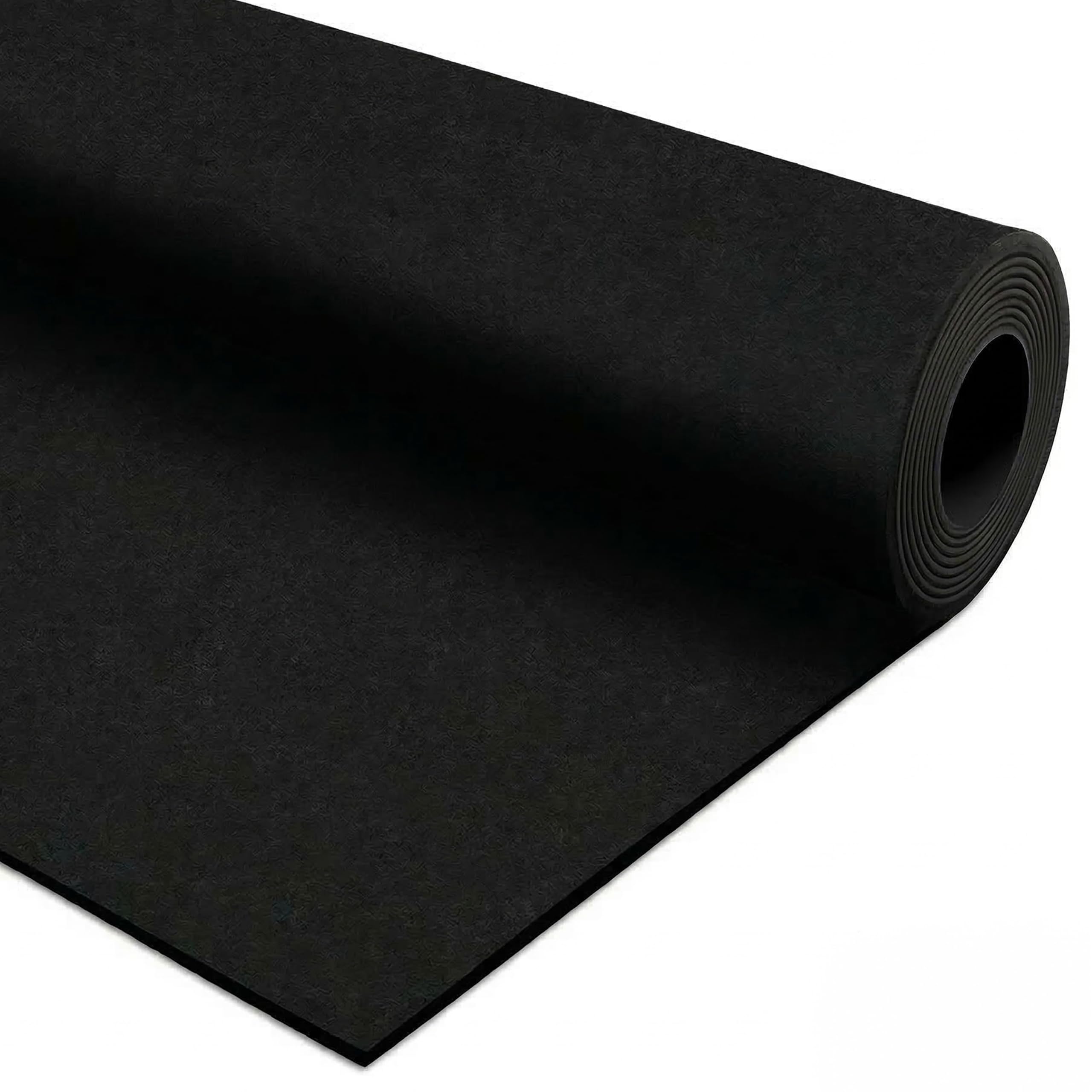
Nine millimeters is the number that matters here. The American Floor Mats roll is the thickest in this group, and that extra rubber is what lets it sit under a rack or a pair of dumbbells without feeling like a cosmetic skin over concrete. We noticed the density before we noticed anything else: it stays put, takes a dropped load with a dull thud rather than a slap, and does not slide when you push a bench across it. The 4 x 8 ft size is a sensible building block, too. One roll covers a platform or a rack footprint; two side by side make an 8 x 8 ft gym floor with a seam down the middle.

The surface is solid black and non-slip, not a diamond plate, so it is easier to sweep and less likely to hold chalk dust in a texture. We liked that it is heavy enough to lie flat without adhesive on a smooth garage slab. It is also heavy enough that positioning it alone is awkward; have a second person for the initial unroll.

The trade-off is coverage and cost. At 32 sq ft per roll, this is not the product for covering a two-car garage, and it costs more per square foot than the thinner utility rolls here. For a home gym, though, that is the right place to spend: the floor is the piece you cannot easily upgrade later without moving everything. This is the one we recommend for a rack, a lifting platform, or a cardio corner. For the walkway around it, a cheaper thin roll makes more sense.

Bottom Line

Our top pick for a home gym: the 9 mm rubber protects concrete under racks and dumbbells, and the 4 x 8 ft size is easy to plan around.

Check Latest Price

Best Value for Home Gyms

Our Score 9.0/10
Rubber-Cal Elephant Bark Roll

Rubber-Cal

Rubber-Cal Elephant Bark Roll

  • Surface Solid black; UV- and water-resistant
  • Material Recycled rubber
  • Roll Size 4 x 8 ft
  • Thickness 3/16 in (0.19 in)
Check Price on Amazon

A lighter, cheaper 4-by-8 roll that still handles cardio and moderate lifting.

Half the thickness of our top pick sounds like a compromise until you see what it buys. The Elephant Bark roll is a 4 x 8 ft sheet of recycled rubber at 3/16 inch, and it is the value choice in this group for a home gym that is mostly cardio and moderate weights. At 31 pounds, it is manageable for one person to unroll and shift, which is not true of every roll here. The surface is solid and non-slip, with enough give to soften a treadmill or a bike without feeling spongy under a bench.

We think it is the right first floor for a lot of garages. It handles a bench, dumbbells, and a rowing machine, and the recycled rubber is UV- and water-resistant, so it can move to a patio or basement if your plans change. The 3/16-inch thickness is the limit: for heavy deadlifts or a rack, we want the 9 mm American roll or a proper platform. Cutting is straightforward with a sharp blade and a straightedge, though the factory edges can be a little uneven, so measure twice and trim if you need a clean seam.

What we appreciated most is how little fuss it adds to a room. It does not need adhesive to stay put on a dry slab, and it sweeps clean without a special cleaner. The rubber odor is present when you first unroll it, as it is with the other rubber rolls here; give it time in a ventilated space before bringing it into a sealed room. For the money, it covers the middle ground between a thin utility mat and a dedicated lifting floor.

Bottom Line

We recommend this as the value home-gym roll when cardio and moderate dumbbells are the main load and you want a lighter, easier-to-handle 4 x 8 ft sheet.

Check Latest Price

Best Large-Coverage Garage Roll

Our Score 9.0/10
VEVOR Diamond-Plate Garage Roll

VEVOR

VEVOR Diamond-Plate Garage Roll

  • Coverage 100 sq ft
  • Material SBR rubber
  • Roll Size 4 x 25 ft
  • Thickness 3 mm (0.12 in)
Check Price on Amazon

A 100-square-foot rubber roll for parking bays, trailers, and workshop floors.

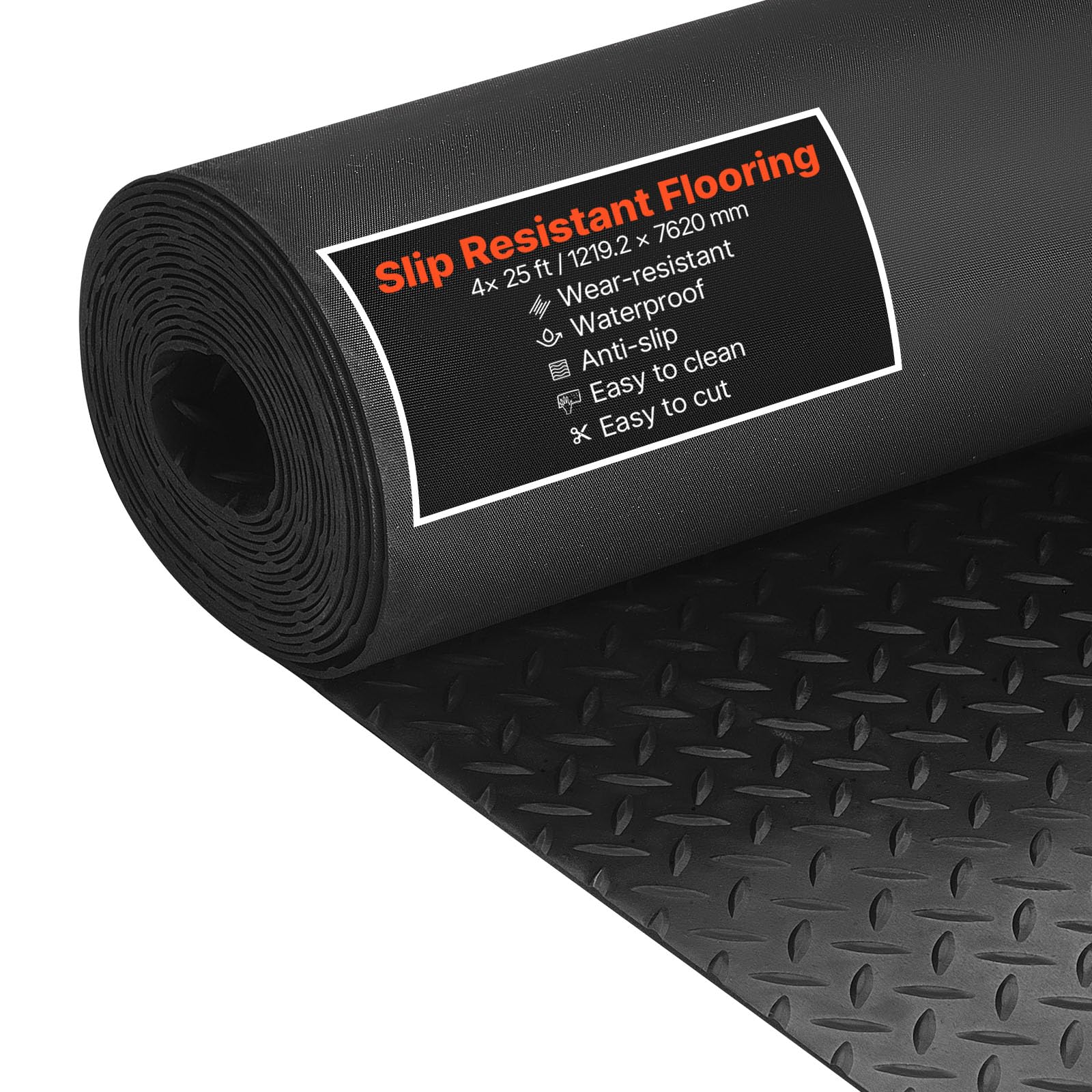
A 4 x 25 ft roll changes what you can cover in one go. The VEVOR diamond-plate mat gives you 100 sq ft in a single piece, which is enough for a parking bay, a trailer floor, or a long workshop aisle without piecing together several smaller mats. At 70.6 pounds, it is a two-person rollout if you are trying to keep the edges straight. The raised diamond pattern gives boots and gear something to grip, and it lets you slide a storage bin or a jack across the surface without it digging in.

The 3 mm thickness is the catch. This is a protective skin for concrete, not a lifting surface: it will keep oil, dirt, and light impact off the slab, but a dropped dumbbell will still find the floor underneath. The long roll can also arrive with memory from the packaging, and both ends may curl until they relax. Plan to let it sit in the sun or a warm garage before taping the edges.

For a garage or trailer, we think the coverage is the whole point, and the VEVOR delivers it at a price that makes a full bay feel practical. It is not the roll we choose for a home gym with free weights, and the rubber smell is noticeable at first. But if your goal is to keep a concrete floor clean and give a parked car or a workshop aisle a non-slip surface, this is the large roll we choose when you want a heavier rubber feel than the PVC mat offers.

Bottom Line

Choose this when you need to cover a garage bay or trailer in one piece and can accept a thin protective skin rather than a lifting surface.

Check Latest Price

Best Budget Utility Roll

Our Score 8.8/10
Rubber-Cal Diamond-Plate Utility Roll

Rubber-Cal

Rubber-Cal Diamond-Plate Utility Roll

  • Surface Diamond plate
  • Material Synthetic rubber
  • Roll Size 4 x 7 ft
  • Thickness 3 mm (0.12 in)
Check Price on Amazon

Grippy diamond-plate rubber for treadmill mats, van floors, and small utility areas.

This is the roll we reach for when the job is a treadmill mat or a van floor, not a gym floor. The Rubber-Cal Diamond-Plate roll is 4 x 7 ft and 3 mm thick, with a raised diamond pattern that gives it more grip than a smooth utility mat. We liked that it is small enough to handle alone and flat enough to lay down without adhesive on a dry surface. At 28 sq ft, it covers a treadmill, a bike, or the back of an SUV without much waste.

The diamond texture is the useful part. It gives shoes and gear something to catch, and it hides scuffs better than a smooth black sheet. The 3 mm rubber is enough to keep a floor dry under a treadmill or protect a van bed from sliding cargo, but it is not impact protection. A dropped dumbbell will compress it and hit the concrete underneath. For a home gym, we treat this as a walkway or equipment mat, not the lifting surface.

Cutting and taping are simple: a sharp utility knife and double-sided tape are enough for most jobs. The rubber smell is strong when it first comes out of the roll, so unroll it in a garage or outside before bringing it into a small room. What we like most is the flexibility of the size. It is the roll we keep for odd jobs, and it earns its place because it does them without pretending to be a heavy gym floor.

Bottom Line

We like this as a budget utility roll for a treadmill, van floor, or small workshop; it is too thin to be your lifting floor.

Check Latest Price

Best For Full garages

Our Score 8.8/10
Grandroad 8x20 Garage Floor Mat

Grandroad

Grandroad 8x20 Garage Floor Mat

  • Coverage 160 sq ft
  • Material PVC rubber
  • Roll Size 8 x 20 ft
  • Thickness 2.8 mm
Check Price on Amazon

An 8 x 20 ft mat is less about a gym and more about covering a parking bay in one shot. The Grandroad roll gives you 160 sq ft of 2.8 mm PVC rubber, enough for a two-car garage or a long workshop aisle without seams every few feet. The diamond pattern is the same idea as the thinner utility rolls: it gives tires and boots something to grip and hides the dust that collects on a garage floor.

We think it is a practical cover for a garage that needs protection from parked cars, drips, and light workshop traffic. It rolls out quickly, cuts with a utility knife, and the included tape helps keep the edges down. The 2.8 mm thickness is the limit: this is not a floor for dropped weights, and it can tear or compress under sharp, heavy objects. Some rolls also arrive reluctant to lie flat, so give it time to relax before taping the perimeter.

The appearance is better than a bare concrete slab, and the surface wipes clean after oil or road salt. What it does not do is add much cushioning or sound deadening to a gym. If you are parking on it, covering a trailer, or protecting a garage floor from winter mess, the size is the reason to buy. If you are lifting on it, step up to a thicker rubber roll.

Bottom Line

We recommend this for covering a full garage floor or parking bay in one piece; it is a protective mat, not a gym floor.

Check Latest Price

Best 1/4-Inch Gym Roll

Our Score 8.6/10
IncStores 1/4-Inch Tough Rubber Roll

IncStores

IncStores 1/4-Inch Tough Rubber Roll

  • Surface Solid black, shock-absorbing
  • Material Recycled rubber
  • Roll Size 4 x 10 ft
  • Thickness 1/4 in
Check Price on Amazon

A middle-weight roll that softens dropped weights without the bulk of stall mats.

A quarter inch is the middle ground between the thin utility rolls and the 3/8-inch gym floor. The IncStores Tough Rubber Roll is 4 x 10 ft, so one piece gives you 40 sq ft, enough for a rack, a bench, or a small lifting area without a seam in the middle. The recycled rubber has a dense, shock-absorbing feel, and it is thin enough that a bench rolls over the edge rather than catching.

We appreciated the five-year warranty and the made-in-USA construction, but the factory cuts are not always square. Measure and trim carefully before laying a seam, and leave yourself a margin at both ends. The 1/4-inch thickness softens dropped dumbbells and protects the floor under a rack, but it is not a substitute for a proper lifting platform under heavy deadlifts.

For a home gym that needs more than a thin equipment mat but does not want the full 9 mm build, we think this is the most useful compromise in the group. It is easier to handle than the thickest roll, covers a longer strip, and still has enough density to take a dropped weight without bottoming out immediately. It is a solid middle option as long as you measure the delivered roll before you cut.

Bottom Line

A solid middle option for a home gym: 1/4-inch rubber covers 40 sq ft and softens dropped weights, though the listed length can run short.

Check Latest Price

How We Tested a Dozen Rubber Flooring Rolls

We started with roughly 40 rolls sold in the U.S. and narrowed them by reading spec sheets closely — overall thickness versus wear layer, roll width and length, whether the listed price was per square foot or per roll, and whether the rubber was virgin or recycled. Then we ordered 12 and put them down where this flooring actually lives: under a squat rack in a basement gym, beneath a workbench in a garage, just inside a back door, and in the corner of a laundry room where the dog gets toweled off. Testing ran six months.

Flatness came first, because a roll that won't lie down is useless. We unrolled each one, weighted the corners, and checked the edges every morning for the first week; some relaxed overnight, others still had two inches of curl after seven days. We measured thickness with calipers at five points across each roll and dropped a 25-pound plate from waist height to see whether it left a lasting dent. Odor got the sniff test on day one, day three, and at the two-week mark, in a closed room with the door shut for an hour.

For grip, we walked each surface in socks and with wet hands after a set, then tried a fast lateral push off the ball of the foot. Cleaning was coffee spilled and left to sit, a dusting of chalk, and a week of accumulated dog hair, cleared with a damp mop, a little dish soap, and a shop vac. We trimmed every roll around a doorframe and a floor drain with a utility knife, noting which ones cut in a single clean pass and which ones dragged or frayed at the edge, then dragged a bench across each surface and looked for scuffs and color shift. Price per square foot went on the same sheet as all of it, because value here is not the sticker alone.

How to Choose

Match Thickness to the Load

Thickness is the first decision because it sets what the roll can absorb. A 2.8 mm or 3 mm roll is a protective skin: it keeps oil, dirt, and light foot traffic off concrete, but it will not cushion a dropped dumbbell. A 1/4-inch roll is the middle ground for a bench and moderate dumbbells. A 3/8-inch roll is what we choose under a rack or a lifting platform. If you plan to park on the floor, thin is fine; if you plan to lift on it, buy thickness before coverage.

Measure Coverage and Plan the Seams

Rolls come in widths from 3 to 8 ft and lengths from 7 to 25 ft, so square footage alone can mislead. A 4 x 8 ft roll makes a clean module: one covers a rack, two side by side make an 8 x 8 ft area. A single 8 x 20 ft roll covers a garage bay but is awkward to move and trim. Measure the room, then decide where seams land; a seam under a rack is less noticeable than one in a walking path. Nominal lengths can run short, so measure the delivered roll before cutting.

Choose Rubber, SBR, or PVC for the Room

Most rolls here are rubber, recycled rubber, SBR, or PVC. Rubber and recycled rubber are the better choice for a gym because they are denser and more forgiving underfoot. SBR is a common garage and trailer material: tough, water-resistant, and usually thinner. PVC is light and easy to clean, which suits a parking pad or a workshop, but it is not the surface we choose for dropped weights. For outdoor use, look for UV and water resistance; for an indoor room, check the maker's care instructions.

Get the Roll Flat Before You Tape It

New rolls arrive with memory from the packaging. Unroll the mat in a warm space, let it relax, and only then trim or tape the edges. Curled ends are a trip hazard, especially at a garage threshold, so keep them out of walkways until they settle. Double-sided tape is enough for most home installations; adhesive is for a permanent floor or a seam that sees traffic. Cut with a sharp blade and a straightedge, and leave a little margin on each end.

Frequently Asked Questions

Final Verdict

For most home gyms, we recommend the American Floor Mats 3/8-inch roll first. The 9 mm thickness is the difference between a floor that protects concrete and a mat that merely covers it, and the 4 x 8 ft size builds a sensible platform without forcing you to buy a whole garage's worth. It costs more per square foot; that is the trade for density.

If the budget is tighter, the Rubber-Cal Elephant Bark roll is the value choice for cardio and moderate weights. If you are covering a parking bay or trailer rather than lifting on it, the VEVOR 4 x 25 ft roll gives you the coverage in one piece. Accept that it is a protective skin, not a lifting platform.