How Thick Should Gym Flooring Be? Choose by Impact, Not Equipment Weight
The short answer: use 6 to 8 mm dense rubber for cardio machines and light training, 8 to 13 mm for general strength work with controlled weights, and 13 to 18 mm rubber or a designed platform for heavier free-weight zones. Repeated Olympic lifting and intentional drops may need 18 to 25 mm or a tested impact system, depending on drop height, load, subfloor, and manufacturer guidance.
Thickness is only one variable. Rubber density, construction, seams, support, subfloor strength, and how weights meet the floor can matter as much as the nominal measurement.
Gym Flooring Thickness by Training Zone
These ranges are conservative starting points for dense fitness-grade rubber. Confirm the flooring maker's application rating and the equipment maker's installation rules before buying.
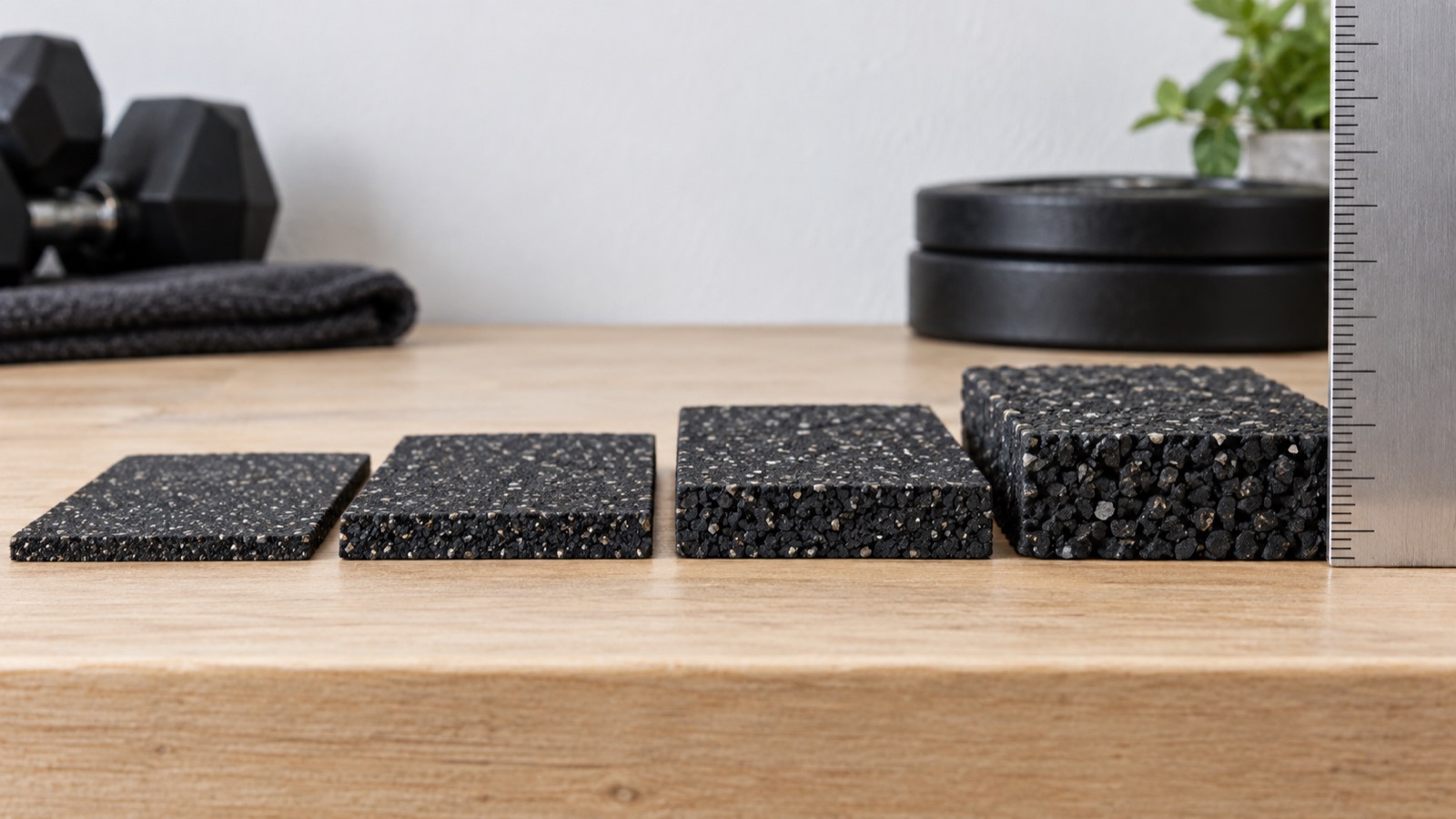
| Training zone | Starting thickness | What it is designed to handle | Important limit |
|---|---|---|---|
| Mobility, bodyweight, and light cardio | 6–8 mm (about 1/4–5/16 in) | Foot traffic, exercise bikes, rowers, and controlled light equipment | A machine mat protects finishes but does not correct a weak or uneven subfloor |
| General home strength | 8–13 mm (about 5/16–1/2 in) | Racks, benches, selectorized machines, dumbbells placed down under control | Thin roll flooring is not a drop platform |
| Heavy free-weight zone | 13–18 mm (about 1/2–3/4 in) | Heavier dumbbells and barbells with stricter impact control | Match the product's tested use; add a platform when the lift or floor requires it |
| Repeated barbell drops or Olympic lifting | 18–25 mm (about 3/4–1 in) or engineered layered system | High-impact zones designed around bumper plates and controlled drop practices | Get product-specific and structural advice; more rubber alone does not protect every building |
| Children's fall protection | Not determined by this chart | Play areas use critical-fall-height standards and tested assemblies | Do not substitute gym-floor thickness guidance |
Why These Ranges Are Starting Points
Commercial manufacturers divide products by use rather than giving one universal home-gym answer. PLAE currently identifies 8 mm flooring for cardio and lighter training, 13 mm for general strength and multi-use zones, and 18 mm for Olympic, powerlifting, and heavy free-weight areas. REGUPOL sells multipurpose rolls from 1/4 to 3/4 inch and states that heavier, higher-impact training may justify thicker flooring. Its dedicated drop-zone material is available from 3/8 to 1 inch.
Those specifications support a use-based range, but they do not make products interchangeable. An 18 mm dual-layer commercial system and an 18 mm low-density puzzle mat can behave very differently.
Match the Flooring to the Subfloor
Identify what is beneath the finish floor before choosing rubber.
| Subfloor | What to check | Typical approach |
|---|---|---|
| Concrete slab | Moisture, cracks, flatness, drainage, and indoor-use requirements | Dense rubber can protect the surface; high-impact lifting may still benefit from a platform or tested drop tiles |
| Wood-framed ground floor | Joist direction, span, condition, bounce, and concentrated loads | Distribute the lifting zone and obtain structural advice for heavy racks, plates, or repeated drops |
| Upper floor or apartment | Building rules, structural capacity, vibration paths, neighbors, and egress | Avoid assuming thick rubber makes barbell drops acceptable; use controlled training and professional review |
| Finished wood, vinyl, or laminate | Staining, plasticizer migration, trapped moisture, and warranty | Use a flooring system approved for direct contact or add a compatible barrier specified by the floor maker |
| Carpet | Compression, rocking, seams, moisture, and anchoring | Do not build a heavy lifting setup on a soft, unstable stack; expose or prepare a firm base where permitted |
Zone the Room Instead of Making Every Inch Extra Thick
A practical home gym often needs two surfaces: thinner continuous rubber under cardio and mobility work, and thicker tiles or a platform only where free weights may contact the floor. This reduces cost, limits height transitions, and makes damaged impact tiles easier to replace.
- Keep doors, drains, vents, and emergency paths clear.
- Use beveled transitions or trim where flooring height changes.
- Place seams away from rack feet, bench paths, and the point where plates land.
- Do not cover anchor locations blindly. Some rack instructions require the feet to anchor directly to the structural floor rather than through rubber.
- Re-level cardio machines and benches after flooring is installed.
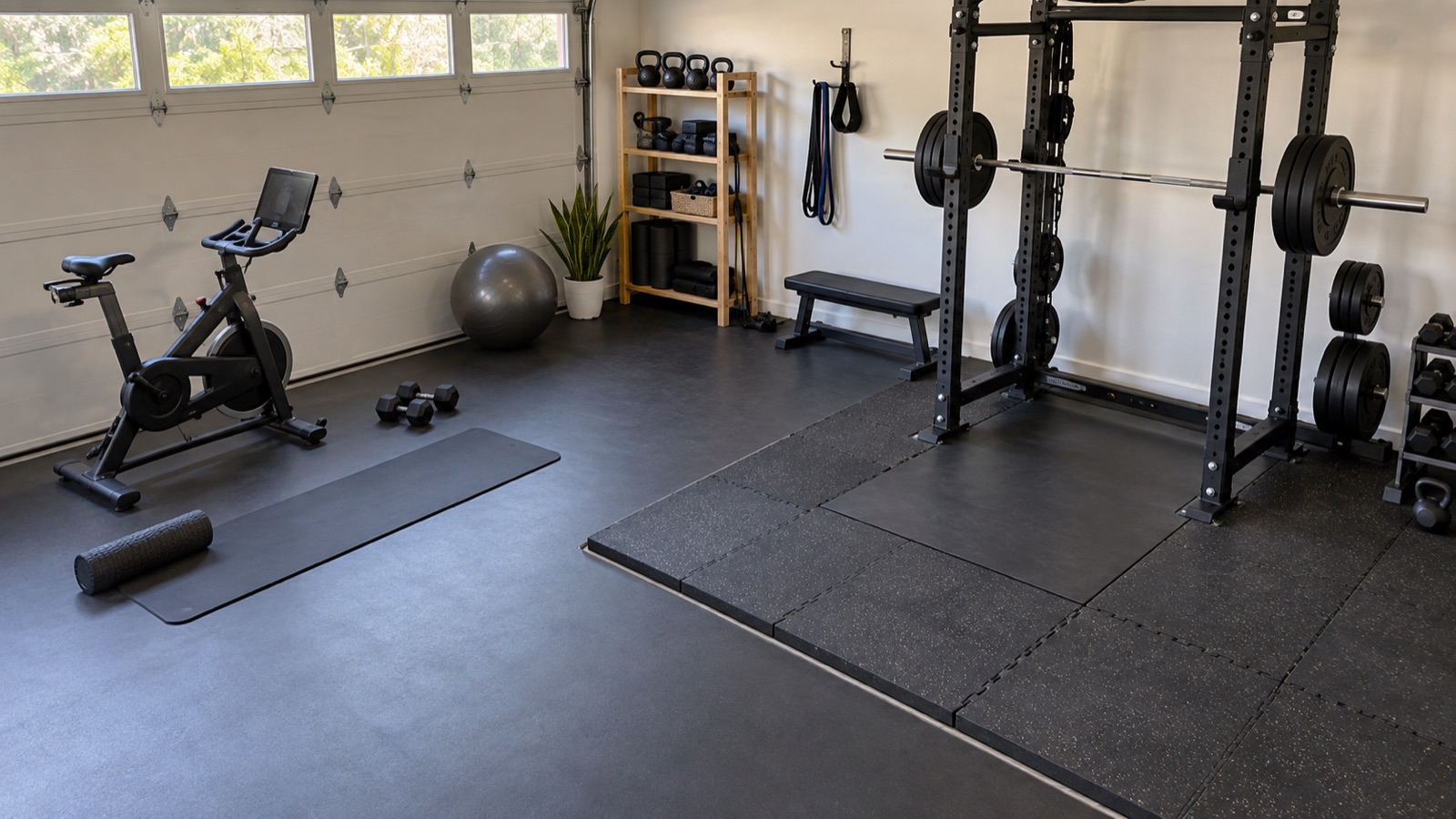
Rolls, Tiles, Mats, and Platforms
- Rubber rolls: fewer seams and efficient wall-to-wall coverage; installation and adhesive requirements matter.
- Interlocking tiles: easier for a removable zone and individual replacement; poor seams can lift or separate.
- Equipment mats: useful under a bike, rower, or treadmill when they fully support the machine; not a substitute for room-wide lifting protection.
- Impact tiles: thicker systems designed for weight contact; verify drop rating, density, and edge treatment.
- Lifting platforms: spread and manage impact with a designed combination of rubber and rigid layers. Follow a tested design rather than stacking loose scrap materials.
- Foam puzzle mats: comfortable for floor exercise but often too soft under racks, benches, and heavy moving loads.
Six Questions to Ask Before Ordering
- Is the product rated for cardio, general strength, heavy free weights, or repeated drops?
- What are its thickness, density, layer construction, and test data—not just the marketing name?
- Can it be loose-laid, or does the warranty require adhesive and professional installation?
- Is it compatible with the finish floor beneath it, including moisture and staining risk?
- What indoor emissions, fire, slip, and building requirements apply to the room?
- How will edges, seams, rack anchors, doors, and height transitions be finished?
Order a sample before committing to a full room. Check odor, surface grip, edge quality, compression under a bench foot, and whether the material marks the existing floor.
Sources and Manufacturer Guidance
Requirements can vary by product, model, and situation. These primary sources informed this guide; official instructions for your exact product and current authoritative guidance take priority.
- PLAE Achieve Rubber Flooring: 8 mm, 13 mm, and 18 mm applications
- PLAE Forge Rubber Flooring: 12 mm specifications
- REGUPOL Aktiv Flooring: thickness options and impact guidance
- REGUPOL Crash Drop Zones: 3/8-inch to 1-inch options
- Rogue Power Platform: 3/4-inch impact-zone construction
- Rogue Rack Installation Instructions: anchoring through rubber flooring
Frequently Asked Questions
-
It is a reasonable starting point for cardio, general exercise, and controlled light strength work on a sound subfloor. It is not automatically sufficient for heavy dumbbell or barbell drops.
-
Three-quarter-inch dense rubber is common in heavy strength zones, but suitability still depends on load, plates, drop height, frequency, flooring construction, and subfloor. Repeated drops may require a purpose-built platform or tested impact system.
-
Rubber can protect the finish and improve grip, but follow the rack's anchoring instructions. Some manufacturers recommend cutting rubber away so rack feet anchor directly to the structural floor.
-
Soft carpet and pad can let tiles, benches, and racks rock or separate. A heavy gym needs a firm, level base; confirm the building and flooring requirements before layering over carpet.
-
It may reduce some impact and vibration, but structure-borne noise depends on the building assembly. Rubber cannot guarantee sound isolation or make weight drops suitable for an upper floor.