Massage Gun Attachment Guide: Choose by Contact Area and Pressure
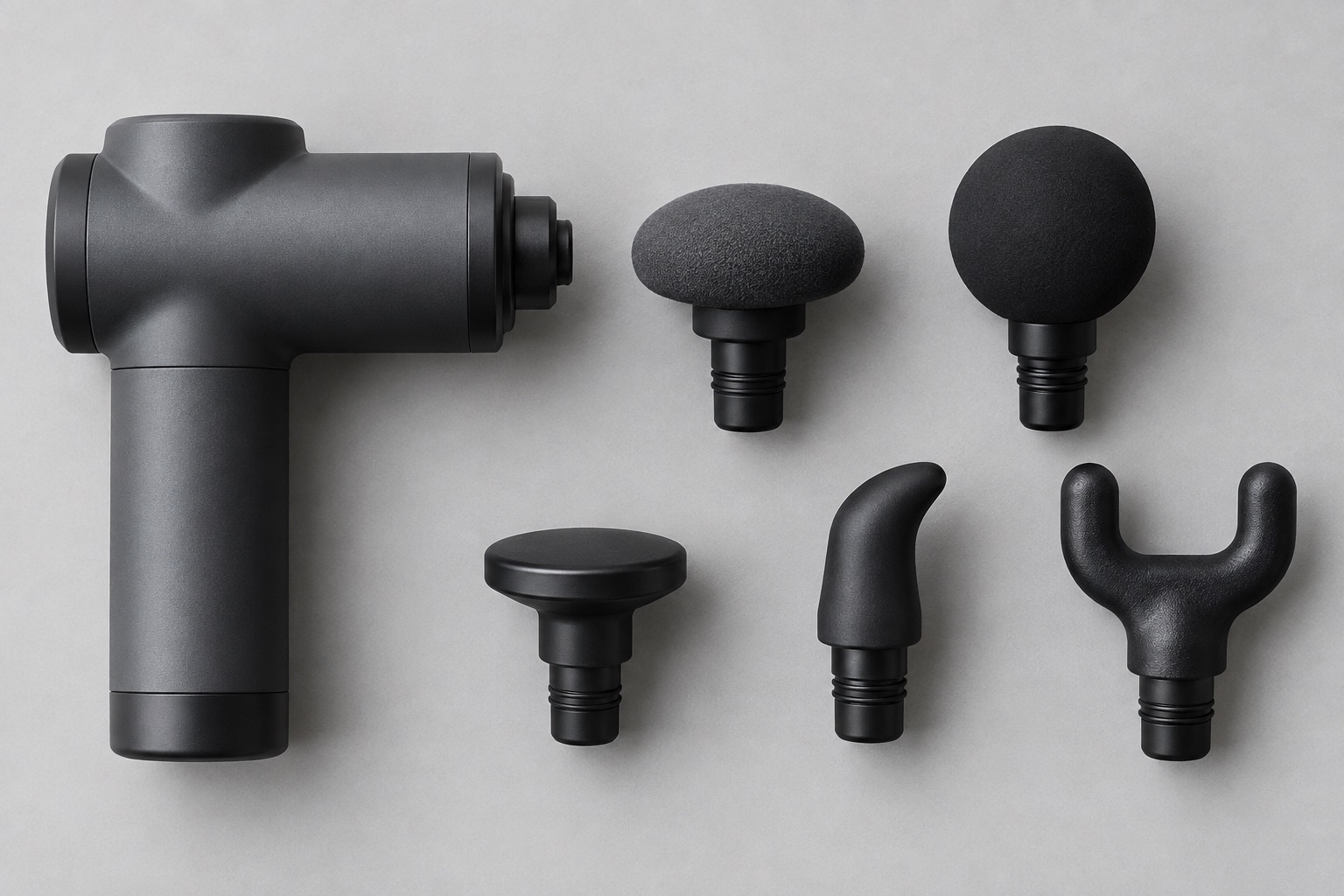
The broadest, softest attachment is the safest starting point for general use. A smaller or harder head concentrates force into less area, so it requires more precise placement and less added pressure. Attachment names and materials are not standardized. “Ball,” “dampener,” “cushion,” “thumb,” and “fork” can differ significantly by manufacturer.
Use only attachments approved for your exact device, power the unit off before changing them, and follow its body-area restrictions. A different head does not make an unsafe location safe.
Common Massage Gun Attachments Compared
| Attachment | Contact pattern | Reasonable starting use | Main caution |
|---|---|---|---|
| Cushion or dampener | Broad and compliant | Beginners, general passes, and tender soft tissue when the manual allows | Tender does not mean injured; still avoid bruises, wounds, bones, and prohibited regions |
| Round ball | Broad with moderate give | General use on quads, glutes, hamstrings, calves, and other large muscles | Foam density varies; reduce pressure if it bounces or feels sharp |
| Flat disc | Broad, firm, and even | Dense large muscle areas where the manual recommends a firmer surface | Hard material transfers more force and is uncomfortable near bone |
| Thumb-shaped head | Small rounded point | Localized pressure on approved soft tissue | Concentrated force can create pain or bruising quickly |
| Bullet or cone | Smallest point | Only model-approved precise applications with minimal pressure | Easiest head to misuse over nerves, vessels, feet, or bony areas |
| Fork | Two narrow contact points | Manufacturer-approved use on muscle bands while the center gap avoids—not contacts—the protected structure | Never assume it makes direct work over the spine, Achilles tendon, or neck safe |
| Wedge or blade | Long edge for a sweeping contact | Maker-guided flushing or scraping-style motion over approved muscle | Do not scrape skin aggressively or cross joints and bones |
Identify Shape Before Trusting the Name
Compare the actual contact surface, firmness, and connector—not only the product name. Two “ball” heads may use different foam, diameter, and give. A third-party head that fits physically may still alter stroke, balance, ventilation, warranty, or safe operation.
Use a Three-Step Selection Rule
- Choose the tissue area: broad healthy muscle only, unless a clinician and the exact manual direct otherwise.
- Choose the broadest comfortable head: begin with cushion or ball; move to a firmer or smaller head only for a clear reason.
- Lower pressure as contact area shrinks: a thumb or bullet concentrates force, so the same hand pressure does not produce the same sensation.
Test a new attachment on an easy-to-reach large muscle at the lowest setting. Stop if it causes sharp pain, tingling, numbness, bruising, or a change in skin color.
A Conservative Body-Area Map
| Area | Conservative option | Boundary |
|---|---|---|
| Quadriceps and glutes | Cushion, ball, or model-approved flat head | Stop before hip landmarks, kneecap, and joint line |
| Hamstrings | Ball or cushion; flat only if comfortable and approved | Avoid the back of the knee and any radiating nerve sensation |
| Calf muscle belly | Ball or cushion | Do not contact the Achilles tendon, shin, ankle bones, or suspicious swelling |
| Upper back muscle | Self-use is hard to control; use only maker-approved routines | No direct contact on spine, neck, shoulder blade edges, or ribs |
| Forearm muscle | Soft or small round head at low setting | Avoid wrist/elbow joints and obvious nerves or vessels |
| Feet | Only if the device manual specifically permits it | Avoid sharp pinpoint force, altered sensation, bone, and inflamed plantar tissue |
Change and Clean Attachments Safely
- Turn the device off and wait until all movement stops.
- Remove and install the head exactly as the manual shows; connectors may pull, twist, lock, or align with a groove.
- Keep fingers away from the shaft and pinch point.
- Inspect for cracks, loose foam, torn coverings, or a connector that no longer seats fully.
- Clean only with the approved method and dry fully before storage.
For movement, pressure, contraindications, and stop signs, read how to use a massage gun safely.
Sources and Manufacturer Guidance
Requirements can vary by product, model, and situation. These primary sources informed this guide; official instructions for your exact product and current authoritative guidance take priority.
Frequently Asked Questions
-
Start with the broadest soft cushion or round ball supplied for general use, at the lowest comfortable setting on a large healthy muscle.
-
Manufacturers commonly designate it as the general-purpose option for large and small muscle groups. Its firmness and diameter still vary by model.
-
Some makers approve it for muscle bands such as calves, forearms, or muscles beside the spine. Do not let the center gap create false confidence about the spine, Achilles tendon, neck, nerves, or vessels.
-
It concentrates force rather than proving a better treatment. Use it only where the exact manual permits, with very light pressure and no neurologic or vascular symptoms.
-
No. Connector size, locking method, weight, material, and safe operating limits differ. Use only attachments the manufacturer lists as compatible.