Recovery

Best Massage Canes of 2026

A massage cane is a hooked shaft with a knob on the end, and its whole job is to let your own body weight work on a knot your hands can't reach. What separates one that helps from one that ends up in a closet comes down to unglamorous details: whether the curve actually lands between your shoulder blades, whether the grip holds when your palms are sweaty, and whether the shaft keeps its shape when you lean in. Get those right and you've solved the spot you can never quite reach.

I've kept one in my desk drawer for years, and every new one gets the same trial: calves after a run, the knot under my right shoulder blade, the arches of my feet at night. Over the past four months my team and I have worked through 16 canes, from bare wooden hooks to rolling-ball versions. What surprises first-time buyers is that the shape and placement of the knobs matters more than length — one well-placed tip beats four that miss the muscle. The picks below are the ones we kept reaching for, and the most expensive cane wasn't the best one.

Best Overall

Our Score 9.4/10
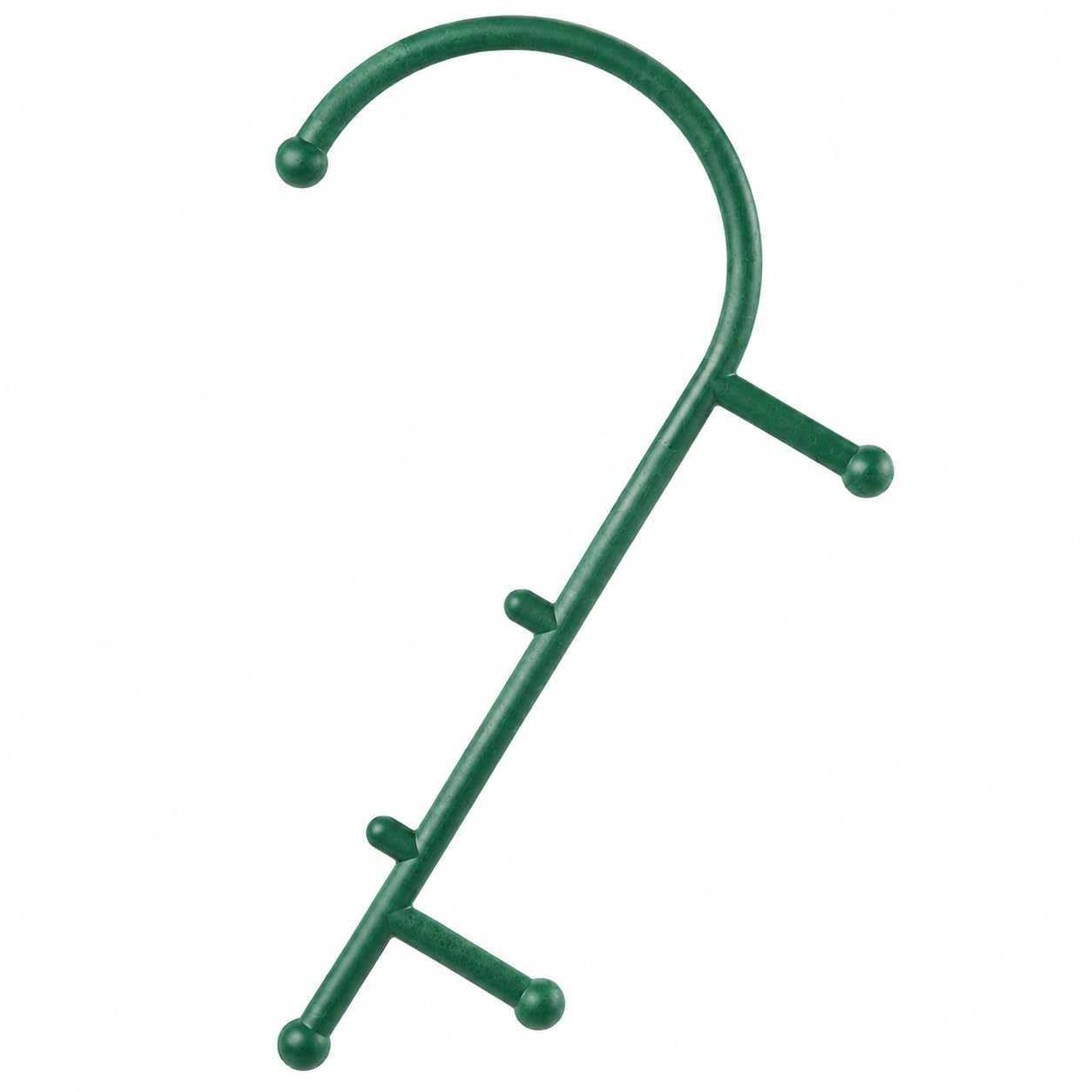
Thera Cane Massager

Thera

Thera Cane Massager

  • Weight About 1 lb
  • Dimensions 24 x 15 x 1 inches
  • Massage Points 6
Check Price on Amazon

Six points and real leverage on a 24-inch frame that reaches the whole back.

Leverage is the reason this one sits at the top. The handles are set at different points along the shaft and the hook, so you can drop your body weight onto a knot instead of pushing with your arm — and that changes how long you can keep going. Canes we had to muscle into place tired out our forearms long before the muscle gave way; this one kept working for the whole session.

The layout is straightforward once you're holding it. Six firm balls sit along a 24-inch frame that's 15 inches across, enough span to get at the shoulder blades, the top of the trapezius and the muscles beside the spine. The big hook takes the upper back and neck, and the smaller points handle the low back and anything else you can angle toward.

Weight mattered more than we expected. At about a pound, the Thera Cane is light enough to hold overhead for a few minutes without your shoulder burning, which isn't true of everything here. Pressure control is where it earns its keep: you dial from a light nudge to a deep hold by changing which handle you're using and how far you lean.

The catch is the one-piece frame. Twenty-four inches of rigid plastic doesn't collapse into a carry-on, and that's the only reason the MAX appears further down this list. If the cane lives at home, the extra reach and the six-point layout make the original the one we reach for.

Bottom Line

We recommend the Thera Cane to anyone who wants one tool for the whole back and neck: six points, genuine leverage, and a 24-inch span that reaches what your hands can't.

Check Latest Price

Best for Travel

Our Score 9.4/10
Thera Cane MAX

Thera

Thera Cane MAX

  • Pieces Three, packable
  • Weight 1.1 lb
  • Dimensions 15 x 1 x 24 inches
  • Massage Points 7
Check Price on Amazon

The full-size Thera Cane shape in three pieces that pack into a duffel.

Three pieces is the whole idea. The Thera Cane MAX separates into an upper section, a lower section and a threaded link ball, and no single part is long enough to fight a duffel. For anyone who has tried to pack a 24-inch hook, that's the feature the decision turns on.

What you keep is the original's geometry. The curved hook, the leverage handles and the 24-inch reach all carry over, and the MAX adds a seventh pressure point where the halves meet — the link ball threads in and doubles as a firm contact point near the spine. At about 1.1 pounds it's still light enough to hold overhead without your shoulder complaining.

The trade-off is that joint. Every session starts with threading it together, and the frame gives a touch more at that link than a single-piece cane does. Neither bothered us much — it stayed solid under real pressure — but it is one more thing to check before you lean in.

Which is why this is the one that leaves the house. Desk drawer at work, duffel for a weekend, the outside pocket of a checked bag: a cane you can break down gets used more often than one that stays in a closet, and this gives up nothing in reach to get there.

Bottom Line

If your cane needs to travel, the MAX delivers the Thera Cane's reach in three packable pieces, and the extra joint costs you almost nothing in use.

Check Latest Price

Best Simple Design

Our Score 9.4/10
Backnobber II

Backnobber

Backnobber II

  • Pieces Two, breaks down
  • Weight 1 lb
  • Dimensions 24 x 13 x 1 inches
Check Price on Amazon

A hook, a handle and firm tips — nothing to learn, nothing to adjust.

There's nothing to adjust, nothing to learn and very little to break. The Backnobber II is a hook, a handle and two firm ends, and that's precisely why it's the one that stays out on the desk. Place the tip on the knot, lean, breathe. The less hardware a cane carries, the less there is to think about while you're trying to get a muscle to let go.

It separates at the middle for travel, which is more useful than it sounds — the two halves lie flat in a laptop bag, and reassembly is a firm push until it seats. Twenty-four inches long and about a pound, it gives you the same reach as the full-size canes, and the shape is simple enough that you find a spot by feel rather than by mirror.

Two things give us pause. That middle joint can work loose if it isn't fully seated, so check it before you lean hard. And it's priced alongside canes carrying far more hardware, which makes a plain plastic hook feel steep — though the flip side is a design with almost nothing to fail.

Bottom Line

The simplest tool here and the one we leave within reach: the Backnobber II applies firm, direct pressure with nothing to figure out, and it splits for a bag.

Check Latest Price

Best One-Piece Build

Our Score 9.4/10
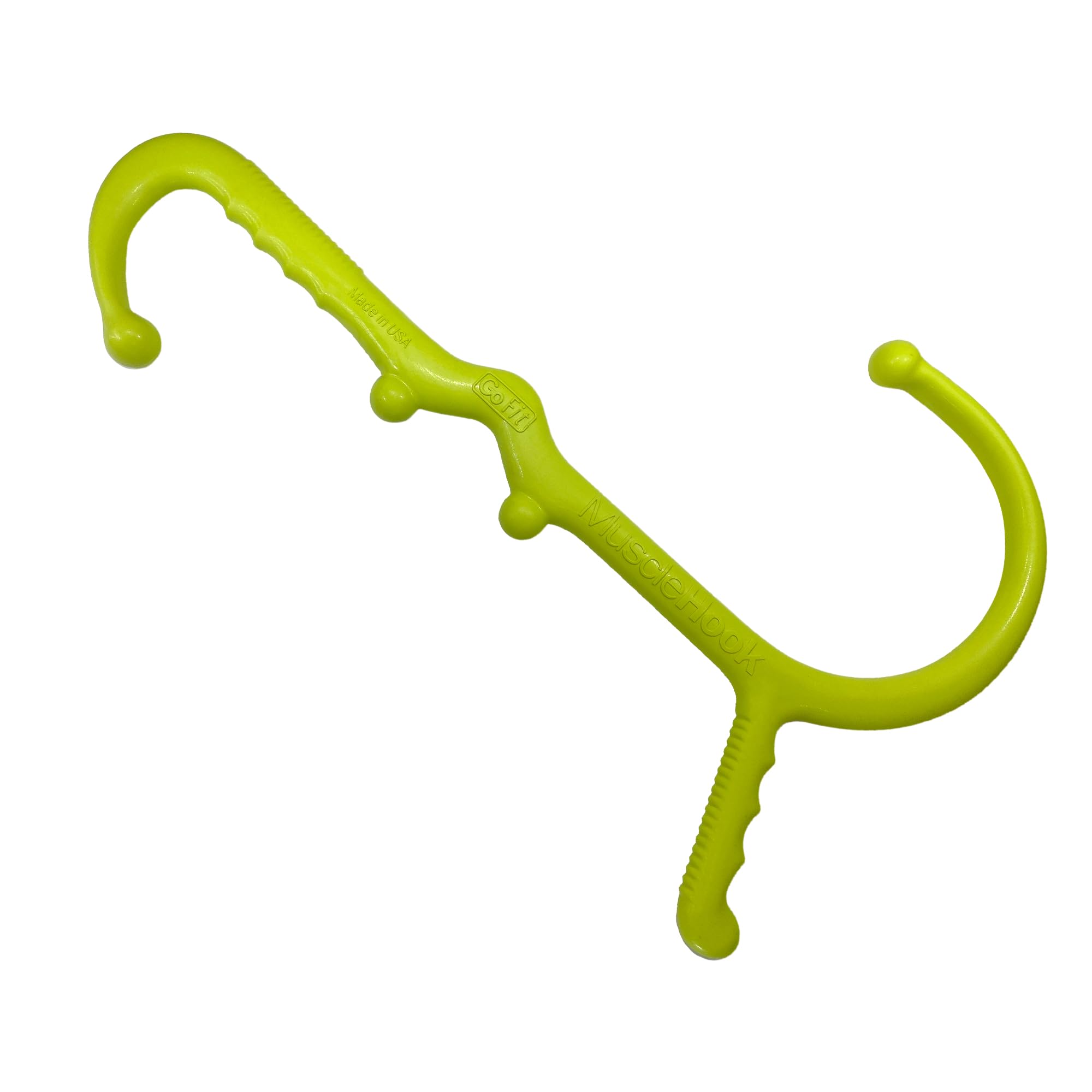
GoFit Muscle Hook Cane

GoFit

GoFit Muscle Hook Cane

  • Weight 2.09 lb
  • Dimensions 1.5 x 23 x 14 inches
  • Construction One-piece urethane
Check Price on Amazon

One-piece urethane that won't flex when you lean your weight into a knot.

Two pounds of urethane is a lot for a massage tool, and it's the first thing you notice picking it up. It's also the entire point: this is molded as a single piece, with no joint, no snap fitting, and enough stiffness that leaning your shoulder into it doesn't make the hook give.

That rigidity is what we liked most. Some canes flex under a hard push and you lose the pressure right where you wanted it; this one sends it straight through to the tip. The ergonomic grip stays put in a sweaty hand, and the urethane body has a dense, solid feel that reads as built for repeat use rather than a season of it.

The molding is a little rough — there's a seam line you can feel on bare skin, so plan to work over a shirt. The weight is the bigger consideration: at 2.09 pounds it's the heaviest cane here, which suits short, hard sessions on a specific knot better than a slow twenty-minute sweep across the whole back.

Bottom Line

When you want to lean your whole weight into a knot, the GoFit's one-piece urethane won't flex or split, and that stiffness is worth the extra heft for hard, short sessions.

Check Latest Price

Best Multi-Point Coverage

Our Score 9.2/10
Body Back Buddy Elite

Body

Body Back Buddy Elite

  • Weight 1.21 lb
  • Dimensions 25 x 16 x 1 inches
  • Knob Shapes 3
  • Massage Knobs 11
Check Price on Amazon

Eleven knobs in three shapes and two hooks for the most adaptable coverage.

Eleven knobs, three profiles, two hooks. If you've ever found that the knot in your shoulder wants a different kind of pressure than the one in your low back, the Body Back Buddy Elite is the cane that gives you the choice — the firmer points dig in, the rounder ones glide, and you switch by rotating the tool rather than hunting for another gadget.

The two-hook shape is the part we came to appreciate most. Working one side of the back and then the other usually means flipping the cane end for end; with hooks at both ends you just change hands. The comfort grip handle is a small thing until minute eight of a stubborn knot, and the numbered knobs are genuinely useful when you want to come back to the one that worked.

One thing to know before you buy: the body is injection molded and the seam along the edge isn't smoothed off. Work over a shirt and you'll never notice it; work it directly on bare skin and it can drag. That's a small accommodation for the most versatile cane in this group, and we'll take the knob variety over a smoother edge every time.

Bottom Line

For a back with several different kinds of knots, the Elite's eleven knobs in three shapes make it the most adaptable cane here, and the two hooks save you from flipping it around.

Check Latest Price

Best for Smaller Frames

Our Score 9.2/10
LiBa Deep Tissue Massager

LiBa

LiBa Deep Tissue Massager

  • Material BPA-, PBDE-, TBBPA-free
  • Water Use Shower-safe
  • Dimensions 14.5 x 10.25 x 1.4 inches
Check Price on Amazon

Compact, shower-safe and light in the hand, with a two-piece frame for travel.

LiBa builds this one without BPA, PBDE or TBBPA and says it's safe in water, which sounded like label decoration until we thought about where a massage tool actually lives — bathroom shelf, gym bag, the ledge of a shower. A cane that shrugs off damp is one less thing to fuss over.

The shape is the real argument. At roughly 14.5 by 10.25 inches it's the most compact full-featured cane here, and the shorter span makes it easy to steer one-handed when you're aiming at something you can't see. Of the group, this is the one we hand to smaller frames and to anyone working in a tight spot beside a desk or a car seat.

It separates into two halves for storage or a bag, and those halves need a firm push to seat fully — do it before you start rather than halfway through a session. Reach is where the compact frame asks for something back: it gets to the upper back and neck comfortably, though a full-length cane gives you more to work with lower down.

Bottom Line

The LiBa is the compact, budget-friendly cane we hand to smaller frames and tight spaces: it steers easily, splits in two for a bag, and doesn't tire your arm.

Check Latest Price

Best Budget Full-Size

Our Score 9.2/10
Ranarose Massage Cane

Ranarose

Ranarose Massage Cane

  • Pieces Two
  • Warranty 3 years
  • Dimensions 14.7 x 1.2 x 24.2 inches
  • Massage Nodes 8
Check Price on Amazon

Eight nodes, full-size reach and a three-year warranty at the budget end.

A three-year warranty is unusual on a piece of molded plastic you're meant to lean your body weight on, and Ranarose is the only cane here that states one. It tells you how the company expects the two-piece joint to hold up, and it means a failed connection is their problem rather than yours.

The rest of the package is conventional but well chosen: eight nodes across a two-sided frame measuring about 24 inches long, so you get full-size reach without premium-cane money. At around a pound it's easy to hold overhead, and it separates into two pieces for storage between sessions.

The span is the thing to think about. A 24-inch hook assumes a certain amount of reach, and shorter users can find it barely wraps around to the spot they're after. If you're small through the torso and shoulders, the compact LiBa is the safer pick; at average height or above, this gives you the most cane for the money.

Bottom Line

Ranarose backs a full-size, eight-node cane with a three-year warranty at the budget end of this group, which makes it the low-risk way to find out whether a cane works for you.

Check Latest Price

Best For First-time buyers

Our Score 9.2/10
Cubetoou Trigger Point Cane

Cubetoou

Cubetoou Trigger Point Cane

  • Pieces Two, snap-fit
  • Material BPA-free plastic
  • Dimensions 14.5 x 1.2 x 23.5 inches
Check Price on Amazon

It ships with instructions and a guide to pressure points, which sounds like filler until you're standing in front of a mirror working out which end goes where. Of the canes on this list, this is the one that treats you like a beginner rather than assuming you already know what a trigger point feels like.

The tool itself is a 23.5-inch two-piece frame in BPA-free plastic, so you get close to full-size reach in something that comes apart for a drawer. It snaps together solidly, and the hook-and-handle layout follows the same logic as the rest of this group — a broad curve for the upper back, a handle low enough to steer from.

The frame is rigid enough that small changes in how you lean translate into small changes at the tip, which is what you want when you're hunting one knot rather than mashing an area. It's the newest design here, and that's the honest reason it sits below the Thera Cane and the Backnobber rather than beside them.

What it does offer is a complete, full-size cane with written guidance at the bottom of the price range, which is exactly what you want for a first purchase. If a cane becomes part of your week, you'll likely trade up for the reach of the Thera Cane or the simplicity of the Backnobber; if you're testing the idea, this is where to start.

Bottom Line

Cubetoou's cane is the one we point a first-timer toward: a full-size two-piece frame, a guide to where the points go, and a price that makes trying it low-risk.

Check Latest Price

How We Tested the Best Massage Canes

We started with every cane we could find from brands that come up repeatedly among physical therapists, runners, and people who sit at desks all day, then narrowed by construction, curve depth, handle material, and how many contact points each one offered. Anything that felt hollow in the hand or had a grip that slid when our palms were dry was cut before it ever reached a tester. That left 16 canes.

Each one lived with a tester for four months. One stayed in a desk drawer and came out at 3 p.m. when a shoulder tightened; another rode in a passenger seat and got used after long drives; the rest were pressed into calves and arches after runs, hip knots on the living-room floor, and necks during movie nights. We leaned our full weight into each shaft to see whether it flexed or stayed put, noted whether a knob dug into the muscle or skated off it, and checked how the grip held once our hands got warm.

Ease of use got its own set of observations: whether we could find the right spot without a mirror, whether the cane worked one-handed, and whether it survived being tossed in a tote. For quality, we looked for seams, loose end caps, and handles that twisted under pressure, then compared whether the cheapest canes held up as well as the priciest. And because a cane you don't enjoy picking up never gets used, we noted which ones we reached for on a normal Tuesday and which ones we had to talk ourselves into.

How to Choose

Start With Reach, Not Features

Full-size canes run roughly 24 inches long and 13 to 16 inches wide; compact frames like the LiBa come in around 14 inches, which behaves like a different tool. Sit down, reach over your shoulder with your hand, and notice where your fingers stop — the cane has to cover the gap from your grip to that spot. Smaller-framed users often do better with a compact frame, while anyone chasing the mid-back wants the longer span.

The shape of the hook matters as much as the length. A deep curve gets under the shoulder blade and around the trapezius; a shallow one only reaches the surface. Hold a cane up before you buy and picture the curve sitting over your shoulder, not just in your hand.

Leverage Beats Arm Strength

There are two ways to make a cane press: push with your arm or lean with your body. Handles are what make the second one possible, and more of them means more working angles without repositioning the tool. This is why we rate the multi-handle designs above the plain ones for longer sessions — forearm fatigue ends a massage well before the muscle lets go.

Weight cuts both ways. A heavier cane like the GoFit feels planted and needs less effort to steady, but you pay for it after ten minutes with your arm overhead. A cane around a pound is easier to hold in place while you hunt for the exact spot.

Contact Points: Shape Matters More Than Count

The tip is what actually touches you, and its shape decides the sensation. A firm acorn or drop tip concentrates force for a deep, specific hold on one knot. A round ball glides over a broader area and suits a warm-up pass. A double-ball spreads pressure on either side of the spine without pressing on it.

Eleven knobs aren't automatically better than two. A cane with one well-shaped tip you understand will beat a dozen you have to keep choosing between — variety helps only when different parts of your body genuinely need different things.

One Piece or Snap-Together

Two-piece canes pack into a bag and disappear into a drawer; one-piece canes are more rigid and have no joint to think about. The joint is also where these tools fail, so if you go two-piece, seat the halves firmly every time and give the connection a squeeze before you lean your weight into it. If the cane never leaves the house, a single-piece design removes the question entirely.

Frequently Asked Questions

Final Verdict

The Thera Cane is the one we point most people to. Six pressure points on a 24-inch frame, handles that let your body do the work, and a shape that gets between the shoulder blades without help — it answers the reason you searched for a cane in the first place.

Two requirements change the pick. If the cane has to leave the house, take the Thera Cane MAX, which breaks into three pieces and gives up nothing in reach. If you're small-framed or working in a tight space, the compact LiBa steers more easily and costs less.