How to Get Rid of Rubber Mat Smell—and When Not to Ignore It
Start with source control and ventilation: remove packaging, separate loose mats where the product instructions allow, move outdoor air through the room and back outside, and clean once with the manufacturer's approved solution. If the smell is musty, sharply chemical, burning, or linked to symptoms, do not treat it as ordinary new-rubber odor.
There is no honest universal promise that rubber smell disappears in a set number of hours or days. Material, temperature, ventilation, surface area, installation, and individual sensitivity all change the result.
First, Identify the Kind of Odor
Walk through the room with machines switched off and no cleaner or fragrance running. Note when the odor started, where it is strongest, and whether moisture, heat, a spill, or new equipment appeared at the same time.
| Odor pattern | Likely direction | Next action |
|---|---|---|
| Strongest at newly opened rubber, weaker outside the room | New-product emissions or surface residue | Ventilate, separate loose pieces if allowed, and clean as directed |
| Musty, earthy, or worse after rain | Moisture beneath mats, at walls, or in the subfloor | Lift only where safe, find the moisture source, dry, and assess damaged material |
| Localized solvent, fuel, adhesive, or cleaner smell | Spill, incompatible chemical, or installation product | Isolate the source and contact the product maker or installer |
| Hot plastic, burning, or fishy electrical odor | Possible motor, cord, outlet, battery, or wiring fault | Stop equipment use, disconnect only if safe, leave the area, and get qualified help |
| Odor with eye, throat, breathing, dizziness, or headache symptoms | Exposure needs immediate attention | Move to fresh air and seek appropriate medical or emergency guidance |
For New-Rubber Odor, Use This Order
- Confirm the source. Smell individual mats, flooring offcuts, packaging, adhesive areas, and nearby equipment separately.
- Remove packaging. Take plastic wrap and cardboard out of the occupied room.
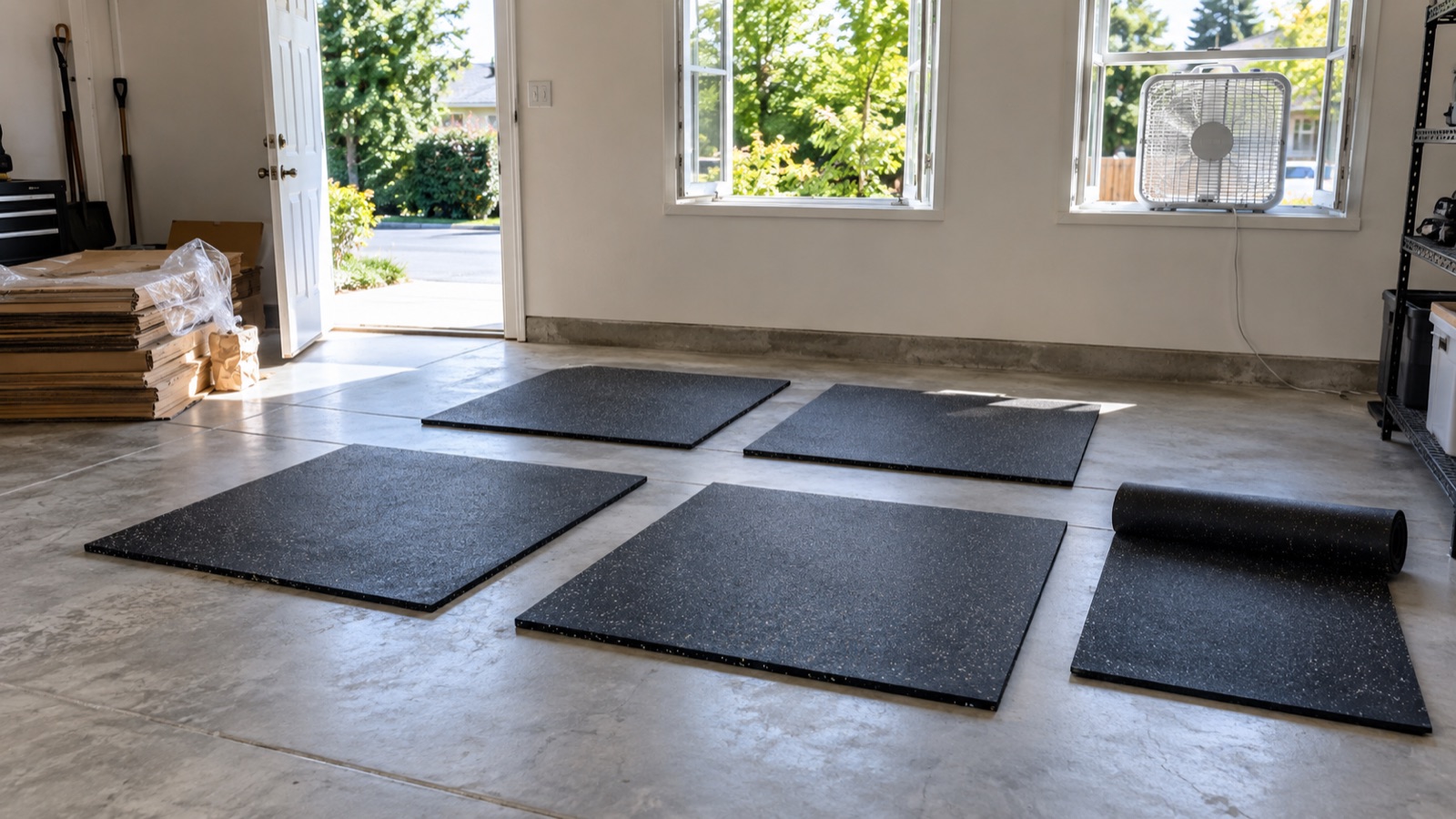
- Increase outdoor-air exchange. Open a window or door and position a fan to exhaust room air outdoors, with a safe path for replacement air.
- Expose surface area. If the manufacturer permits, unroll or separate loose pieces so both faces are not sealed together. Do not disrupt a glued installation.
- Clean once, correctly. Vacuum debris, then use the compatible cleaner and exact dilution. Recover residue and dry fully.
- Reduce heat and moisture. Warm, stagnant, humid rooms often make odor more noticeable. Correct water intrusion before replacing mats.
- Reassess. If the odor remains unacceptable, ask the seller for emissions documentation, care instructions, return terms, and product-specific advice.
Odor and Emissions Certification Are Not the Same Test
A strong smell does not by itself quantify health risk, and a low-emitting certification does not promise that a product has no detectable odor. Ask for documentation tied to the exact product and color, such as current FloorScore or CDPH-method testing, a safety data sheet, and installation requirements.
That information helps compare products and identify approved adhesives and cleaners. It does not replace ventilation or an investigation of moisture, spills, electrical faults, or symptoms in the room.
Do Not Use an Ozone Generator in an Occupied Home
The U.S. Environmental Protection Agency recommends source control and ventilation as primary indoor-air strategies. It states that ozone at concentrations within public-health standards is generally ineffective against many odor-causing chemicals and can react indoors to form irritating byproducts. Ozone can also damage rubber and other materials.
A portable air cleaner may supplement source control when properly selected, but it cannot make an unsuitable or contaminated product acceptable. A particle-only filter is not designed to remove gases; gas removal requires media intended for gases and enough capacity for the room and source.
When to Return, Remove, or Escalate
- The seller cannot identify the product or provide care, emissions, or installation documentation.
- The odor is increasing, sharply chemical, linked to a spill, or confined beneath flooring.
- Mats are oily, crumbling, swollen, stained, or changing texture.
- Moisture or microbial growth is visible, or the subfloor remains damp.
- Ventilation and correct cleaning do not make the room acceptable to its users.
- Anyone develops symptoms that improve away from the room.
Keep photos, batch or lot information, purchase records, room temperature and humidity, installation date, cleaner details, and a short odor timeline. That is more useful to a manufacturer, installer, indoor-air professional, or clinician than a description such as “it smells bad.”
Sources and Manufacturer Guidance
Requirements can vary by product, model, and situation. These primary sources informed this guide; official instructions for your exact product and current authoritative guidance take priority.
Frequently Asked Questions
-
There is no reliable universal duration. Product formulation, thickness, exposed surface area, temperature, ventilation, packaging time, and sensitivity all matter. Use progress—not a promised number of days—as the test.
-
Only if the manufacturer permits the temperature, sunlight, moisture, and storage conditions. Outdoor exposure can warp, fade, contaminate, or wet some products. A covered, dry, ventilated location may be appropriate for loose mats, but verify first.
-
It may add another odor and may not be compatible with the rubber, finish, or adhesive. Use the approved cleaner instead of improvised acid treatment.
-
It may supplement ventilation if it includes gas-removal media appropriate to the pollutants and has adequate capacity. It does not replace removing or correcting the source, and a particle-only filter is not designed for gases.
-
No. FloorScore addresses indoor-air emissions against defined criteria; it is not a no-odor guarantee. Confirm that documentation applies to the exact product you are buying.