How to Choose Running Shoes: A Fit-First Decision Guide
Choose the shoe for your primary surface and workout, then select the model that fits securely and feels comfortable during an actual run. Measure both feet, try the shoe with your running socks and orthotics, and compare at least two models at the pace you will use.
Do not treat arch height, a wet-foot test, or visible pronation as a diagnosis that automatically selects one shoe category. An ACSM running-shoe guide notes that pronation is normal and that foot shape or arch height alone are not good indicators of which running shoe to buy. A Cochrane review also found limited or uncertain evidence that prescribing shoes by foot posture prevents injury.
Start With the Job the Shoe Must Do
| Primary use | Prioritize | Common mismatch |
|---|---|---|
| Everyday road running | Comfortable fit, predictable cushioning, enough outsole for your routes, and a stable transition | Buying a fragile racing shoe as the only high-mileage trainer |
| Speed sessions or racing | Lower weight and a geometry that feels smooth at target pace | A stiff or aggressive shoe that feels awkward at easy pace or during turns |
| Trail running | Outsole grip for the actual surface, secure foothold, underfoot protection, drainage, and terrain-appropriate stability | Road foam and smooth rubber on loose, muddy, or rocky trails |
| Treadmill running | Fit, ventilation, and comfort at indoor pace; outsole demands may be lower | Assuming treadmill use fixes a shoe that pinches or slips |
| Run/walk or first running plan | Comfort, simple transition, and enough room as feet warm and spread | Changing shoe style and training volume sharply at the same time |
| Clinician-directed return to running | The features and progression specified for your condition | Replacing clinical assessment with a retail gait label |
Fit the Larger Foot While Standing
- Measure both feet and begin with the larger or longer measurement.
- Wear the running socks and any prescribed orthotic or insole you will use.
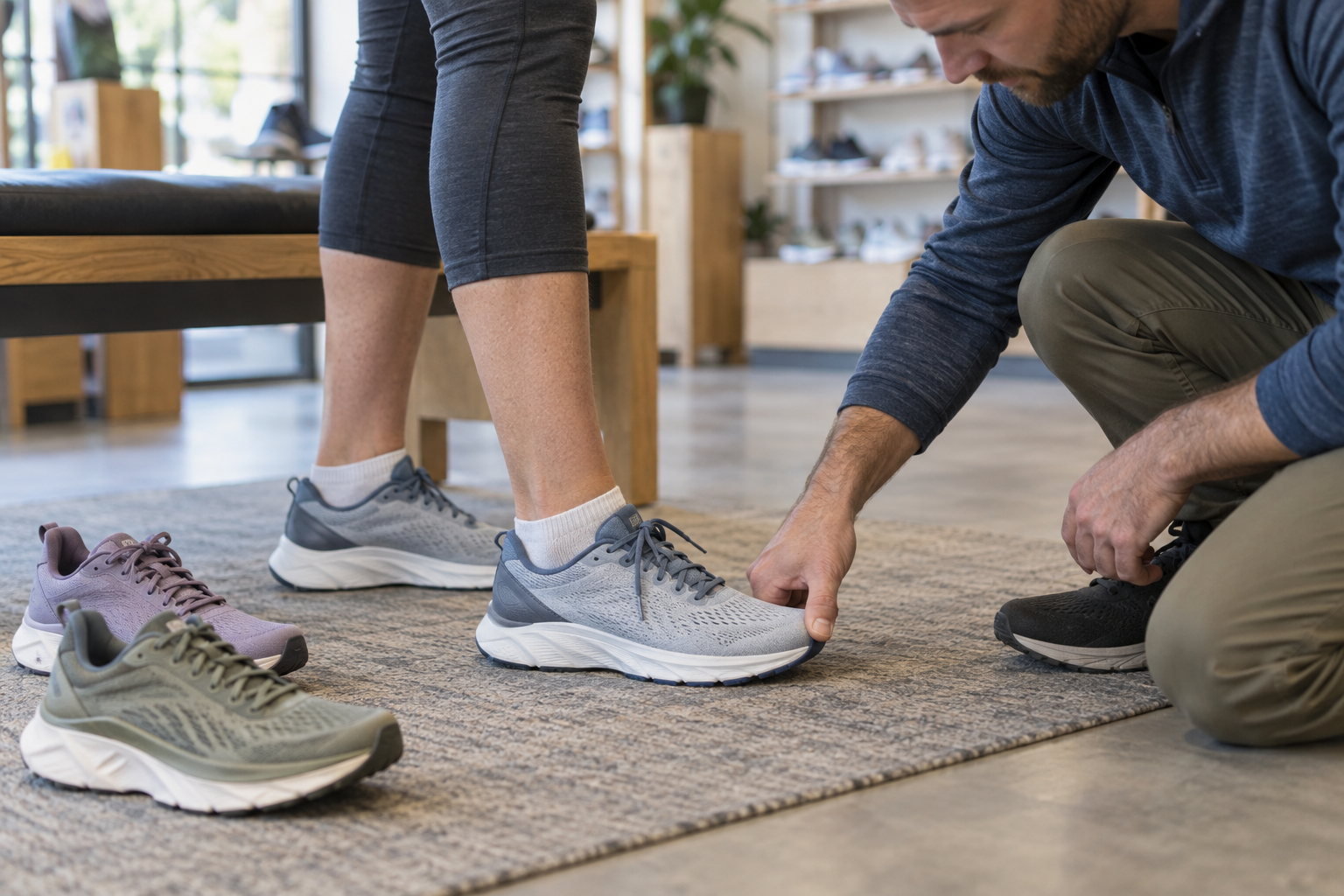
- Stand with the shoe fully laced. Check space in front of the longest toe, not automatically the big toe.
- Make sure every toe can lie flat and spread without the upper pressing or the foot sliding sideways.
- Walk and jog. The heel should stay secure without painful collar pressure, while the midfoot feels held rather than squeezed.
- Confirm the shoe bends and rolls in a location that works with your foot rather than buckling under the arch.
ASICS offers roughly half to one thumb's width in front as a fitting guide, but the exact space depends on foot shape, shoe construction, and the activity. Use the model's size chart and the on-foot test together.
Translate Shoe Features Into Trade-Offs
| Feature | What it changes | Selection question |
|---|---|---|
| Cushioning and stack | Underfoot feel, ground sensation, geometry, and often weight | Does it remain stable and comfortable at your pace and on turns? |
| Heel-to-toe drop | Relative heel and forefoot height; may change how the shoe feels through the ankle and lower leg | Are you accustomed to this geometry, or will you transition gradually? |
| Support elements | How the platform guides or resists movement | Does the shoe feel naturally stable without pressing the arch or forcing the foot? |
| Rocker geometry | How the shoe rolls from landing toward toe-off | Does the transition feel smooth at both easy and target pace? |
| Rigid plate or rods | Longitudinal stiffness and, with some foams/geometries, racing performance | Can you corner, warm up, and run your intended distance comfortably? |
| Outsole | Traction, exposed foam, durability, and flexibility | Does the rubber pattern match wet roads, gravel, track, or trail? |
| Upper and lacing | Volume, lockdown, ventilation, and pressure distribution | Can you secure the heel without numbness, lace bite, or toe compression? |
Use a Three-Stage Try-On Test
1. Standing and walking
Reject pressure, numbness, toe contact, unstable side-to-side movement, or obvious heel lift. Do not expect a painful fit to “break in.”
2. Easy running
Jog long enough to notice the transition, heel hold, forefoot room, and whether laces need excessive tightening. Compare models on the same surface.
3. Intended pace and movement
Add a short segment at target pace plus a gentle turn, incline, or trail step when relevant. A shoe that feels pleasant standing still may behave differently once load and speed increase.
Use a store treadmill or return policy only as permitted. Keep shoes clean until the decision is final.
Transition Without Changing Everything at Once
A markedly different drop, stack, stiffness, rocker, or minimalist construction changes the training stimulus. Begin with shorter familiar runs and avoid increasing shoe novelty, mileage, speed, and hills in the same week. Alternate with the known shoe while monitoring fit and response.
Stop the test for sharp pain, numbness, blistering, altered gait, or pain that persists after the run. A sports-medicine clinician or qualified foot professional can assess recurring symptoms; a shoe store cannot diagnose an injury.
Use This Scorecard Between Finalists
| Question | Pass condition |
|---|---|
| Length | Longest toe stays clear on flat ground and descents |
| Width and volume | Toes lie flat; no side bulge, pressure ridge, or instep numbness |
| Heel hold | Secure during running without harsh collar or Achilles pressure |
| Ride | Transition feels smooth at the intended pace, not merely soft while standing |
| Stability | Foot stays centered during turns and uneven steps without fighting the shoe |
| Traction | Outsole matches expected surface and weather |
| Returnability | Enough permitted testing time to confirm fit without damaging the product |
Sources and Manufacturer Guidance
Requirements can vary by product, model, and situation. These primary sources informed this guide; official instructions for your exact product and current authoritative guidance take priority.
- American College of Sports Medicine: Selecting Running Shoes
- Cochrane Review: Running shoes for preventing lower-limb running injuries in adults
- Brannock Device: official measuring and shoe-fitting instructions
- Journal of Sport and Health Science: Umbrella review of running-related injury risk factors
- ASICS: Running shoe wear and fit guidance
Frequently Asked Questions
-
Do not apply a universal size-up rule. Measure both feet and use the model's chart, then confirm toe space, width, heel hold, and running comfort. Brand and model sizing varies.
-
Pronation is normal. Do not select a category from pronation alone; compare comfort and running function, and seek clinical guidance when pain, injury history, or a diagnosed condition requires it.
-
A common starting check is roughly half to one thumb's width ahead of the longest toe, with enough width and volume for all toes to lie flat and spread. Running confirms whether that space works.
-
Price does not guarantee fit or injury prevention. Pay for features that suit your use, but reject any shoe that is uncomfortable or mechanically awkward for you.
-
Walking and running mechanics differ. A short retail observation can inform a try-on, but it should not be treated as a diagnosis or the sole basis for prescribing a shoe.