How Long Do Running Shoes Last? Use Mileage and a Wear Check
Many running-shoe brands use 300 to 500 miles as a general replacement range, but mileage is a checkpoint—not an automatic expiration date. A shoe may need retirement earlier after structural damage, traction loss, sole separation, or a major change in ride. Another pair may remain usable beyond the range if its structure and function are still sound.
Track distance, inspect both shoes together, and compare how they feel on a familiar route. Do not wait for the outsole to become completely smooth: midsole cushioning can change even when visible wear looks modest, and research suggests runners may not reliably perceive all cushioning degradation.
Treat 300–500 Miles as an Inspection Window
Brooks and ASICS both publish a general 300–500 mile range. At 20 miles per week, that is roughly 15–25 weeks; at 40 miles per week, roughly 7.5–12.5 weeks. Those calendar estimates include only recorded running, so walking and gym use in the same pair make an untracked contribution.
Model construction, runner, pace, body mass, gait, surface, weather, fit, and care all affect wear. Lightweight racing shoes, exposed-foam designs, rugged trail shoes, and durable daily trainers should not be expected to age identically.
The Five-Part Replacement Check
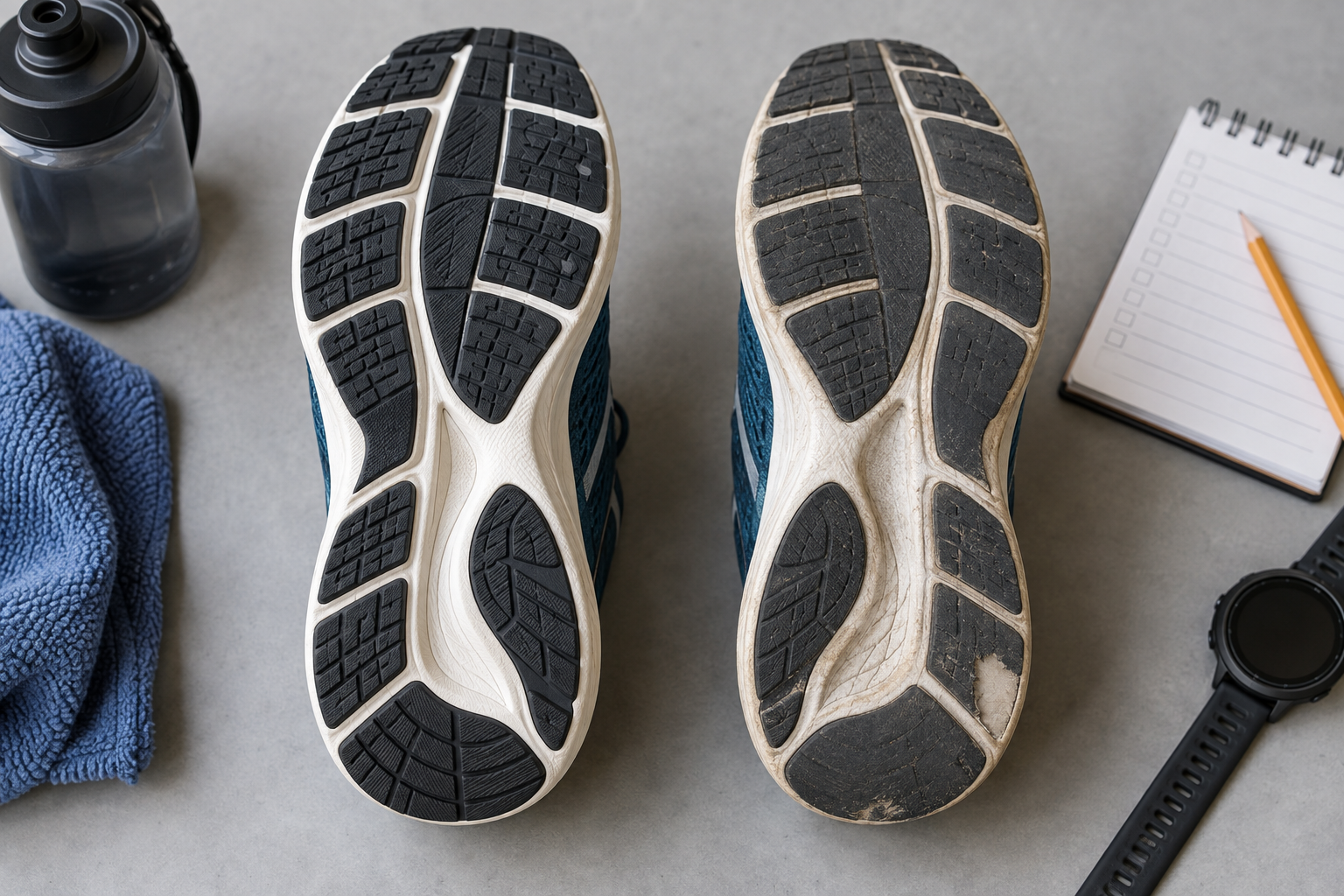
| Area | Inspect | Replace or stop when |
|---|---|---|
| Outsole | Compare left/right tread depth, smooth patches, rubber worn through, and wet-surface grip | Traction is unreliable or midsole foam is exposed in a critical contact area |
| Midsole | Look for permanent tilt, deep asymmetrical collapse, splits, or a ride that feels materially harsher on a familiar run | The platform no longer feels stable or predictable |
| Upper | Check toe fabric, eyelets, sidewalls, heel lining, and the bond to the sole | A tear no longer holds the foot securely or the sole separates |
| Structure | Place shoes on a flat surface and compare lean, twist, and heel-counter condition | One shoe sits deformed, a plate or rigid element may be damaged, or the shoe no longer holds the foot |
| Runner response | Note new rubbing, hot spots, instability, or a repeatable ride change | Symptoms recur in this pair; stop and rule out both shoe and training causes |
Keep a Mileage Log That Includes the Shoe
- Create a separate entry for each pair and colorway; similar shoes are easy to confuse.
- Record the first run date and starting mileage if the pair is already used.
- Assign every run to the shoe in your watch, app, spreadsheet, or paper log.
- Add untracked walking, travel, and gym sessions when they are substantial.
- At 300 miles, begin a quick inspection every 25–50 miles rather than waiting for a failure.
- Photograph the outsole and sidewalls under the same lighting so change is easier to compare.
Mileage supports the decision; it does not override obvious damage at 80 miles or prove safety at 550.
What Can Shorten or Extend the Useful Life
| Factor | Why it matters | What to do |
|---|---|---|
| Abrasive pavement and rough concrete | Increases outsole abrasion | Inspect high-contact zones more often |
| Mud, grit, and road salt | Can abrade the upper and collect in seams | Clean by the manufacturer's method and dry naturally |
| Poor fit | Heel slip and toe contact accelerate lining and upper wear | Correct sizing and lacing rather than accepting holes as normal |
| All-day casual use | Adds compression and outsole distance that apps do not record | Reserve the pair for running if mileage tracking matters |
| Heat and poor storage | Can affect adhesives and materials | Store dry and ventilated away from direct heat and a hot car |
| Aggressive lightweight design | Less outsole rubber or specialized foam may prioritize performance over durability | Use the model's intended purpose and inspect sooner |
Do Not Use Soreness as the Only Wear Gauge
A familiar route feeling harsher can prompt an inspection, but soreness also changes with training load, sleep, terrain, illness, and injury. Conversely, a 2017 study found recreational runners did not reliably identify measured changes in heel cushioning over 640 km.
Use symptoms as one signal alongside mileage and physical inspection. Stop running for sharp pain, altered gait, or persistent symptoms and seek clinical evaluation when appropriate; buying a new shoe is not a diagnosis.
Retire the Shoe According to Its Condition
A pair that has only lost its preferred running feel may still work for low-risk casual use. A structurally damaged or slippery pair should not be reassigned to gym training, yard work, or wet-weather walking simply to avoid disposal.
Remove insoles or laces for reuse only if compatible and clean. Check local brand take-back, textile-recycling, or footwear-donation rules; programs may reject worn or damaged shoes.
Sources and Manufacturer Guidance
Requirements can vary by product, model, and situation. These primary sources informed this guide; official instructions for your exact product and current authoritative guidance take priority.
- Brooks Running: 300–500 mile life-expectancy guidance
- Brooks Running: When to replace running shoes
- ASICS: Running shoe wear, replacement signs, and care
- International Journal of Sports Physical Therapy: Perception and measurement of heel cushioning changes with mileage
- Footwear Science: Changes in heel cushioning characteristics with running mileage
Frequently Asked Questions
-
Calendar life depends on weekly mileage. At 20 miles per week, 300–500 miles is about 15–25 weeks; inspect condition rather than using months alone.
-
Some may remain functional, but 500 miles is a sensible inspection point rather than proof that they are safe. Check structure, traction, upper security, and ride.
-
A treadmill may reduce some outsole abrasion, but midsole cycles, fit, heat, and total use still matter. Track treadmill mileage and inspect the shoe normally.
-
It spreads mileage across pairs, so each reaches a given distance later on the calendar. Do not assume rotation increases the total safe mileage of a particular shoe.
-
Loss of traction is a functional failure, especially on wet or loose surfaces. Replace the shoe rather than waiting for the outsole to wear through completely.