How to Choose Resistance Bands: Match the Band to the Movement
Start with the movement, then choose the band format and a resistance range you can control through the full exercise. Color is not universal, and a band labeled “30 lb” does not pull with 30 pounds at every length.
Elastic resistance rises as a band stretches. A useful product listing tells you the original length and the force at a stated elongation—such as 100%, when the band has been stretched to twice its resting length.
Choose the Band Type First
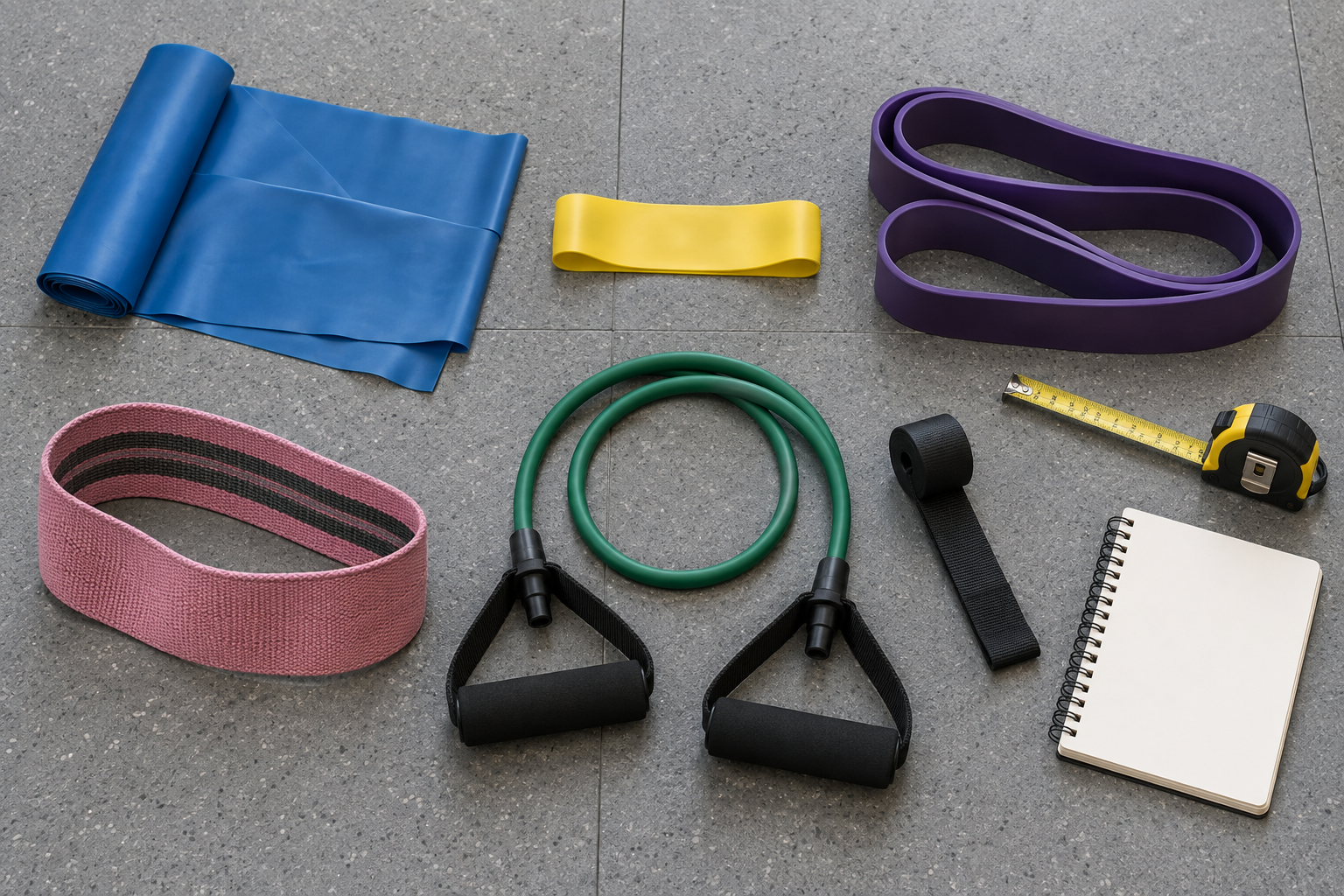
| Band type | Good uses | Main limitation |
|---|---|---|
| Flat strip | Rehab-style exercises, mobility, tying custom lengths, lighter upper-body work | No built-in handle or loop; knots shorten working length and can damage the material |
| Mini loop | Lateral steps, hip work, light upper-body activation | Short travel; can roll or pinch, especially in thin latex |
| Fabric hip loop | Lower-body drills where comfort and roll resistance matter | Usually limited stretch and not suitable for pull-up assistance or long-range anchored work |
| 41-inch power loop | Pull-up assistance, mobility, banded barbell work, anchored strength movements | Wide force range through the motion; thick bands can be difficult to control |
| Tube with handles | Rows, presses, curls, and travel workouts | Handles, carabiners, tube ends, and anchors create extra wear points |
| Cuff or specialty system | Exercise-specific cable-like setups and guided programs | Replacement parts and resistance ratings may be proprietary |
Read Resistance as a Range, Not a Fixed Weight
Elastic force depends on percent elongation:
percent elongation = (stretched length − resting length) ÷ resting length × 100
A 24-inch band stretched to 48 inches is at 100% elongation. TheraBand's published system, for example, specifies pull force at defined elongations. Rogue likewise notes that its Monster Band figures are estimates at 100% stretched length and may vary in manufacturing.
This is why two people can feel different resistance from the same band: their anchor distance, limb length, grip position, and range of motion change the stretch. Compare brands only when they state force at the same elongation and test method.
Select Resistance by What Must Happen in the Rep
| Goal | Start with | Correct level looks like |
|---|---|---|
| General strength exercise | A light and a medium option in the appropriate format | You control the return, keep the intended joint path, and complete the target reps without shortening range |
| Pull-up assistance | Several power loops or an adjustable assistance system | You can initiate from the bottom and finish over the bar without being launched upward |
| Mobility or stretching | Light flat band or power loop sized for the anchor distance | Tension guides the position without forcing the joint or pulling you off balance |
| Hip and lateral work | Mini loop or fabric loop that stays flat | Knees and feet track as intended; the band does not force a smaller step or twisted stance |
| Barbell accommodating resistance | Matched pairs made for the setup and an experienced program | Both sides have equal pretension and the rack has proper band pegs; tension never pulls the bar off line |
| Clinician-directed rehab | The exact format and progression prescribed | Pain, range, tempo, and dosage remain within the clinician's plan |
For Pull-Ups, More Band Means More Help at the Bottom
A loop band stretches most when you are hanging low, so assistance is greatest near the bottom and decreases as you rise. A thicker band is not a direct substitute for developing strength across the entire pull-up.
- Use a secure pull-up bar and a band the manufacturer permits for assistance.
- Attach it exactly as directed and keep face, hair, and loose clothing clear.
- Enter and exit with a stable step or a partner rather than stretching the band blindly under one foot.
- Choose the lightest assistance that allows controlled full-range repetitions.
- Progress by reducing band assistance, not by shortening the movement.
Material and Anchor Matter as Much as Resistance
- Natural latex: elastic and common, but unsuitable for someone who must avoid latex exposure.
- Latex-free material: available in flat and tube formats; compare that exact product's force chart rather than assuming identical feel.
- Fabric: comfortable for short hip movements but often has a limited range and different force curve.
- Door anchor: use a purpose-built anchor on a sound door in the direction specified by the maker. Never rely on a loose handle or damaged door.
- Rack or post: the surface must be smooth, stable, and free of sharp edges. Do not route bands over bare threads or knurled metal.
Inspect Before Every Session
- Relax the band and inspect its full length under good light.
- Look for tears, cracks, cuts, abrasions, thinning, sticky areas, discoloration, and damaged seams.
- Inspect tube-to-handle connections, carabiners, cuffs, and anchors separately.
- Replace a band at the first sign of wear; do not tape, knot, or glue a damaged section.
- Follow the maker's maximum stretch, storage, cleaning, and replacement guidance.
Sources and Manufacturer Guidance
Requirements can vary by product, model, and situation. These primary sources informed this guide; official instructions for your exact product and current authoritative guidance take priority.
Frequently Asked Questions
-
Choose a light level that allows the full intended range and a controlled return for every repetition. Buying adjacent light and medium levels makes progression easier than guessing one color.
-
The band has been lengthened by its full resting length. A 24-inch band stretched to 48 inches is at 100% elongation.
-
No. Treat colors as levels only within the same manufacturer's named product line.
-
Only if the manufacturer permits that setup and every band, connector, and anchor is rated and inspected. Combining bands changes both total force and the recoil hazard.
-
Immediately when you find a tear, crack, abrasion, thinning, damaged seam, sticky area, or compromised connector. Also follow any time-based replacement schedule from the maker.