How Much Does a Barbell Weigh? 20 Kg, 15 Kg, and Specialty Bars
A men's Olympic weightlifting bar weighs 20 kilograms, or 44.1 pounds. A women's Olympic weightlifting bar weighs 15 kilograms, or 33.1 pounds. Many U.S. gyms call the 20 kg bar a “45-pound bar,” but 20 kg is about 0.9 pound lighter than 45 pounds.
That answer applies to those competition-style straight bars—not every barbell. Technique bars, fixed-weight barbells, one-inch standard bars, curl bars, trap bars, safety squat bars, and short Olympic bars can have very different unloaded weights. Check the exact product before logging a lift.
Common Barbell Weights at a Glance
The first two rows are defined competition formats. The remaining categories vary by product and should never be logged from appearance alone.
| Bar type | Common unloaded weight | How to verify |
|---|---|---|
| IWF men's weightlifting bar | 20 kg / 44.1 lb | 20 kg specification, 28 mm grip section, 2,200 mm overall length, and manufacturer identification |
| IWF women's weightlifting bar | 15 kg / 33.1 lb | 15 kg specification, 25 mm grip section, 2,010 mm overall length, and manufacturer identification |
| Power bar | Often 20 kg / 44.1 lb or marketed as 45 lb | End cap, model page, and powerlifting certification—do not treat the two labels as mathematically identical |
| Technique or junior straight bar | Commonly 5–15 kg, but varies | Printed weight, end cap, manual, and sleeve construction |
| One-inch standard straight bar | Varies widely | Exact model or a safe weighing method |
| EZ curl bar | Often about 15–35 lb, but varies | Rackable length and construction change the weight; check the product |
| Trap or hex bar | Often about 45–90+ lb, but varies | Frame, handles, and removable parts change the total |
| Safety squat bar | Often about 45–70+ lb, but varies | Include the installed handles and pads specified by the maker |
| Fixed-weight studio bar | Whatever is permanently marked | Read both ends; confirm whether the marking is total bar weight |
15 kg vs 20 kg Olympic Bars
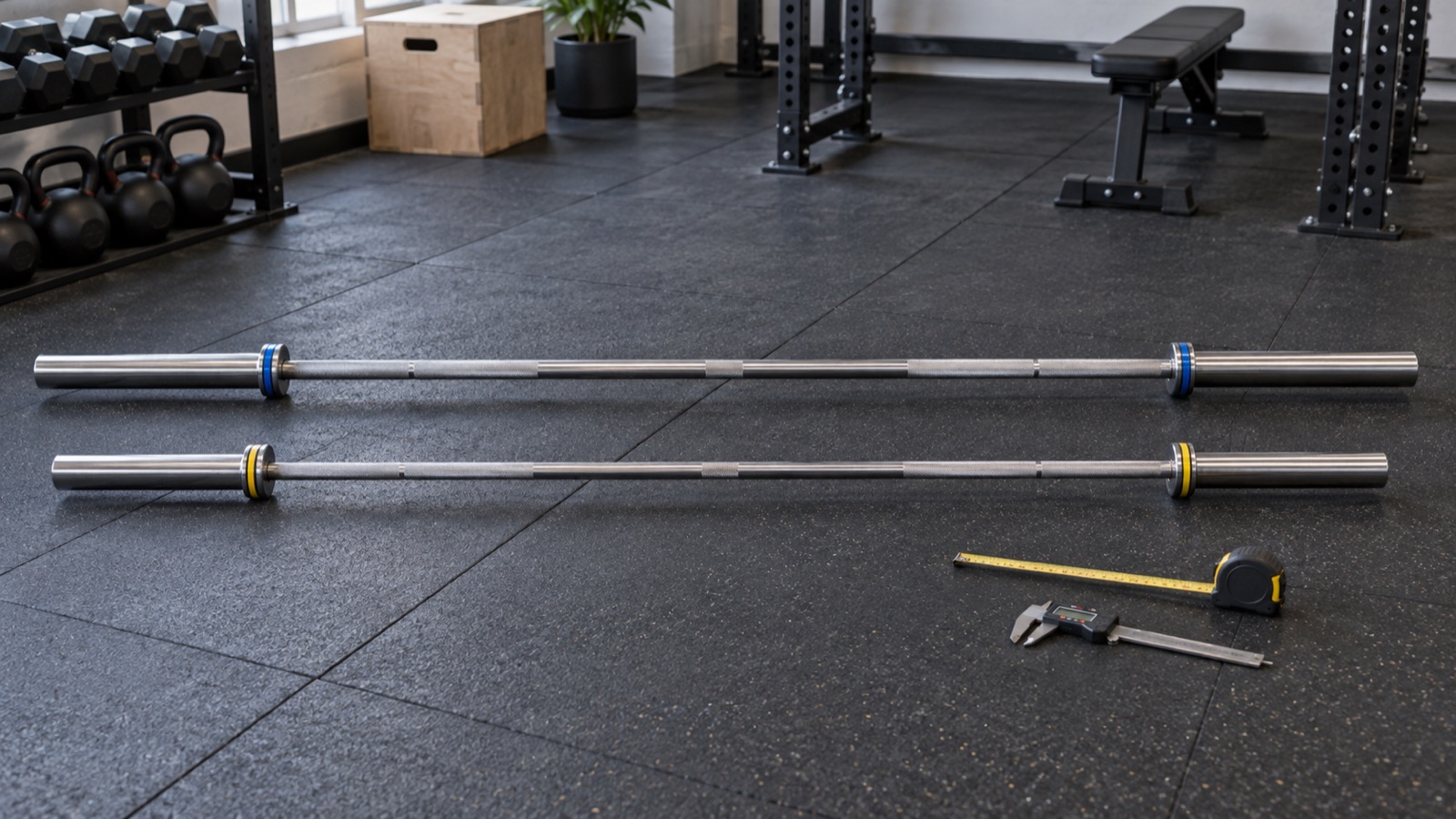
IWF specifications distinguish more than weight. The 20 kg men's bar is 2,200 mm long with a 28 mm grip section; the 15 kg women's bar is 2,010 mm long with a 25 mm grip section. Both use rotating 50 mm sleeves for Olympic plates, but the shorter 15 kg bar typically has less loadable sleeve length.
Color identification markings can help on certified equipment, but home-gym products use many coatings and end-cap designs. Dimensions and the exact model are more reliable than color alone.
How to Identify an Unknown Bar
- Check both end caps and the inner sleeves. Record every model name, weight mark, serial, and manufacturer.
- Look up the exact model. Archived receipts, manuals, and the manufacturer's product page outrank a visual guess.
- Measure overall length. Do not infer weight from length alone; use it to narrow the product family.
- Measure shaft and sleeve diameters. A 25 mm or 28 mm grip and 50 mm rotating sleeves suggest an Olympic format, but training and specialty models still vary.
- Note center knurl, grip marks, bends, frames, handles, and removable parts. These can identify a specific power, curl, trap, or safety bar.
- Weigh only if identity remains uncertain. Use a stable method that cannot let the bar roll, tip, or fall.
Safe Ways to Weigh a Barbell
- Best: place the entire unloaded bar on a suitably sized, rated platform or shipping scale with chocks or a cradle that prevents rolling.
- Two-scale method: support one end on each level scale, keep the bar horizontal and fully stable, then add the readings. Use scales with adequate capacity and similar calibration.
- Body-weight difference: for a bar you can hold comfortably, compare your weight alone with your weight while holding the unloaded bar in a clear area. This is a rough check, not a calibration method.
Remove plates and loose collars first. Install the handles or parts that the manufacturer includes in the stated bar weight. Do not balance a long bar vertically on a bathroom scale or suspend it from an improvised strap.
Why Specialty Bars Must Be Looked Up
Even one manufacturer's catalog shows the range. REP lists its rackable curl bar at 35 pounds, a conventional trap bar at 55 pounds, a safety squat bar at 68 pounds, and its modular open trap bar from 71.2 to 92.4 pounds depending on the installed handle pair. Those are model-specific examples, not category standards.
Removable handles, chains, pads, integrated jacks, and aftermarket attachments can also change the working unloaded weight. Record the configuration used in your training log.
Calculate the Loaded Bar Correctly
Use:
total load = bar + left plates + right plates + collars or attachments included in the lift
For a symmetrical barbell, add both sides. A 20 kg bar with one 20 kg plate per side is 60 kg before any additional collar weight. A “45-pound bar” with one 45-pound plate per side is 135 pounds.
Do not mix pounds and kilograms without converting. Use 1 kilogram = 2.20462 pounds, and keep rounding consistent with the equipment markings and the rules of the training or competition.
Sources and Manufacturer Guidance
Requirements can vary by product, model, and situation. These primary sources informed this guide; official instructions for your exact product and current authoritative guidance take priority.
- International Weightlifting Federation: Competition equipment specifications
- IWF Technical and Competition Rules and Regulations (2025)
- International Powerlifting Federation Technical Rulebook (effective March 2026)
- REP Fitness Barbell Guide: 15 kg and 20 kg straight-bar examples
- REP Fitness Specialty Barbell Guide
- REP Open Trap Bar: configuration-dependent unloaded weights
Frequently Asked Questions
-
Not necessarily. A 20 kg Olympic bar weighs about 44.1 pounds and is often casually called 45 pounds. Bars labeled as 45 lb, 15 kg, technique, standard, curl, or specialty may weigh differently.
-
The IWF women's bar weighs 15 kg, or about 33.1 lb. It also has a 25 mm grip section and is shorter than the 20 kg men's bar.
-
There is no category-wide weight. Many are roughly 15 to 35 pounds, but rackable and heavy-duty models can differ. Check the exact model or weigh it safely.
-
Trap bars vary widely—roughly 45 to more than 90 pounds among common designs. Frame style, handles, integrated jack, and removable components all matter.
-
They count when the rules or training log include them. IWF competition collars weigh 2.5 kg each; many home-gym spring or lock collars weigh much less. Record the convention you use.