Strength & Weights

Best Soft Plyo Boxes of 2026

The first time you clip a shin on a wooden plyo box, the box stops being gym equipment and becomes an obstacle. A soft plyo box changes that bargain: the foam gives when you catch an edge, and the whole thing is light enough to drag aside when the workout is over. But softness alone doesn't make a box safe. A squishy box that shifts under a landing is worse than a firm one that stays put, so the right pick needs a forgiving surface and a stable base.

Over the past six months, my team and I tested ten soft plyo boxes in a garage gym and a living-room corner, rotating them through step-ups, box jumps, and missed reps. The differences came down to foam density, cover durability, and whether a box stayed planted on off-center landings. We also noted which ones moved easily with one hand, stored against a wall without taking over the room, and still felt worth the money after months of use. The picks below are the ones we kept reaching for.

Best For Stacking height

Our Score 9.6/10
Philosophy Gym Soft Foam Plyo Box

Philosophy

Philosophy Gym Soft Foam Plyo Box

  • Height 6 in
  • Weight 8 lb
  • Capacity 440 lb
  • Platform 28 x 28 in
Check Price on Amazon

A six-inch box isn't a smaller plyo box, it's a different tool. The Philosophy Gym platform measures 28 by 28 inches, weighs 8 pounds, is rated to 440 pounds, and is built to be strapped to a second or third unit with self-fastening straps, so you add height in six-inch increments and break it back down into a step when you're finished.

That makes it the most flexible thing here for a shared space: a low platform for step-ups, hip thrusts, and rehab work, and a way to add height later without replacing everything. It's also rated high enough to load with dumbbells for split squats. What it isn't is a jump box on its own. A 28-inch platform is plenty to land on, but a single unit only ever puts you six inches off the floor.

Bottom Line

The stackable building block of soft plyo boxes: buy one for step-ups and rehab work, then add a second when you want real height.

Check Latest Price

Best Firm Landing

Our Score 9.4/10
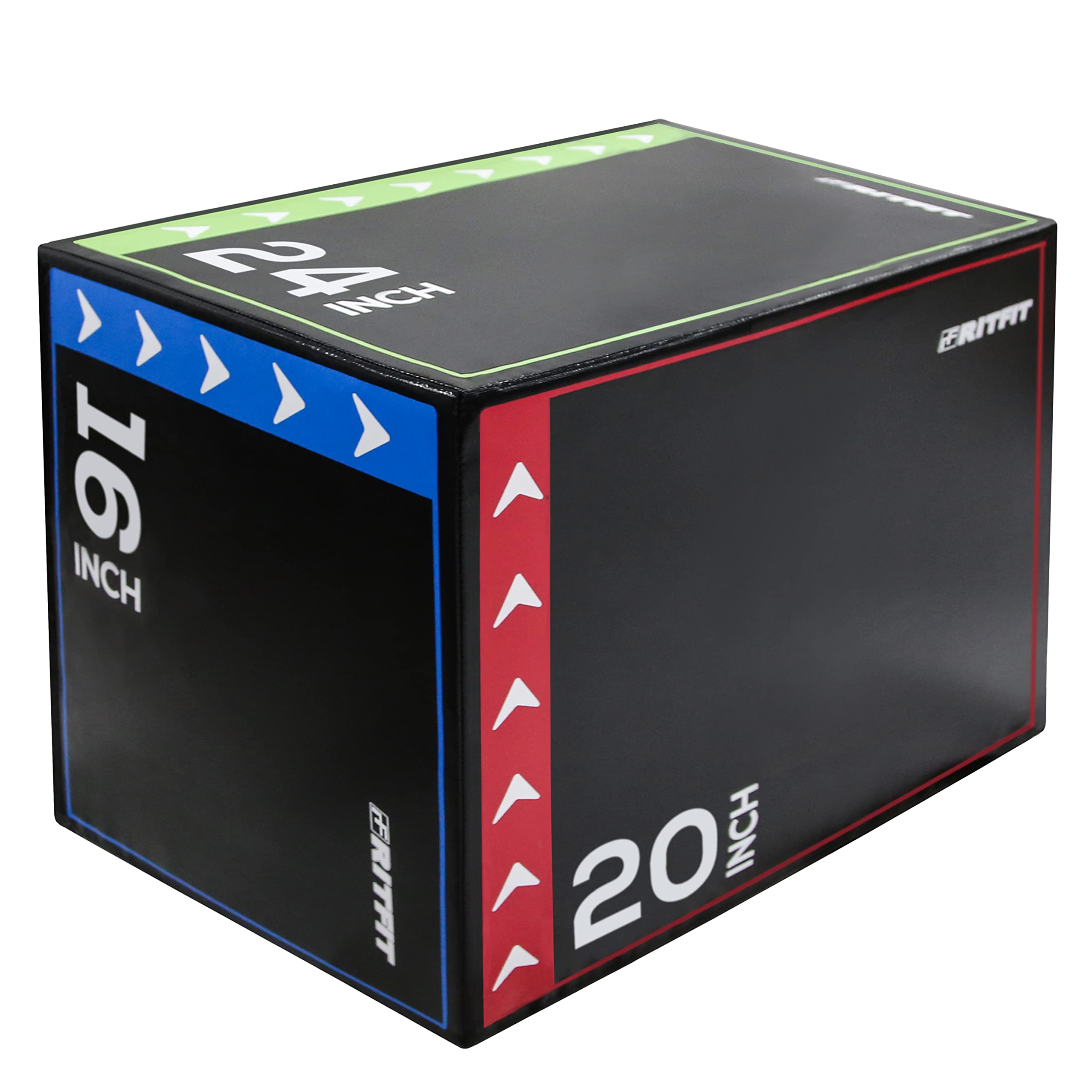
RitFit Extra Firm Soft Plyo Box

RitFit

RitFit Extra Firm Soft Plyo Box

  • Foam Extra-firm high density
  • Cover Zip-off PVC
  • Weight 35 lb
  • Heights 16, 20, 24 in
Check Price on Amazon

Extra-firm foam that won't swallow a landing, plus a cover that unzips for washing.

The cover on the RitFit unzips and comes off, and that single detail says more about the box than the foam does. A foam plyo box spends its life in a garage, taking sweat, chalk, and whatever the floor hands it, so being able to pull the PVC off and wipe it down is the difference between equipment that stays presentable and equipment that doesn't.

Underneath is extra-firm high-density foam, which is the other thing that sets it apart. The 16 by 20 by 24 block covers the standard three heights with no assembly, and at 35 pounds it sits where you put it instead of skating across the floor. Worth knowing: at 24 inches you're standing on that 16 by 20 face, and a firm, dense box will tell you if the floor isn't level.

Which brings us to the trade we accept. This is the firmest-feeling foam box in this group, and it's also the heaviest of the standard 16/20/24 boxes here and one of the priciest. If you're a heavier athlete or you land hard, that firmness is worth both. If you're carrying the box between exercises, our top pick does the same job at a fraction of the weight.

Bottom Line

The firmest landing among these picks, with a cover that unzips for washing, and worth the heavier carry if you want a box that feels planted.

Check Latest Price

Best Big Box

Our Score 9.4/10
papababe 3-in-1 Jump Box

papababe

papababe 3-in-1 Jump Box

  • Fill Heavy-duty foam
  • Cover 1000D oxford weave
  • Weight 68 lb
  • Heights 20, 24, 30 in
Check Price on Amazon

A 20/24/30-inch block that stays put: 68 pounds of foam that doesn't move.

If the box is going to live in one spot, the corner of a garage or the back of a training room, the papababe is the one we point to, because 68 pounds does something no amount of foam density can: it keeps the box exactly where you left it.

The block measures 20 by 24 by 30 inches, so the faces run 24 by 30 at the 20-inch setting, 20 by 30 at 24 inches, and 20 by 24 at the full 30. That last face is the useful one. A 20 by 24 landing at 30 inches is a bigger target than the 16 by 20 you get at 24 inches on a standard three-height block, which is the detail that makes the height worth owning. The cover is a 1000D oxford weave rather than vinyl, so it has a fabric feel and a water-resistant finish.

What it gives up is flexibility. There's no 16-inch face, since 20 inches is the lowest setting, so it's a poor first box for a beginner and anyone sharing it with one is stuck at 20. For a tall athlete who wants a 30-inch target that doesn't move, that's an easy trade to make.

Bottom Line

For a box that never leaves its spot and a 30-inch target you can trust, this is the one, as long as you accept that it's a fixture rather than portable gear.

Check Latest Price

Best for Small Spaces

Our Score 9.4/10
REP Soft Plyo Box

REP

REP Soft Plyo Box

  • Foam High-density
  • Cover Anti-slip vinyl
  • Heights 16, 18, 20 in
  • Capacity 400 lb
Check Price on Amazon

Just 16 to 20 inches tall, with a 400-pound rating and two-inch height steps.

Sixteen, eighteen, twenty. The REP box climbs in two-inch steps where most three-in-one blocks here jump four inches between faces, and that changes how you use it. You move up when a set starts feeling easy rather than when you've cleared a four-inch hurdle.

For a small room, that's the box we reach for. The small version runs roughly 16 by 18 by 20 inches, carries a 400-pound rating, and wraps dense foam in a grippy vinyl cover. Nothing about it felt like a compromise in use: the padding is firm enough for jumps and forgiving enough to bump a shin against.

The catch is the landing area. At 20 inches you're landing on 16 by 18 inches, which is fine for step-ups, split squats, and a shorter athlete's jumps, and tight for a tall jumper used to a 20 by 24 target. It can also creep on a smooth floor, and a weight plate set on the base settles it. Neither issue turns up if the box lives on a mat in a corner.

Bottom Line

The best small-space foam box here: three heights in two-inch steps, a 400-pound rating, and a footprint that tucks into a corner.

Check Latest Price

Best Overall

Our Score 9.2/10
BalanceFrom 3-in-1 Foam Plyo Box

BalanceFrom

BalanceFrom 3-in-1 Foam Plyo Box

  • Foam High-density
  • Cover Textured non-slip
  • Weight 10 lb
  • Heights 16, 20, 24 in
Check Price on Amazon

Light enough to move, firm enough to jump, with three heights and shin-friendly foam.

Ten pounds is the number that shapes everything about this box. The BalanceFrom rotates through 16, 20, and 24 inches, and at that weight you can pick it up with one hand and set it down wherever the workout moved to. The foam is high density, all three faces carry a textured non-slip surface, and the edges give enough that a missed jump is a bruise rather than a scrape.

The rotation is also where the geometry gets interesting. Every three-in-one trades landing area for height, and on this block the 16-inch face gives you 20 by 24 inches while the 24-inch face gives you 16 by 20. That's a smaller target than the 24-inch box at a gym, and it's the thing to picture before you commit to the top face.

In use, the light weight cuts both ways. On a rubber mat it stayed exactly where we put it; on bare garage concrete, a hard landing toward an edge could nudge it out of place. A mat underneath or a wall behind fixes that in seconds, and the payoff is a box you actually move between exercises instead of working around. The fabric at the edges is the part we watch, since it can bunch where the box gets dragged.

What earns it the top spot is coverage. Of the boxes here, it's the only full 16/20/24 range at a weight one person can handle, so a beginner and a seasoned jumper can share the same block, and it costs less than the other full-range pick. Buy it if you want one box for warm-ups, jumps, and step-ups that doesn't need its own corner of the garage.

Bottom Line

The foam box we point most home gyms to: a full 16/20/24 range, ten pounds you can carry one-handed, and foam that forgives a missed jump.

Check Latest Price

Best For First plyo box

Our Score 9.2/10
Yes4All 3-in-1 Foam Plyo Box

Yes4All

Yes4All 3-in-1 Foam Plyo Box

  • Foam High-density PE
  • Weight 27 lb
  • Heights 16, 18, 20 in
  • Capacity 350 lb
Check Price on Amazon

Yes4All's small foam box does most of what the REP box does and asks more for it, which is the main reason it sits further down this list. Same idea, a 16/18/20 block with a foam core and a PVC cover, with a 350-pound rating and about 27 pounds of heft behind it.

What you're paying for is the material. The core is PE foam rather than the EPE used in several boxes here, and the denser material is what gives the box its firmer character and its genuine shin protection on a missed jump. Where it loses ground is steadiness: on a hard floor the box can shift under a landing that catches an edge, and the 18-inch depth leaves less room to correct than the wider blocks here. At this price, the REP is the better buy in the same size class.

Bottom Line

A denser foam box in the small size class, but it costs more than the REP and can shift on a hard landing, so it earns a place only if firmness is the thing you want.

Check Latest Price

Best For 30-inch jumps

Our Score 9.0/10
Epic Fitness 3-in-1 Foam Plyo Box

Epic Fitness

Epic Fitness 3-in-1 Foam Plyo Box

  • Foam High-density EPE
  • Cover PVC leather
  • Weight 16 lb
  • Heights 20, 24, 30 in
Check Price on Amazon

We expected the 30-inch face to be the intimidating part of the Epic Fitness box. It isn't. It's the 16 pounds sitting underneath it.

The block runs 20 by 24 by 30 inches in high-density EPE foam with a PVC leather cover, so the height range matches the papababe at a fraction of the weight. At 20 and 24 inches on a rubber mat, that lightness is a pleasure: you carry the box out with one hand and put it away just as easily.

At 30 inches the same lightness becomes the whole conversation. The box doesn't have the mass to feel planted when you land high, and a landing that catches an edge can move it. Where that trade works is anyone who has to transport their gear, like a coach working out of a car or a shared space where the box goes back on a shelf. If it stays in one place, the heavier 30-inch option here is the safer buy and costs about half as much.

Bottom Line

The 30-inch box you can carry under one arm, a good fit for a coach moving between sites and a compromise for a gym where the box stays put.

Check Latest Price

How We Tested Soft Plyo Boxes

We started with a shortlist of soft plyo boxes sold for home gyms, filtering out options with vague foam specs, slippery covers, or footprints that would overwhelm a small room. We ordered ten and used them for six months, rotating them through the same sessions: step-ups and box jumps in a garage gym, quick conditioning circuits in a living-room corner, and partner workouts where the box had to be moved between sets. Each box stayed in the rotation until we had a clear sense of how it handled repeated use.

Stability and safety came first. We landed deliberately off-center, watched whether the box rocked or slid, and checked how much the foam compressed under a knee or a foot. To judge softness, we compared how each edge felt against a shin during a missed jump and whether the surface felt supportive or bottomed out. For durability, we inspected seams and covers after every few sessions, looking for splitting, fraying, and foam that stayed dented after a landing.

Maneuverability and home-gym fit were just as practical. We carried each box with one hand, dragged it across rubber mats and carpet, and stored it upright between sessions to see how much floor space it claimed. We also compared what each box delivered for its price, including whether the cover felt sturdy enough to justify the cost and whether the foam held its shape after months of use. The boxes that scored best were the ones we could move without thinking, land on without hesitating, and leave out without resenting the space they took.

How to Choose Soft Plyo Boxes

Weight Is the Design Decision

A foam box around ten pounds is one you move with one hand; one in the sixties is furniture. Neither is wrong, but they solve different problems. A heavier box plants itself on a hard garage floor and holds through a landing that catches an edge, while a light one gets carried out and put away, which usually means it gets used more often.

We pick lighter boxes for shared rooms and heavier ones for dedicated gyms, and we put a rubber mat under either. If you train alone on smooth concrete, weight is the closest thing you have to a safety feature.

Read the Landing Area, Not Just the Height

Every three-in-one block trades footprint for height. On a 16 by 20 by 24 box, the 16-inch face gives you a 20 by 24 landing, but the 24-inch face is a 16 by 20 rectangle, because the block rotates onto its narrowest side to get tall.

Before you commit to a height, picture the surface you jump on at a gym now. If it's 20 by 24 and you buy a 16 by 20 top face, the first session will feel smaller than you expected. Step down a face or size up the block.

Firm Foam Beats Soft Foam

Soft is the word that sells these boxes, but you want firm. A landing should stop where it meets the foam rather than sink into it, because a deep, vague landing is harder to balance out of than a crisp one. Listings that say extra firm or high density are pointing at the right thing.

Weight capacity is the other clue: a box rated to 400 pounds usually has more material packed into it than one rated to 200. If you're a heavier athlete or you land hard, pay for density before anything else.

Covers: Vinyl, PVC, and Oxford Weave

The cover decides how the box feels underfoot and how it ages. Vinyl and PVC wipe clean and grip well with shoes; the oxford-weave fabric on the papababe is softer to the touch and water-resistant, but it holds dust and chalk in a way smooth covers don't.

A cover you can take off is worth paying for if the box lives in a garage, since washing a cover is far easier than scrubbing a foam core. Otherwise, a damp cloth once a month keeps seams from collecting grit.

Frequently Asked Questions

Final Verdict

There's a reason we keep coming back to the BalanceFrom. It's the only box here that pairs a full 16/20/24 range with a weight one person can move, and it costs less than the other full-range pick. For most home gyms, that combination is the whole decision.

If you want the box to feel planted and don't mind carrying it with two hands, the RitFit's extra-firm foam and washable cover are worth the step up. And if your training space is a corner rather than a room, the REP box's two-inch steps will get more use than a 24-inch face you don't have room to land on.