Yoga & Mobility

Best Slant Boards of 2026

A slant board is a wedge—until you stand on a flimsy one and feel it flex under your heel. The right board holds steady while you drop into a calf stretch, adjusts to the angle your physical therapist recommended, and stays put on hardwood or carpet. It turns a few minutes of stretching into something you’ll do daily, whether you’re loosening up after a run or trying to undo a day at a desk.

I started using one after my calves felt like concrete following long walks, and the difference between a wobbly board and a solid one was obvious in seconds. Over eight months, my team and I tested a dozen slant boards, comparing how stable each felt, how deeply we could stretch our calves, and whether the adjustable models held their angle. One thing buyers miss: the steepest setting isn’t better—most get more from a moderate angle they can hold comfortably. The picks below are the ones that held up after daily use, adjusted without fuss, and felt worth the money and floor space.

Best Overall

Our Score 9.6/10
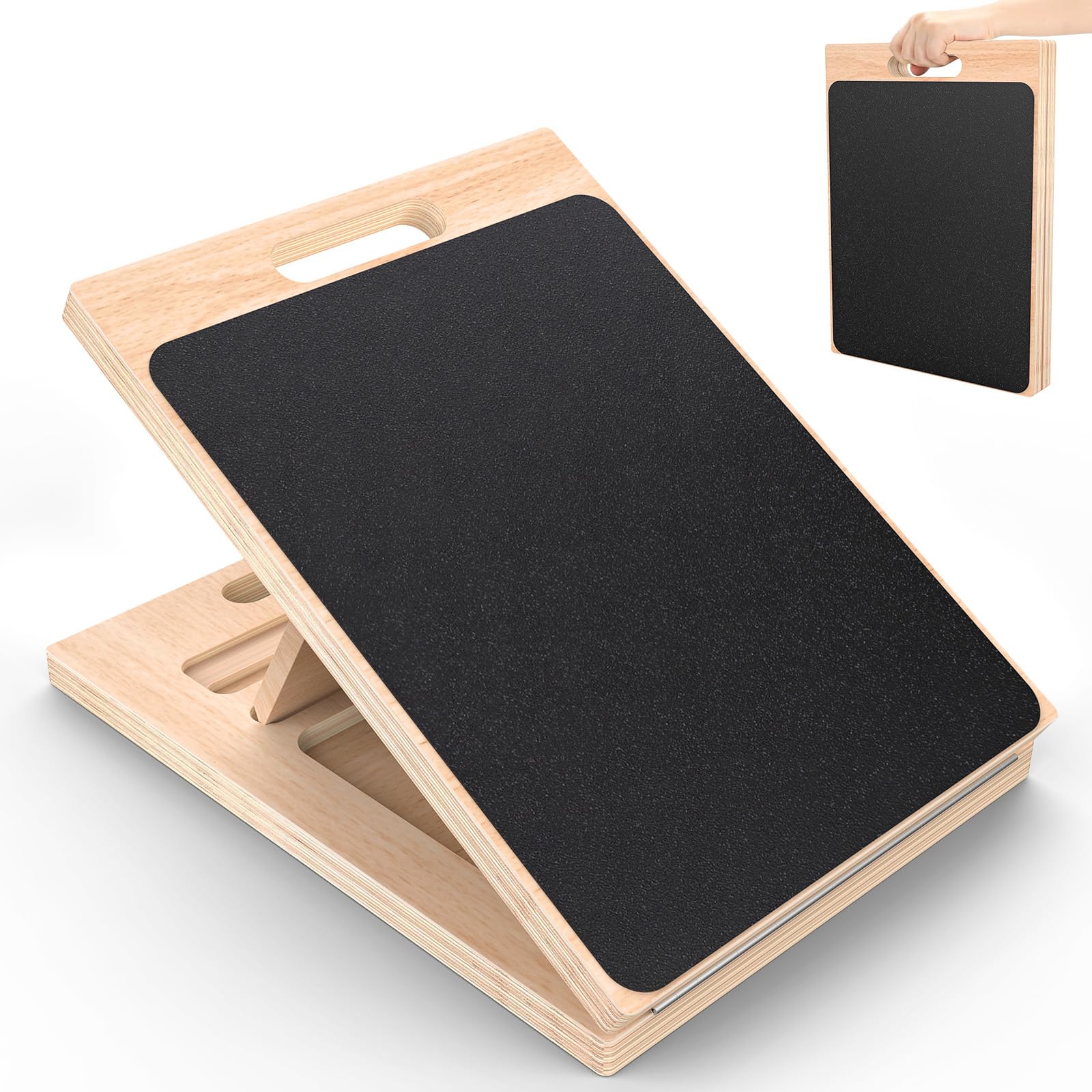
StrongTek Wooden Slant Board

StrongTek

StrongTek Wooden Slant Board

  • Weight 8.97 lb
  • Material Lauan hardwood plywood
  • Deck Size 16 x 12.5 in
  • Incline Angles 15°, 20°, 25°, 30°, 35°
Check Price on Amazon

Gentle 15-to-35-degree steps on a hardwood deck that does not budge.

Fifteen degrees is where a good slant board starts, and it's where much of this group doesn't. StrongTek's lowest setting is 15 degrees, and above it the ladder climbs in five-degree steps — 20, 25, 30, 35. That's the progression we want for a first board: gentle enough that you can hold a real stretch at the bottom, granular enough that moving up a notch is a nudge rather than a leap.

What we came to appreciate after standing on it is how little the board wants to move. It's roughly nine pounds of Lauan hardwood plywood, 16 inches deep and 12.5 wide, and that mass does the work a thin plastic wedge can't: you lean into the stretch and nothing skates across the floor. The grip tape is aggressive enough for a bare foot and still fine under a lifting shoe, and the side handles mean one hand moves it between rooms instead of a two-armed hug.

Fit and finish are the other reason it sits first. The edges are sanded clean, the plywood is a hardwood rather than the pine several boards here use, and the deck sits flat with no rock in it. You pay a premium for that, and for the nine pounds. Neither feels wasted on something you'll stand on most days of the week.

Bottom Line

We recommend this as the one board most people should buy: a genuinely gentle 15-degree start, five even steps, and a hardwood deck that stays put underfoot.

Check Latest Price

Best For Gentle rehab progressions

Our Score 9.6/10
ANVICTOX Wooden Slant Board

ANVICTOX

ANVICTOX Wooden Slant Board

  • Weight 5.6 lb
  • Deck Size 15.7 x 11.8 in
  • Incline Angles 15°, 20°, 25°, 30°
  • Weight Capacity 250 lb
Check Price on Amazon

If a therapist has told you to start shallow and stay there, this is the board built around that instruction. Four settings — 15, 20, 25 and 30 degrees — and nothing above 30, so the whole range is progression rather than performance.

The reasoning behind the hardware is what convinced us. Wooden boards in this group tend to fail at the adjustment bracket, where short fasteners pull out of the deck; ANVICTOX runs longer screws through that joint, which is the right place to spend a little extra. At 5.6 pounds with a 15.7-by-11.8-inch deck, it's light enough to move and big enough for both feet.

The 250-pound capacity is the lowest here and the reason we don't rank it higher — if you're a heavy lifter, the 500- and 900-pound boards are the honest choice. For everyone else it's the gentle, inexpensive way into daily stretching, and it's the newest design in this group, so we're still watching how those reinforced brackets age.

Bottom Line

We recommend this for anyone told to start shallow and stay there: four five-degree steps from 15 to 30 degrees and no temptation to jump ahead.

Check Latest Price

Best Value

Our Score 9.4/10
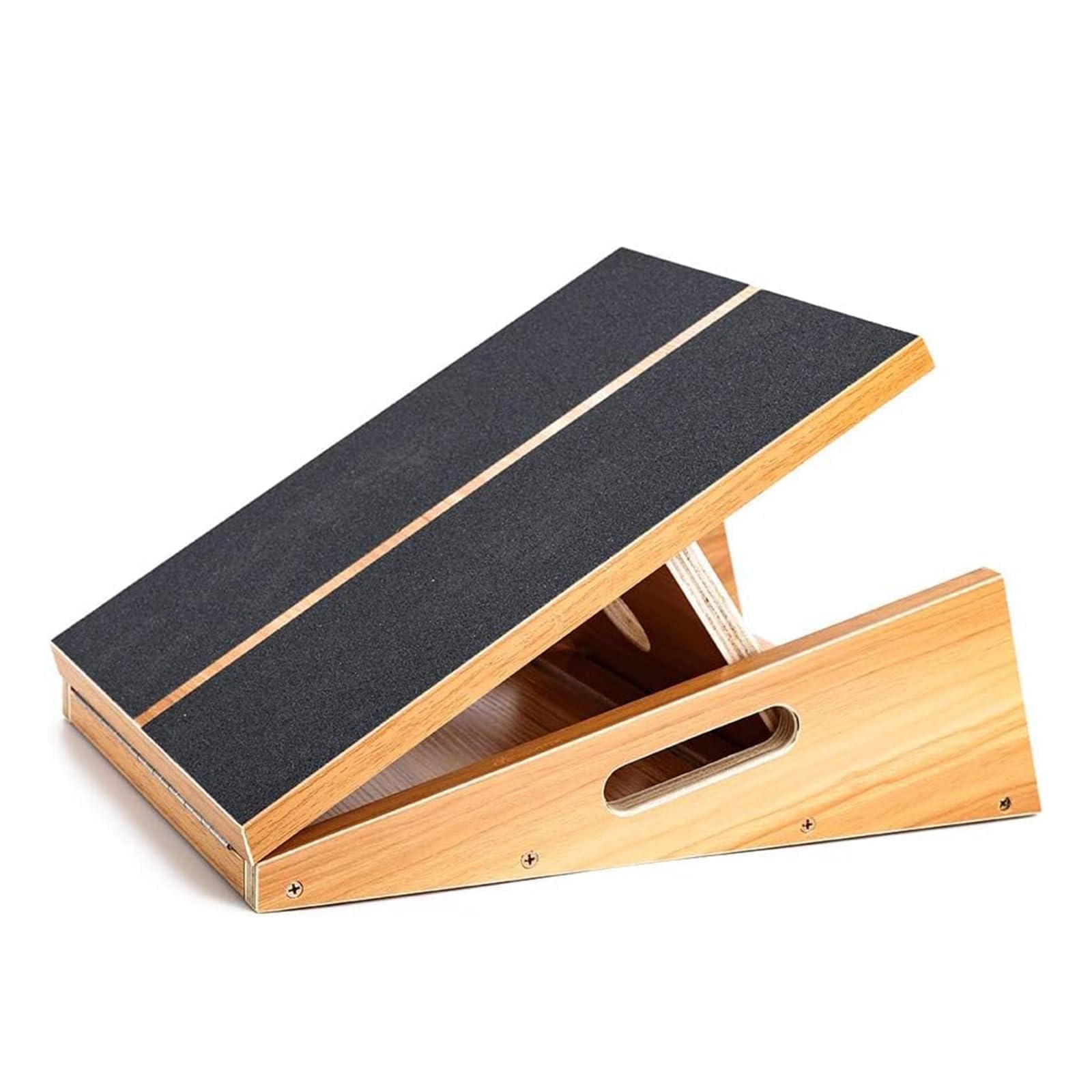
MUCITAGF Wooden Slant Board

MUCITAGF

MUCITAGF Wooden Slant Board

  • Warranty 3 years
  • Deck Size 16 x 12.5 in
  • Incline Angles 15°, 20°, 25°, 30°, 35°
  • Weight Capacity 500 lb
Check Price on Amazon

The same 15-to-35 angle ladder for less, backed by a three-year warranty.

Set this board next to our top pick and the differences are mostly in the materials: the same five angles from 15 to 35 degrees, the same 16-by-12.5-inch deck, the same pair of side handles. What you save is real, and the three-year manufacturer warranty is longer than anything else here. That combination makes it the value pick rather than the compromise.

It's rated to 500 pounds and built from plywood with reinforced supports under the deck. The standing surface is textured rather than smooth, which holds a sock foot in place — a smaller thing than it sounds until your heel starts creeping mid-stretch. The base is slip-resistant too, so a hardwood floor doesn't turn the whole board into a sled.

Where it gives ground to the StrongTek is the finish and the heft. This one feels like a well-made tool rather than a piece of furniture, and it's a touch lighter. We keep it in the garage-gym recommendation without hesitation, and the included exercise guide is a genuine help if you've never set up a heel-elevated squat before.

Bottom Line

We tell anyone who liked our top pick but not its price to buy this instead — same angles, same deck size, and the longest warranty in the group.

Check Latest Price

Best for Squats

Our Score 9.4/10
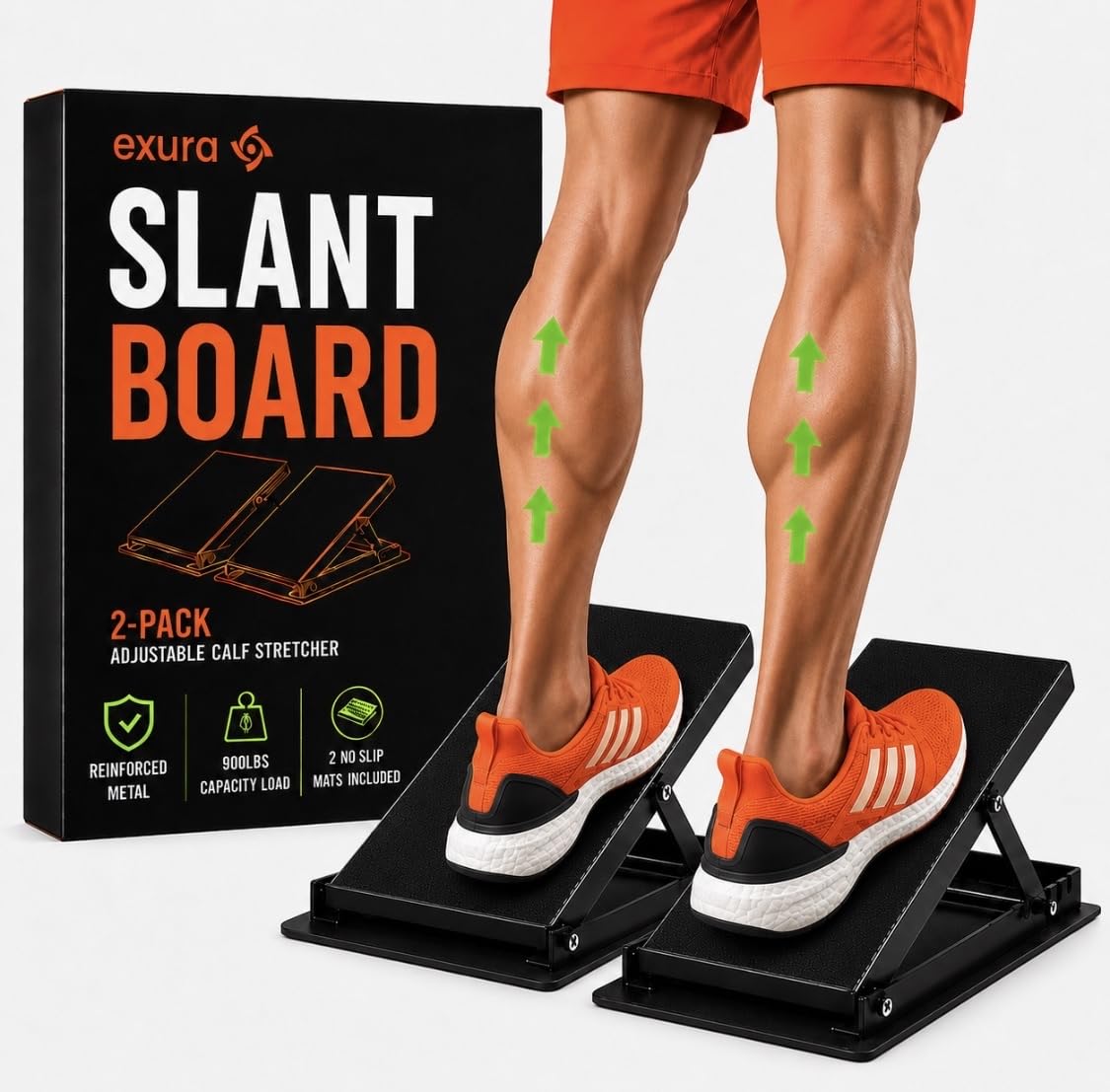
EXURA Adjustable Slant Board

EXURA

EXURA Adjustable Slant Board

  • Material Metal
  • Platforms Two, independent
  • Weight Capacity 900 lb
  • Incline Settings Four levels, 20° to 40°
Check Price on Amazon

Two independent 900-pound platforms let each foot take its own angle.

Two plates instead of one deck is the entire idea. Each metal platform tilts on its own, and you set them wherever your feet want to be — close together for a calf stretch, wide for a sumo squat, staggered for a split squat. There's no board deciding your stance for you.

For plain calf stretching, that independence is a nicety. For squatting it's the most useful thing in this guide. Heel-elevated squats want the heel up and the stance free, and a single 12-inch deck forces your feet into the width it was built for. We reached for the EXURA pair whenever squats were the point of the session, and for a single deck when they weren't.

The build justifies the spend: matte black metal, anti-slip rubber on the standing surface, no wobble in the frame, and a 900-pound capacity that's the highest in this group. Two plates are also two things to store and to keep together, which is the cost of the design rather than a fault in it. If you want one board to lean in a corner, this isn't the one.

Bottom Line

If squatting is why you're shopping, we point you here: two independent metal platforms let each foot find its own angle and your stance find its own width.

Check Latest Price

Best Steel Build

Our Score 9.2/10
YONKFUL Steel Slant Board

YONKFUL

YONKFUL Steel Slant Board

  • Weight 10.8 lb
  • Material Steel
  • Incline Angles 15°, 23°, 30°, 35°, 40°
  • Weight Capacity 600 lb
Check Price on Amazon

A steel deck rated to 600 pounds that will not crack or splinter.

Almost every board here is wood, and wood is where this category's failures come from: a deck that cracks, a bracket that pulls its screws. YONKFUL's answer is to stop using wood. The frame and deck are steel, finished in black, rated to 600 pounds, with sandpaper grip on the standing surface and four rubber feet underneath.

That's why it earns a place. It's the board we point heavier lifters to, and the one that doesn't care if it gets dropped on a garage floor. The angle range is odd but generous — 15, 23, 30, 35 and 40 degrees. That seven-degree jump off the bottom is clumsy next to the five-degree ladders elsewhere, but a 15-degree floor and a 40-degree ceiling give you more usable range than our top pick does.

Nearly 11 pounds of steel is the price of all that. You won't carry it up and down stairs often, and the frame eats into the usable standing area — if you like a wide two-foot stance, a wood deck gives you more room between the rails. For loaded work, neither matters much.

Bottom Line

We recommend the steel build to heavier lifters and to anyone who has already had a wooden deck give way underneath them.

Check Latest Price

Best For Deep stretch work

Our Score 9.2/10
NORBASE Wooden Slant Board

NORBASE

NORBASE Wooden Slant Board

  • Weight 5 lb
  • Material Wood
  • Deck Size 15.74 x 11.81 in
  • Incline Angles 30°, 35°, 40°, 45°
Check Price on Amazon

Thirty degrees is where this board starts, which reads as either a warning or a recommendation depending on who's holding it. Four settings — 30, 35, 40 and 45 — make it the steepest-starting board in this group and, at the top end, as steep as anything here.

If you've been stretching for years and 15 degrees stopped doing anything for you, this is the one that goes where the others can't. The same applies if you're using a board for heel-elevated squats and split squats, where the point is depth rather than a gentle ramp. It's also the easiest wooden board here to live with: five pounds, about 15 by 12 inches, and thin enough to stow under a dresser or stand behind a couch.

The non-slip pads hold on a wood floor even at the steepest setting, which is where a light board usually starts walking, and the deck is wide enough to take both feet in shoes. We see it as a second board for a flexible user rather than a first board for a tight one, and the extra stowability is what makes that realistic.

Bottom Line

A board for people whose calves are already loose: it starts where most boards finish, at 30 degrees, and climbs to the steepest setting here.

Check Latest Price

Best Folding Design

Our Score 9.0/10
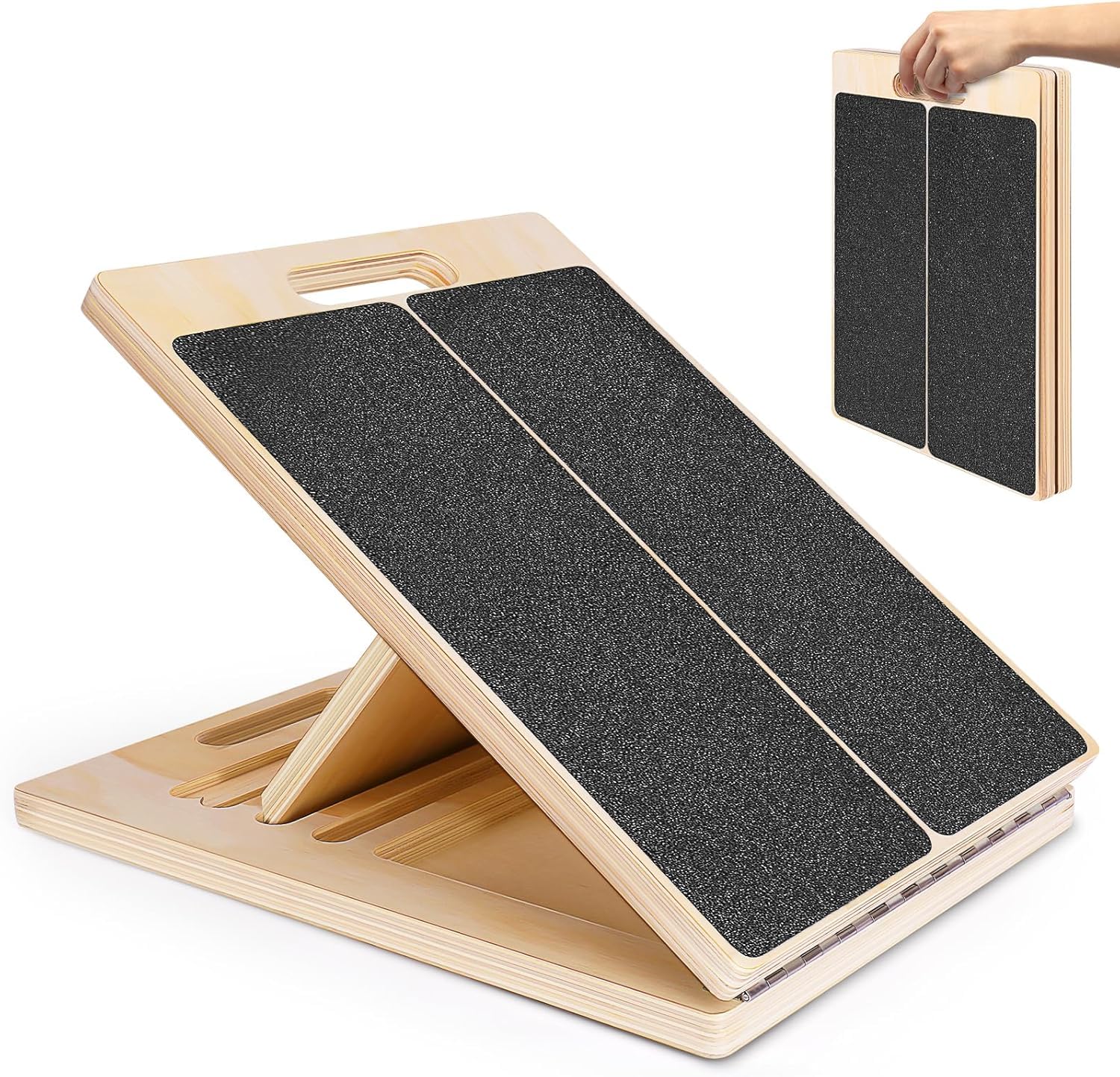
TEMI Folding Slant Board

TEMI

TEMI Folding Slant Board

  • Folds Flat, built-in handle
  • Deck Size 15.75 x 11.8 in
  • Incline Angles 20°, 25°, 30°, 40°
  • Weight Capacity 500 lb
Check Price on Amazon

Folds flat, carries by a handle, and holds 20 to 40 degrees.

Storage decides how much you actually stretch. This is the board we hand someone whose stretching spot is a hallway, a corner of a bedroom, or a living room that has to look like a living room ten minutes later. It folds flat, carries by a built-in handle, and slides behind a door or under a bed between sessions.

Four angles — 20, 25, 30 and 40 degrees — and a non-slip surface that holds a shoe or a sock foot. Twenty degrees is the gentlest it gets, which is fine for most calves and not enough for an ankle that's been told to start at 15.

The folding hinge is one more part carrying your weight, and it's where this board is weakest: the deck can crack during use. Keep the screws snug and stay inside the 500-pound rating, and it's a fair trade for a board that disappears when you're finished with it.

Bottom Line

We recommend this for anyone whose stretching spot is a hallway or a shared room — it folds flat, carries by a handle, and starts at a usable 20 degrees.

Check Latest Price

Best For Balance plus stretch

Our Score 8.8/10
ODCPN 3-in-1 Slant Board

ODCPN

ODCPN 3-in-1 Slant Board

  • Modes Slant plus 180°/360° balance
  • Material Wood
  • Deck Size 17 x 11.8 in
  • Incline Angles 20°, 23°, 30°, 35°, 40°, 45°
Check Price on Amazon

Three arc-shaped panels clip magnetically onto this board and turn it into a rocker. Set them up one way and it tilts across 180 degrees; set them the other and it rotates a full 360. Pull them off and you have a wooden slant board with six angles running from 20 to 45 degrees.

For an ankle working its way back from a sprain, that pairing earns its keep. The stretch buys range in one direction; the rocker makes the joint control load in every direction. It does the work of a separate wobble board without a second object on the floor, which in a small rehab corner counts for more than it sounds.

What keeps it out of the top tier is the balance hardware itself. Three panels to keep track of, and a conversion to check before every session. We recommend it for ankle work specifically rather than as a general-purpose stretcher; the simpler boards here handle a plain calf stretch with fewer parts to lose.

Bottom Line

We recommend this for an ankle coming back from injury: it stretches and then converts into a rocker, replacing a second piece of equipment in the same footprint.

Check Latest Price

How We Tested Slant Boards

To build our shortlist, we read through physical therapy forums, running-club threads, and home-gym reviews, then filtered for boards with credible weight limits, secure grip surfaces, and angle ranges that made sense for first-timers and daily stretchers. We narrowed that group to a dozen boards, from fixed wedges to multi-angle adjustable models, and tested them for eight months.

During that time, the boards lived where people actually stretch: on hardwood in a living room, on low-pile carpet in a home office, and on a rubber mat in a garage. Each morning I used one before a walk; in the evening we did wall calf stretches, toe raises, and balance drills. We stood on every board barefoot and in sneakers, shifted weight side to side, and noted any flex, wobble, or sliding. To judge calf stretching, we measured how far our heels could drop at each angle and whether the pull landed in the upper or lower calf. On adjustable models, we changed settings mid-session, timed the switch, and checked whether pins and hinges locked securely.

At the end of each month, we re-checked every board for wear: peeling grip tape, splintered edges, compressed foam, rusted hardware, and any new wobble. We also measured the actual angle of each setting instead of trusting the label, and stored each board under a couch, behind a door, and on a shelf to see how much space it really took. For value, we compared construction and materials against the typical price of similar boards and asked whether each one felt like a long-term tool or a stopgap.

How to Choose

Start With the Lowest Setting

Boards in this group begin anywhere from 15 to 30 degrees, and that bottom number decides whether you can use one on day one. Fifteen or 20 degrees is where a stiff calf or a recovering ankle belongs. Thirty degrees is already a deep stretch, and a board that begins there has nothing to offer someone who needs to build into it.

The top end matters less than the marketing suggests. For general mobility, 35 degrees is plenty; only deep-stretch and squat work calls for 40 or 45. Pay attention to the gaps, too. A board that jumps 10 degrees between settings feels like a shove, while five-degree increments let you creep up on a new range without dreading the next notch.

Stability Is a Weight and Footprint Question

Light boards slide. A four-and-a-half-pound wedge on a hardwood floor can skate the moment you lean forward into a stretch, and the cure is either mass or grip. Our steadiest picks run close to nine pounds with a full non-slip base; the lightest ones lean on rubber pads and a textured deck instead. On carpet, weight matters less and deck size matters more.

Check what the base actually covers. A board with four small feet can rock on an uneven surface, while a full pad or a solid rubber rim sits flat. Grip on top is the other half: textured decks and sandpaper both hold a dry foot, but dust and pet hair defeat either, so keep the surface wiped.

Wood, Steel, and Where the Load Goes

Almost every board here is plywood, and the failure they share is at the joint carrying your weight — a bracket that pulls its screws, a deck that cracks across the grain. The sturdier wood boards reinforce that joint or use hardwood instead of pine. The steel option sidesteps the question entirely, at the cost of three extra pounds and a narrower standing area between its frame rails.

A folding board adds one more loaded part, which isn't a reason to avoid one but is a reason to check the hinge screws when it arrives and again every few months. Whatever you buy, stay well inside the stated capacity rather than at the top of it; the rating is a ceiling, not a target.

One Deck or Two, and Where It Lives

A single deck around 12 inches wide takes both feet for a calf stretch and doubles as a squat wedge. Two independent platforms cost more, but they let you set stance width and per-foot angle yourself — worth it if squats and split squats are the main event, unnecessary if calf stretching is.

Then be honest about where it will live. The board you use is the board you leave out, so a fixed wedge beside the kitchen counter gets stepped on daily while a folding one tends to stay folded. A fixed wedge also stands tall enough at its steepest to catch a toe, so park it against a wall rather than in a walking line.

Frequently Asked Questions

Final Verdict

Buy the StrongTek if you want one wooden board that outlasts your resolution: a 15-degree floor, five-degree steps, hardwood instead of pine, and enough weight that it never moves underfoot. If the hardwood doesn't justify the extra spend for you, the MUCITAGF runs the identical angle ladder with a longer warranty and is the smarter buy for a garage gym.

And if your training is squats rather than stretching, skip both. The EXURA pair is the only design here that lets your stance and each foot's angle be your own decision.