Strength & Weights

Best Power Rack and Smith Machine Combos of 2026

A power rack, a Smith machine, and a cable station used to mean three separate purchases and most of a garage. The combo units that have taken over the category fold all three into one footprint, and that tradeoff is the whole story: you save the space of two machines, and you accept that every function has to work well inside the same frame. When it works, it's the most useful thing in a home gym. When it doesn't, you're lifting inside a cage that walks across the floor on heavy sets while the Smith bar binds halfway up.

I've trained on enough of these to know a spec sheet lies by omission — the weight rating says nothing about whether the guide rods glide or grind, and nothing about whether the hole spacing actually lines up with your bench press. Six combos have lived in my garage and my team's basements over the past ten months, and the difference between a good one and a frustrating one shows up in week one, usually during assembly. The picks below are the ones we kept coming back to.

Best Overall

Our Score 9.8/10
pooboo P43 Power Cage

pooboo

pooboo P43 Power Cage

  • Warranty 2 years
  • Footprint 62.9"D x 43.3"W x 82.6"H
  • Cable Rating 1,000 lb
  • Weight Capacity 2,000 lb
Check Price on Amazon

Narrowest full cage here, with a 2,000-pound rating and the cleanest record in this guide.

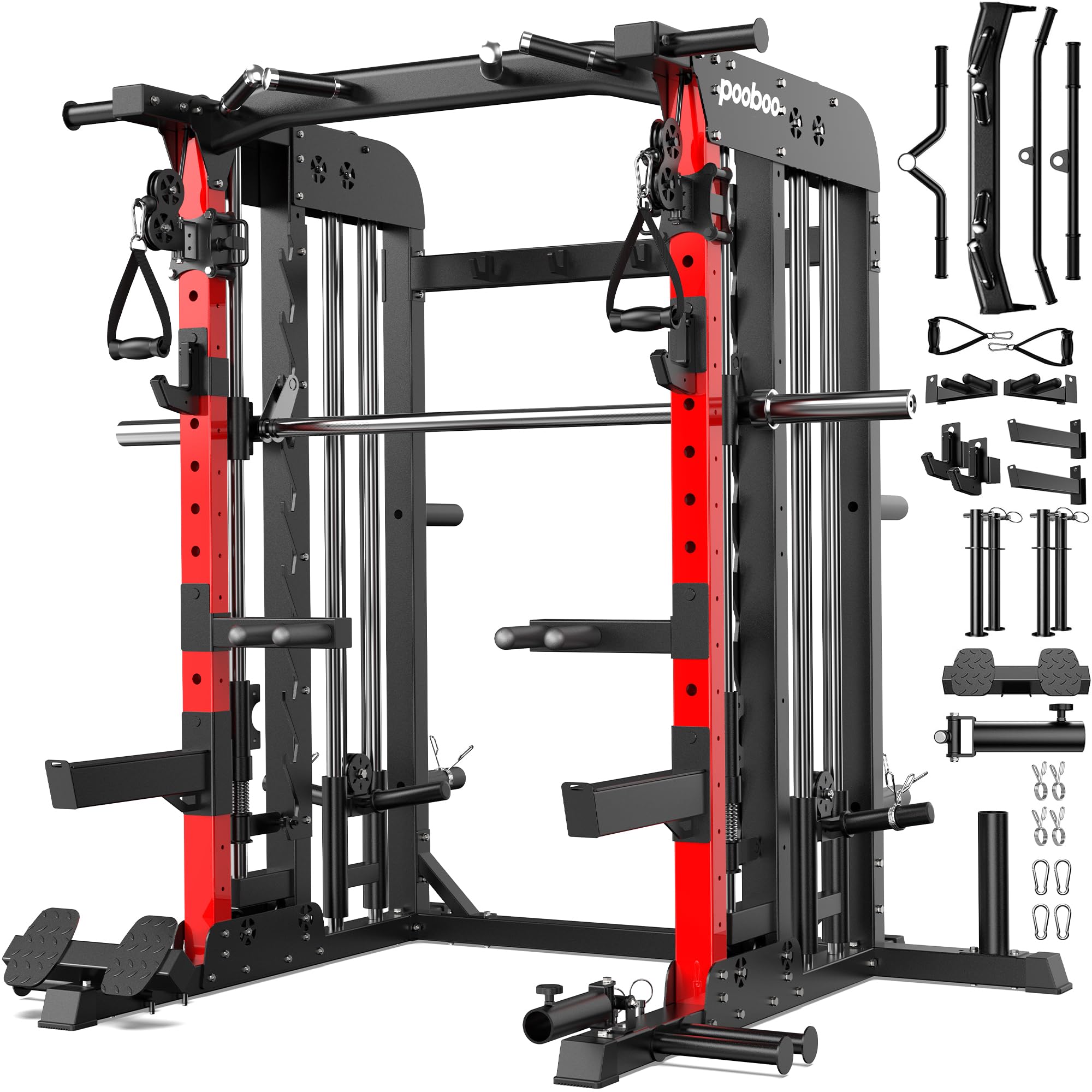
Forty-three inches is the number that earns the P43 the top spot in this guide. That's the width across the frame, and it's the narrowest full cage here by a clear margin — narrow enough to sit against a garage wall and still leave room to load a bar. Everything else about the footprint is ordinary; it's that width, paired with a 2,000-pound rating on the rack and Smith bar, that made us stop comparing.

The build holds up to the number. The frame squares without shimming, the instructions are illustrated and in a sensible order, and an afternoon with a second pair of hands gets you from boxes to a finished cage. The more than 20 attachments in the box aren't filler, either: spotter arms, dip bars, cable handles and a lat bar cover the extras that quietly add up on cheaper racks.

The cable station runs on bearing pulleys rated to 1,000 pounds, and resistance comes from plates you hang on the carriages, so the weight you feel starts with what's in your plate pile. It's the one station where the stack machines in this guide have the advantage, and it's worth knowing before you order.

One thing to settle before assembly day: 417 pounds of built steel doesn't slide across a floor, so choose the spot and stay with it. Get that right and there's very little about this machine you'll still be thinking about a month in, which is the highest compliment a home gym gets.

Bottom Line

The full cage we recommend first: narrow enough for a real garage wall, rated to 2,000 pounds, and the least argued-about machine in this guide.

Check Latest Price

Best For First setups

Our Score 9.4/10
OPPSDECOR All-in-One Smith Machine

OPPSDECOR

OPPSDECOR All-in-One Smith Machine

  • Storage Barbell and plate holders
  • Stations Smith bar, lat pulldown, landmine
  • Weight Capacity 1,400 lb
Check Price on Amazon

If this is your first rack and the budget is tight, the OPPSDECOR is the one we point you to. It's the least expensive combo here by a wide margin, and it still gives you a Smith bar, a lat pulldown, a landmine and a pull-up bar on a 1,400-pound frame.

The details are better than the price suggests: bearing pulleys rather than sliding collars, a triangular frame that keeps the base from sprawling, and storage for a barbell and plates so the floor stays clear. The lat bar, row bar and pull-up bar come with it.

The catch is information. The listing gives 40 by 70 inches without saying which figure is the width, so confirm the assembled footprint with the seller before you commit a wall to it. Assembly runs a few hours and goes faster with the hardware laid out by step.

The frame is the whole argument: 1,400 pounds covers a lot of home lifting, and a machine that gets you training this month beats a better one you're still saving for. It won't be the last rack you buy, but it might be the one that starts the habit.

Bottom Line

The entry point: four stations on a 1,400-pound frame for less than anything else here, provided you confirm the footprint before you buy.

Check Latest Price

Best with Weight Stacks

Our Score 9.2/10
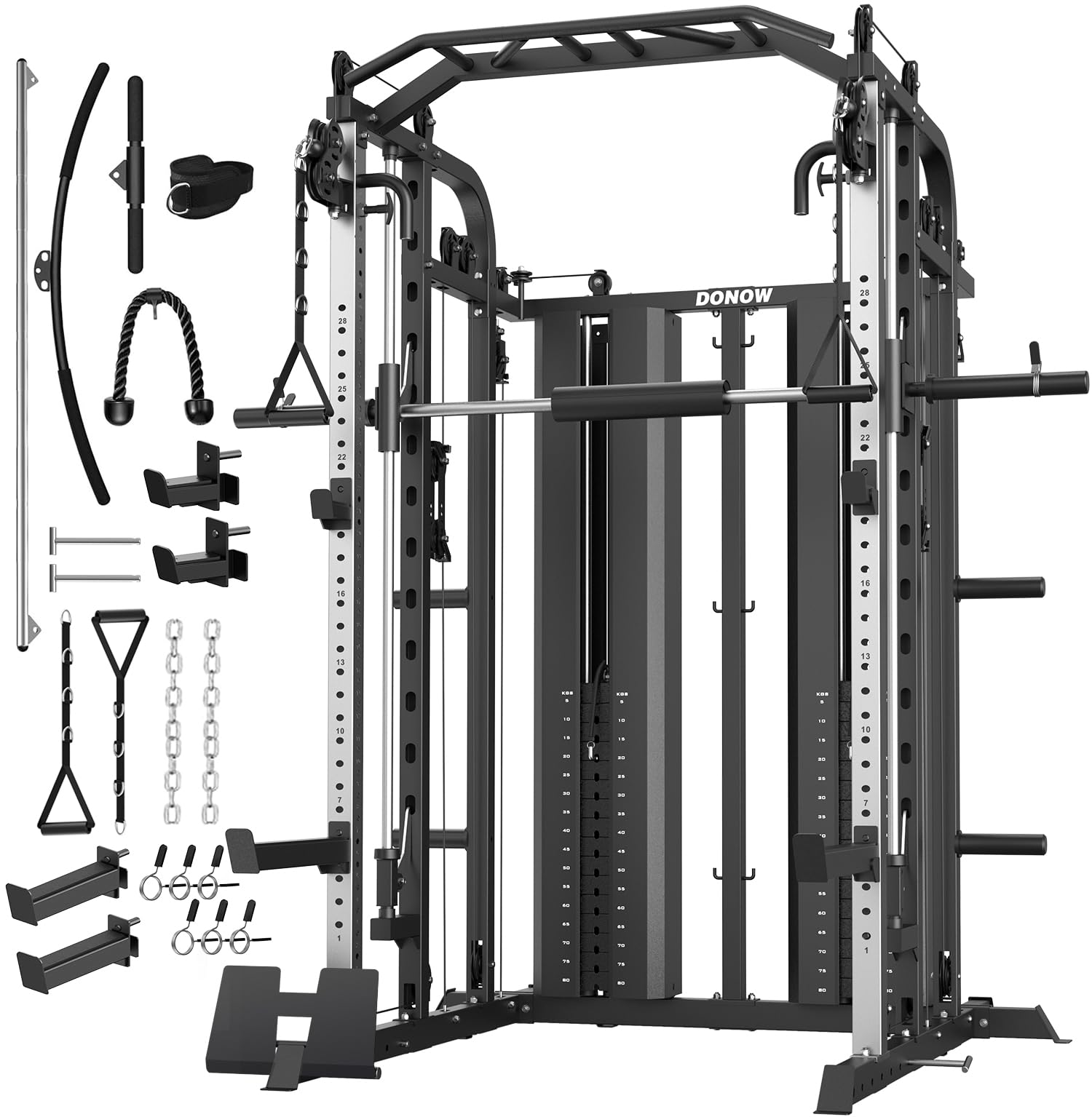
DONOW DN-DS938 Smith Machine

DONOW

DONOW DN-DS938 Smith Machine

  • Warranty 2 years
  • Footprint 54.7"D x 78.58"W x 88"H
  • Weight Stacks 352 lb total, 2:1 ratio
  • Weight Capacity 2,240 lb
Check Price on Amazon

Two selectorized stacks mean you pin resistance instead of loading plates.

Two weight stacks change how a machine like this gets used. The DN-DS938 carries 352 pounds of selectorized resistance split across two independent sides, running through a 2:1 pulley ratio that trades some felt weight for a longer, smoother pull. A lat pulldown or a crossover takes a pin instead of a plate shuffle, and two people can work at once without negotiating.

The commercial feel is in the details: stacks enclosed in steel covers, a Smith bar on linear bearings, and a frame rated to 2,240 pounds — the highest figure in this guide. For anyone whose program leans on cables, it's the pick here.

Assembly is the part we braced for, and the manual is why. It arrives in eight boxes, the written steps and the video have confusing stretches, and the job is realistically a couple of evenings rather than one. Build it in stages, leave the bolts snug until the frame is square, then tighten everything down.

What you're buying over the plate-loaded cages is a station you'll use every session without setup: walk up, pull the pin, train. That convenience is worth more than the frame rating on the days you're short on time.

Bottom Line

Buy this one if cables are the point of your training: two independent stacks, a 2,240-pound frame and the shortest setup-to-workout path here.

Check Latest Price

Best For Premium cable feel

Our Score 9.0/10
Major Fitness Drone2

Major Fitness

Major Fitness Drone2

  • Uprights 2" x 2" steel
  • Warranty 1 year
  • Pulley Ratio 1:1
  • Weight Capacity 2,000 lb
Check Price on Amazon

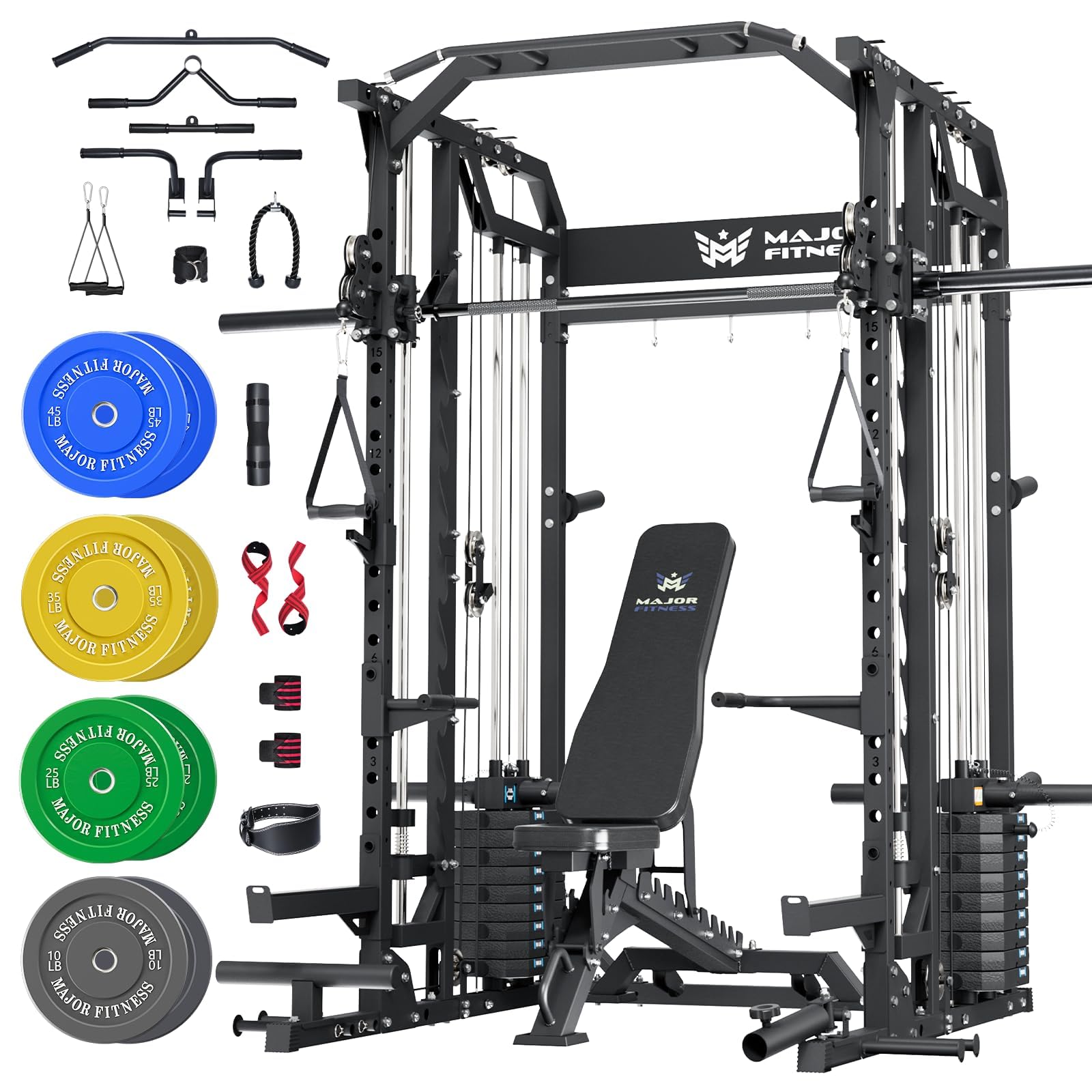
A 1:1 pulley ratio is what separates the Drone2 from most of the field. Where a 2:1 system halves the load and lengthens the pull, this one hands you the plate weight you loaded — better for slow, heavy cable work, less flattering on high-rep burnout sets.

Around that pulley set sits a serious frame: 2-by-2-inch commercial-grade steel, a 2,000-pound rating and an aluminum pulley set that stays quiet under load. The accessory kit — dip handles, a T-bar, handles and the rest — comes in the box rather than adding up piece by piece.

What the money buys is the absence of friction: the cable path stays smooth through a long set, the Smith bar tracks straight, and the frame doesn't walk when you pull hard. We noticed it most on slow eccentric reps, where a cheap pulley shows up as a catch rather than a grind.

It's the premium end of this guide by a distance, and it earns that mostly at the cable station rather than in the attachment count. If a pin beats a plate for you, the DN-DS938 answers that need for a lot less.

Bottom Line

The smoothest cable feel in this roundup, at a premium, for the lifter who wants every plate they load to count.

Check Latest Price

Best Budget Full Cage

Our Score 8.8/10
JELENS M21 Smith Machine

JELENS

JELENS M21 Smith Machine

  • Pulleys Independent dual
  • Uprights 50 x 50 mm steel
  • Height Settings 20
  • Weight Capacity 2,000 lb
Check Price on Amazon

A 2,000-pound cage with independent pulleys at the lowest full-cage price here.

We keep the M21 on this list for one reason: it's the least expensive route here to a full cage rated to 2,000 pounds, with independent pulleys on both sides so two people can work at once. That combination is unusual at any price.

The frame is 50-by-50-millimeter steel with 20 height positions for the Smith stops and J-hooks, and the attachment set covers the usual stations — lat pulldown, cable handles, the rest. On paper it's a lot of machine for the money, and the Smith bar runs on a smooth track rather than a sticky one.

The action item before you order is the footprint: the listing never states an assembled size, and a cage is the last thing to guess at. Ask for the dimensions in writing, then measure the wall and the ceiling. With those confirmed, this is the least expensive way into a full cage that we found here.

Bottom Line

The cheapest way here into a 2,000-pound cage with independent pulleys, and a fair buy if your loads are moderate and your floor is solid.

Check Latest Price

Best For Exercise variety

Our Score 8.8/10
SunHome SH-999 Smith Machine

SunHome

SunHome SH-999 Smith Machine

  • Storage 6 plate posts, 1 bar post
  • Footprint 72"D x 60"W x 90"H
  • Frame Weight 440 lb
  • Max Weight Recommendation 800 lb
Check Price on Amazon

The SH-999's listing argues with itself. The title claims a 2,000-pound capacity; the specification line recommends a maximum of 800. Until that's cleared up in writing, treat it as an 800-pound machine — still more than most home lifters will ever load, but not the number on the box.

That caveat aside, what struck us here is the breadth: 440 pounds of steel, a butterfly chest station, six plate posts, a barbell post, storage hooks and rolling-bearing pulleys. It's the budget machine for someone who wants chest, back, legs and arms without three separate purchases.

Assembly is where the saving shows up. The manual is picture-only, the steps don't always match the hardware in front of you, and the build runs across a couple of evenings. Use a helper, keep the bolts loose until the frame is square, then tighten everything down.

Two measurements to check first: at 90 inches it's the tallest machine here, so it clears an eight-foot ceiling but not a low basement, and 72 inches of depth wants a long wall. Neither is a dealbreaker — they're just the two things you can't fix after delivery.

Bottom Line

The most exercise variety you can get on a budget, held back by a listing that can't agree on its own capacity and a hook that needs practice.

Check Latest Price

Best Compact Stack Machine

Our Score 8.6/10
Mikolo M4 2.0 Lite

Mikolo

Mikolo M4 2.0 Lite

  • Footprint 70.86"D x 47.3"W x 87"H
  • Weight Stacks 117 lb per side
  • Height Settings 34
  • Weight Capacity 2,200 lb
Check Price on Amazon

Weight stacks and a 47.3-inch width, so it fits a narrow garage bay.

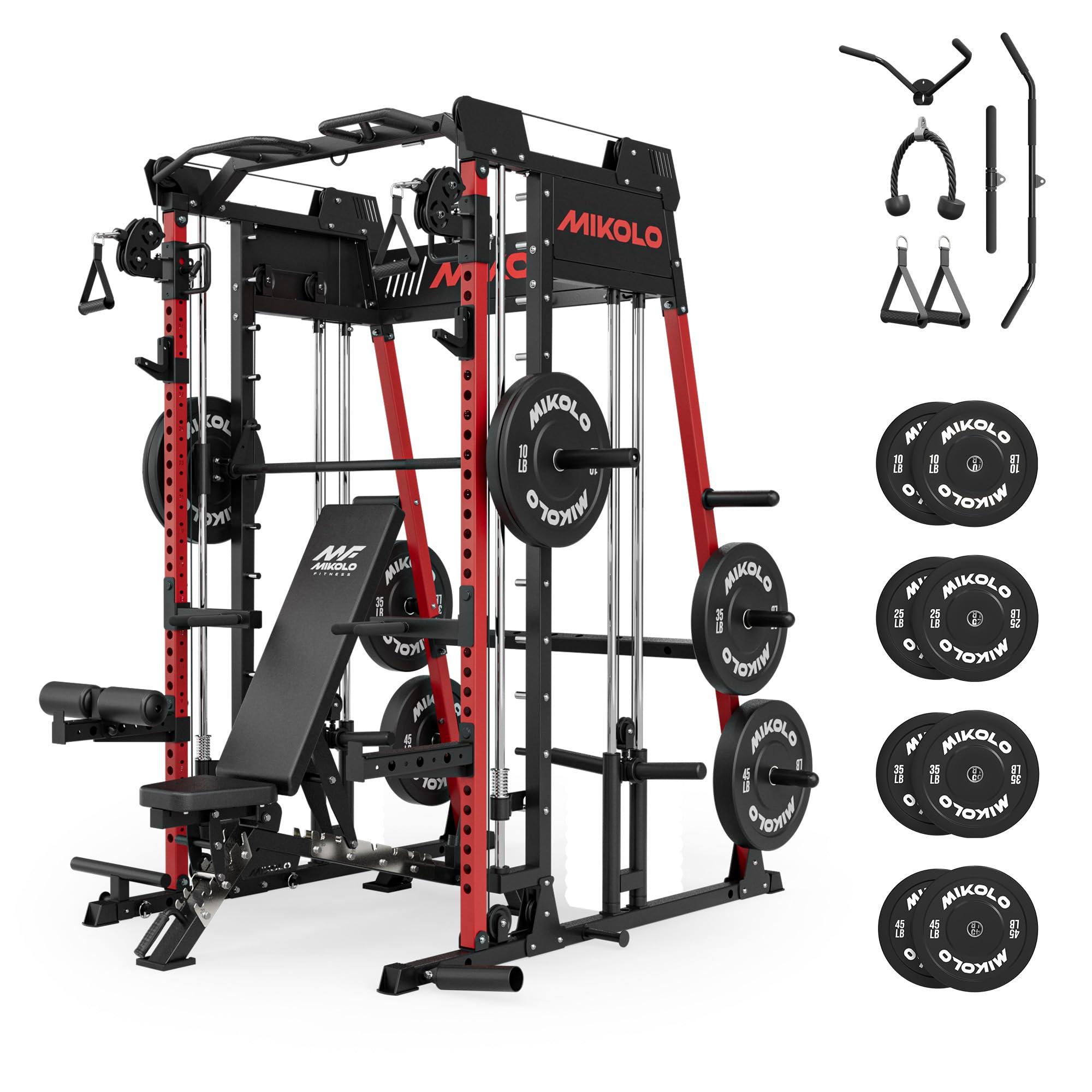
A couple of the M4 2.0 Lite's bolt-on accessories can miss their mark: the landmine bracket can be too small for its adapter, and one of the peg fittings can be too large for its hole. The rack itself is sound — it's the add-ons where the tolerances slip, and it's worth dry-fitting every accessory before the frame is fully together.

Past that, this is the most space-efficient stack machine in the guide. Two 117-pound stacks with 9-pound increments sit inside a 47.3-inch width, roughly what a plate-loaded cage takes up, and 34 height settings on 2-inch spacing put the J-hooks, safeties and Smith stops where your body actually is rather than two inches off.

What we appreciated most in daily use is how little of the floor and the session it takes up: dedicated rails for the J-hooks, safety arms and dip bars, plate posts and Smith bar storage mean you're lifting within a minute of walking in. Assembly is manageable with a helper, and the finished frame is sturdier than 389 pounds suggests.

Bottom Line

The stack machine for a tight room: 47.3 inches wide, 34 height settings, and enough storage that a session doesn't start with a search.

Check Latest Price

Best for Heavy Lifting

Our Score 8.6/10
RitFit M1 Pro Smith Machine

RitFit

RitFit M1 Pro Smith Machine

  • Footprint 63"D x 47.8"W x 85.2"H
  • Frame Weight 360 lb
  • Frame Warranty Lifetime
  • Weight Capacity 1,850 lb
Check Price on Amazon

Lifetime frame warranty and 1,850-pound steel for lifters chasing heavy numbers.

RitFit backs the M1 Pro's frame for life. That's the longest structural warranty in this guide, and it isn't decoration on a light machine: 2-by-2-inch steel uprights, a 360-pound frame and an 1,850-pound rating.

The Smith bar runs on linear bearings with spring-loaded protection, and the cable crossover uses a dual slide rail with aluminum pulleys. The bar tracks straight, and the uprights stay planted when you set up for a heavy squat.

The ecosystem is the other reason to look here: landmine, T-bar, dip handles, a lat pulldown bar and band pegs all come in the box and mount to the same uprights, so you're not buying brackets one at a time later. Assembly is a long afternoon rather than a weekend.

Where it lands for us is as the frame-first choice: more steel and a longer warranty than the budget cages, for a machine that will take everything you can put on it. If your training is bar work with cables as a supplement, that's the right priority.

Bottom Line

A frame you can stop worrying about, backed for life, with a Smith bar that behaves under a heavy single — as long as the cables aren't your main event.

Check Latest Price

How We Tested the Power Rack Smith Machine Combos

We started with every power rack and Smith machine combo we could confirm real specs for — around 30 — and cut the ones that couldn't clear a standard ceiling with a pull-up bar mounted, the ones whose listed footprint didn't match what buyers measured in their own garages, and the ones that couldn't take a rack pull at a weight a mid-level lifter would actually load. Six made it onto the floor.

Two of us built each unit from the crate on a Saturday, timing the job and noting where the manual went quiet: whether hardware was bagged by step, whether a diagram skipped a washer, whether it genuinely needed two people. Then each rack lived in a garage or basement gym for ten months — early sessions before work, weekend bench days, and deliberate abuse, including rack pulls heavy enough to make the frame complain and a few missed reps dumped onto the safeties. We watched the feet for lift and the uprights for any drift across the floor.

Between sets we paid attention to the boring stuff. How long it took to move the J-hooks and safeties one-handed, whether we could switch from the Smith bar to a free barbell without unloading plates, and whether the Smith bar glided the same empty as it did loaded. We checked the guide rods for play, ran each cable from the top pulley to the bottom and back looking for fraying, snagging, or rubbing against the frame at full extension, and judged plate storage by whether it stayed out of the bar path. Accessories got weighed against what they'd cost bought separately.

Fit we measured rather than trusted: upright to upright with a tape, ceiling height at the top of the pull-up bar, and bar clearance inside the cage. Welds, powder coat, and knurling got a look on arrival and again ten months in.

How to Choose

Measure the wall before the feature list

These machines are deeper than they look. Depth across this set runs from about 55 to 72 inches, and the Smith bar needs clear working room in front of the frame, so add a couple of feet to whatever the listing says. Width is where the choices really diverge: the P43 is 43.3 inches across while the DN-DS938 needs 78.58. Height runs from 82.6 to 90 inches, which clears an eight-foot garage ceiling but not a low basement joist.

Measure the wall, the ceiling and the door on the delivery route, in that order. A cage you can't stand up in isn't a bargain at any rating.

Weight stacks or plate-loaded cables

Selectorized stacks are the biggest single upgrade in this category: resistance changes with a pin, two people can work independently, and the stack is enclosed. You pay for it in money and width — the DN-DS938 needs 78.58 inches of wall for its two stacks.

Plate-loaded machines are cheaper and narrower, but you move plates between the Smith bar and the cable carriages. If cables carry your program, buy the stacks. If they supplement the rack, save the difference.

How the Smith bar locks and catches

The Smith bar is fixed to a track, so the hook is your safety net on a failed rep. Look for a bar that engages with a short, deliberate rotation and hooks you can see from your lifting position. Rehearse the re-rack at a light weight before you load it — on the SH-999 the bar can slide past the hook.

Then set the spotter arms just below your lowest position and treat them as the real safety, not the hook.

Budget two evenings for assembly

Every machine here ships in multiple boxes, and the manuals range from clearly illustrated to picture-only. Two habits save the build: lay the hardware out by step before you start, and leave the bolts snug until the frame is square, then tighten everything. Watch the assembly video for the section you're on if the listing has one.

A helper halves the time and saves your back when the uprights go up.

Match capacity to your lifts, attachments to your training

Ratings here run from 1,400 to 2,240 pounds, well past what most home lifters load — read the number as a proxy for steel thickness and how planted the frame feels. Attachments matter more week to week: spotter arms, dip bars and a landmine earn their space; a butterfly station earns it if you train chest at home.

Buy for the program you'll run in a year, not the one you're starting.

Frequently Asked Questions

Final Verdict

The pooboo P43 is the machine we point most people to. At 43.3 inches wide it fits walls most cages here won't, the frame and Smith bar are rated to 2,000 pounds, and nothing about it reads like a corner was cut.

If you'd rather pin a stack than hang a plate and you have the wall for it, the DN-DS938 delivers 352 pounds of selectorized resistance on a 2,240-pound frame. Cable-first or cage-first — that's the decision.