Strength & Weights

Best Lifting Chalk of 2026

Lifting chalk is one of those small gym purchases that can make or break a heavy set: a little grit on your palms is the difference between a confident pull and a bar that feels like it's coated in butter. But the chalk aisle is weirdly confusing—blocks, loose powder, liquid formulas—and the wrong pick either crumbles into dust before your first set or leaves a white mess all over the platform. What you want is grip you can trust, a clean and consistent texture, and packaging that keeps the stuff where it belongs.

I've been lifting long enough to be picky about my hands, and my team and I recently put 14 lifting chalks through four months of regular training. We used them on deadlifts, pull-ups, kettlebells, and a few sweaty garage sessions, paying attention to how each one felt, lasted, and cleaned up. The best ones shared a few traits: reliable grip, solid containment, and enough value that you don't wince every time you reorder. The picks below are the ones we kept reaching for.

Best Bulk Block

Our Score 9.4/10
Rage Fitness Gym Chalk

Rage Fitness

Rage Fitness Gym Chalk

  • Format Block chalk
  • Material Pure magnesium carbonate
  • Quantity 1 lb (eight 2 oz blocks)
Check Price on Amazon

A pound of blocks; the most chalk for the money in this guide.

A pound of chalk split into eight two-ounce blocks is a supply rather than a purchase — the kind of thing you buy once and find in the bottom of a bag two seasons later. For a garage gym, a coach chalking up a group, or anyone who goes through powder fast, that's the whole case.

The blocks arrive compressed and firm, which is how they survive shipping, and they break apart easily when you want powder. Rubbed straight onto the palms they leave a thin, dry layer that suits pull-ups and gymnastics holds; crumbled into a bucket they behave like any loose chalk. Having both options in one box is genuinely useful.

Grip is the thing to think about. Block chalk sits drier and thinner on the hand than powder poured from a bag, so for a maximal deadlift we crumble a corner and load the hands more heavily rather than rubbing the block. That's a technique adjustment rather than a flaw, but the box does reward a little effort.

Per ounce, nothing else here comes close, and a box this size means chalk stops being something you think about for a season or two.

Bottom Line

Eight blocks make this the box to buy if you stock a garage gym, coach a group, or go through chalk fast enough to notice the cost.

Check Latest Price

Best Premium Loose Chalk

Our Score 9.4/10
Primo Chalk Bucket

Primo

Primo Chalk Bucket

  • Format Loose chalk powder
  • Quantity 1 lb
  • Additives Essential oils
  • Packaging Resealable bucket
Check Price on Amazon

Ultra-fine powder with skin-conditioning oils in a resealable bucket.

The powder in this bucket is finer than anything else in the guide — soft enough that it goes on almost like a liquid, with no grit to work into the palm. Dipping a hand in is genuinely pleasant, which is not a sentence we expected to write about chalk.

It's blended with essential oils, and that shows up after the session rather than during it: hands that feel conditioned instead of tightened and dry, plus a light scent in the bucket that replaces the neutral mineral smell of plain magnesium carbonate. The resealable bucket keeps the powder dry, which matters if your gym is a garage.

Fine powder goes airborne more readily than a block, so treat this as a home-gym or lifting-gym pick rather than something to bring to a fitness club with a chalk policy. The bucket is compact enough to sit on a shelf and the lid seals properly, which is what you want in a humid space.

What the money buys is the last five percent: a finer grind, a nicer feel on the hands, and skin that doesn't resent you after a week of daily sessions. If you chalk up twice a week, save the money; if it's part of your setup, this is the one to spend on.

Bottom Line

If chalk is part of your daily routine, this is the one to spoil yourself with: soft powder, oils, and hands that don't hate you afterward.

Check Latest Price

Best Overall

Our Score 9.2/10
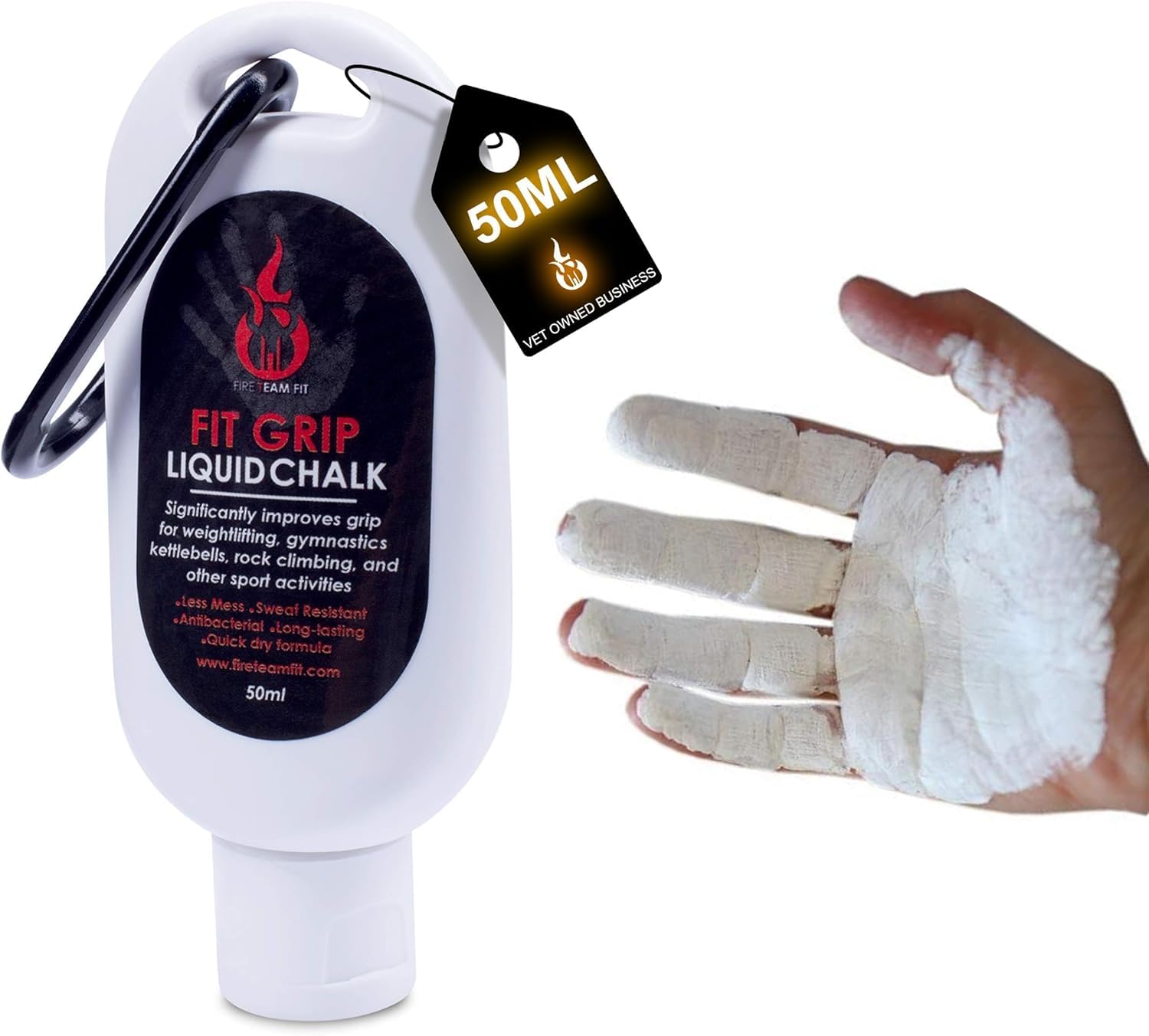
Fire Team Fit Liquid Chalk

Fire

Fire Team Fit Liquid Chalk

  • Format Liquid chalk
  • Bottle Size 250+50ml
  • Common Uses Deadlifts, pull-ups, kettlebells
Check Price on Amazon

Dust-free liquid chalk with a big bottle that carries you through a session.

The bottle is the argument: 250 ml with a 50 ml spare tucked into the pack, which makes it the biggest liquid container in this guide and enough chalk to last a lifter months rather than weeks. It squeezes out thicker than the watery liquids, closer to lotion than hand sanitizer, so a small blob covers both palms and sets into a dry, faintly tacky film. We got through full sessions of deadlifts, rows, and pull-ups on one application, and it came off with soap and water instead of leaving gray handprints on the bar.

High-volume work is where it thins out. Long sets of snatches, or a deadlift taken past ten reps, wear the coating through at the palm crease, so the small bottle earns its place in your bag for a mid-session top-up. Give it a moment to set before you touch a bar; liquid chalk that hasn't dried just slides.

A block or a bag of powder still puts a thicker, drier layer on your hands, and if you lift at home or in a powerlifting gym where dust is part of the floor, one of those is the better buy. What this bottle buys is the setting: no cloud, no gray platform, no conversation with a staff member about the mess under the squat rack.

Bottom Line

Anyone lifting in a gym that frowns on dust should start here: thick enough for deadlifts, dry within seconds, and it washes off with soap.

Check Latest Price

Best Loose Chalk

Our Score 9.2/10
321 STRONG Gym Chalk

321 STRONG

321 STRONG Gym Chalk

  • Format Loose chalk powder
  • Quantity 3.53 oz
  • Packaging Zip-top bag
Check Price on Amazon

Fine powder in a zip bag for the smallest outlay here.

A hundred grams of loose powder in a zip-top bag is the plainest thing in this guide, and for a lifter who already owns a chalk bucket it's the obvious refill. The powder is fine and dry, coats evenly in a couple of passes, and doesn't clump the moment your hands start sweating.

What keeps us coming back is the outlay: nothing here asks less of your wallet for chalk that genuinely works. It's good on a knurled bar, on kettlebells, and on rings, and it brushes off the bar at the end of a session rather than smearing into the knurling the way a liquid film can.

The bag is the weak point. The zip itself holds, but the opening is narrow for the size of the bag, so getting a full hand in means digging around; we decanted ours into a wider tub. Keep it inside something rigid as well — a seam that splits empties a hundred grams of powder into whatever it's sitting beside.

Buy it when you want the smallest possible commitment and a supply you can pour into whatever container you already use. If sheer volume matters more than the up-front outlay, the Rage box goes much further.

Bottom Line

You get good chalk with the smallest possible commitment here — fine powder in a zip bag that refills any ball, bucket, or bag you already own.

Check Latest Price

Best for the Gym Bag

Our Score 9.2/10
EVMT Liquid Chalk

EVMT

EVMT Liquid Chalk

  • Format Liquid chalk
  • Bottle Size 2 oz (50 ml)
  • Drying Time 10–15 seconds
Check Price on Amazon

A pocket-sized bottle that dries fast and bails you out anywhere.

Two ounces, a screw cap, and a shape that vanishes into a side pocket: this is the bottle we keep as a spare and the one we hand someone who has never used liquid chalk. It's small enough that there's no excuse to leave it at home.

We were surprised by how far a bottle this size stretches. A couple of drops per hand dry in seconds into a coating that holds a deadlift set without going slick, and it wipes away with a damp towel between lifts if you need a clean palm for anything else.

The trade is volume. Two ounces goes faster than you expect if you train four or five times a week, so treat it as a bottle to keep in the bag and replace a few times a year rather than a bulk buy. For twice-a-week lifters, and for anyone who just needs chalk on the days the gym's bowl is empty, it's plenty.

Bottom Line

Keep one in your bag and you're covered on the days the chalk bowl is empty, the gym bans dust, or you simply forgot your own.

Check Latest Price

Best Budget Chalk Ball

Our Score 9.2/10
Z Athletic Chalk Ball

Z Athletic

Z Athletic Chalk Ball

  • Size 2 oz
  • Format Chalk ball
  • Covering 100% cotton
Check Price on Amazon

Contained, easy to squeeze, and the simplest way to chalk between sets.

Squeeze, rub, put it back — a chalk ball is the least fussy way to chalk up between sets, and this cotton one is the version we reach for first. The shell meters powder out slowly, so you get a light, even coat without the puff that comes from dipping a hand into loose chalk.

The shell is also the limit. Balls split at the seam or wear through where you grip them hardest, and when one goes, its contents go with it. Ours lives in a small plastic tub between sessions for exactly that reason; a ball loose in a gym bag is a bag full of powder waiting to happen.

On kettlebells, rings, and pull-up bars the coating is quick and consistent, and because you only release what you need, two ounces stretches further than the number suggests. For a maximal deadlift a block still lays down a heavier layer, but for everything else in a normal week this ball does the job.

Bottom Line

Squeeze, rub, put it away — the least fussy way to chalk up between sets, and the cheapest ball in this guide.

Check Latest Price

Best For Fine-grain grip

Our Score 9.2/10
Friction Labs Magic Chalk Ball

Friction Labs

Friction Labs Magic Chalk Ball

  • Size 2.2 oz/62.36 g
  • Format Refillable chalk sock
  • Origin Made in the USA
Check Price on Amazon

The sock is the first thing you notice: a cotton bag with a drawstring and a small plastic closure, filled with chalk fine enough to pass through the weave with a squeeze. It's a nicer object than a plastic bag of powder, and the mesh meters chalk out in a light dusting rather than a cloud.

The chalk itself is unusually fine, and it takes a session to recalibrate. With powder this light a thin coat is all you need; over-chalk and your hands go slick instead of grippy, which is the opposite of what you paid for.

Refillability is the quiet advantage. The sock takes loose powder, so once you've bought it you can top it up from a bag and keep the fine cotton mesh, which costs less over a year than replacing sealed balls.

Where it lands for us: the pick for someone who already likes a dry, fine chalk and wants it portable, or who climbs as well as lifts. If you want the simplest cheap ball, the Z Athletic covers the same ground for less; if you want to grind a block into your palms, nothing here beats the Rage box.

Bottom Line

The finest chalk here in a refillable sock, worth it for climbers and anyone who likes a light, dry coat.

Check Latest Price

Best For Compact carry

Our Score 9.2/10
Cramer Gym Chalk Block

Cramer

Cramer Gym Chalk Block

  • Format Block chalk
  • Quantity 2 blocks, 4 oz total
  • Block Size 3.54 x 3.54 x 1.77 inches
Check Price on Amazon

Each block is about three and a half inches square, so a two-pack takes up less room in a bag than a water bottle. That's the appeal of this one: a solid, tidy format you can carry without a container, in a size that drops into a side pocket.

They hold their shape better than the crumbly blocks here. Ours stayed square in a gym bag across several sessions, and the corners broke down gradually into powder instead of shedding all at once, which keeps the dust down until you actually want it.

The grip is honest rather than dramatic. A rub leaves a dry, even layer that's good for pull-ups, dumbbell work, and gymnastics, and it doesn't cake onto the hands. For a maximal pull we crumble a little into the palms rather than rubbing the block, since the layer it lays down straight from the block is thin.

What you're paying for is the format — a block that travels without a tub and doesn't shed until you ask it to. For a lifter who chalks up twice a week and keeps everything in one bag, that's a fair trade.

Bottom Line

Two solid blocks that travel without a tub and hold their shape — the tidy choice for a small gym bag.

Check Latest Price

How We Tested Lifting Chalk

We started by gathering the lifting chalks that kept surfacing in gym forums, product reviews, and conversations with lifters, then narrowed the field by form (block, loose, liquid), ingredient list, and cost per use. That left 14 options, which we rotated through four months of training: heavy deadlift days, pull-up sessions, kettlebell circuits, and a handful of humid garage workouts when grip gets honest fast. Each chalk lived in a gym bag between sessions, so we also saw which containers leaked, which blocks crumbled, and which bottles clogged.

On the platform, we applied each chalk the way we normally would and noted whether it coated the hands evenly, felt tacky or greasy, and left residue on the bar. We did repeated deadlift sets and pull-ups to judge grip, then checked whether the chalk stayed put or wore off mid-set. Texture got its own attention: some felt like fine powder, others like grit, and a few turned gummy once they mixed with sweat. We also watched consistency from one session to the next—whether a block stayed uniform or developed hard spots, and whether a liquid dried down the same way every time.

Messiness was easy to measure: we packed each option in a gym bag, opened and closed it repeatedly, and checked for dust on clothes, car seats, and the floor. Durability came down to how many sessions a block or bottle lasted before it hit the bottom, and we tracked cost per session so value wasn't just a guess. Quality showed up in the details—how cleanly each one applied, whether it rinsed off without a fight, and if it left the bar ready for the next lifter. The best options were the ones we didn't have to think about: easy to apply, reliable on a heavy pull, and tidy enough to keep in the bag.

How to Choose

Start with the format your gym allows

Liquid chalk dries into a thin film that stays on your hands instead of drifting onto the floor, which is why it's the format most commercial gyms tolerate. Blocks and loose powder pull sweat off the skin more aggressively and put a thicker layer between you and a knurled bar, but they shed dust onto everything within a few feet. Chalk balls sit in between: contained, but still powder.

If you train in a fitness club with a no-chalk sign, buy liquid and stop there. If you lift at home or in a powerlifting gym, buy a block or a bag of powder and save the liquid for travel. And don't confuse no dust with no mess — liquid chalk still leaves a white film on bars, straps, and dark clothing.

How long a coat survives

Durability depends on the format and on how much you sweat. A liquid film sits on the surface of the skin and wears away at the palm crease, so it's the format that wants a mid-session top-up during high-rep work. Block and loose powder settle into the grain of the hand and hold longer through a long set, which is why strength athletes still carry a block in the bag.

Humidity is the other variable. Chalk pulls moisture out of the air as readily as out of your hands, so a muggy garage or a rainy week means rechalking more often whatever you use. Judge a chalk by the third set rather than the first, and keep a small container within reach.

Containment matters more than you think

Chalk destroys gym bags. A zip-top bag that splits, a ball that wears through, a cap that works loose — all three end the same way, with a fine white layer over your shoes and straps. Whatever format you pick, give it a second container: a rigid tub for bags and balls, an upright pocket for bottles.

This is where format affects daily life rather than performance. The compact Cramer blocks travel without a tub, the 321 STRONG bag really wants one, and a screw-cap bottle needs checking before it goes into a bag. It's a small habit that saves a large cleanup.

Buy the amount that matches how you train

Chalk is cheap per session, and the real difference between products is how much you commit to at once. A hundred grams suits someone lifting twice a week who wants to try chalk properly; a pound of blocks is the better buy for a garage gym, since blocks keep in a sealed container for a long time and cost less per ounce.

Store it sealed and dry. Blocks left in a humid garage go soft and crumbly, and loose powder clumps once it takes on moisture. A resealable bucket, or a zip bag inside a plastic tub, is enough to keep a supply usable for months.

Frequently Asked Questions

Final Verdict

Fire Team Fit is the bottle we point most lifters to, and the reason is boring in the best way: it works in any gym, it leaves no cloud behind, and the large bottle lasts long enough that the higher price evens out. If your gym has a chalk policy, that ends the decision.

Train at home or somewhere that hands out blocks, and the Rage box is the better buy — a pound of chalk for less per ounce than anything else here, and a heavier layer on a max deadlift. The one case for going smaller is a bag that travels light, and that's the EVMT bottle.