Strength & Weights

Best Free-Standing Pull-Up Bars of 2026

A free standing pull up bar has one job, and it either does it or it doesn't: hold your full body weight overhead without moving. The failure is obvious the first time you feel the base lift as you pull — a bar that rocks, flexes, or creeps across the floor turns every set into a negotiation with your own equipment, and no amount of chalk fixes that. What you're actually shopping for is a base that stays planted, uprights that don't bow, and a footprint your room can spare. Get those three right and you have a real pull-up station anywhere, with no studs, no anchors, and no membership.

I've tested enough home gym gear to know the spec sheet rarely predicts which bar wobbles, and the listed weight capacity almost never is the limiting factor. Over the past six months, my team and I assembled, loaded, and lived with 10 free standing bars in garages, spare bedrooms, and one long-suffering basement. The differences showed up in the first ten minutes of assembly and in the first hard set. Everything below is a bar that stayed put.

Best Overall

Our Score 9.6/10
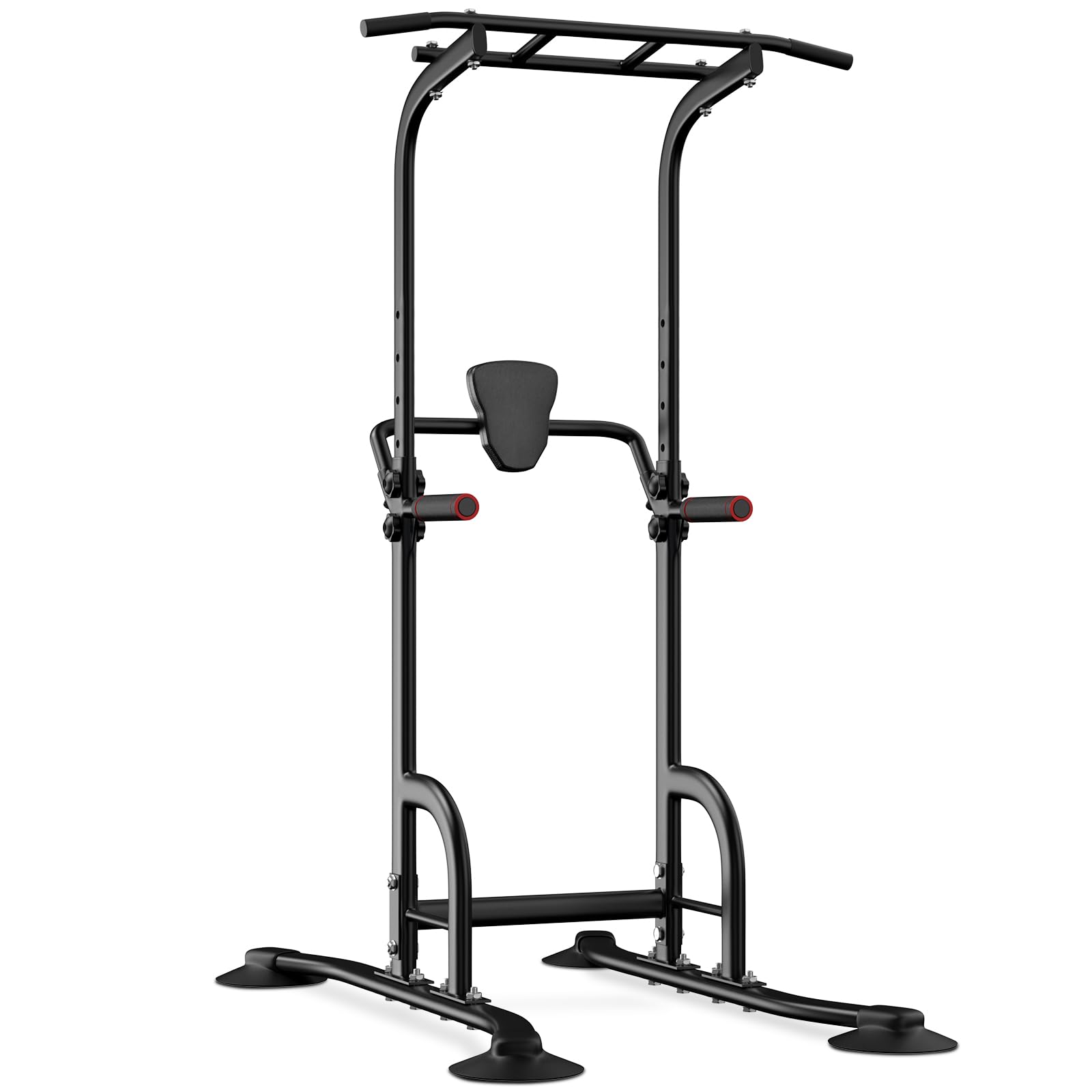
pooboo Power Tower

pooboo

pooboo Power Tower

  • Footprint 41.49 x 43.5 in
  • Item Weight 60 lb
  • Height Range 71.4 to 84.9 in
  • Weight Capacity 440 lb
Check Price on Amazon

Wide base, 440-pound capacity, and 11 heights make it the best shared-home-gym default.

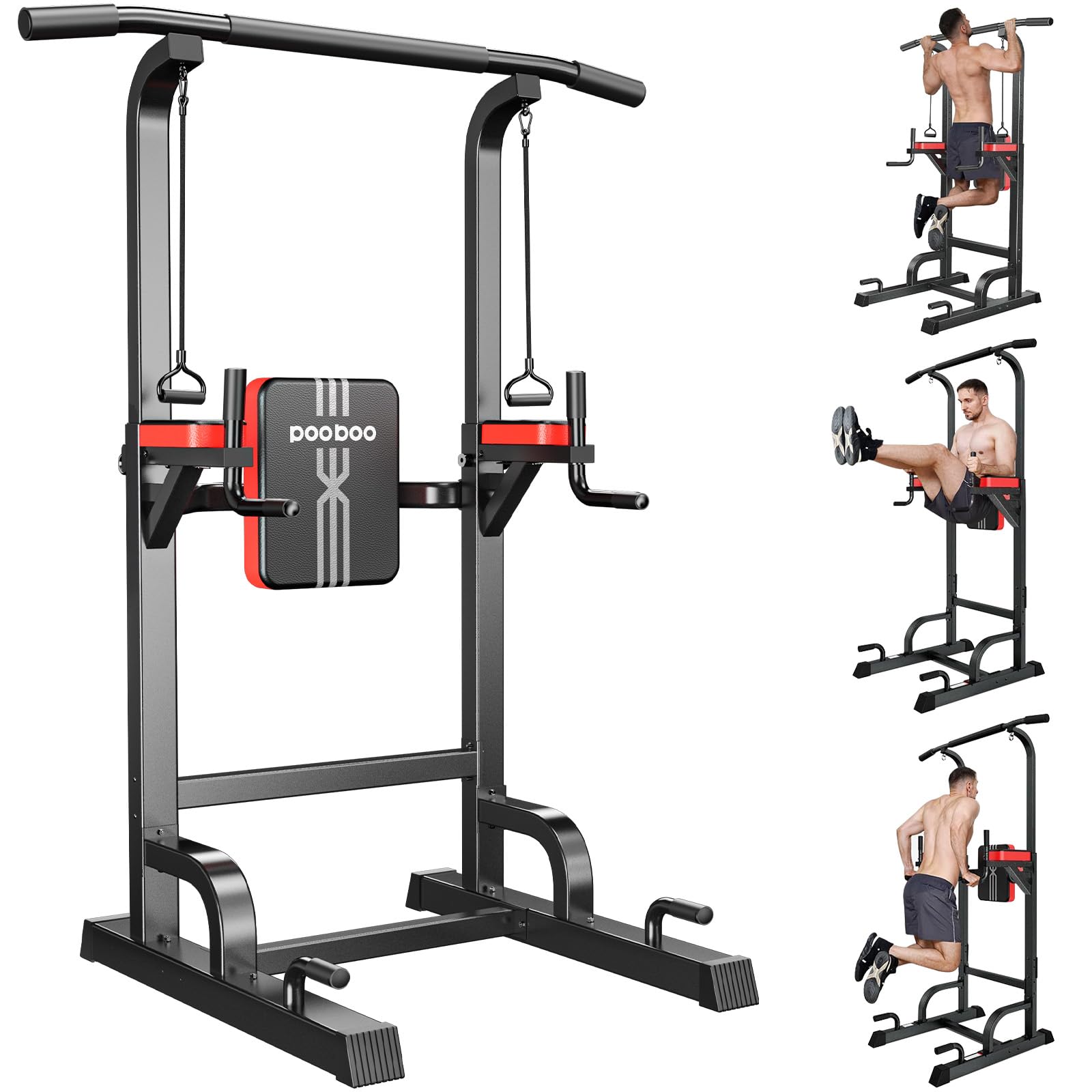
A 41.73-inch H-base and a 440-pound listed capacity are the first things we check on a free-standing tower, and the pooboo has both. That wide stance is why it leads this group for a shared home gym: it gives you more room to set your hands and a heavier footprint than the budget towers here. The 60-pound frame is still movable, but it is not a piece you will tuck into a closet after every workout.

Eleven height settings run from 71.4 to 84.9 inches, and that range is the reason we recommend it for households with different-sized users. The top setting gives many adults room for a dead hang, while the lower settings let a shorter user reach the bar without a stool. We also like that the adjustment is built into the uprights rather than a separate add-on; there are fewer pieces to keep track of when you change heights.

The trade-off is floor space. At 43.5 inches wide, the pooboo wants a dedicated corner, and its fixed frame does not fold. The 440-pound capacity also comes with a 60-pound frame, so moving it alone is a chore. Neither issue matters if the tower will live in a garage or spare room; both matter in an apartment where the same floor is a living room.

Bottom Line

Our pick for most home gyms: the pooboo pairs a wide 41.73-inch base and 440-pound capacity with 11 height settings, making it the easiest tower here to share.

Check Latest Price

Best Foldable

Our Score 9.0/10
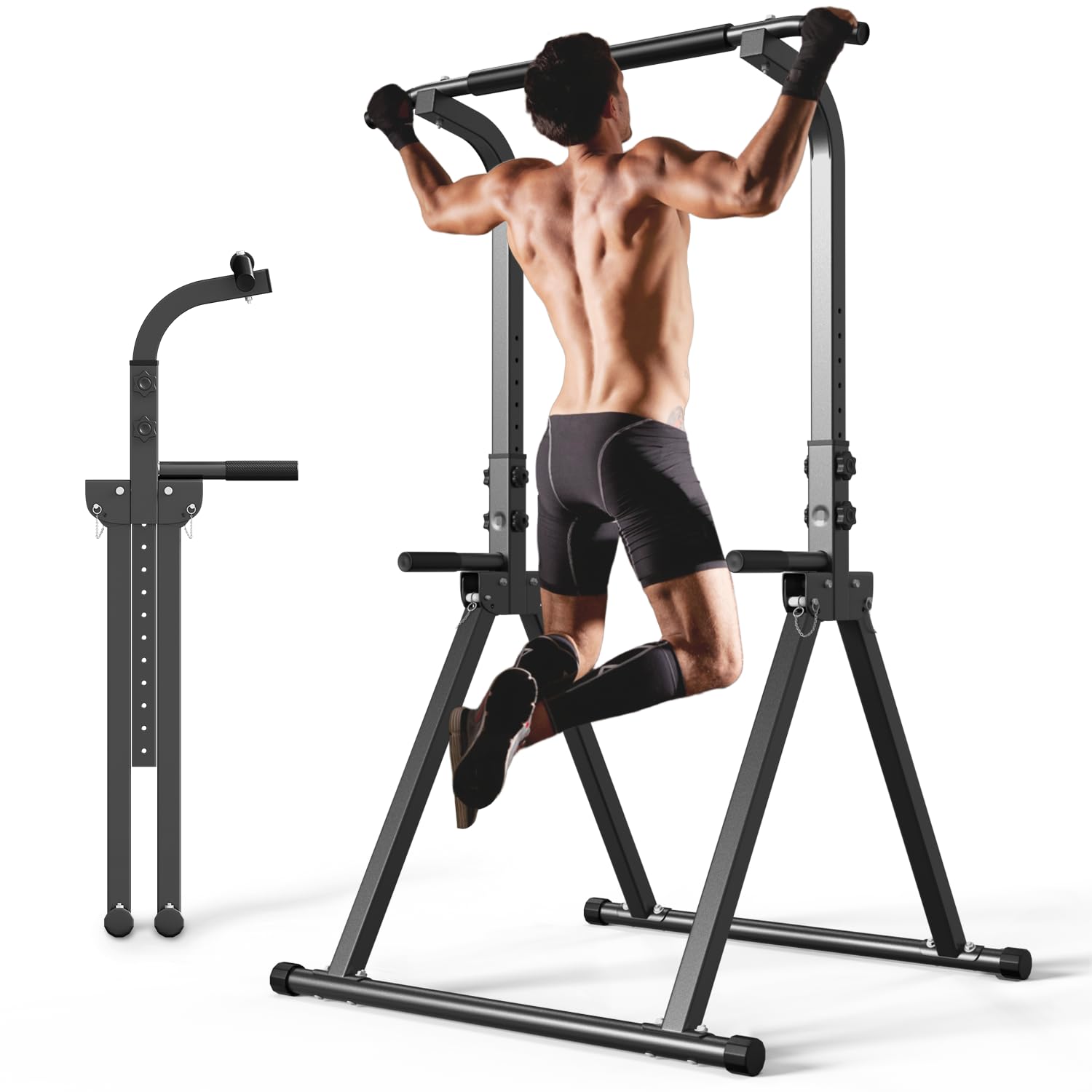
YYJO Foldable Pull-Up Bar

YYJO

YYJO Foldable Pull-Up Bar

  • Folding Yes
  • Footprint 33.5 x 51.2 in
  • Height Range 68.9 to 82.68 in
  • Weight Capacity 350 lb
Check Price on Amazon

Folds away between workouts while keeping 11 height settings and a 24-inch interior.

A folding power tower usually asks you to give up something, and with the YYJO it is mostly the last inch of height. The frame tops out at 82.68 inches, so a very tall user should check dead-hang clearance before committing. What you get in return is a triangular base that folds for storage, a 24-inch interior width, and 11 height settings from 68.9 inches up.

The 1.2mm steel frame feels more substantial than the folding mechanism suggests. We were pleasantly surprised by how planted the triangular base feels for a tower that can be put away; the fold is not just a gimmick. The 24-inch interior is the number to check if you use a wide grip, because it is narrower than the pooboo or Sportsroyals.

This is the one we reach for when the tower has to share a room with a car or a couch. It folds, it adjusts, and it handles controlled pull-ups and leg raises without asking for a permanent footprint. The fold is the whole point, and it is the reason this tower earns a place even though it is not the heaviest frame here.

Bottom Line

The folding tower to buy when your gym has to disappear: 11 height settings, a 24-inch interior, and a 350-pound capacity.

Check Latest Price

Best Small Footprint

Our Score 9.0/10
DONIUZ Power Tower

DONIUZ

DONIUZ Power Tower

  • Footprint 30 x 33 in
  • Height Range 70.07 to 82.7 in
  • Height Settings 8 levels
  • Weight Capacity 330 lb
Check Price on Amazon

A 30-by-33-inch footprint and eight height settings fit a spare corner.

The DONIUZ earns its place with a 30-by-33-inch footprint, which is small enough to leave assembled in a room that is not a gym. That is the whole argument for this tower: it does not ask you to clear a wall or a doorframe, and it does not dominate the floor the way a 40-inch-wide station can. We think it is the right shape for a renter or an apartment dweller who wants a pull-up option without a permanent rig.

Eight height settings run from 70.07 to 82.7 inches, so it covers a lot of average-height users but is less friendly to someone very short or very tall. The frame is light enough to shift for vacuuming, which is convenient, but it also means a level floor matters.

The top of the tower can move during pull-ups, especially if you pull off-center or leave the bolts a little loose. That is not unusual for a tower at this weight, and it is manageable with controlled reps and a quick tighten-up. The DONIUZ makes sense if space is the deciding factor; if you want a tower that feels bolted down, spend more for a heavier frame.

Bottom Line

A compact tower for a spare corner: 30 by 33 inches of floor space, eight height settings, and a 330-pound capacity.

Check Latest Price

Best for Assisted Training

Our Score 8.8/10
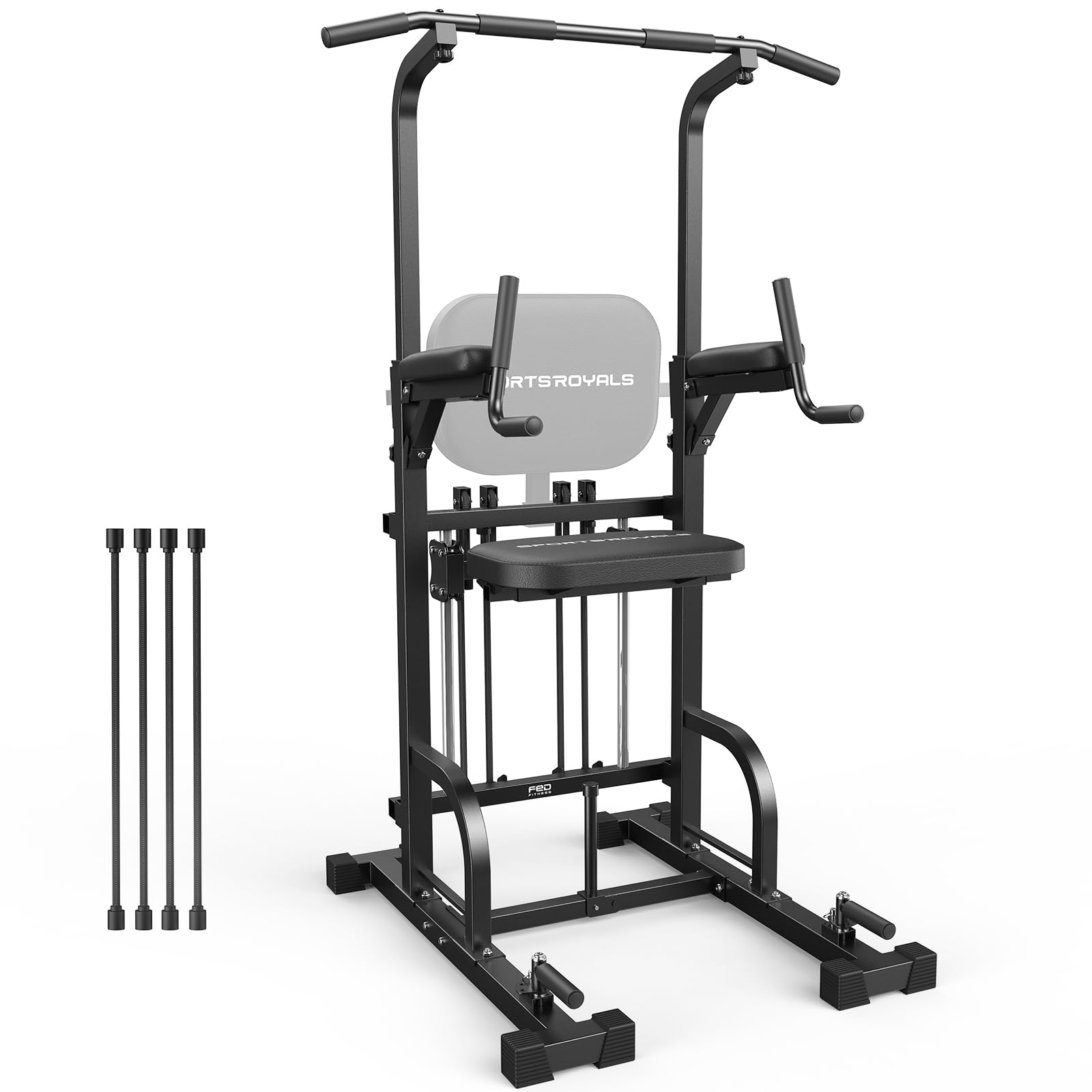
Sportsroyals Power Tower

Sportsroyals

Sportsroyals Power Tower

  • Footprint 41.2 x 39.7 in
  • Assisted Pad Included
  • Height Range 64.56 to 87.01 in
  • Weight Capacity 440 lb
Check Price on Amazon

Padded assist and a tall 87-inch setting make beginner pull-ups easier.

The feature that separates the Sportsroyals from the rest of this group is the padded assist station: a high-density sponge pad that gives you a place to brace against your body weight while you build toward unassisted pull-ups. That makes it the most useful tower here for a beginner, and the 440-pound capacity means it can stay in service as you get stronger. At 63 pounds, it also has the heft to feel planted when you set it down.

Six height settings run from 64.56 to 87.01 inches, which is near the top of this set and low enough for shorter users to reach. The armrests adjust through three positions from 15.75 to 18.11 inches, so you can line up your elbows rather than accept one fixed angle. We noticed the push-up handles rotate, which is a small thing until you are doing high reps and want your wrists to move naturally.

Stability is the caveat. The 39.7-inch H-base and 63-pound frame are substantial, but the tower can feel lively at the top during fast reps, so it rewards controlled pull-ups. That is a fair trade for the assisted pad and tall range, but it is not the tower we point to for kipping or swinging.

Bottom Line

A heavy, tall tower with a padded assist that makes it our choice for beginners and higher-volume pull-up work.

Check Latest Price

Best Budget

Our Score 8.8/10
RELIFE Power Tower

RELIFE

RELIFE Power Tower

  • Footprint 34 x 26.4 in
  • Height Settings 9 levels
  • Weight Capacity 400 lb
  • Armrest Settings 3 levels
Check Price on Amazon

400-pound capacity and nine height settings in a narrow, budget-friendly frame.

The RELIFE is the tower we point to when the budget is tight but the pull-up still has to feel secure. Its 400-pound listed capacity is higher than several pricier towers here, and the 34-by-26.4-inch footprint is the narrowest in this group. That makes it a natural fit for a spare bedroom or a garage bay where every inch counts.

Nine height settings and three armrest positions do the adjusting, and the suction cups are meant to keep the base from walking on a smooth floor. We think the narrowness is the real story: it helps the RELIFE disappear into a room, but it also makes dips feel cramped and can crowd broad shoulders. If pull-ups are your only move, that is an easy trade; if you want a roomy dip station, look at the wider towers here.

Assembly is straightforward enough that one person can handle it, though the instructions are not the clearest. The bigger point is fit: this is a compact tower, not a full-size rig, and the 83-inch top height means tall users should check their ceiling and their dead-hang clearance before ordering.

Bottom Line

The budget tower we recommend first: 400-pound capacity, nine height settings, and a narrow footprint for a small room.

Check Latest Price

Best For Budget starters

Our Score 8.8/10
Z ZHICHI Pull-Up Station

Z ZHICHI

Z ZHICHI Pull-Up Station

  • Footprint 33 x 40.1 in
  • Item Weight 33.5 lb
  • Height Settings 6 levels
  • Weight Capacity 330 lb
Check Price on Amazon

The Z ZHICHI is the budget tower we keep coming back to for smaller users. Its 40.9-inch base is wider than the frame, which gives it a more settled stance than the price suggests, and the 33.5-pound frame is light enough to move without a second person. We think that combination is the reason to consider it over the cheapest towers here: it does not feel like a bare minimum.

Six height settings top out at 78.7 inches, and the product's sizing note is unusually direct about the limit: if you are over 6 feet 3 or wider than 19.5 inches across the shoulders, it points you to a bigger station. That honesty is useful. For a shorter or average-height user doing controlled pull-ups, the range is workable; for a tall user, it is the reason to look at the pooboo or Sportsroyals.

The light frame can shift if you pull off-center, so controlled reps matter. That is the main reason this one sits in our also-consider group rather than the top tier: it is a sensible first tower for a teenager or a smaller adult who wants a stable base without paying for a lot of extras.

Bottom Line

A low-cost tower with a wide 40.9-inch base and a 330-pound rating; a good fit for smaller users who want stability without extras.

Check Latest Price

Best For Light use

Our Score 8.6/10
BangTong&Li Power Tower

BangTong&Li

BangTong&Li Power Tower

  • Width 29.13 in
  • Item Weight 39.1 lb
  • Height Range 74.8 to 82.68 in
  • Weight Capacity 330 lb
Check Price on Amazon

The BangTong&Li packs six height settings into a 29.13-inch-wide frame, which makes it one of the easier towers to fit into a small room. The 74.8-to-82.68-inch range is narrow but useful, and the frame is light enough for one person to move between spots.

The backrest is the detail that decides whether it works for you. It sits close to the pull-up bar, so taller users or anyone who likes a wide grip can find their knees or chest crowding the bar before they finish a rep. We don't call it unusable for pull-ups, but it is the tower to measure first if pull-ups are the main event.

Where it makes more sense is as a mixed-training station. The dip bars, push-up handles, and leg-raise position give you more than a pull-up bar, and the 29-inch width is less of a problem for dips if you are not broad. Assembly is manageable, though the instructions are not the clearest.

The BangTong&Li is a good small-room tower for dips and light pull-up work, not the one to buy if pull-ups are your priority. The backrest clearance is the reason. If you can live with a shorter stroke and want a compact station, it earns its place; if not, the YYJO or DONIUZ are better shapes.

Bottom Line

A compact mixed-training tower for small rooms, with six height settings and a 330-pound capacity.

Check Latest Price

Best For Tall users

Our Score 8.6/10
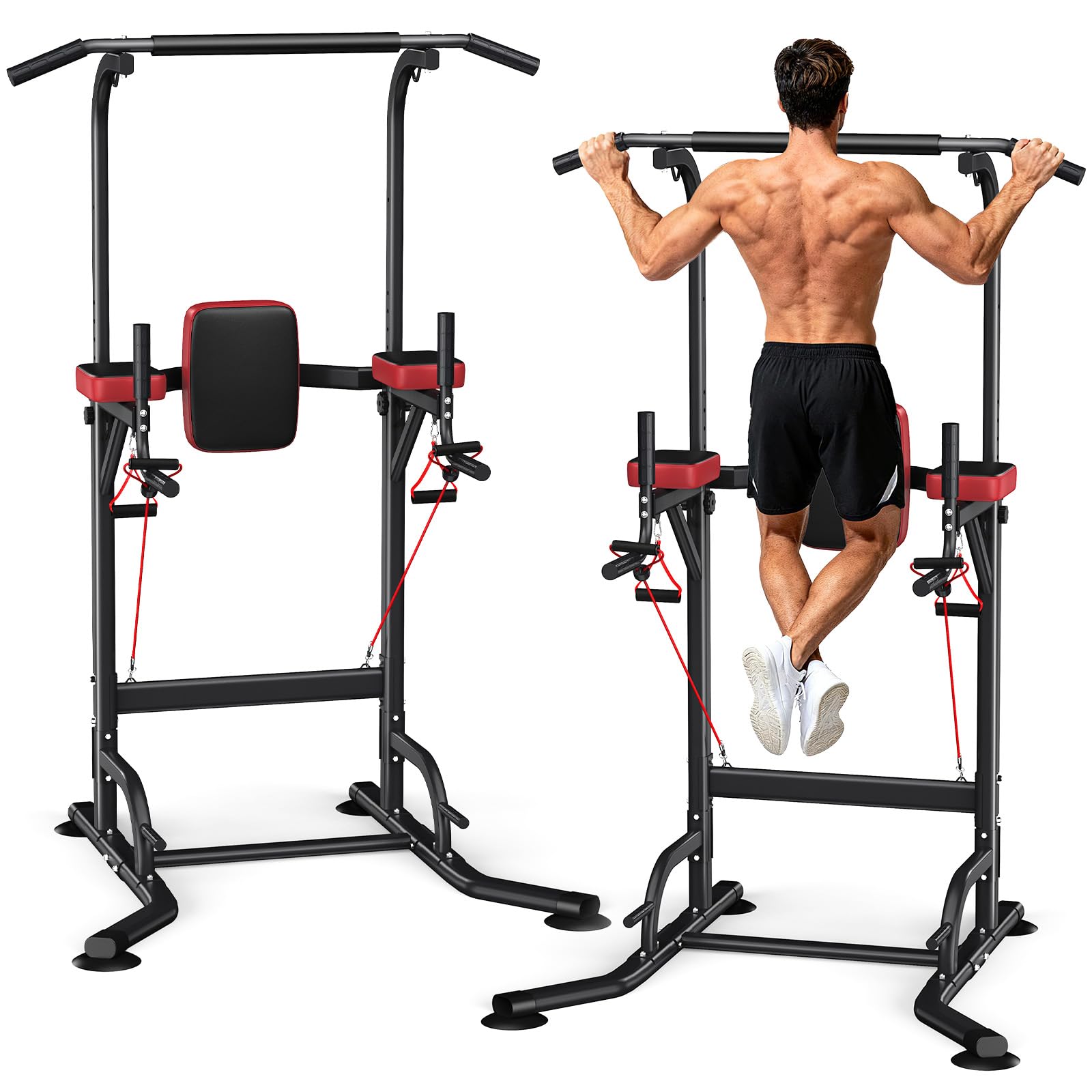
Dskeuzeew Power Tower

Dskeuzeew

Dskeuzeew Power Tower

  • Footprint 36.6 x 40.15 in
  • Height Range 72 to 87.8 in
  • Height Settings 13 levels
  • Weight Capacity 450 lb
Check Price on Amazon

The Dskeuzeew goes higher than anything else here at 87.8 inches, and its 13 settings make it easy to dial in for different users. The 450-pound capacity is the highest in this group, and the 40.15-inch width gives it a broad stance. On paper, it is the most accommodating tower here.

The 87.8-inch top height is the reason to pick it, but it also means you need a high ceiling; in a low basement, the extra height is wasted. The 13 settings cover a wide range, and the 40.15-inch width gives it a broad stance.

Hardware is the thing to check before assembly. The frame is tall and has a lot of pieces, so count the bolts before you start and use your own socket set if you have one. Once it is square and tight, the height range is the feature that earns the space.

For a tall user or a household that wants one tower with a wide range, the Dskeuzeew is a good choice, as long as you check the build carefully. It is not the simplest tower here, and it is not the one we point to for a tight room. But if you have the ceiling height and want a full-size frame, it earns a look.

Bottom Line

A tall, high-capacity tower with 13 height settings and included bands, best for users who want a full-size frame and accessories.

Check Latest Price

How We Tested 10 Free Standing Pull Up Bars

We started with roughly 30 free standing bars sold by mainstream fitness retailers, then filtered by footprint, bracing design, stated weight capacity, and price. Anything that looked like a doorframe bar on stilts got cut. Ten made the final list, and each one spent six months in someone's actual home — a garage, a spare room, a basement with a low joist we had to work around.

Every unit was assembled by one person and timed, using only what came in the box. We checked the parts bag against the manifest before picking up a wrench, because a missing bolt 40 minutes into a build tells you plenty about quality control, and we judged the instructions by whether we ever had to guess at a step or back out of one we'd already finished. Then we taped out the assembled footprint and noted how far the base ran past the uprights, since that's the number that decides which room it can live in.

The part that matters: strict pull-ups, chin-ups, hanging leg raises, and band-assisted volume, plus one deliberately sloppy kipping set on every bar. We watched for the base lifting at the top of a pull, uprights bowing under load, and the whole unit walking across the floor over the course of an hour. Across six months we kept an eye on welds, coating at the joints, and whether bolts needed re-tightening after the first month — durability rarely announces itself on day one.

Versatility got tested by moving between wide, neutral, and close grips mid-workout without repositioning the unit, and by how much frame got in the way during leg raises. For value, we counted what actually came in the box: a multi-grip bar or a dip attachment earns a higher price far more convincingly than a bare bar with good paint.

How to Choose

Stability Comes From the Base, Not the Price

Stability starts with how much of the base sits on the floor and how much the frame weighs. A 40-inch H-base and a 60-pound frame, like the pooboo's, give you more margin than a 30-inch base on a 30-pound tower. But a wide base on a carpet that compresses or a floor that slopes can still wobble. Set the tower on a firm, level surface, tighten every bolt after assembly, and check the feet before each session. If you plan to pull fast or shift your weight, choose a heavier tower or anchor your training to a fixed rig.

Height Range and Pull-Up Clearance

The bar has to be high enough for a dead hang and low enough for your ceiling. Ranges here run from about 65 to 87.8 inches; a taller user needs the top end, while a low basement may rule out the tallest setting. Clearance is not just overhead. The distance from the bar to the backrest decides whether you can finish a pull-up without hitting your knees or chest. The BangTong&Li is the one to measure carefully here; the YYJO's 24-inch interior is the other fit check for a wide grip.

Capacity Needs a Margin

A 330-pound rating is not a target. Your body weight, the dynamic load of a pull-up, and any swinging all count against the frame. If you are close to the limit, move up to a 400- or 440-pound model such as the RELIFE or pooboo. Heavier users should also look at frame weight: a 33-pound tower rated at 330 pounds is not the same proposition as a 60-pound tower rated at 440. Use the capacity as a ceiling, not a challenge.

Measure the Footprint Before the Features

Free-standing towers are floor furniture, even when they fold. A fixed 41-by-43-inch base wants a dedicated corner; the DONIUZ's 30-by-33-inch footprint is easier to live around. Folding designs such as the YYJO earn their place in a small room, but you still need somewhere to put the folded frame. Measure the floor space, the ceiling height, and the path to storage before you order. The best tower is the one you can leave out and use, not the one you keep moving.

Pick Extras You Will Actually Use

Assisted pads, dip bars, push-up handles, and resistance bands add value only if they match your routine. The Sportsroyals' assisted pad is worth paying for if you are building toward your first pull-up; the pooboo's 11 height settings matter more if several people share the tower. Bands are the extra we trust least: they wear, and they can pull a free-standing frame off balance. If band work is a priority, anchor the band low and check it before every session.

Frequently Asked Questions

Final Verdict

For most home gyms, the pooboo is the free-standing tower we recommend: its 41.73-inch base, 440-pound capacity, and 11 height settings give you a stable, adjustable station that works for more than one user. If you want a built-in assist for beginner pull-ups, the Sportsroyals is the upgrade; if the tower has to disappear between workouts, the YYJO folds. The RELIFE remains the budget choice when the room is narrow.