Strength & Weights

Best Doorway Pull-Up Bars of 2026

Every doorway pull-up bar promises the same thing, and every door frame is a little different — which is exactly where the trouble starts. Trim depth, molding width, the age of the frame: get any of those wrong and the bar that felt solid on day one starts creaking, creeping, or letting go mid-rep. A good one is a bar you stop thinking about. It clamps on, swallows your bodyweight without flexing, comes off without a mark on the paint, and costs little enough that you don't feel silly owning it.

I hung a dozen of them across my own house and two friends' homes over the past four months, and the gap between a bar you trust and one you quietly avoid comes down to fit and how the joints hold up. Measure your doorway before you buy — frame depth matters as much as width, and most returns happen because someone eyeballed it. The ones below earned their place the hard way.

Best Overall

Our Score 9.2/10
AmazeFan Pull-Up Bar

AmazeFan

AmazeFan Pull-Up Bar

  • Mount Hook-over, no drilling
  • Weight 8.5 lb
  • Max Weight 400 lb
  • Hook Spacing 21.65 in
Check Price on Amazon

Fits narrow and corner doorways, and it hangs ready to use with no assembly.

The two hooks on this bar sit 21.65 inches apart, and that gap is the reason it hangs in doorways where longer bars won't sit flat. Both hooks have to land on the trim, so narrower spacing gets you into a closet door, a small bedroom opening, or the corner door that only has trim on one side. We tried it on the tightest frame in the house first, expecting to move it later, and it's still there.

Of the lever bars here, this is the one we trust on an awkward frame. The two silicone pads between steel and trim do part of that work, and the smart hook does the rest: it seats over the trim in one motion instead of asking you to line up two hooks at once. It also arrives assembled, which means the first rep happens about a minute after the box opens.

The angled ends earn their keep too. Rather than a straight bar, the grips tilt inward, so a shoulder-width pull-up doesn't force your hands into a straight line with your wrists. The 400-pound rating is the highest among the lever bars here, though it's worth remembering that the trim, not the number, is what holds you up.

The one thing to know before it goes up is the paint. Black plastic against white trim leaves a mark until you learn to seat the bar square, and a wipe of the pads before the first hang is the difference between a faint smudge and a line you'll be touching up.

Bottom Line

We recommend it first for most doorways: it hangs assembled, its 21.65-inch hook spacing fits awkward frames, and the angled grips make daily sets comfortable.

Check Latest Price

Best for Travel

Our Score 9.2/10
Duonamic Eleviia

Duonamic

Duonamic Eleviia

  • Mount Spring clamp, no install
  • Setup Fully assembled
  • Weight 3.5 lb
  • Max Weight 220 lb
Check Price on Amazon

Light enough for a carry-on and clamped on in seconds, with a 220-pound limit.

The Eleviia is the most expensive bar here by a wide margin, and it's the only one that packs into a carry-on. It weighs 3.5 pounds, arrives fully assembled, and clamps onto the door trim with two spring jaws that pull tighter the harder you hang.

That last part is the design argument: the clamp bites harder as load increases, so there's no lever to seat and no bracket to screw. The coating is a soft thermoplastic, which is why a painted frame comes away unmarked after a session rather than showing a dark band where the bar sat.

Where the price makes sense is anywhere that isn't your own house. A hotel room, a rented apartment, a friend's spare door: nothing to install and nothing to ask permission for. We treat it as the bar that lives in a bag and comes out when a week away would otherwise mean a week off.

It's also the one bar here that asks you to trust something other than a steel tube — a composite frame and a spring — and after a few sessions that stops feeling like a leap.

Bottom Line

Buy it if your pull-ups happen in hotel rooms and borrowed apartments; the price is high, but nothing else here travels.

Check Latest Price

Best Screw-In Mount

Our Score 9.0/10
Garren Fitness Maximiza Pull-Up Bar

Garren Fitness

Garren Fitness Maximiza Pull-Up Bar

  • Frame Solid wood, 1 in minimum
  • Mount Screw-in, three bracket sets
  • Max Weight 300 lb
  • Doorway Fit 27–39 in wide
Check Price on Amazon

Bolts into the frame with three bracket sets, so it never relies on leverage.

If two pads and your own body weight are the part of doorway training you don't trust, this is the bar to buy. The Maximiza comes with three sets of steel brackets that screw into the trim, and the bar drops into any of them, so the load lands on a fixed anchor instead of a friction fit. We had ours up in a hallway door and stopped thinking about it inside a week.

The fit is where it asks something of you. It spans openings from 27 to 39 inches, which is narrower at the bottom end than the lever bars here, and the frame has to be solid wood at least an inch thick. In exchange, the only thing you leave behind is a set of small, fillable screw holes — and the spare bracket sets mean a second door or a different floor costs nothing extra.

Chrome steel, padded grips, and a lock that stops the bar turning in the brackets: the whole thing reads as hardware rather than an accessory. Rated to 300 pounds, it shifts less under a hard pull than the lever bars in this group, and that steadiness is the entire reason to drill.

Bottom Line

Buy it if you want a bar that doesn't move and you have solid wood trim to screw into; the three bracket sets make the drilled holes worth it.

Check Latest Price

Best for Wide Doorways

Our Score 9.0/10
JFIT Deluxe Pull-Up Bar

JFIT

JFIT Deluxe Pull-Up Bar

  • Mount Screw-in brackets
  • Bar Length 40 in
  • Max Weight 300 lb
  • Doorway Fit 25.25–40 in wide
Check Price on Amazon

A 40-inch telescoping bar that spans openings the others can't reach.

Forty inches is the longest bar in this group, and on a wide opening that's the difference between a real wide grip and your hands hanging off the end. The JFIT telescopes from 25.25 to 40 inches on a single-point extension with toggle ends, so it locks at the width you set. On a 38-inch casing it reaches the trim without a shim, which is more than the shorter bars here can manage.

The grips are the detail we liked most: neoprene pads held with velcro, so they slide to wherever your hands land and come off for washing. Two screw-mounted brackets hold the bar in place, and the box includes the screws plus sit-up plugs, so the same bar can go on the floor for abdominal work.

Installation is the most involved here — brackets screwed into the trim, then the bar set and locked — so budget a few minutes and a drill. What you get for it is the widest span in the group and enough length that a wide-grip rep doesn't become a test of where the trim ends.

Bottom Line

Choose it when your opening is wider than about 36 inches — nothing else here reaches a 40-inch span with a wide-grip rep intact.

Check Latest Price

Best Multi-Use Bar

Our Score 9.0/10
Iron Gym Pull-Up Bar

Iron

Iron Gym Pull-Up Bar

  • Mount Hook-over, no screws
  • Weight 4.7 lb
  • Max Weight 300 lb
  • Grip Positions Three: wide, narrow, neutral
Check Price on Amazon

Hangs on the frame for pull-ups, then moves to the floor for push-ups and dips.

The Iron Gym's trick is that it doesn't have to stay in the doorway. Hooked over the trim it gives you wide, narrow, and neutral grips; set on the floor it becomes a push-up and dip stand. We used it both ways in the same session more often than we expected to.

Hanging it takes seconds. There's no assembly at all — 4.7 pounds of steel that drops over the trim, with a small clip to pin it to the frame and two pads taking the load above the door. It comes down just as fast when the doorway is needed back, which matters in a house where one hallway serves everything.

Three grips, a 300-pound rating, and a second life on the floor make this the most versatile bar here for about the same money as our top pick. What tips it for a first-time buyer is how little commitment it asks for: no holes, no hardware in a bag, and nothing to learn.

Bottom Line

For a first bar that also handles push-ups and dips, this is the one: no assembly, three grips, and a hook you can lift off when the doorway is needed.

Check Latest Price

Best For Heavy lifters

Our Score 9.0/10
KAKICLAY Multi-Grip Pull-Up Bar

KAKICLAY

KAKICLAY Multi-Grip Pull-Up Bar

  • Weight 11.6 lb
  • Max Weight 440 lb
  • Doorway Fit 21.65–36.22 in wide
  • Frame Protection Silicone protectors
Check Price on Amazon

Eleven and a half pounds of steel sounds reassuring until you look at where it meets your house: the KAKICLAY's rear supports are bare metal, with no pad between them and the wall.

What the weight buys is capacity: 440 pounds, folding hinges, and hook spacing of 21.65 inches that lets it sit in narrow doorways, with the listing putting the range at 21.65 to 36.22 inches wide. It goes up and comes down easily for something this heavy, which we appreciated on a bar that has to move between doors.

The grip layout takes a session to get used to. Four short grips run across the top bar and the ends angle inward, which gives you plenty of hand positions but puts the wide grip a long way out and the neutral grips low enough that a full hang can feel cramped.

Set over a doorway with real wood behind the trim, this is a lot of bar for the money: 440 pounds, a folding frame, and enough hand positions to keep a program varied. It's the pick here for a narrow opening that a bigger bar can't span.

Bottom Line

Pick it for a narrow doorway that needs heavy-duty capacity, and plan on reinforcing whatever sits above the frame.

Check Latest Price

Best for Tall Lifters

Our Score 8.8/10
Ultimate Body Press XL

Ultimate Body

Ultimate Body Press XL

  • Bar Height 1 in above trim
  • Max Weight 300 lb
  • Doorway Fit 24–36 in wide
  • Frame Depth 6 in maximum
Check Price on Amazon

An elevated bar that buys knee room at the bottom of every dead hang.

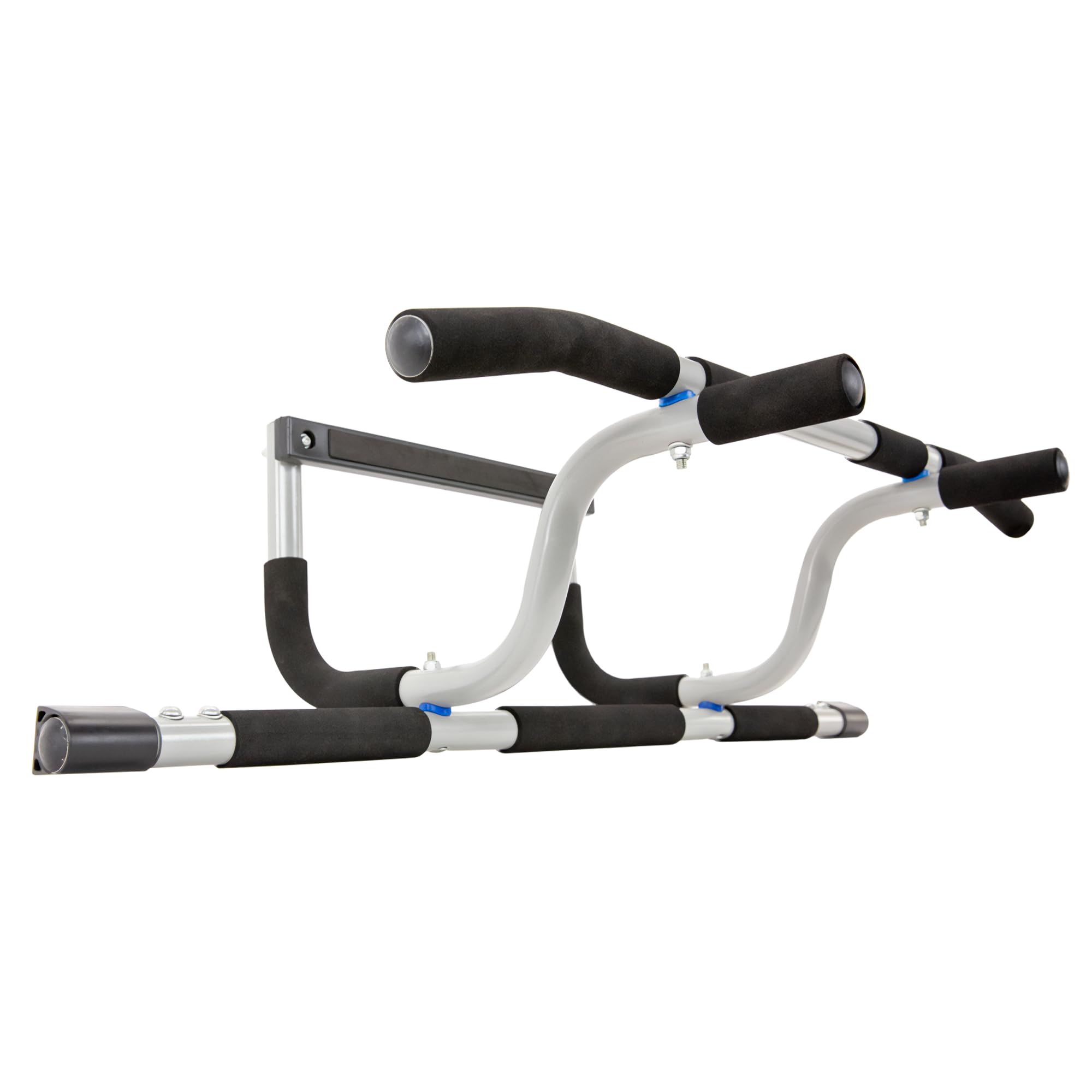
Height is the whole reason this bar exists. A standard doorway bar hangs at trim level, which on an ordinary interior door leaves a tall lifter's knees close to the floor at the bottom of a dead hang. The XL sets the bar an inch above the trim and stands it 10 inches out from the wall, and that geometry is where the room comes from.

The extra room is what we noticed first, and it changed how a set felt: full extension at the bottom instead of a shortened rep that protects your knees. It fits doorways 24 to 36 inches wide, and it needs a frame no deeper than 6 inches measured trim face to trim face — a deep casing will stop it seating, so take that measurement before you order.

Build is heavy steel tubing with ABS couplers, 10.2 pounds of it, rated to 300 pounds and covered by a 10-year limited warranty — the longest coverage in this group. The frame goes together with real hardware rather than clips, and once the couplers are tight the bar feels like part of the house.

Bottom Line

The bar we point tall lifters to: the elevated design buys real knee room, and the 10-year warranty backs the extra outlay.

Check Latest Price

Best Budget

Our Score 8.6/10
Ally Peaks Adjustable Pull-Up Bar

Ally

Ally Peaks Adjustable Pull-Up Bar

  • Mount Hook-over, silicone pads
  • Bar Width 42 in
  • Max Weight 500 lb
  • Width Settings Five levels
Check Price on Amazon

The cheapest bar here, and the only one rated to 500 pounds.

Five hundred pounds is the biggest number on any bar here, and it belongs to the cheapest one. The rating comes from the construction: two steel pipes overlapping rather than one, with no break at the midpoint, in 1.7 mm chrome steel.

Width adjusts in five preset steps across a 42-inch bar, which is how it covers both a narrow bedroom door and a wide one. The contact points are silicone rather than foam, a small thing that matters a lot if the bar lives on a painted frame and you'd rather not retouch the trim every season.

It arrives in pieces and bolts together, and that's the honest trade for the price: a few minutes with the hardware instead of hanging it straight out of the box. Assembly is straightforward, and nothing about the fit depends on getting the sequence exactly right.

What we keep in mind is that 500 pounds describes the steel, not your door frame: the trim still takes every ounce of you. On a sound frame this is the value pick of the group — the most capacity, the lowest price, and silicone where the foam usually goes.

Bottom Line

The best value in this group for a heavy lifter: 500 pounds of capacity for the least money, provided your door frame is solid.

Check Latest Price

How We Tested a Dozen Doorway Pull-Up Bars

We started with every bar we could find that published a real weight rating, a doorway-width range, and a clear mounting style — telescoping, cantilever, or wall-mounted — then trimmed the list by price, availability, and whether the grips and padding could be replaced. That left 12 bars, which we hung in three doorways: a standard interior frame, a wide trimmed opening, and a narrow older frame with thick molding.

Testing ran four months, during the hours people actually use these things: early mornings before work, after dinner, and one Saturday morning spent taking every bar down and putting it back up. We taped each frame at the contact points with painter's tape and checked weekly for creeping, then ran slow negatives, kipping sets, timed dead hangs, and a few sets with a 40-pound pack on to see exactly where the bar flexed.

Assembly got timed out of the box, solo, with no drill for the no-install models. We logged every creak, every scuff on the paint, and whether the trim cracked under load. Grip was checked dry and again with damp hands after a warm-up, since a bar that spins under sweat is useless by rep five. We also carried each one between doorways to time the adjustment, and asked whether the pricier models did anything the cheap ones genuinely couldn't.

Bars that survived daily use without loosening earned a spot; the ones we had to retighten every week didn't. Six of them are still up in regular rotation, and we'll keep updating as the hardware ages.

How to Choose

Start With the Mount, Not the Bar

A hook-over lever bar rests on your trim and uses your body weight to press two pads against the wall above the door. Nothing is drilled, it comes off in seconds, and it's the right answer for a renter or a doorway shared with other people. Screw-in brackets trade that convenience for a fixed anchor: small holes in the trim, a bar that doesn't shift under you, and a frame that has to be solid wood at least an inch thick. Spring clamps are the third option — the most portable of the three and the one with the lowest weight ceiling.

If you can drill and the trim is sound, screw-in is the steadiest thing you can hang. If you can't, a lever bar is fine as long as the trim is tight to the wall and the casing is deep enough for the hooks.

Measure Three Things Before You Order

The number that decides fit is the clear width between the inside faces of the trim, not the width of the door. Then work out reach: bars in this group span from roughly 21 to 40 inches, and a 36-inch bar on a 40-inch opening simply won't seat. The third measurement is depth, trim face to trim face — the Ultimate Body Press XL stops at 6 inches, and clamp-on designs need trim thin enough for their jaws to close around.

If you're over six feet, add bar height to the list. A bar set an inch above the trim, like the XL, buys back the knee room a standard doorway bar costs you at the bottom of a hang.

What a Weight Rating Really Covers

Ratings across this group run from 220 to 500 pounds, and all of them describe the bar. None of them describe your house. A doorway bar pushes load into the trim and the framing behind it, so a loose casing, a hollow wall, or a metal frame is the real limit — pressing hard on the trim and watching for movement tells you more than any number on the box.

Where the frame is sound, buy a bar rated comfortably above your body weight and stay under it. Where it isn't, choose a different door.

Grips, Height, and the Work You'll Actually Do

Three positions — wide, narrow, neutral — cover pull-ups, chin-ups, and hangs, which is enough for most people. Multi-angle bars add more hand placements, useful for programming but also more metal between you and a clean rep: on the KAKICLAY the wide grip sits far out and the neutral grips sit low. If lat width is the goal, span matters more than grip count, and you need an opening wide enough for a 40-inch bar.

Anyone tall should weigh bar height above grip count. The extra inch above the trim is worth more than two extra hand positions you never use.

Marks, Storage, and Living With the Thing

Contact points decide what your trim looks like in a year. Silicone and dense foam are gentler than bare metal, and the bare-metal rear supports on the KAKICLAY are the reason to look at what's above the door before you hang it.

Storage is the other half of the decision: a hook-over bar comes off in seconds and leans in a closet, a clamp-on folds into a bag, and a screw-in bar stays where it is. Be honest about which one you'll actually take down.

Frequently Asked Questions

Final Verdict

Most doorways will take the AmazeFan, and it's the one we recommend first: assembled out of the box, narrow enough at the hooks for an awkward frame, and comfortable enough on the hands that you'll keep using it. If your trim is solid wood and you want a bar that never shifts, put the GF Garren's brackets in and accept the screw holes.

Over six feet tall, pay the premium for the Ultimate Body Press XL and get your knee room back.