Strength & Weights

Best Battle Ropes of 2026

A battle rope looks simple: a thick length of rope, an anchor, and enough floor space to make waves. The wrong one announces itself quickly—fibers shed onto the garage floor, the rope kinks when you change direction, or it is so heavy that your grip fails before your lungs do. I have used them in gyms and my own driveway, and the difference between a rope you keep using and one you drape over a rafter comes down to how it moves and how it survives months of slamming. A good one turns a patch of concrete into a full-body conditioning station; a bad one just takes up space.

We spent six months with 12 battle ropes in a garage gym, on a concrete driveway, and in a basement. I care most about whether a rope keeps its shape after repeated waves, whether the handles stay secure, and whether setup is simple enough that you actually anchor it and start. Value shows up later, when a rope hasn't frayed or gone limp.

Best Overall

Our Score 9.6/10
Perantlb Sleeved Battle Rope

Perantlb

Perantlb Sleeved Battle Rope

  • Length 30 ft
  • Sleeve Full-length nylon
  • Diameter 1.5 in
  • Included Anchor strap, carabiner, bolts
Check Price on Amazon

Sleeve, anchor strap, and a 1.5-inch by 30-foot size make it the home-gym default.

What comes in the box is what settled this one for us. The anchor strap, carabiner, and the bolts to fix it to a post ship with the rope, so a first session is a ten-minute job instead of a second order. The rope itself is the size most home gyms can actually use: 1.5 inches thick, 30 feet long, with a full-length nylon sleeve and 8.66-inch heat-shrink handles.

That sleeve earns its keep the longer you own the rope. Every wave drags the working length across the floor, and on a garage slab it is the rope, not your arms, taking the punishment; the nylon wears so the twist underneath does not. The handles are long enough for a two-handed grip or a choke with gloves on, and the ends are heat-sealed so the strands stay put at the tip.

Thirty feet is the honest limit. It suits a single-car bay or a driveway apron and leaves enough slack for traveling waves without rope puddling at your feet. Point it down a two-car bay and you will want the 40- or 50-foot version, which this rope comes in; the floor decides, not the spec sheet.

Bottom Line

Our pick for most home gyms: the anchor kit, full-length sleeve, and sane 30-foot length mean you can hang it and train the day it arrives.

Check Latest Price

Best for Outdoor Use

Our Score 9.6/10
Power Guidance Battle Rope

Power

Power Guidance Battle Rope

  • Sleeve Double-layer nylon
  • Warranty 2 years
  • Length Options 30, 40, or 50 ft
  • Diameter Options 1.5 or 2 in
Check Price on Amazon

Double-layer cover, wider straps, and a two-year warranty for hard, weather-facing sessions.

This is the most expensive rope in the group, and the premium shows before you uncoil it: a double-layer nylon cover over a 100% polyester rope, anchor straps wider than the webbing on most kits, and a two-year warranty. No cheaper pick here combines all three.

We think the cover is the part worth paying for. One layer protects the rope; the second keeps grit away from the cover itself, which is where a sleeved rope starts looking tired after a season outside. It is the rope here we trust most on abrasive ground, and the 30-, 40-, and 50-foot options let you size it to a long driveway or a two-car bay rather than making the space fit the rope.

Where it stops: hung on a wall above rubber mats and pulled out twice a week, the cheaper sleeved picks do the same job. What you are paying for is abrasion resistance and a warranty, and a matted indoor floor asks very little of either.

Bottom Line

Spend more only if the rope will live outdoors or take daily abuse; the double-layer cover and two-year warranty are what the extra money buys.

Check Latest Price

Best Grip

Our Score 9.6/10
Yes4All Battle Rope

Yes4All

Yes4All Battle Rope

  • Length 30 ft
  • Handles 10 in heat-shrink
  • Diameter 1.5 in
  • Rope Weight 16 lb
Check Price on Amazon

Ten-inch heat-shrink handles and an included steel anchor hold up to heavy sets.

Long handles are the first thing we noticed and the reason this rope stays in our rotation. Ten inches of heat-shrink at each end beats the 8.66-inch grips on our top pick and the 7.5-inch ones on the Power Guidance rope, and that length matters once your palms are sweating through the last set of a circuit.

The rest of the package points the same way. A steel anchor and strap come in the box, the nylon sleeve runs the working length, and the poly dacron core gives the rope a dense, deliberate feel, the kind that makes a 30-second set read as real work rather than a warm-up. It is the pick we hand to someone who already tried a cheap rope and found it too light.

Bottom Line

Buy this one for the handles: long heat-shrink grips and an included steel anchor make heavy sets easier to hold onto.

Check Latest Price

Best 40-Foot Rope

Our Score 9.4/10
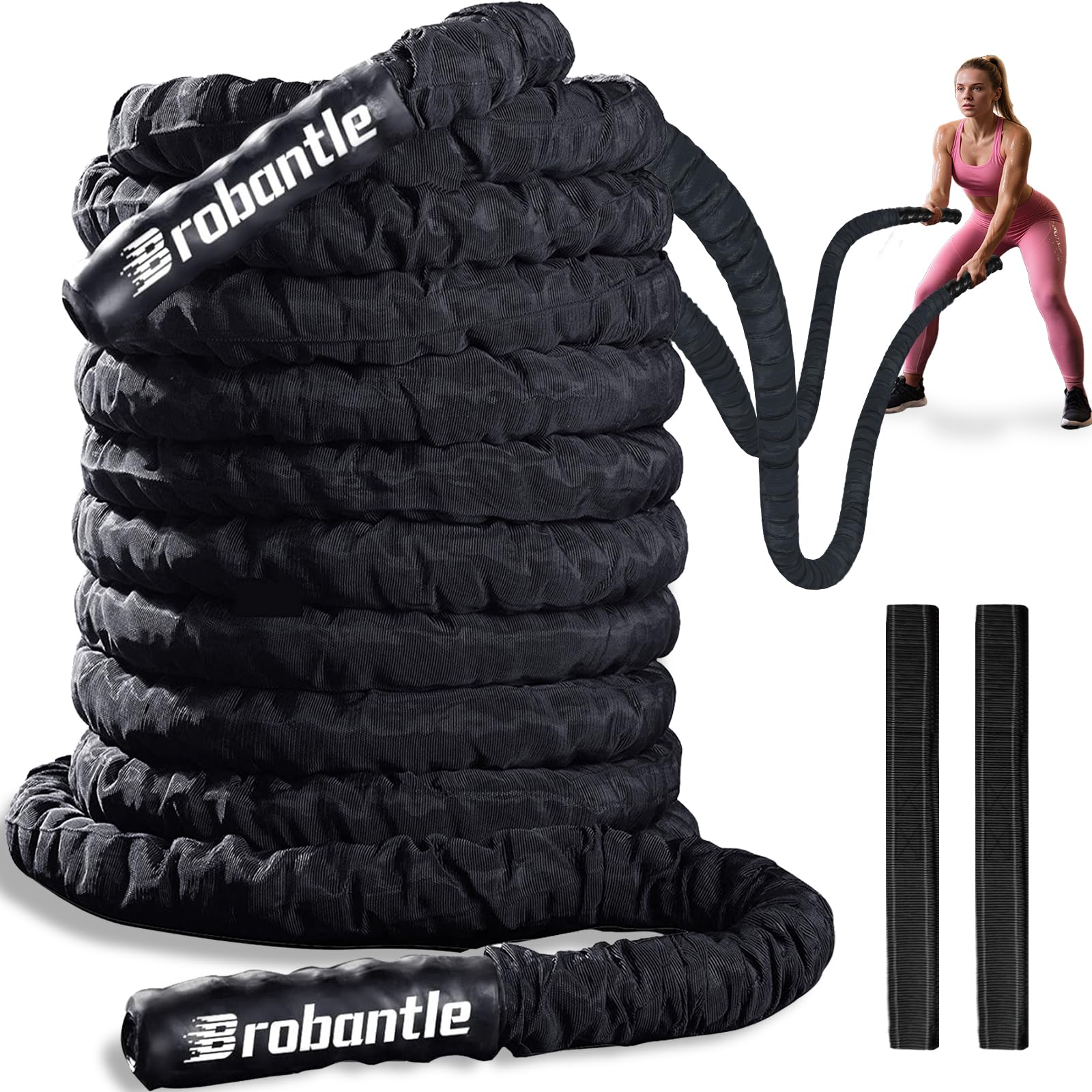
Brobantle Battle Rope 40 ft

Brobantle

Brobantle Battle Rope 40 ft

  • Sleeve Nylon cover
  • Handles Heat-shrink
  • Length Options 30 or 40 ft
  • Diameter Options 1.26 or 1.5 in
Check Price on Amazon

Extra length gives waves room to travel in a bigger garage or driveway.

Forty feet changes the workout. The waves have room to travel before they die, so a double wave or a lateral whip reads as a wave instead of a shudder, and there is enough rope for two people working opposite ends. The nylon cover and heat-shrink handles are the standard kit here, and 1.5 inches is the right middle ground for most adults.

Our take: this is the length to buy if the floor exists, and a mistake if it does not. It wants a clear run longer than a single garage bay; in a short space you end up choking the rope and doing a worse version of the same exercise. Where the room is there, the extra ten feet of travel is worth paying more for than a 30-footer.

Bottom Line

Choose it when you have the floor space: 40 feet of sleeved rope gives bigger waves and room for two people to work.

Check Latest Price

Best For First garage rope

Our Score 9.4/10
Amazon Basics Battle Rope

Amazon Basics

Amazon Basics Battle Rope

  • Length 30 ft
  • Sleeve 600D Oxford
  • Diameter 1.5 in
  • Rope Weight 15.8 lb
Check Price on Amazon

There is a bright tracking line running the length of this rope, and it is more useful than it sounds: it makes the rope easy to spot in a cluttered garage and easy to watch for the moment the outer twist starts to go. A small thing, but a genuinely useful one.

The rest is conventional and sensible: a 1.5-inch by 30-foot poly dacron rope in a three-strand twist, 15.8 pounds, a 600D Oxford sleeve over the section that rubs, and heat-shrink caps on the ends. It is the least expensive sleeved rope in this group, which counts for a lot in a garage gym built on a budget.

What we keep coming back to is the weight. At 15.8 pounds it feels substantial when you pick it up and light enough that the rope does not dictate your pace, and for a one-car garage and a twice-a-week session that is about the right balance.

Bottom Line

A dependable, widely owned starter rope, and the cheapest sleeved one here; just watch the ends, which are where it wears first.

Check Latest Price

Best For Advanced heavy work

Our Score 9.4/10
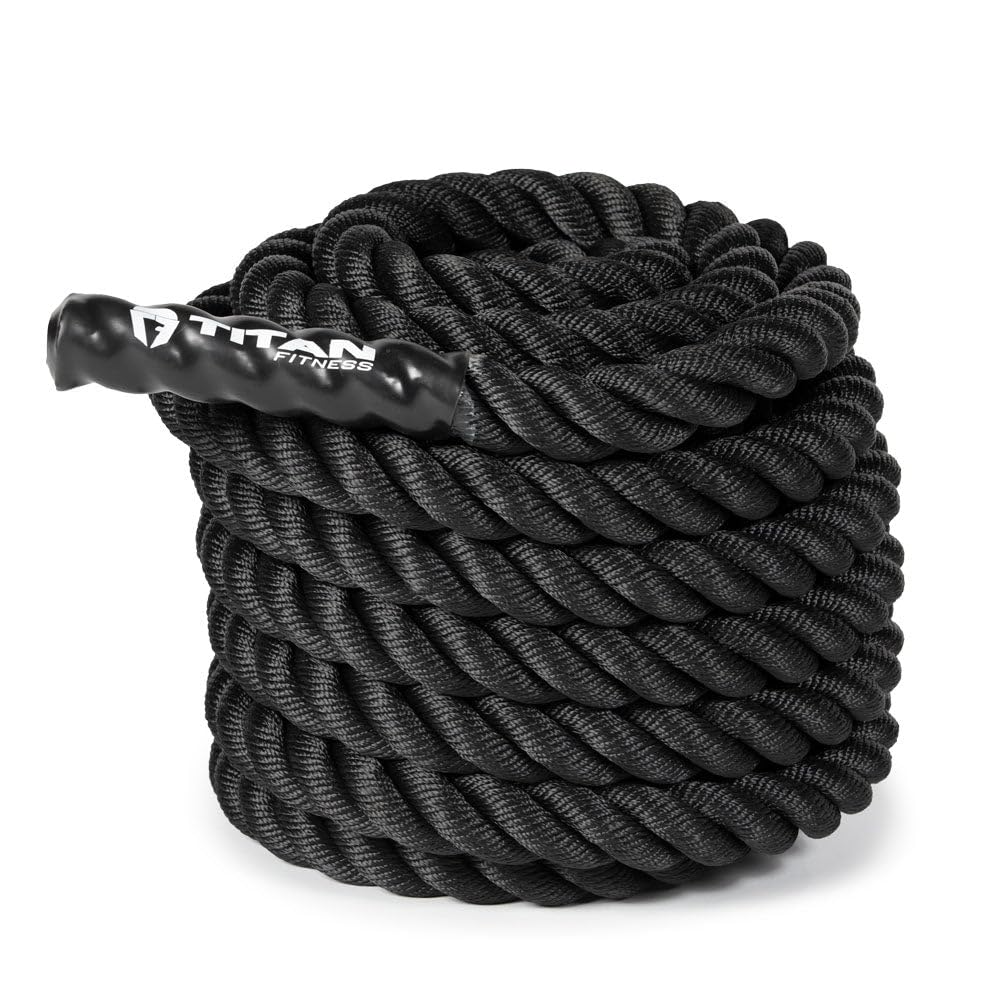
Titan Fitness Battle Rope

Titan Fitness

Titan Fitness Battle Rope

  • Length 40 ft
  • Diameter 1.5 in
  • Material Poly Dacron blend
  • Rope Weight 19.8 lb
Check Price on Amazon

Almost 20 pounds of rope is a different animal. At 40 feet by 1.5 inches the Titan is the heaviest rope here, and the first set tells you so: the waves come back at you with weight behind them, and your shoulders work against mass rather than rhythm.

The protection here is a poly dacron three-strand build and an extra coating on the handles rather than the full-length sleeves our other picks carry. On a rubber floor that is fine. On a driveway the working length takes the grit directly, and you should expect it to look used.

Workout feedback on this rope is uniformly good, and it is easy to see why: it is a rope for someone who has been at this a while and wants the exercise to get harder without getting longer.

Our call: this is the rope we reach for when we want our form tested by fatigue instead of speed. It rewards a base of strength. If you are still learning the rhythm, start on a lighter 30-footer and come back to this one when the waves stop being the hard part.

Bottom Line

For advanced training in a big space: 40 feet and almost 20 pounds of rope that fights back on every single wave.

Check Latest Price

Best Budget

Our Score 9.2/10
Fitvids Battle Rope

Fitvids

Fitvids Battle Rope

  • Length 30 ft
  • Handles Heat-shrink ends
  • Diameter 1.5 in
  • Warranty 2 years
Check Price on Amazon

A full 1.5-inch by 30-foot rope for the least money up front.

The least expensive rope here, and for a first rope we think that is the whole argument. You get a full 30 feet at 1.5 inches, heat-shrink ends, a two-year manufacturer warranty, and a coil that rolls up small enough to hang behind a door.

A straight 1.5-inch by 30-foot rope is the right starting point: heavy enough that the waves take real effort, light enough that you can keep them going for a full set instead of fighting the rope. It is also the one that disappears into a gym bag, which is more than the sleeved picks here can claim.

For a first rope, or a second one that travels, that is plenty. Thirty feet suits a small bay or a patch of driveway, and the simple build means your form, not the equipment, is what you are working on.

Bottom Line

The cheapest way into rope training that still gets you a full 1.5-inch, 30-foot rope and a two-year warranty.

Check Latest Price

How We Tested Battle Ropes in Garages, Driveways, and Basements

We started by comparing specs and customer reviews for ropes sold at home-gym and fitness retailers, looking at diameter, length, material, handle construction, and the anchor hardware included. We ruled out ropes with vague weight listings, bare ends that looked likely to unravel, and straps that seemed too short for a garage beam or driveway post. That left 12 ropes, which we used for six months.

For six months, we ran 15- to 20-minute sessions in a garage gym, on a concrete driveway, and in a basement with a low ceiling. We timed solo setup—uncoiling, wrapping the anchor strap, and clipping or tying off—and noted whether the rope twisted, slipped, or needed readjusting mid-workout. We weighed each rope and swung it through alternating waves, double-arm slams, side-to-sides, and rope pulls, watching whether the wave traveled cleanly to the anchor or died halfway, and whether our grip faded before our breathing did.

After every few sessions, we dragged each rope across concrete, coiled it, and checked the fibers, handle attachments, and end caps for fraying, loosening, or stiffness. At the six-month mark, we compared that wear against what each rope cost, because a cheap rope that shreds is no bargain. The ropes that held their shape, stayed comfortable in hand, and set up without fuss are the ones still in rotation.

How to Choose

Match the length to the floor, not the workout

A rope needs a clear run: anchor at one end, you at the other, with enough slack that the waves travel instead of puddling at your feet. Thirty feet covers a single garage bay or a driveway apron; 40 and 50 feet want a two-car bay, a long basement, or a patio. Measure the open floor you actually have and subtract a stride before you pick. Our 40-foot pick is the right rope for a big space and a frustrating one in a small one.

Diameter and rope weight set the resistance

Battle ropes get harder in two directions: thicker and longer. A 1.5-inch rope is the adult standard, and a 2-inch version of the same length is a real jump in mass, with more resistance on every wave and more shoulder fatigue per set. Length adds weight too, so a long 1.5-inch rope can feel heavier in the hands than a short 2-inch one.

If you are new to ropes, start at 1.5 inches and 30 feet and add difficulty with tempo rather than a thicker rope. Thick ropes reward the people who already have the rhythm and punish everyone else.

Sleeves, floors, and the ends

A sleeve is the cheapest insurance you can buy. On concrete, a bare rope grinds against grit with every rep and the ends go first; a nylon or Oxford cover takes that wear instead and keeps the rope cleaner. The catch is bulk, since a sleeved rope coils larger and dries slower. Shake the grit out after outdoor sessions rather than coiling it damp. On rubber mats indoors, an unsleeved rope wears much more slowly and the cover buys you less.

Anchoring: check what ships in the box

Most kits assume a wood stud or a post and send lag bolts. If you rent, or your walls are masonry, plan to wrap the rope around a power rack, a heavy kettlebell, or a tree instead. Set the anchor low enough that the rope runs roughly level from the wall to your hands; anchor it high and you fight the rope as much as the floor. Strap-and-carabiner kits are the easiest to move between a garage and a backyard.

Handles, ends, and storage

Heat-shrink handles run from about 7.5 to 10 inches. Longer grips give you room for gloves and for choking up when your forearms fail, and they protect the rope where your hands work hardest. The ends are where a rope dies, so check the last few inches for lifting strands and hang it over a wide hook or a wall strap rather than stacking it in a bucket where moisture sits.

Frequently Asked Questions

Final Verdict

Length, diameter, and a sleeve are the three decisions, and the Perantlb gets all three right for a normal garage: 30 feet of 1.5-inch rope, a full-length nylon cover, and the anchor strap in the box. It is the rope we point most people to first.

If your rope will live outdoors or take daily abuse, the Power Guidance is the one to buy, since its double-layer cover and two-year warranty are what the extra money purchases. And if you are still working out whether rope training suits you at all, the Fitvids answers that for the least money.