Yoga & Mobility

Best Balance Boards of 2026

Strip a balance board down and it's a plank on a pivot — which is exactly why the pivot matters so much. A rocker only tips heel to toe, a wobble board rolls in every direction, and a sphere wanders wherever you push it, so two boards that look identical on a shelf can feel like completely different equipment underfoot. What the right one fixes is dead time: a few minutes on a board while the coffee brews does more for your ankles and core than another hour in a chair.

Over the past six months, twelve boards have lived in my living room, my home office, and one patient kitchen, used barefoot, in socks, and in sneakers. Grip turned out to matter more than any spec on the box — the boards we kept reaching for were the ones that didn't make us think about our feet — and fun counted for more than we expected. The picks below sort by what you actually want a pivot to do.

Best Overall

Our Score 9.6/10
Revbalance 101 v2

Revbalance

Revbalance 101 v2

  • Board Weight 6.8 lb
  • Weight Limit 400 lb
  • Traction Surface DuraSoft
  • Difficulty Adjustment Magnetic stops, no tools
Check Price on Amazon

Tool-free magnetic stops let a beginner start slow and keep progressing.

The stops on this board are held by magnets, and that single design choice is why it tops our list. Slide them in and the roller's travel shortens to something a beginner can survive; slide them out and the same deck becomes a full-length trainer. There are no tools and no bolts to lose, and no second board to buy when the first setting gets easy. It is the one deck here that adjusts across a continuous range rather than clicking between two or three drilled positions.

The traction surface is the second thing we noticed. DuraSoft is soft enough that bare feet do not complain and textured enough that shoes do not skid, which is more than several decks here manage. The sandpaper-topped boards grip well and feel like a woodworking tool on your arches. At 6.8 pounds the board stays planted through a set but still lifts onto a shelf with one hand.

On carpet it is steady and predictable, and the roller runs faster on a hard floor, which is the setting to graduate to rather than start on. The 400-pound rating is generous for a home board but sits below the two heaviest-rated decks in this group, so check the number if a larger adult will be sharing it.

What keeps it at the top is the absence of friction between deciding to train and training. Set the stops short on day one, walk them out over a month, and the board keeps asking a slightly harder question instead of becoming something you have solved and stopped thinking about.

Bottom Line

We recommend this to anyone who wants a board they will still be using in six months, because the difficulty moves with you instead of arriving fixed.

Check Latest Price

Best All-In-One Value

Our Score 9.6/10
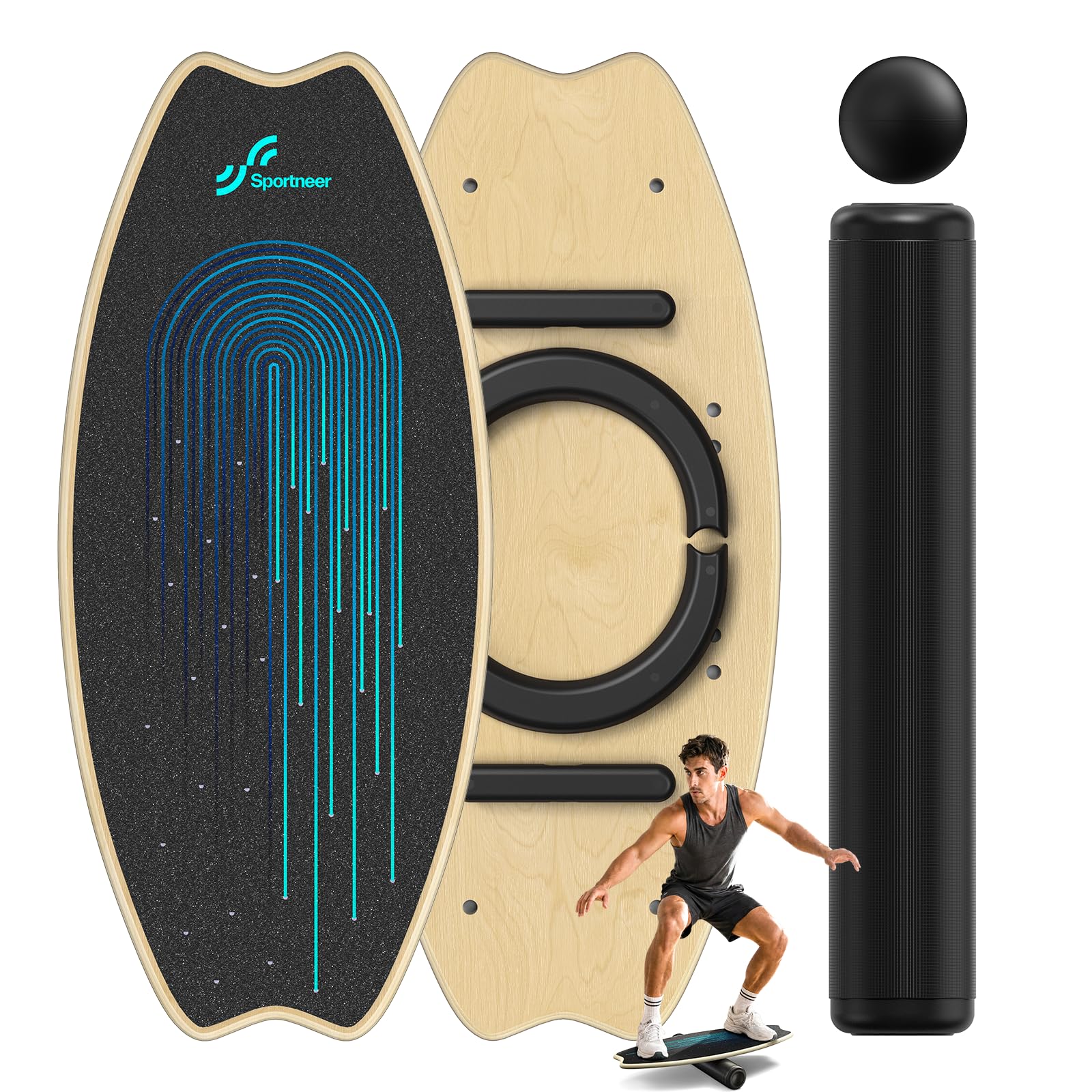
Sportneer Balance Board

Sportneer Balance

Sportneer Balance Board

  • Material Birch
  • Deck Size 31.5 x 14.17 inches
  • Weight Limit 450 lb
  • Difficulty Adjustment Stoppers, roller, or ball
Check Price on Amazon

Roller, ball, and stoppers deliver seven setups for less than the premium boards.

Two kinds of instability arrive in the same box: a roller for front-to-back work and a ball for the round, all-directions kind, plus stoppers that set how far the roller can run. Sportneer counts seven modes, which is arithmetic as much as engineering, but the practical version holds up. You can roll straight to warm up and then switch to the ball and feel an entirely different set of muscles take over.

At a midrange price, this is the board we hand most people. The birch deck is rated to 450 pounds, the matte surface keeps bare feet from skating, and 31.5 inches of length gives you room to shift your stance around. It is more board than a beginner needs and less money than the premium options, and that combination is rare enough to be worth naming.

One caution about the ball: it is the setting that humbles people fastest, and a first attempt on it tends to end in a laugh and a near-miss. Start on the roller with the stoppers short and treat the ball as a month-two exercise. The stoppers themselves are small enough to migrate to the bottom of a drawer, so keep them with the board.

Bottom Line

This is the board we point most people to first, because roller, ball, and stoppers cover beginner through advanced without a premium price.

Check Latest Price

Best Adjustable Clinical Rocker

Our Score 9.6/10
Fitterfirst Professional Rocker

Fitterfirst

Fitterfirst Professional Rocker

  • Material Baltic birch plywood
  • Deck Size 20 x 20 inches
  • Weight Limit 350 lb
  • Tilt Settings 10, 12, and 15 degrees
Check Price on Amazon

Three tilt settings and a wide deck for controlled, repeatable rehabilitation work.

One plane of tilt, three angles, and no roller at all. Fitterfirst builds the clinical version of a balance board: a 20-inch square of Baltic birch plywood that pitches front and back, with two spheres underneath that reposition for 10, 12, or 15 degrees of tilt.

That restraint is exactly why we rate it for rehab rather than general training. Single-plane work is what a therapist usually wants after an ankle or knee injury, one controlled direction at a time with the angle turned up as strength returns, and the wide deck gives a forgiving stance while you rebuild.

At 7.5 pounds it stays planted through a set, and the 350-pound rating covers most adults. Setup is a deck and two spheres: there is nothing to assemble, and switching the angle takes a moment rather than a search for tools.

If board-sport training is the goal, this is not the tool, since a roller board gives the free front-to-back and side-to-side movement that surf and skate work needs. For controlled, repeatable rehabilitation at home, nothing else here comes as close.

Bottom Line

We rate this for supervised rehabilitation rather than general training, because the three tilt angles let you rebuild a joint one controlled direction at a time.

Check Latest Price

Best Budget Roller Board

Our Score 9.4/10
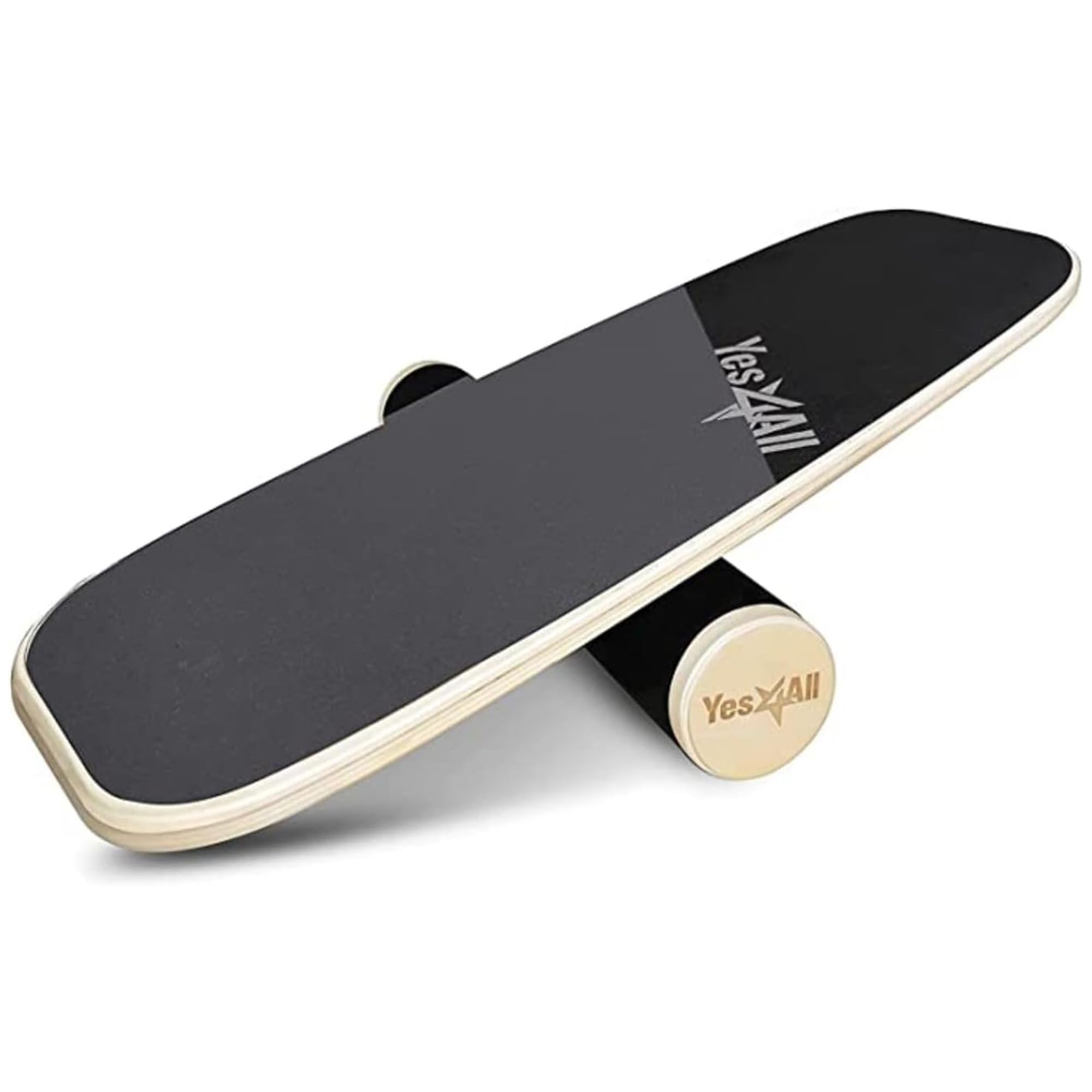
Yes4All Wooden Trainer 3-in-1

Yes4All

Yes4All Wooden Trainer 3-in-1

  • Warranty 1 year
  • Deck Size 29.53 x 11.22 inches
  • Weight Limit 300 lb
  • Stopper Distances 11, 16, and 22 inches
Check Price on Amazon

Three stopper positions turn an inexpensive deck into a step-by-step trainer.

Three holes, two stoppers, and a roller. Yes4All drills its stopper positions 11, 16, and 22 inches apart, so the roller's run, and with it the difficulty, changes with a pull and a re-seat rather than a new purchase. It is a cruder mechanism than the magnetic stops on our top pick, and it costs a great deal less.

The deck is 15-ply pressed wood with an emery surface, 29.5 inches long and a little over 11 inches wide, rated to 300 pounds. With the stoppers in close it is a gentle first board. At full length the roller runs free and the same deck behaves like a surf trainer, refusing to forgive a weight shift you did not plan.

What we did not expect to value is how much the stoppers change who can use it. One deck covers a cautious adult and a teenager practicing for skate season, which is more range than most single-difficulty boards here offer. It is the board we hand a family that wants one deck rather than three, and the one we point to when somebody is not ready to commit real money to the hobby.

Bottom Line

This is the roller board we suggest to anyone buying their first one, since three stopper positions cover a beginner and a teenager on a single deck.

Check Latest Price

Best For Kids and play

Our Score 9.4/10
Gentle Monster Wooden Board

Gentle

Gentle Monster Wooden Board

  • Length 35 inches
  • Material Natural wood
  • Age Range 3 years and up
  • Weight Limit 480 lb
Check Price on Amazon

A 35-inch curve of natural wood gets adopted as a bridge, a ramp, a slide, and a rocking seat long before anyone thinks of standing on it to balance. That is the point of this board: it is a play object that happens to train balance, not a trainer that happens to be fun.

It is rated to 480 pounds, the highest here, so an adult can sit or stand on it without a second thought, and the finish is real wood with visible grain rather than a laminate print. It is also the only board in this group rated for children as young as three, which is why it turns up in playrooms more often than in gyms.

Check the ends when it arrives. Boards can turn up chipped, dented, or splintered at the tips, and that stings when the whole appeal is how the thing looks in a room. It is cosmetic rather than structural, since the deck still rocks perfectly well, but inspect it before it becomes a gift or gets tucked away.

What it will not do is train you. There is no roller, no adjustable resistance, and no way to make it harder as you improve, so an adult chasing measurable progress runs out of board within a season. It belongs in a playroom or a stretching corner, with a roller board kept for the actual training.

Bottom Line

Buy this for a child or a playroom, where a board that doubles as a ramp and a rocker gets far more use than one that only trains.

Check Latest Price

Best Rocker for Rehab

Our Score 9.2/10
StrongTek Wooden Balance Board

StrongTek Wooden Balance

StrongTek Wooden Balance Board

  • Deck Size 17.5 x 13.5 inches
  • Board Type Single-plane rocker
  • Board Weight 4.7 lb
  • Weight Limit 350 lb
Check Price on Amazon

A stable single-plane rocker that suits PT homework and post-injury ankle work.

If a physical therapist has handed you homework, this is the board that matches it. It is a single-plane rocker, meaning a curved base with no roller and no ball, and it tips forward and back over a textured deck. Rubber pads underneath hold on carpet and hard flooring alike. Nothing about it is complicated, and for daily rehab that is the appeal rather than a shortcoming.

The deck measures 17.5 by 13.5 inches and carries 350 pounds, which covers most adults, and at 4.7 pounds it is light enough to keep beside a chair and pull out for five minutes. We appreciate the low profile: at 3 inches tall it is a short step up, so you can get on and off without reaching for a counter once you are steady.

Width is the consideration. The deck is noticeably narrower than the 20-inch clinical rockers, so a wide stance feels tippier than it does on the Fitterfirst. If your therapist has you working with your feet far apart, that is the reason to spend more. For ankle and knee work at home with a normal stance, it does the same job for a fraction of the money.

Bottom Line

Buy this if a physical therapist has given you single-plane work to do at home and you want a stable, inexpensive board to do it on.

Check Latest Price

Best For First board

Our Score 9.2/10
Amazon Basics Wood Wobble Board

Amazon Basics

Amazon Basics Wood Wobble Board

  • Material Wood
  • Warranty 1 year limited
  • Deck Size 15.75 x 15.75 inches
  • Weight Limit 265 lb
Check Price on Amazon

The cheapest board here is still a solid wood deck rather than plastic, which is the first surprise. It is 15.75 inches square and 3 inches tall, with a sandpaper-textured top and a one-year limited warranty: a small, simple wobble board with nothing to adjust and nothing to break.

That sandpaper surface earns its keep and takes a toll. It grips bare feet and shoes on a hard floor, and it is rough enough that forearms complain during planks and push-ups, so throw a towel down for upper-body work and it stops mattering.

On smooth flooring the board can skate, and a thin mat underneath fixes that while also softening the difficulty if balancing turns out harder than expected. Carpet does the same job for free: the deck that is a challenge on tile becomes noticeably gentler on a rug, which is a sensible place to start.

What you are really buying is an answer to a question, which is whether you will use a balance board at all. If yes, this deck becomes the spare or the hand-me-down and the money was well spent. If no, you have spent the least of anything in this guide finding out.

Bottom Line

We suggest this to anyone who is not sure they will stick with balance work, since it answers that question for less than anything else here.

Check Latest Price

Best for Standing Desks

Our Score 8.8/10
FEZIBO Standing Desk Board

FEZIBO

FEZIBO Standing Desk Board

  • Tilt 8.5 degrees, 360-degree swing
  • Deck Size 20 x 12 inches
  • Board Weight 6.4 lb
  • Weight Limit 320 lb
Check Price on Amazon

Cushioned wobble platform that keeps your hips moving through a long workday.

This is not a training board and does not pretend to be. The FEZIBO is a 20 by 12-inch platform with a cushioned top, 8.5 degrees of tilt, and a full 360-degree swing. It sits closer to a standing mat that moves than to a deck you would do push-ups on.

At a desk it earns its place. Standing still is the real problem with standing desks, and a platform that lets your hips drift while you answer email does more than a thicker mat. We like how shallow the tilt is: enough to keep you shifting weight, not so much that you are thinking about balance during a call. It is 2.2 inches tall and 6.4 pounds, so it slides under the desk when you sit down.

The weak point is underneath. The bottom pad can separate from the plywood base, and once it does the platform rocks unevenly and no longer sits flat. That is the difference between a cushioned deck and the solid wood boards here, which have nothing to delaminate. Ours has been a desk fixture rather than a training tool, and that is the honest way to buy it.

Bottom Line

Buy this for a standing desk rather than for training, and expect a workday accessory with a finite life rather than gym equipment.

Check Latest Price

What Six Months on 12 Balance Boards Taught Us

We built the shortlist from published specs first: pivot type, deck length and width, stated weight limit, surface material, and warranty. Anything with a deck too short for a size 10 foot to land on squarely, or a stated limit under 250 pounds, came off the list before we ordered a single box. That left twelve boards.

For six months those boards rotated through a home office with a standing desk, a carpeted living room, and a kitchen with hardwood floors. Two testers of different heights and weights ran every board through the same script: barefoot, then socks, then sneakers, sixty seconds balancing on one foot, and a count of how many times the deck's edge slammed into the floor.

Grip we judged the honest way — whether a sock foot slid on the surface, and whether that surface still felt the same after months of daily use. Decks were checked monthly for compression, scratches, and any splitting where the pivot attaches, and each one got wiped down to see how easily it cleaned up. Size was measured against real feet, with our tallest tester standing on every deck to see whether heels or toes hung off the end. We also noted which boards skated across hardwood and which stayed put, because a board that travels across the room is a board nobody uses.

How to Choose

Match the board to the movement

A wobble board on a fixed pivot or hemisphere tips in every direction at once, which is the closest thing to standing on a moving surface and the easiest to work at a desk. A single-plane rocker tips front to back only, and that is the design most physical therapists hand you after an ankle or knee injury, because it isolates one direction and lets you feel progress. A roller board puts a cylinder under a deck and is the surf-and-skate end of the family: more travel, less forgiveness, more transfer to board sports. Settle the movement first; everything else is refinement.

Adjustable difficulty keeps a board in use

Nearly every board is hard for a week and easy by the third. What separates the ones that stay in rotation is a way to move the goalposts: Revbalance slides its magnetic stops without tools, Yes4All's stoppers sit at 11, 16, and 22 inches, and the Sportneer kit swaps a roller for a ball. That matters twice over when more than one person will use it, since a beginner needs the shortest setting while a teenager wants the longest. A deck with one fixed difficulty is the one that ends up behind the couch.

Grip, socks, and the floor underneath

Two surfaces decide whether a board feels secure: the deck under your feet and the floor under the board. Sandpaper-style grip holds bare feet and shoes but is unpleasant against forearms during planks, while bare or lightly finished wood is kinder to skin and slicker in socks. Underneath, hard flooring lets a board skate, and a thin mat or a rug fixes it, while carpet slows the same board down and makes it noticeably easier. Treat that as a dial rather than a flaw: start on carpet, move to the hard floor when the challenge fades.

Capacity, deck size, and everyone else in the house

Weight ratings in this group run from 265 to 480 pounds, so check that number first if two adults or a teenager will share the board. Deck size decides stance as much as difficulty does: a 20-inch square like the Fitterfirst gives a wide, forgiving platform for rehab, while an 11-inch-wide deck is a narrower, more technical place to stand. If the board will live in a living room, portability counts too, since a 4.7-pound rocker tucks behind a chair and a roller kit needs somewhere to put the roller.

Frequently Asked Questions

Final Verdict

Buy the Revbalance 101 v2 if you want one board that stays interesting: the magnetic stops set the difficulty where you are today and move it as you improve, and the soft traction surface means you will actually use it barefoot in the living room.

If that is more than you want to spend on a first board, the Sportneer kit adds a roller and a ball for a good deal less. And if a physical therapist has handed you single-plane work to do at home, the StrongTek is the board that matches the assignment.