Walking Pad vs. Treadmill: Which One Fits Your Use?
Choose a walking pad when your main goal is low-speed walking, often under a standing desk, and compact storage matters more than running features. Choose a treadmill when you want jogging or running, a longer and wider deck, fixed handrails, incline, structured workouts, or higher-duty use.
The names are not strict technical standards. Some hybrid walking pads add folding rails and jogging speeds, while compact treadmills can be small and foldable. Compare the actual speed range, walking surface, frame, duty rating, safety features, and warranty—not the product label alone.
Walking Pad vs. Treadmill at a Glance
The ranges below describe common designs, not rules. WalkingPad’s own support center separates walking-only models, hybrids, and full treadmills by their published speed and use.
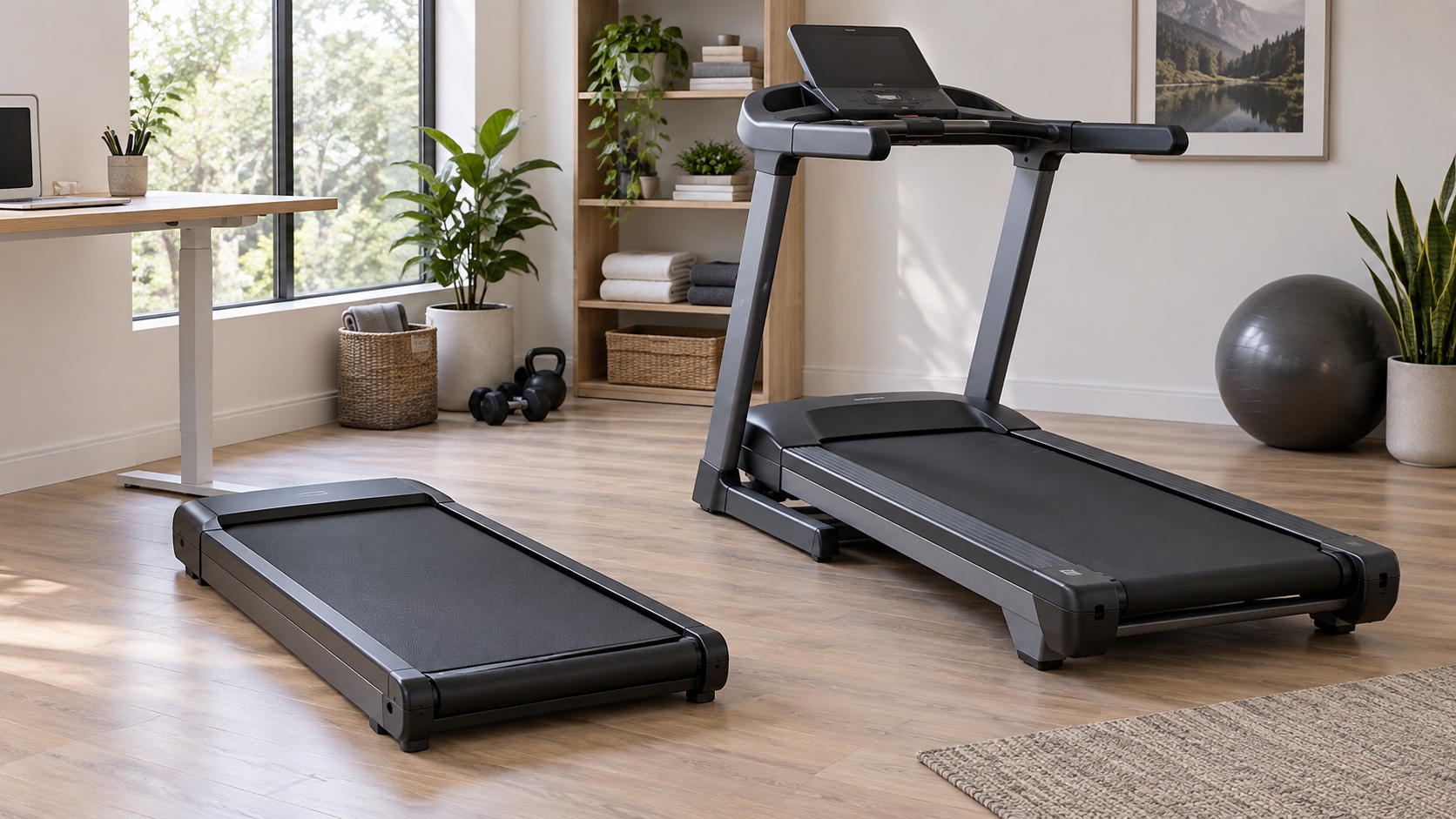
| Feature | Typical walking pad | Typical treadmill |
|---|---|---|
| Primary use | Walking and desk walking | Walking, jogging, and running |
| Speed | Often limited to walking speeds; hybrids may go faster | Usually a wider range with higher top speed |
| Handrails | None, low rail, or foldable rail | Fixed uprights and handrails |
| Walking surface | Shorter and narrower | Longer and wider, especially for running |
| Incline | Often absent; some models add manual or powered incline | Common on mid-size and full-size models |
| Controls | Remote, small display, or app | Console plus physical speed and incline controls |
| Storage | Low profile; may roll under furniture or fold at the belt | Larger; some decks fold upright |
| Machine weight | Usually lighter, but still awkward to lift | Usually heavier and more stable at speed |
| Maintenance access | Compact covers and model-specific belt system | More space, but more components and larger parts |
| Best fit | Steps during work and small-space walking | Dedicated cardio training and mixed users |
Choose Based on the Hardest Workout You Will Actually Do
Choose a walking pad if:
- You intend to walk, not run.
- You need the deck beneath a standing desk.
- You will store it frequently and can handle its actual weight.
- You are comfortable using a remote or small external display.
- The published daily-use recommendation matches your expected hours.
Choose a treadmill if:
- You plan to jog, run, or do fast intervals.
- You want fixed handrails, quick controls, incline, or built-in workouts.
- Tall users or runners need a longer deck.
- Several people will use the machine at different speeds.
- You have permanent floor space and can meet the electrical and clearance requirements.
If both lists fit, a hybrid with a folding rail may work—but verify its speed with the rail up and down, deck dimensions, emergency-stop system, and whether the warranty covers your intended use.
For Desk Walking, Check More Than Footprint
- Step-up height: the pad raises your standing position, so the desk must extend high enough to preserve a neutral working posture.
- Deck length: the desk should not force you to walk too close to the front housing.
- Control access: you must be able to stop the belt immediately without reaching awkwardly.
- Cord route: the cord must not cross a walkway, sit under the pad, or be pinched by a sit-stand desk.
- Storage reality: measure the proposed space, including furniture legs and the product’s thickest point—not only its deck height.
LifeSpan’s current under-desk models illustrate why specifications matter: published step-up height, product weight, speed range, recommended use, and warranty differ by model even within one brand.
Safety Differences That Matter
Fixed treadmill rails provide a stable place to straddle the belt at startup and controls that remain in one location. A rail-free walking pad relies more heavily on low speed, clear floor space, remote access, and the user’s balance.
- Use only the speed and activity approved for the model.
- Do not run on a walking-only pad.
- Keep the remote or stop control accessible.
- Do not step onto a belt already moving faster than the manual permits.
- Keep children, pets, loose clothing, and chair wheels away from the belt.
- Use the safety key or tether whenever the model provides one.
Noise, Maintenance, and Durability
A walking pad is not automatically quieter or shorter-lived. Noise varies with speed, user weight, floor, belt condition, maintenance, motor, rollers, and frame stiffness. A full treadmill can be quieter at the same walking speed if it has a heavier frame and better isolation, while its running footfall will usually create more impact.
Compare the maintenance schedule and warranty before buying. Some belts require routine lubrication; others are marketed as self-lubricating or maintenance-free. Warranty length is not a life expectancy, but short parts coverage and unavailable replacement belts increase ownership risk. See our walking pad lifespan guide for a wear-based evaluation.
Specifications to Compare Before Buying
- Walking-only, hybrid, or running-approved use
- Minimum and maximum speed in each rail configuration
- Usable belt width and length
- Product weight, user capacity, and recommended daily use
- Step-up height and stored dimensions
- Emergency stop, rail, side rails, and remote behavior
- Incline type and whether it can be used under a desk
- Belt lubrication and adjustment requirements
- Frame, motor, parts, and labor warranty terms
- Replacement belt, remote, controller, and service availability
Sources and Manufacturer Guidance
Requirements can vary by product, model, and situation. These primary sources informed this guide; official instructions for your exact product and current authoritative guidance take priority.
Frequently Asked Questions
-
Only if the manufacturer specifically approves that model and rail configuration for running. Many low-profile pads are walking-only, while some hybrids allow jogging with the rail raised.
-
The better choice is the one that safely supports the activity you will do consistently. A walking pad can add low-intensity movement during work; a treadmill supports higher-speed or incline workouts. Neither product guarantees weight loss.
-
They can be used safely within their instructions, but they provide less physical support. Start slowly, keep the stop control accessible, maintain clear space, and choose a rail-equipped model if balance is a concern.
-
Yes for low-speed walking when the model meets your size and duty needs. It does not replace a running treadmill when you need higher speed, incline, a long deck, fixed rails, or structured workouts.
-
Yes. Common tasks include cleaning, belt tracking checks, cord inspection, and model-specific lubrication. A product marketed as maintenance-free may reduce lubrication work but still needs inspection and cleaning.