How Long Do Walking Pads Last? A Wear-Based Answer
There is no defensible universal number of years for a walking pad. A lightly used, serviceable model can outlast its warranty, while a low-duty pad used for hours every workday may develop belt, deck, roller, motor, or controller problems much sooner.
Estimate lifespan from cumulative hours and operating conditions—not age alone. The most useful signals are the manufacturer’s recommended use, belt and deck condition, recurring heat or noise, ability to hold speed under load, maintenance history, warranty, and availability of replacement parts.
Estimate Your Annual Usage Hours
Multiply average hours per day by days per week, then by 52. A pad used 30 minutes on five days per week logs about 130 hours per year. Two hours on five days per week is about 520 hours. Four hours each workday is about 1,040 hours.
Compare that total with the model’s published recommended use or duty limit. Do not assume every under-desk treadmill is intended for an eight-hour workday. LifeSpan, for example, publishes model-specific recommended daily use on some treadmill-desk products; the number differs between models.
| Typical schedule | Approximate annual use | What to verify |
|---|---|---|
| 30 min × 5 days/week | 130 hours | Basic home-use coverage and maintenance schedule |
| 1 hour × 5 days/week | 260 hours | Belt tracking, cleaning, lubrication type, and parts support |
| 2 hours × 5 days/week | 520 hours | Published daily-use recommendation and warranty exclusions |
| 4 hours × 5 days/week | 1,040 hours | Commercial or high-duty rating, cooling breaks, motor/deck design, and service availability |
The Parts That Usually Decide Useful Life
A walking pad is a system: a new motor cannot compensate for a damaged deck, and a new belt will not solve a failing controller.
| Component | Early warning signs | Why it matters |
|---|---|---|
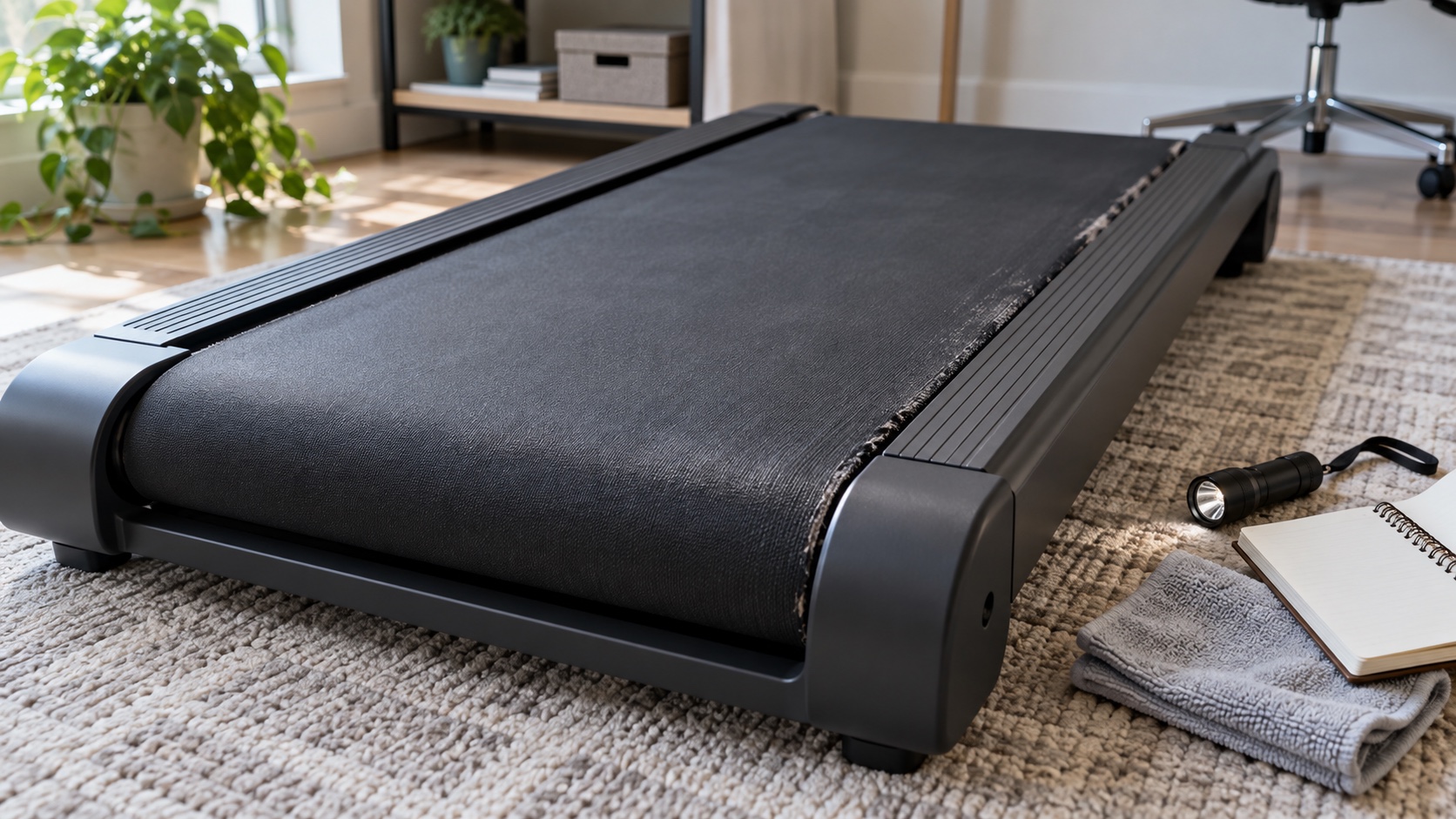
| Walking belt | Drift, slip, frayed edge, raised seam, glazing, or repeated tension changes | A damaged or high-friction belt can increase motor and controller load |
| Deck | Grooves, rough surface, heat, delamination, or friction that returns after correct maintenance | A worn deck can quickly damage a replacement belt |
| Rollers and bearings | Grinding, rhythmic knock, rough rotation, or belt movement that will not stabilize | Poor roller movement affects tracking, tension, and load |
| Motor | Loss of speed under normal load, overheating, odor, or unusual hum | Motor symptoms may also be caused by belt/deck friction or power problems |
| Controller and sensor | Surging, speed error, random stops, error codes, or failure to start | Electrical diagnosis should not be replaced by repeated belt adjustments |
| Folding joint or frame | Play, cracking, failure to lock flat, or uneven belt path | Structural instability is a stop-use condition |
| Remote and display | Intermittent control, delayed stop, pairing failures | A pad without reliable speed and stop control may not be safe to use |
How to Help a Walking Pad Last Longer
- Stay within the published use. Respect user capacity, maximum speed, daily-use recommendation, and any continuous-use or cooldown limit.
- Keep it clean. Vacuum the floor and belt surface so grit does not enter the belt/deck system or vents.
- Maintain the correct belt position. Stop before an edge rubs or folds. Use only the model’s alignment and tension procedure.
- Follow the exact lubrication system. Some pads require silicone; others use a self-lubricating or maintenance-free belt. More lubricant is not better.
- Give it ventilation. Do not block motor openings, push the pad tightly against furniture, or store it while hot.
- Use a stable, level floor. A twisted frame can affect belt tracking and noise.
- Store it as designed. Do not stand a flat-only model upright, fold a non-folding belt, or place heavy items on the deck.
- Record hours and symptoms. Note maintenance dates, bolt turns, error codes, heat, noise, and warranty contacts.
Repair or Replace the Walking Pad?
Start with the full cost and the fault, not the product’s age.
| Situation | Repair may make sense | Replacement may make more sense |
|---|---|---|
| Remote, cord, or simple external part | Exact replacement is available and the underlying machine is healthy | The safety control is unsupported or incompatible parts are the only option |
| Walking belt wear | Correct belt is available and the deck, rollers, motor, and controller test well | Deck is also damaged or labor and shipping approach replacement cost |
| Motor or controller fault | Covered by warranty or supported by an authorized repair route | Part is unavailable, diagnosis is uncertain, or multiple systems are failing |
| Folding frame or structural crack | Manufacturer authorizes a covered structural repair | Frame integrity or lock reliability cannot be restored and verified |
| Repeated shutdown and heat | A technician finds one serviceable cause such as belt/deck friction | The pad continues to overheat or stop after correct repair |
What to Check Before Buying for Longevity
- A published daily-use recommendation, not only peak motor horsepower
- Separate frame, motor, parts, and labor warranty terms
- Whether the belt, deck, roller, remote, and controller can be purchased
- In-home service versus customer-paid return shipping
- Maintenance instructions available before purchase
- Product weight and frame design appropriate for the intended user and speed
- A real support channel that accepts model, serial number, error details, photos, and video
Our walking pad vs. treadmill guide can help determine whether a compact pad is the right product category before durability becomes the deciding issue.
Sources and Manufacturer Guidance
Requirements can vary by product, model, and situation. These primary sources informed this guide; official instructions for your exact product and current authoritative guidance take priority.
Frequently Asked Questions
-
Not necessarily. A low-duty pad used for long workdays may wear quickly, while a well-built under-desk treadmill used within its rating can last much longer. Compare duty recommendation, components, maintenance, and support rather than size alone.
-
Use the model’s published limit. Some products are intended for short personal sessions; others publish several hours of recommended daily use. Include any required rest or cooldown periods.
-
It is common on some consumer models, but it leaves more long-term repair risk with the owner. Read what parts are covered, who pays shipping and labor, and whether wear items are excluded.
-
Replace or professionally evaluate it when it is torn, deeply frayed, folded, delaminated, glazed, unable to hold alignment or tension, or causing persistent friction. Inspect the deck and rollers at the same time.
-
Usage beyond the model’s duty rating can increase heat and wear. User weight, speed, continuous run time, ventilation, belt condition, and maintenance all affect the actual load.