How to Calculate Sweat Rate: A Practical Field Test
Sweat rate is an estimate for one workout under one set of conditions—not a permanent personal number. Weigh immediately before and after exercise, record everything you drink and urinate, then divide estimated sweat loss by exercise time.
Repeat the test when heat, humidity, clothing, pace, elevation, or acclimatization changes. The goal is to make a better hydration plan, not to force fluid intake equal to every drop lost.
Sweat Rate Calculator
Enter weights taken on the same scale in the same dry clothing state. Measure only fluid consumed during the timed session and any urine passed between the two weigh-ins.
Run a Cleaner Field Test
- Choose a representative 45- to 90-minute session and record weather, indoor temperature, clothing, workout type, and intensity.
- Use the bathroom, then weigh as close to the start as practical, ideally with minimal dry clothing.
- Measure the starting volume of every bottle. Do not estimate from sip count.
- Complete the session without changing your usual effort solely to manipulate the result.
- Record any urine produced during the test.
- Towel visible sweat from skin and hair, remove wet outer layers, and weigh immediately in the same clothing state and on the same scale.
- Measure the fluid remaining and enter the consumed amount in the calculator.
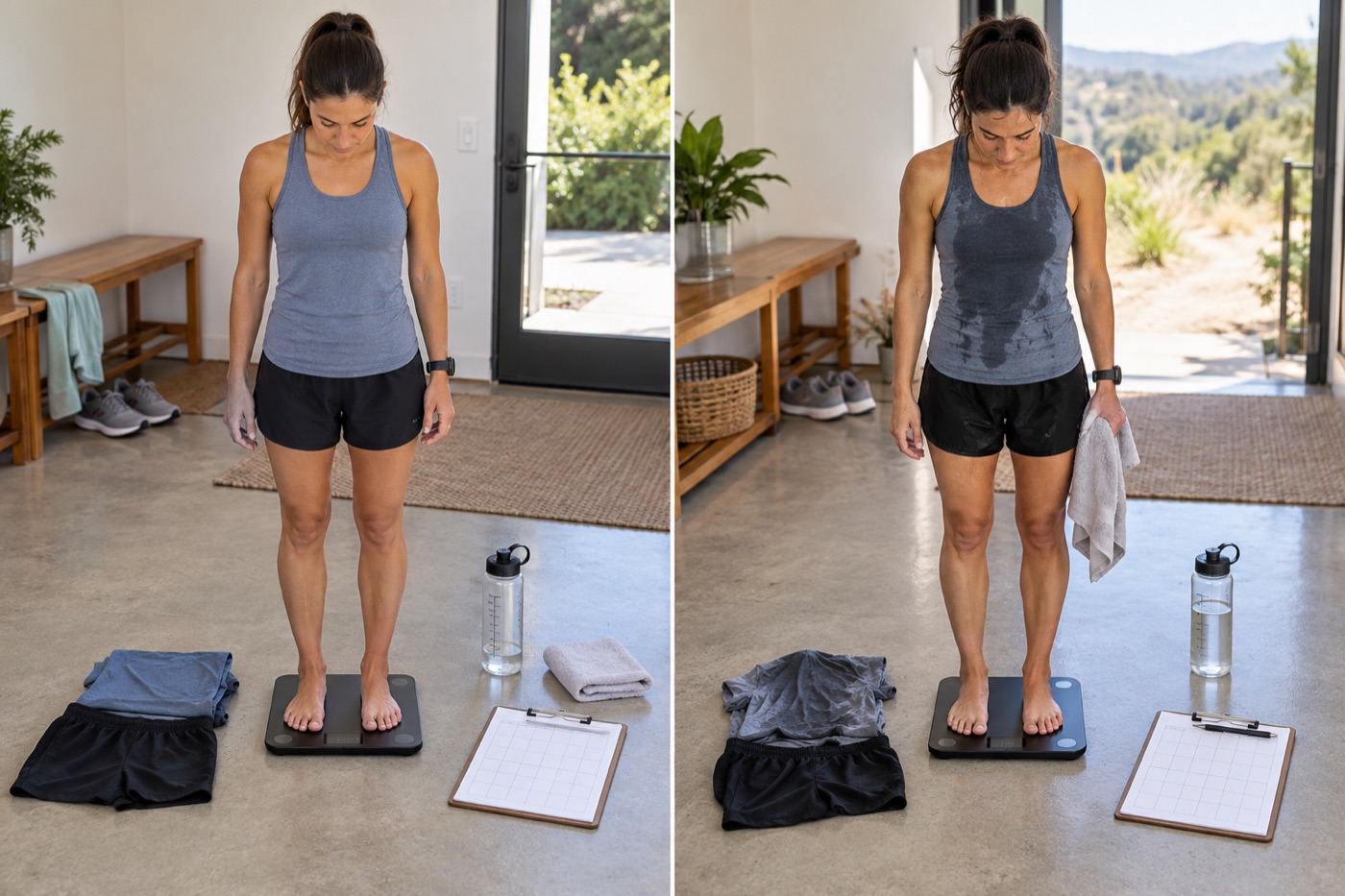
Formula and Worked Example
Sweat loss (L) ≈ pre mass (kg) − post mass (kg) + drink (L) − urine (L).
Sweat rate (L/h) = sweat loss ÷ exercise hours.
Example: an athlete starts at 70.0 kg, finishes at 69.3 kg, drinks 0.60 L, produces no urine, and exercises for 1 hour. Estimated sweat loss is 70.0 − 69.3 + 0.60 = 1.30 L, so sweat rate is about 1.30 L/h.
The calculation assumes short-session mass change mostly reflects water. For sessions longer than roughly two to three hours, fuel use, respiratory water loss, and metabolic mass changes can make the simple field equation less precise.
Build a Small Sweat-Rate Library
| Repeat condition | Record | Why it matters |
|---|---|---|
| Cool easy session | Temperature, pace or power, layers | Creates a lower-demand reference |
| Warm or humid session | Heat, humidity, sun, wind | Sweat rate can rise sharply |
| Hard interval or race effort | Work intervals and total time | Intensity changes heat production |
| Different sport | Run, ride, court, gym | Airflow and body position differ |
| After acclimatization or fitness change | Date and recent training environment | Sweat response can change over time |
How to Use the Result
Use the rate to estimate the upper boundary of observed loss in similar conditions. Then consider access to fluid, thirst, session duration, stomach tolerance, start hydration, and post-exercise recovery. Many people do not need to replace 100% of sweat during a session.
For a planned two-hour workout at 0.8 L/h, observed loss would be about 1.6 L if conditions remain similar. That does not automatically prescribe 1.6 L of drinking. Test a practical plan in training and avoid finishing heavier than you started.
If you have a laboratory or validated patch result for sweat sodium concentration, combine it with this rate in our sweat sodium loss calculator.
Common Measurement Errors
| Error | Effect | Better method |
|---|---|---|
| Finishing in soaked clothing | Wet fabric raises post weight and understates loss | Match dry clothing state and towel off |
| Unmeasured fountain drinks | Understates fluid input and sweat loss | Use measured bottles |
| Scale on carpet or different floor | Creates unstable readings | Use the same hard, level surface |
| Long delay after exercise | Adds untracked drinking, urination, or continued sweating | Weigh immediately |
| One test used year-round | Ignores environment and intensity | Repeat representative conditions |
Sources and Manufacturer Guidance
Requirements can vary by product, model, and situation. These primary sources informed this guide; official instructions for your exact product and current authoritative guidance take priority.
- National Athletic Trainers' Association: Fluid Replacement for the Physically Active
- American College of Sports Medicine position stand: Exercise and Fluid Replacement
- Gatorade Sports Science Institute: Sweat Testing Methodology in the Field
- Exercise-associated hyponatremia review: avoid dehydration and overhydration
Frequently Asked Questions
-
Rates vary widely with the person, sport, intensity, clothing, and environment. NATA reports a broad adult range, but a population range is not a personal target. Measure your own repeatable conditions.
-
Not automatically. A plan should limit excessive dehydration without causing weight gain from overdrinking. Session length, thirst, fluid access, and recovery time all matter.
-
You can track drinking and symptoms, but not a useful field estimate of total sweat loss. Pre- and post-exercise mass is the central measurement.
-
Seek personalized advice for kidney, heart, blood-pressure, or endocrine conditions; pregnancy; medications that affect fluid balance; repeated heat illness; confusion; severe headache; vomiting; or unusual swelling.