How to Read a Protein Powder Label Without Falling for Front-Label Math
Start with the facts panel—not the large number on the front. Find serving size, servings per container, and grams of protein per serving. Then check whether one serving is one scoop, two scoops, or a weight in grams. Only after that should you compare ingredients, allergens, directions, package weight, lot details, and voluntary certifications.
A scoop is a volume tool, not a guaranteed protein amount. A 35-gram serving that supplies 24 grams of protein is not “35 grams of protein,” and two tubs with the same front-label claim may provide different numbers of actual servings.
The 60-Second Label Reading Order
- Identify the panel. A dietary supplement uses Supplement Facts; a conventional food uses Nutrition Facts.
- Read serving size. Note both scoops and grams. The labeled serving may be the maximum recommended amount per eating occasion for a supplement.
- Read servings per container. This turns tub price into cost per labeled serving.
- Find protein grams per serving. Do not substitute total serving weight or scoop capacity.
- Scan calories, carbohydrate, fat, sodium, and added sugar according to your dietary needs.
- Read the entire ingredient list and allergen declaration.
- Read directions, warnings, storage, net weight, lot code, and date.
- Verify any certification in the certifier's own directory and read what its mark actually covers.
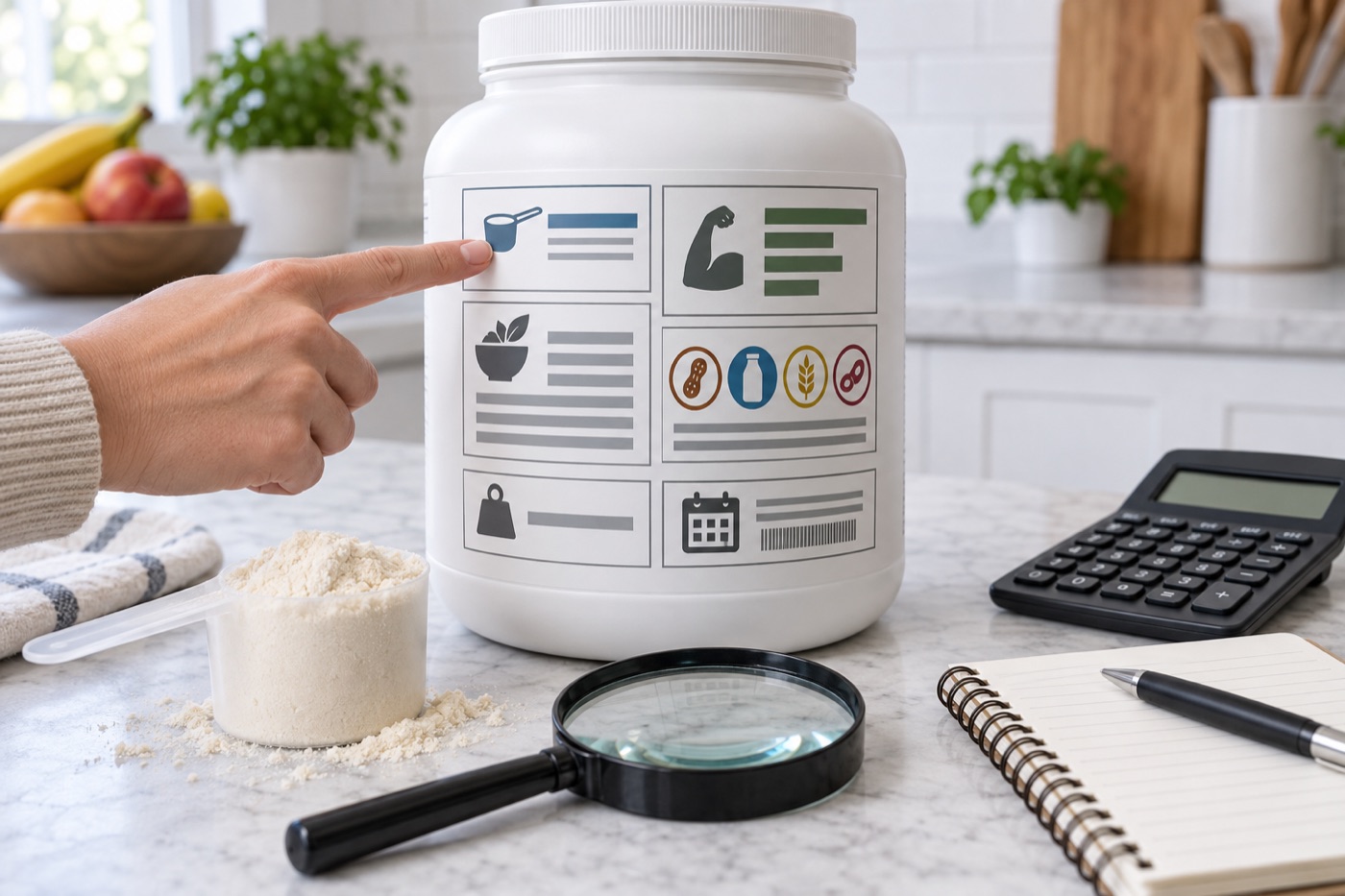
Separate Serving Weight From Protein Weight
Use these three label values:
- Serving weight: the total grams of powder in one labeled serving.
- Protein per serving: the grams of protein declared for that serving.
- Servings per container: the label's approximate count.
For a rough concentration comparison, calculate protein grams ÷ serving grams × 100. A 24-gram protein serving weighing 32 grams is 75% protein by weight. This can reveal how much of the serving is flavoring, carbohydrate, fat, minerals, or other ingredients—but it does not measure amino-acid quality, digestibility, taste, or manufacturing quality.
For value, compare cost per gram of protein, not cost per scoop.
Read the Ingredients as a Formula
Ingredients are generally listed in descending order by weight. First identify the protein source: whey concentrate, whey isolate, casein, milk protein, egg, soy, pea, rice, or a blend. Then note flavors, cocoa, sweeteners, oils, gums, lecithin, enzymes, vitamin/mineral blends, and other functional ingredients.
A longer list is not automatically worse, and “proprietary” does not automatically mean unsafe. The practical question is whether you can identify the ingredients, tolerate them, and understand the amount of the dietary ingredients the facts panel declares. If a blend prevents you from knowing the amount of a component important to your decision, treat that uncertainty as a limitation.
Check Allergens in Two Places
Read both the ingredient list and any “Contains” statement. U.S. labels must identify the food source of major allergens used as ingredients, such as whey (milk) or lecithin (soy). A separate “Contains” line is not the only valid way to disclose an allergen, so never skip the ingredient list.
If cross-contact matters, also read advisory language and contact the manufacturer about shared equipment and controls. Absence of a voluntary “may contain” statement is not a guarantee that a facility is free of your allergen. People with a diagnosed allergy should follow their clinician's plan.
Translate Front-Label Claims Into Checkable Questions
| Claim | What to verify | What it does not prove |
|---|---|---|
| 25 g protein | Is that per labeled serving, and how many scoops? | That every scoop you serve by volume weighs exactly the label amount |
| Isolate | Is isolate first in the ingredient list, or is it part of a blend? | Zero lactose or suitability for a milk allergy |
| Plant-based | Which sources and how much protein per serving? | Complete amino-acid profile or easy digestion for every person |
| No added sugar | Check total carbohydrate, total sugar, sweeteners, and serving size | Unsweetened or low calorie |
| Clean | Look for a defined standard on the package or maker site | A regulated universal definition |
| Third-party tested | Which organization, exact product/lot, and test scope? | FDA approval or proof of every marketing claim |
Do Not Ignore the Boring Parts of the Package
Record the lot code and date when opening the container. Keep the product name, manufacturer or distributor contact, directions, warnings, storage statement, net weight, and adverse-event contact information accessible. These details matter when a product changes texture, a recall names specific lots, or customer service needs to investigate.
Compare the net weight with serving size × servings per container; a small difference can come from rounding. A large unexplained mismatch is a reason to recheck units and ask the manufacturer.
Sources and Manufacturer Guidance
Requirements can vary by product, model, and situation. These primary sources informed this guide; official instructions for your exact product and current authoritative guidance take priority.
Frequently Asked Questions
-
No. A labeled serving may be one scoop, two scoops, or a weight in grams. Scoops can also settle differently, so use the label and a scale when precise powder weight matters.
-
Serving size is the total amount of powder. Protein per serving is only the protein within that amount. The rest can include carbohydrate, fat, flavoring, minerals, sweeteners, and other ingredients.
-
No. Verify the certifier and scope, but do not treat a voluntary testing mark as FDA preapproval of the supplement or every claim on its label.
-
They may appear in the ingredient name, in parentheses after an ingredient, or in a “Contains” statement. Read the full ingredients even when a separate Contains line is present.