Yoga & Mobility

Best Yoga Mats of 2026

A yoga mat looks like a simple rectangle until you're halfway through a downward dog and your hands are sliding toward the front of the room. I've practiced on borrowed studio mats that smelled faintly of a gym locker and on plush ones that felt great in child's pose but wobbled in tree. A good mat fixes friction and focus: it keeps palms and feet planted, cushions knees and wrists, and stops you from fussing with a corner that won't lie flat. Over the past six months, we've put 14 mats through living-room flows, studio classes, and sweaty vinyasa sessions.

The first surprise is that thicker isn't automatically better. A half-inch mat feels luxurious under your knees but can turn squishy in a balancing pose; a thinner one gives more ground feel but less cushioning. Portability matters too: a dense mat is lovely at home and a chore to carry to class. The picks below cover both ends of that tradeoff, plus the in-between mats most of us actually want.

Best Overall

Our Score 9.4/10
Gaiam Premium 6mm Print Mat

Gaiam

Gaiam Premium 6mm Print Mat

  • Weight 3.1 lb
  • Material Polyvinyl chloride (PVC)
  • Warranty Lifetime warranty
  • Dimensions 68"L x 24"W x 0.23"Th
Check Price on Amazon

Six millimeters of cushioning that kneels comfortably, keeps balance poses honest, and grips dry hands.

Six millimeters is the number we keep landing on. Kneeling poses stop being a negotiation with a hardwood floor, and a standing balance pose still feels like it is happening on the ground rather than on a sponge. Unroll one of the inch-thick mats further down this list and the difference shows up in the first tree pose: the foam compresses under one foot and not the other, and you spend the rest of the pose correcting.

That balance is why this Gaiam is our top pick. It is a PVC mat, 68 by 24 inches, with a fine texture across the top that feels tacky rather than slick under a dry palm. It held through slow flows and long holds in our sessions, and it lay flat within a few minutes of unrolling instead of curling at the ends.

The PVC is made without the six phthalates that turn up in cheap mats — DEHP, DBP, BBP, DINP, DIDP and DNOP — and it comes in a long run of prints, of which the Athenian Rose colorway is the one that looks like it belongs in a living room rather than a locker. New PVC smells. Unroll it in a spare room for two or three days before your first class and it settles down; take it straight from the box to a studio and your neighbors will notice.

Sixty-eight inches is the standard length, and it is the one place this mat lets a tall practitioner down: much past six feet, a forehead or fingertips start landing on bare floor in a long pose, which is where the CAMBIVO comes in. For everyone else — a home practice, a weekly class, Pilates on the rug — the decision is easy.

Bottom Line

Buy this one if you want a single mat for yoga, Pilates and home workouts: six millimeters of cushioning that still lets you feel the floor, a tacky dry surface, and a lifetime warranty behind it.

Check Latest Price

Best for Knees and Floor Work

Our Score 9.4/10
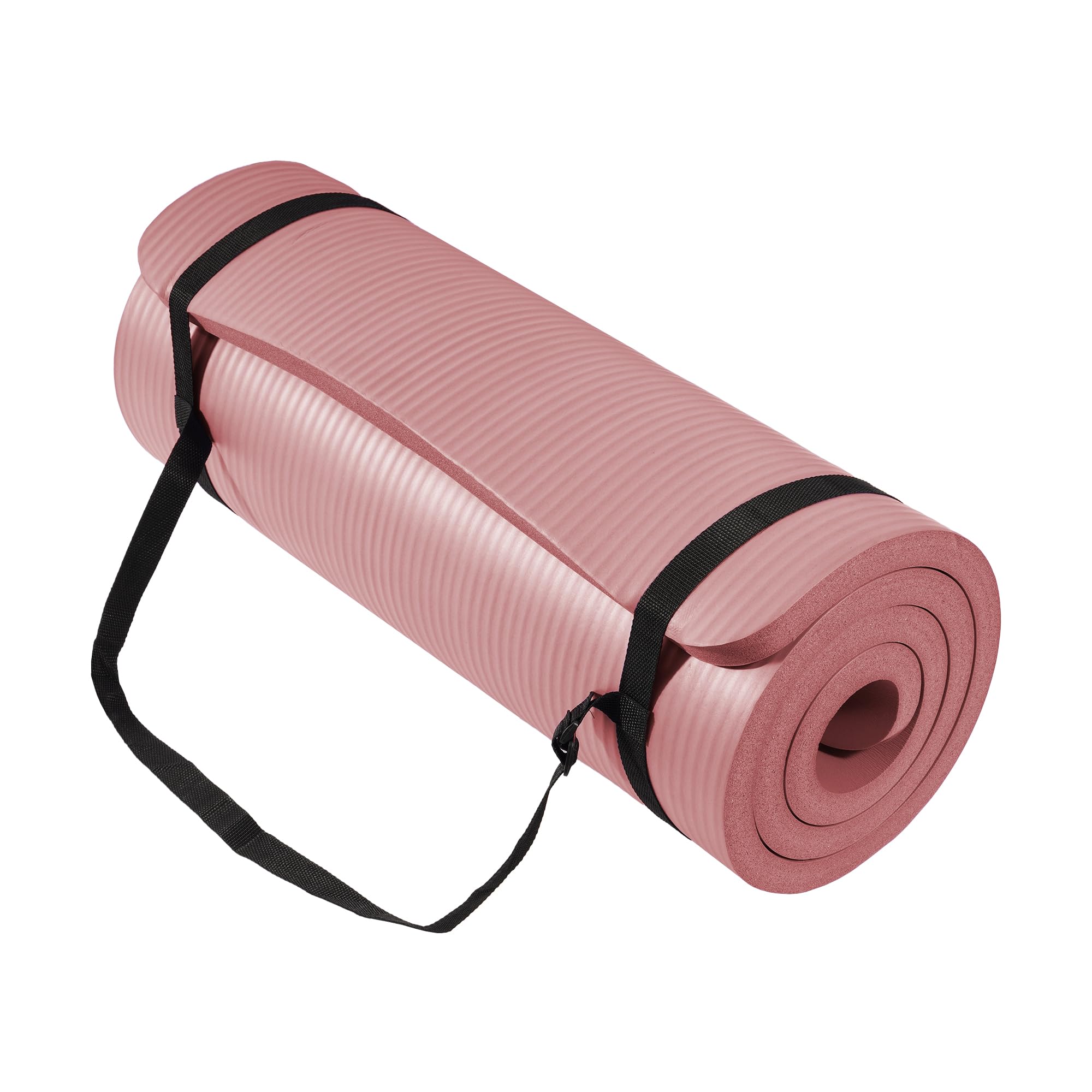
BalanceFrom 1-Inch Extra Thick Mat

BalanceFrom

BalanceFrom 1-Inch Extra Thick Mat

  • Care Hand wash only
  • Included Reinforced nylon carrying strap
  • Material Nitrile butadiene rubber (NBR)
  • Dimensions 71"L x 24"W x 1"Th
Check Price on Amazon

A full inch of foam that takes the pressure off knees, hips and sit bones.

If kneeling on a bare floor is the reason you are shopping, start here. A full inch of high-density foam is a genuinely different experience from the quarter-inch mats most studios stock: the pressure comes off knees, hips and sit bones, and a twenty-minute stretch stops being a countdown. It is the most comfort per dollar in this group, and the compliment is specific rather than general.

What the inch gives in cushioning it takes back in stability. Standing poses get harder rather than easier, because the foam compresses unevenly under each foot, and a balance sequence on this surface feels like practicing on a mattress. Where it makes sense is the floor — Pilates, core work, stretching, a bodyweight circuit on a basement slab — and it is also the mat to hand someone with arthritic knees who has quietly given up on the rug.

The practical side is well handled. The textured surface wipes clean with soap and water instead of soaking up sweat, it rolls up quickly, and the reinforced nylon strap holds the roll tight enough to stand in a cupboard corner. It is a big, soft thing that wants to live indoors; treat it as a home mat and it earns its space.

Bottom Line

Buy it if floor work on a hard surface is the problem you are solving: the full inch of foam protects knees, hips and sit bones in a way no 6 mm mat can.

Check Latest Price

Best For Home beginners

Our Score 9.4/10
NewMe Fitness Printed Pose Mat

NewMe Fitness

NewMe Fitness Printed Pose Mat

  • Weight 2.6 lb
  • Material Polyvinyl chloride (PVC)
  • Dimensions 68"L x 24"W x 0.2"Th
  • Printed Guide 70 illustrated poses
Check Price on Amazon

Seventy illustrated poses, printed straight onto the surface. It reads like a novelty and works like a teaching aid: for a beginner practicing alone, having the next shape under your hands removes the pause where you unlock the phone, find the video, and lose the thread. We followed the mat instead of a screen for a session and got further into a flow than expected.

The caveat is five millimeters of PVC under a knee. That is a sound cushioning layer for stretching, seated work and a gentle flow, and it is not the mat for a bad knee or a bony spine, nor the one to unroll on concrete. As a first mat that teaches while you use it, though, it earns its place, and it doubles as a reference you can study from across the room.

The rest is straightforward: 68 by 24 inches, dual-sided so the underside holds the floor, free of BPA, latex and phthalates, and light enough to move between rooms. Once the poses are memorized, the print becomes decoration, and what is left is a light, plain mat.

Bottom Line

Buy it if you are learning at home and keep reaching for your phone mid-flow: 70 poses are printed exactly where your hands go.

Check Latest Price

Best for Tall Yogis

Our Score 9.2/10
CAMBIVO Extra Long Wide Mat

CAMBIVO

CAMBIVO Extra Long Wide Mat

  • Weight 5 lb
  • Backing Honeycomb anti-tear
  • Material Polyvinyl chloride (PVC)
  • Dimensions 84"L x 30"W x 0.24"Th
Check Price on Amazon

Eighty-four inches long and 30 inches wide, so tall bodies fit inside every pose.

Eighty-four inches long and 30 inches wide. If you are over six feet, or broad through the shoulders, that footprint is the entire argument: on a standard 68-by-24 mat your head, hands or knees end up on bare floor at the extremes of a long pose, and no amount of cushioning rescues a mat that is too small.

We think the extra area is worth what it costs. Six millimeters of PVC with a honeycomb backing that grips the floor, a textured top, and enough width that wide-legged poses stop hanging off the edge. The surface is the weak point: our downward dogs crept once palms got damp, and a towel at the top of the mat became part of the setup. If grip is your first priority, the Gaiam and the Fitvids are ahead of this one.

Cushioning lands where the standard mats do — fine for kneeling and seated poses, well short of the pillow that the inch-thick BalanceFrom is — and cleaning is a damp cloth and air drying. It is a specialist mat for a specific body, and it does that job without compromise.

Bottom Line

Buy it if a standard mat leaves your head or hands on bare floor: 84 by 30 inches of cushioned PVC, at the cost of weight and a little grip.

Check Latest Price

Best For Simple spare mat

Our Score 9.2/10
CAP Barbell 1/2-Inch Mat

CAP Barbell

CAP Barbell 1/2-Inch Mat

  • Weight 2.16 lb
  • Included Carrying strap
  • Material Nitrile butadiene rubber (NBR)
  • Dimensions 68"L x 24"W x 0.5"Th
Check Price on Amazon

No print, no alignment lines, no pose guide — black foam, a strap, and 68 by 24 inches. Some mats are trying to be equipment; this one is trying to be a mat, which is a fair brief if you already know what you are doing.

The half inch of latex-free NBR does what the other thick mats here do: it takes the edge off a hard floor under knees, hips and elbows. It is the lightest of the thick mats at just under a kilogram, the ridges across the surface hold their place on hardwood, and the strap keeps the roll tidy in a closet.

This is the mat we point at when someone needs a second mat rather than a daily companion — for the garage, the basement, a partner who joins twice a month. It is honest foam at the bottom of the price range, and it does the one job without asking for attention. If you want a mat to look at, buy one with a print; if you want a mat to kneel on, this is enough.

Bottom Line

Buy it as a second mat rather than a daily one: half an inch of latex-free foam at the lowest price tier here, with no extras to pay for or figure out.

Check Latest Price

Best Value

Our Score 9.0/10
Fitvids 1/2-Inch Thick Mat

Fitvids

Fitvids 1/2-Inch Thick Mat

  • Weight 2.91 lb
  • Included Carrying strap
  • Material Nitrile butadiene rubber (NBR)
  • Dimensions 71"L x 24"W x 0.5"Th
Check Price on Amazon

Our budget pick: half-inch cushioning with the most reliable grip among the thick mats.

Half an inch of foam, 71 inches long, and a strap in the box. When someone asks for a mat that will do the job without becoming a project, this is the one we point to, and the price is a large part of why. It is also a couple of inches longer than the CAP Barbell below, which matters the first time you lie down and your heels are still on foam.

Grip is where thick foam usually disappoints: soft NBR compresses under a palm and the hand slides into the dent. This Fitvids held better than the other thick mats on the list — dry hands stayed planted through a slow flow, and the mat did not skate across the floor at the start of a lunge. Of the thick mats here, it is the one we trust most on a bare floor.

What you give up is polish. The strap is a strap rather than a bag, the edges are cut plain, and nothing here was designed to be looked at. None of that changes the recommendation for a home practice: the length is generous, the roll is light enough to sling over a shoulder, and it lies flat again the next morning. For a first mat, or a second one for the basement, it is the easy answer.

Bottom Line

Buy it if you want cushioning, a strap and a generous length without spending much: half an inch of foam that gripped better for us than the other thick mats here.

Check Latest Price

Best Lightweight Mat for Studio Classes

Our Score 9.0/10
YOGATI Alignment Yoga Mat

YOGATI

YOGATI Alignment Yoga Mat

  • Weight 1.81 lb
  • Markings Laser-etched alignment lines
  • Material Thermoplastic elastomer (TPE)
  • Dimensions 72"L x 24"W x 0.24"Th
Check Price on Amazon

Light enough to sling over a shoulder, with lines that show where hands go.

Laser-etched lines down the center of a mat sound like a gimmick until you are three weeks into practicing alone and nobody is there to tell you that your hands are uneven. We lined up palms and heels against them the way a beginner would, and they turned out to be the most useful thing about this mat — a correction you can make without leaving the pose.

Around that, a well-judged lightweight: 820 grams, the lightest mat on this list, and TPE foam that does not arrive reeking the way new PVC does. Six millimeters puts it in the same cushioning class as the Gaiam, and the reversible two-tone finish looks deliberate rather than gym-ish. If your practice happens in a studio twice a week and you are tired of hauling a heavy roll across town, this is the swap.

Rolling it up takes seconds, and the included harness is a strap rather than a bag — nothing to zip, nothing to lose, one less thing to think about on the way out of the door.

Bottom Line

Buy it if you practice alone and want a light mat to carry: the alignment lines are genuinely useful, and 6 mm gives you the same cushioning class as our top pick.

Check Latest Price

How We Chose and Tested the Best Yoga Mats

We started by pulling together mats from brands we knew and newer names, then filtered by material, thickness, texture, price, and whether they were built for general practice or hot yoga. We ruled out anything that was impossible to wipe clean or came only in one extreme thickness. That left us with 14 mats, which we put through six months of regular practice.

For six months, those mats lived in my living room, my car, and a rotating cast of studio classes. I unrolled each one on hardwood and carpet and left it there for a day to see whether the ends curled. I measured thickness with a ruler and checked it again after a month of daily use, then noted where knees and wrists sank in. Grip got a mist of water on my palms and the mat before a downward dog, warrior II, and a few balance poses; I noted sliding hands, slipping feet, and whether the surface got slicker as I sweated.

Odor was judged at unboxing and again after a week—some mats smelled like rubber tires, others faded fast. After each weekly wipe-down, I checked for flaking, peeling, compression, and fading. I weighed every mat and carried it in a tote to class, noting whether the strap cut into my shoulder or the roll stayed tight. At the end, I compared what each mat cost against how it looked and performed after six months; a few cheap ones held up better than pricier ones, and a couple of thick mats never stopped shedding.

How to Choose

Thickness: cushioning versus balance

Four to six millimeters is the range most standing practices want: enough padding for kneeling and seated poses, thin enough that the floor still talks to you in a balance pose. Ten millimeters and up is for joints that need it — arthritic knees, a hard basement slab, a lot of floor-based Pilates — and the price is stability, because thick foam compresses unevenly under two feet.

The BalanceFrom's inch of foam is the right answer for floor work and the wrong one for a vinyasa class. If one mat has to cover both, stay near the middle: the Gaiam's 6 mm kneels comfortably without turning standing poses into a wobble.

Grip: dry hands and damp hands are different problems

Almost every mat claims to be non-slip, which tells you very little, because the claim is about dry skin. What separates them is minute twenty. Closed-cell PVC — the surface on the Gaiam and CAMBIVO mats — is the tackier material when dry, while the soft NBR behind most thick mats is comfortable and slicks over quickly once palms dampen.

Our sessions bore that out: the thick mats wanted a towel long before the PVC ones did. If your practice is heated, budget for a towel at the top of the mat or a pair of grippy socks, because nothing on this list is a hot-yoga specialist.

Length and width: the numbers tall buyers check last

A standard mat is 68 by 24 inches, which works up to about six feet and gets cramped above it: in a long pose your forehead or fingertips land on bare floor. Longer mats run 72 to 74 inches, and the CAMBIVO goes to 84 by 30 for people who are tall, broad, or both. Width matters as much as length in wide-legged poses and anything on hands and knees.

Size costs weight — the CAMBIVO is five pounds rolled, against 820 grams for the YOGATI — so decide whether the mat travels before you size up.

Material, smell and care

Three materials cover this list. PVC is dense, grippy and long-wearing, and it off-gasses for the first few days; every PVC mat here asks for two or three days unrolled before use. NBR is the soft, light foam behind the extra-thick mats: it cushions beautifully and tears more readily. TPE, the YOGATI's material, is the lightest and the least smelly.

None of them likes a washing machine. Wipe with mild soap and water, dry flat, and keep PVC out of direct sun, which makes it brittle.

Durability: where mats fail first

Mats rarely wear out evenly. Damage shows at the hands and feet, where foam compresses, dents and eventually tears — which is why the thick NBR mats here carry durability caveats and the closed-cell PVC mats mostly do not. A stated warranty is worth more than a few extra millimeters of foam, because it covers the failure you will actually meet, and the Gaiam Premium comes with a lifetime one. If you practice daily, put the money into the surface rather than the padding.

Frequently Asked Questions

Final Verdict

Most people should buy the Gaiam Premium 6mm Print Mat. Six millimeters kneels comfortably without giving up balance, the textured PVC is tacky under dry hands, and a lifetime warranty covers the failure the surface will eventually meet.

Two things change the answer. If your knees are the reason you are shopping, the BalanceFrom's full inch of foam is a different class of cushioning for floor work. If you want to spend as little as possible and still get a strap and a half-inch of foam, the Fitvids is the one.