Yoga & Mobility

Best Extra-Long Yoga Mats of 2026

Somewhere around the third sun salutation, my heels find the floor instead of the mat. That half-inch of bare hardwood is exactly where an extra-long yoga mat earns its keep — not only for tall people, but for anyone whose practice travels forward through a vinyasa or who shares a mat with a taller partner. The extra length buys you a full stride in Warrior II, somewhere to land in a long lunge, and the small luxury of not shuffling back to center every few poses.

Length alone doesn't make a mat, though. My team and I spent seven months practicing on 12 extra-long mats — sunrise flows on a living room rug, sweaty evening studio classes, one memorably grim session on a basement floor — and the ones worth keeping got width, thickness, and grip right along with the extra inches. Worth knowing before you buy: extra length almost always means extra weight and bulk, so if the mat travels in a tote bag, check the rolled diameter as closely as the tape measure. The picks below are the ones I'd unroll again tomorrow.

Best Overall

Our Score 9.2/10
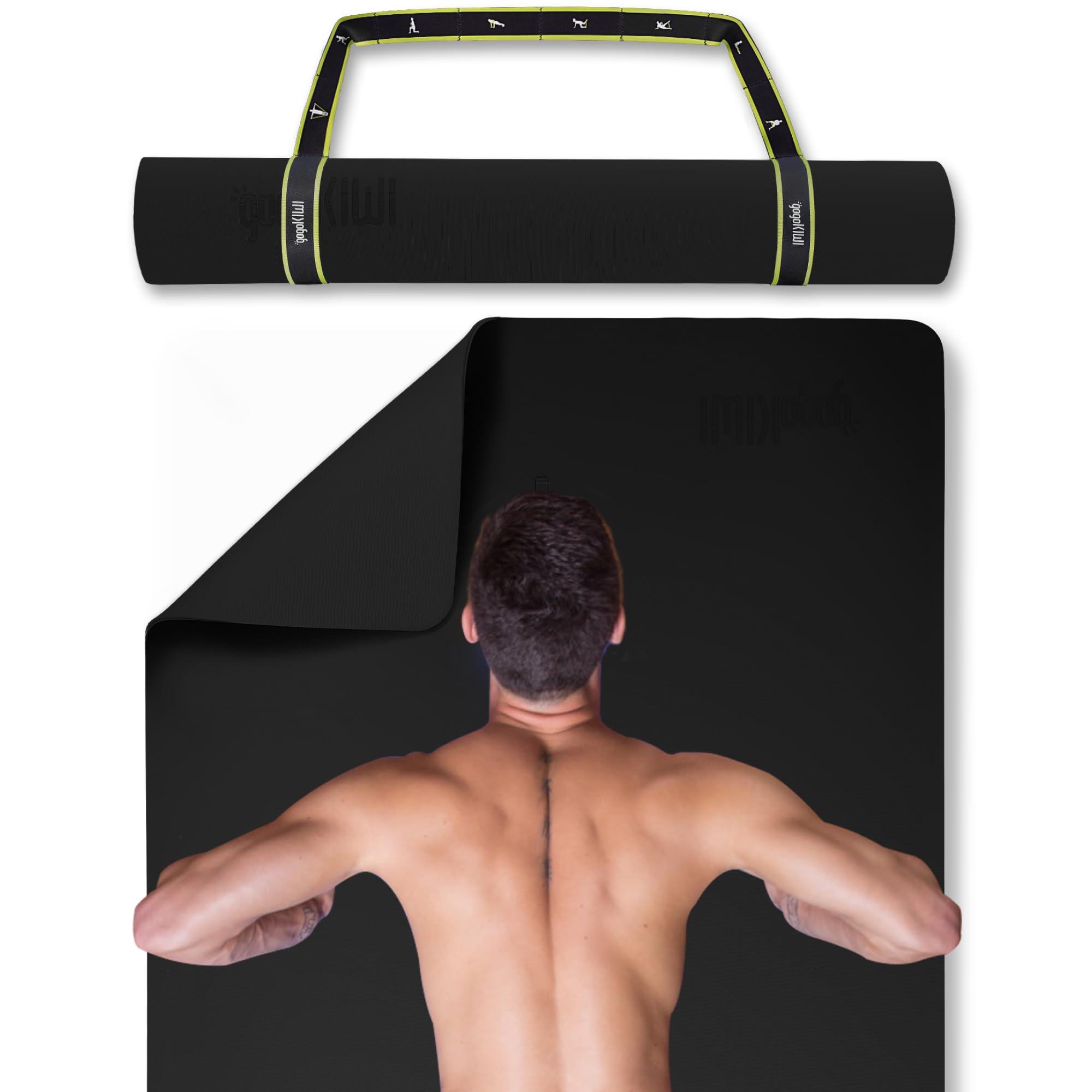
Gogokiwi Extra Wide Yoga Mat

Gogokiwi

Gogokiwi Extra Wide Yoga Mat

  • Weight 2.7 lb
  • Material RecFoam
  • Thickness 6 mm (12 mm option)
  • Dimensions 72"L x 36"W
Check Price on Amazon

Widest mat here at 36 inches, with room for tall frames and wide poses.

Thirty-six inches is the reason this one sits at the top. That's the widest surface in this guide — four inches broader than the Hatha and the KEEP, six broader than the CAMBIVO — and the difference shows up in any pose where your feet travel apart. Wide-legged folds, seated straddles and shoulder-width planks finish on the mat rather than half off it. Length is the standard extra-long 72 inches, which covers most people lying flat; if you're much over six feet, read the next entry instead.

Cushioning is a choice at checkout: a quarter inch as standard, or half an inch if your knees want more. We worked with the standard, and it's the version we prefer for a practice with standing balance in it — you stay close to the floor and the mat doesn't fight you in a lunge. At 2.7 pounds it's also the lightest of the four picks, which is why it's the one that leaves the house with us. The strap earns its place too: it's long enough to loop around a foot for hamstring work rather than sitting in a drawer between classes.

Grip is where it gives ground. The fine texture on top held our feet on a wood floor without the mat sliding underneath, but once hands get damp the surface stops grabbing through a long downward dog. A towel fixes it; a hot class without one won't be much fun. What we keep coming back to is the footprint — no other mat here gives you this much room without also handing you four or five pounds to carry.

Bottom Line

Our default pick: the 36-inch width keeps tall frames and wide poses on the mat, and at 2.7 pounds it's light enough to carry to class.

Check Latest Price

Best for Very Tall Users

Our Score 9.2/10
CAMBIVO Extra Long 84-Inch Mat

CAMBIVO

CAMBIVO Extra Long 84-Inch Mat

  • Weight 5 lb
  • Material PVC
  • Thickness 6 mm
  • Dimensions 84"L x 30"W
Check Price on Amazon

The longest mat in this guide at 84 inches, with real room to spare.

If you're six-four and every mat you've owned has ended somewhere around your shins, this is the one that stops the search. It runs 84 inches — a full 16 inches past a standard mat and a foot past the other picks here — so a very tall body can lie down, reach overhead and still be on foam. Width is 30 inches, the narrowest of the four, and that's the trade you make for the extra distance.

The length is what earns the recommendation, and it's the part that holds up. Supine stretches, long savasana and any pose where you extend through the heels stop being a negotiation with the edge of the mat. The PVC surface is firm and closed rather than soft and spongy, and at 5 pounds it's the heaviest mat here — a home-and-garage mat more than a walk-to-studio one. Ours lives rolled in the corner of the room, and that's how we'd plan to use it.

Grip is the weak part of the package. Of the four mats here, this is the one whose surface we trust least once hands and feet get damp, and a long sweaty flow had us resetting our hands more than once. New-mat smell is the other thing: PVC arrives smelling like PVC, so unroll it somewhere airy for a few days before the first class. What you're paying for is the extra foot; everything else about this mat is ordinary.

Bottom Line

We point very tall practitioners here: at 84 inches it's the longest mat in this guide, though the PVC surface is the slickest and it weighs 5 pounds.

Check Latest Price

Best for Sore Knees

Our Score 9.2/10
Hatha Extra Thick Yoga Mat

Hatha

Hatha Extra Thick Yoga Mat

  • Weight 4 lb
  • Material TPE
  • Thickness 12 mm
  • Dimensions 72"L x 32"W
Check Price on Amazon

Twelve millimeters of cushion that makes kneeling and floor work comfortable.

Twelve millimeters is roughly twice the foam of the thinner mats here, and it changes what the mat is good at. Knees, elbows, hips and a bony spine all get real padding — this is the mat we reach for when the floor is tile or concrete — but the same depth that protects a kneecap makes a standing balance pose feel like it's happening on a mattress. If your practice is mostly standing work, that's a real cost.

The surface is TPE, and it aired out faster than the PVC mat did. Texture is sticky enough dry; get warm and it slicks up, so plan on a towel for anything hot or fast. At 4 pounds and 72 by 32 inches it rolls into a fat cylinder, which makes the included strap matter more than you'd expect for a mat this size. Width is the same 32 inches as the KEEP, so the money here buys depth, not footprint.

It's the priciest mat in this guide. What you're paying for is foam rather than length, and for a restorative practice, a yin sequence or a body that has opinions about hardwood, that's money well spent. What it does better than anything else here is make a hard floor forgettable — and that's an easy thing to underestimate until you've knelt through a long session on tile.

Bottom Line

We recommend it to anyone whose knees complain on a thin mat: the 12 mm cushion is the most forgiving here, at the cost of some stability and a higher price.

Check Latest Price

Best Budget

Our Score 9.2/10
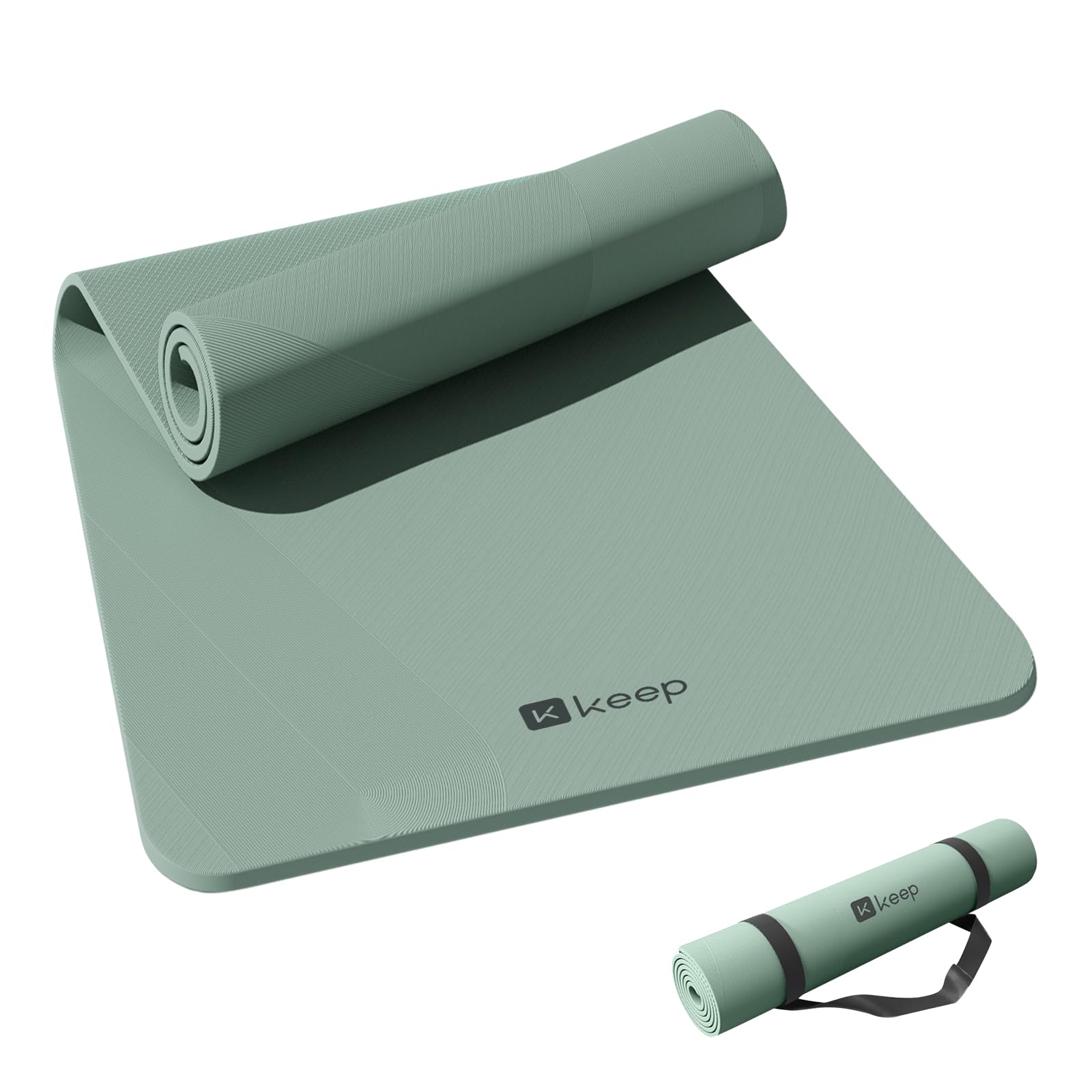
KEEP Extra Wide Yoga Mat

KEEP

KEEP Extra Wide Yoga Mat

  • Weight 2.8 lb
  • Material TPE
  • Thickness 7 mm
  • Dimensions 72"L x 32"W
Check Price on Amazon

Extra length and a 7 mm pad for the least money in this set.

The KEEP is the cheapest route to a 72-by-32-inch mat, and it doesn't feel like a penalty when you unroll it. The 7 mm pad is a touch more forgiving than the Gogokiwi's quarter inch and nowhere near the Hatha's half inch, which puts it in the middle of this set — enough that a knee doesn't complain on a wood floor, thin enough that you still feel planted in a standing pose.

What you give up is mostly finish. The TPE surface has a fine grain that grips well dry and less well once hands get damp, so sweaty flows want a towel. It also marks: scuffs and shallow dents show up with rough use, and it's the pick we'd keep shoes and abrasive gear away from. Treated as a mat for bare feet and a living-room floor, it holds up fine — ours has taken daily stretching without drama.

At 2.8 pounds it's the second-lightest mat here, and the strap is the easy-on kind that slides over the roll instead of fighting it. For a beginner, a home practice, or a spare mat that lives under the couch, that's plenty. It's the budget pick by a wide margin, which also makes a second mat for the basement an easy call rather than a splurge.

Bottom Line

The value pick: we recommend it to beginners and home practitioners who want extra length and a decent pad without paying for extras.

Check Latest Price

How We Tested Extra-Long Yoga Mats

We started by pulling every mat we could find that measured at least 72 inches long, then filtered by width, thickness, material, and price to land on 12 that represented the real range of what's sold. Each one lived with us for seven months — not on a lab bench, but in the places mats actually get used: a hardwood living room at 6 a.m., a rented studio with industrial carpet, a hot class that left puddles behind, and a concrete basement floor that punishes thin foam.

Length and size: we measured every mat ourselves with a tape and had our tallest tester, at 6 feet 4 inches, run a full sun salutation, noting whether his hands and heels stayed on the surface or crept off the end. Thickness and cushioning: we held kneeling lunges and two-minute child's poses on hardwood and concrete, paying attention to whether knees felt pressure or the mat bottomed out. Grip: downward dog with dry palms, then again with wet ones, watching whether hands slid toward the front edge.

Odor got its own test — we unrolled each mat straight out of the box, sniffed at one hour and again at 48, and noted which ones still smelled like a tire two weeks in. For durability, we marked our usual hand and foot placements and checked those spots after roughly 60 sessions for flaking, stretching, and compressed dents. Finally, value: we weighed every mat, timed how long it took to roll and cram into its carry strap, and checked whether it fit a standard studio cubby.

How to Choose

Length and Width Are Two Different Kinds of Room

A standard mat runs 68 inches long and about 24 wide. Seventy-two inches is the usual extra-long size and covers most people up to roughly six feet; past that, or if you reach wide in standing poses, 84 inches is the number that changes things, and the CAMBIVO is the only pick here that goes there. Width buys lateral room, and the spread in this set is real: the Gogokiwi's 36 inches against the CAMBIVO's 30. Before you buy, lie down and reach your arms overhead — that distance, not your height, is what savasana needs.

Grip Is the Spec You Can't Read Off the Label

Every mat here holds well when dry, and every one of them gives ground once hands get damp. It's the most consistent limitation in this category, and it's why a mat that felt secure in a cool studio can turn on you in a warm room. The practical answer is a thin towel over the top for hot or fast practice, and testing a new mat on your own floor before you take it to class. Also check the underside: a textured base grips wood and tile better than a smooth one, so don't blame the mat's surface for a problem that starts underneath.

Thickness: Cushion or Stability, Rarely Both

Six to seven millimeters is the sweet spot for most practice — enough to take the edge off a hardwood floor, thin enough that you can still feel the ground in a balance pose. Twelve millimeters, which is the Hatha, is a different tool: closer to a mat for stretching, floor work and knees that object to tile. If standing poses already feel wobbly, go thinner rather than thicker, and fold a blanket under the knee for the poses that hurt. If kneeling is what stops you practicing, the thick mat earns its lack of subtlety.

Material, Smell, and Getting It There

PVC is dense, firm and heavy — the 84-inch CAMBIVO is 5 pounds — and it arrives smelling like plastic for a few days. TPE is lighter and generally less fragrant out of the box, which is why the two lightest mats here are both TPE. If the mat lives in your living room, weight barely matters and you can choose on cushioning alone. If it goes to class with you, anything over about 3 pounds gets old on a ten-minute walk, and the rolled diameter matters as much as the number on the scale.

Frequently Asked Questions

Final Verdict

If you want one mat that handles a full practice and still goes in the car, the Gogokiwi is the pick. The 36-inch width is the most useful difference in this set, and 2.7 pounds means you'll actually take it with you. Choose the CAMBIVO instead if you're over six feet and the mat stays home — 84 inches is a different category of room, and the weight and slickness matter far less on a living-room floor.

And if your knees are the reason you started shopping, the Hatha's 12 mm of foam is worth the premium. The KEEP is the honest budget answer: you give up surface durability, not length.