Yoga & Mobility

Best Yoga Mats for Carpet of 2026

Rolling a mat out over carpet is a small physics problem. Carpet gives, so a thin mat bottoms out under your knees, and a smooth underside that grips hardwood will skate across pile the moment you step into a lunge. What you need is a mat that stays put, adds real cushioning on top of padding that's already soft, and doesn't turn Warrior II into a balance drill. Get that right and a corner of the living room becomes a usable studio.

I've practiced on the same beige carpet for years, and the gap between a mat that works on it and one that doesn't shows up in a single sun salutation. Over the past four months, we rolled out 12 mats on low-pile, medium-pile, and one plush bedroom rug, and the pattern held: grip comes from the underside's texture, not from how tacky the top feels in the store. Weight matters too, since a mat that's fussy to unroll doesn't get unrolled. The picks below stayed flat, cushioned my knees, and didn't smell like a tire by week two.

Best for Floor Work

Our Score 9.4/10
BalanceFrom All Purpose 1-Inch Mat

BalanceFrom

BalanceFrom All Purpose 1-Inch Mat

  • Weight 2.2 lb
  • Warranty 2-year warranty
  • Thickness 1 inch
  • Dimensions 71 x 24 inches
Check Price on Amazon

An inch of dense foam that spares knees and hips during pilates and stretching.

A full inch of foam is more cushioning than any other mat here offers, and on a carpeted floor it is the difference between knees that complain through lunges and knees that do not. We recommend it wholeheartedly for pilates, stretching, core work, and anything else spent seated or kneeling: the high-density foam is firm enough that you do not sink through to the subfloor, and supportive enough that hips and spine stop noticing it.

The thickness does its own anchoring, which is what makes it work on carpet. A mat this deep has no thin, floppy edge to catch and roll under, so it lies flat the moment you unroll it and stays there, with a textured face gripping the pile on one side and your hands on the other. It also rolls up against velcro-ended straps that keep the bundle tidy, and it carries a two-year warranty, which is unusual among the mats here.

The trade-off is height. Standing balances on an inch of foam are markedly less steady than on a 6mm mat, because the foam compresses unevenly under a single foot. If your practice is mostly standing flows, choose thinner and fold a blanket under your knees for floor poses. For everyone else, this is the most comfortable surface here to spend twenty minutes on your back.

Bottom Line

If your practice is mostly seated, kneeling, or on your back, we think an inch of this foam is the most comfortable thing here to do it on.

Check Latest Price

Best-Looking

Our Score 9.4/10
Gaiam Premium 6mm Print Mat

Gaiam

Gaiam Premium 6mm Print Mat

  • Weight 3.1 lb
  • Material PVC, 7P-free
  • Thickness 6 mm
  • Dimensions 68 x 24 inches
Check Price on Amazon

Soft 6mm surface and prints worth leaving out in a carpeted practice corner.

A mat that lives permanently on a carpeted bedroom floor is furniture as much as equipment, and this is the one here that looks like it. The Sublime Sky print reads closer to a watercolor than a gym logo, which is why it is the mat in this group we are happiest to leave down between sessions.

Underneath the print it is a straightforward 6mm PVC mat: 68 x 24 inches, a little over three pounds, with a textured, slightly tacky surface and a formulation free of the seven phthalates named on the label. It arrives smelling strongly of the factory, as printed PVC does. Unroll it in a spare room for a few days before you practice on it and the smell is gone.

We rate it as the best-looking mat in this set and a good one for slow, dry practice in one spot. Traction is the honest caveat: it holds well on cool, dry skin and turns slick once hands and feet get damp, which puts fast or heated flows near the edge of what it can do. For seated and restorative work on carpet, that trade will never reach you.

Bottom Line

The best-looking mat here, and we are happy to leave it out on a carpeted floor for slow, dry practices, though sweaty flows will have your hands sliding.

Check Latest Price

Best for Beginners

Our Score 9.4/10
NewMe Fitness Printed Pose Mat

NewMe Fitness

NewMe Fitness Printed Pose Mat

  • Weight 2.6 lb
  • Thickness 5 mm
  • Dimensions 68 x 24 inches
  • Printed Poses 70 poses
Check Price on Amazon

Seventy poses printed on the mat, so you can flow without checking a phone.

Practicing from a phone propped against the sofa is how a lot of home yoga actually happens, and this mat is built for that: seventy illustrated poses printed straight onto the surface, laid out so you can follow along without breaking a pose to check a screen. That is the feature that earns it a place, because for a beginner on a carpeted living-room floor it effectively turns the mat into the instructor.

At 5mm and about two and a half pounds it is thin enough to lie flat on pile without the lifted edges you get from thick foam, and the carpet underneath supplies the padding the mat does not. The PVC is made without BPA, latex, and phthalates, and there is a mild new-mat smell that fades after a few days of airing.

Traction is where it gives ground. The surface is textured but not properly sticky, and damp hands slide on it, noticeably more than on the Gaiam above. If your practice is slow and dry and the printed sequence is the reason you are buying, that is a fair trade. If you are holding a lot of downward dog in a warm room, add grip socks or choose something stickier.

Bottom Line

We like it most as a teaching mat: the printed poses keep a home practice moving, though the surface gets slick once your hands do.

Check Latest Price

Best for Tall Practitioners

Our Score 9.2/10
CAMBIVO Extra Long Wide Yoga Mat

CAMBIVO

CAMBIVO Extra Long Wide Yoga Mat

  • Weight 5 lb
  • Material PVC
  • Thickness 6 mm
  • Dimensions 84 x 30 inches
Check Price on Amazon

84 inches long and 30 wide, so tall practitioners stop landing off the edge.

This is the mat you buy when your hands and feet keep landing on the floor, and the one you stop carrying to class once the novelty of the size wears off. At 84 x 30 inches it gives you sixteen more inches of length and six more of width than a standard 68 x 24 mat, which changes wide-legged forward folds, supine twists, and anything else where a 24-inch width has you hanging off one side.

The 6mm PVC is dense rather than squishy, so it does not swallow your balance the way thick foam does, and the fine-grained surface feels grippy in a dry room. It is a big, flat slab of a mat, and it reads that way underfoot: planted rather than cushioned.

The honeycomb-patterned underside is the detail that matters on carpet. It has real relief to press into pile, and at five pounds the mat carries enough weight to stay where you put it rather than wandering between poses. Sweat is the equalizer: the surface turns slick once hands are damp, more so than the NBR foam mats here, so keep a towel within reach in a warm room.

Buy it if length is your constraint and you practice in one spot. If you are average height, or you want a mat that lives in a tote bag, the weight and the diameter of the roll make it more mat than you need; the Fitvids covers the same ground in a package you can carry.

Bottom Line

We recommend it for tall and broad practitioners tired of landing off the edge of a standard mat, with the caveat that it stays home rather than travelling to class.

Check Latest Price

Best For Budget second mat

Our Score 9.2/10
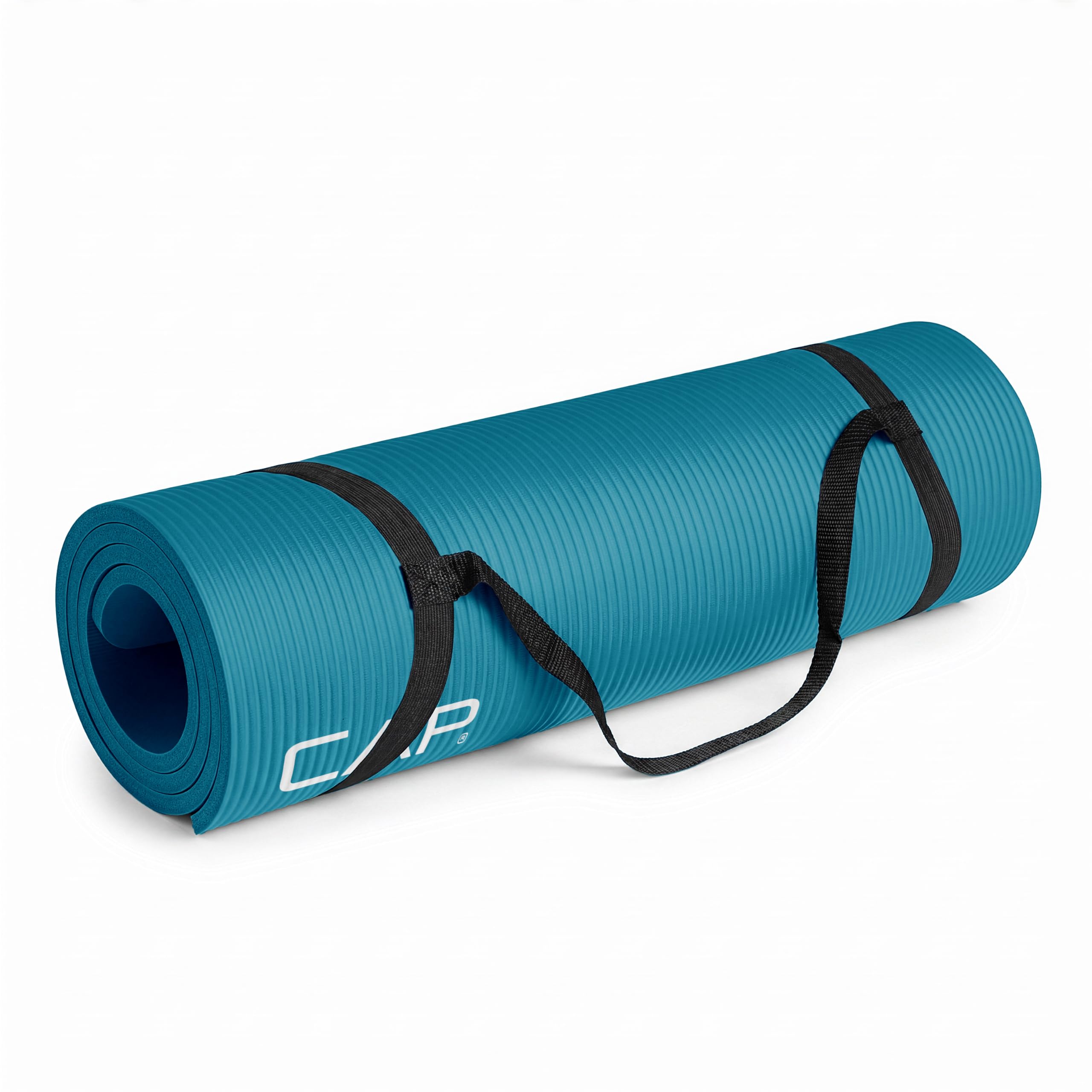
CAP Barbell 1/2-Inch Yoga Mat

CAP Barbell

CAP Barbell 1/2-Inch Yoga Mat

  • Weight 2 lb
  • Material Latex-free NBR foam
  • Thickness 0.5 inch
  • Dimensions 68 x 24 inches
Check Price on Amazon

This is the least expensive mat here, and it does the one thing a carpet mat has to do: sit still. Under planks and stretches on a carpeted floor it held its position, and the ridged texture on the surface gives forearms and bare feet something to push against rather than a smooth sheet to slide on.

The half inch of NBR foam is latex-free, which matters in a house where a rubber allergy rules out a good part of the category, and at 68 x 24 inches and two pounds it rolls, straps, and leans in a corner indefinitely. It is the mat you drag out for a garage session or a stretch before bed without thinking about it, and the included carry strap keeps it out of the way in between.

Bottom Line

A no-frills mat we are glad to recommend as a second mat for a basement or garage floor, where its low cost and steady footing make sense.

Check Latest Price

Best Overall

Our Score 9.0/10
Fitvids 1/2-Inch Thick Yoga Mat

Fitvids

Fitvids 1/2-Inch Thick Yoga Mat

  • Weight 2.91 lb
  • Material NBR foam
  • Thickness 0.5 inch
  • Dimensions 71 x 24 inches
Check Price on Amazon

Stays put on carpet pile and cushions without the wobble of a thicker mat.

Nearly every mat in this guide was designed to hold a hard, sealed floor, and carpet gives that kind of grip nothing to hold. What sets the Fitvids apart is the underside: a double-sided texture that presses down into pile instead of skating over the top of it, backed by half an inch of high-density foam with enough body to keep its shape once it is unrolled.

That is the reason it is our default. Traction is where these mats split most sharply, and on the low-pile carpet we practiced on this one held its ground through sun salutations and plank work while thinner sheets wanted to travel. The half inch also lands in a useful middle: enough padding to spare knees and elbows on a firm rug, not so much that a standing balance turns into a balancing act.

Living with it is easy. It rolls up quickly and weighs just under three pounds, light enough to tuck under an arm, and the strap is a flat webbing tie that cinches the roll tight rather than a shoulder sling, which is fine for the walk to the car and less fine for a mile on foot. A damp cloth takes care of the dust and pet hair it picks up from the floor.

The choice between this and a one-inch mat comes down to what your practice actually looks like. If most of a session happens on your back, hips, and knees, the extra depth of the BalanceFrom is worth having. If you stand up, this is the one that keeps you steady.

Bottom Line

We recommend this one for most carpeted home practices: the textured back settles into pile instead of sliding, and half an inch of foam cushions without the wobble of a thicker mat.

Check Latest Price

Best For Plush budget mat

Our Score 9.0/10
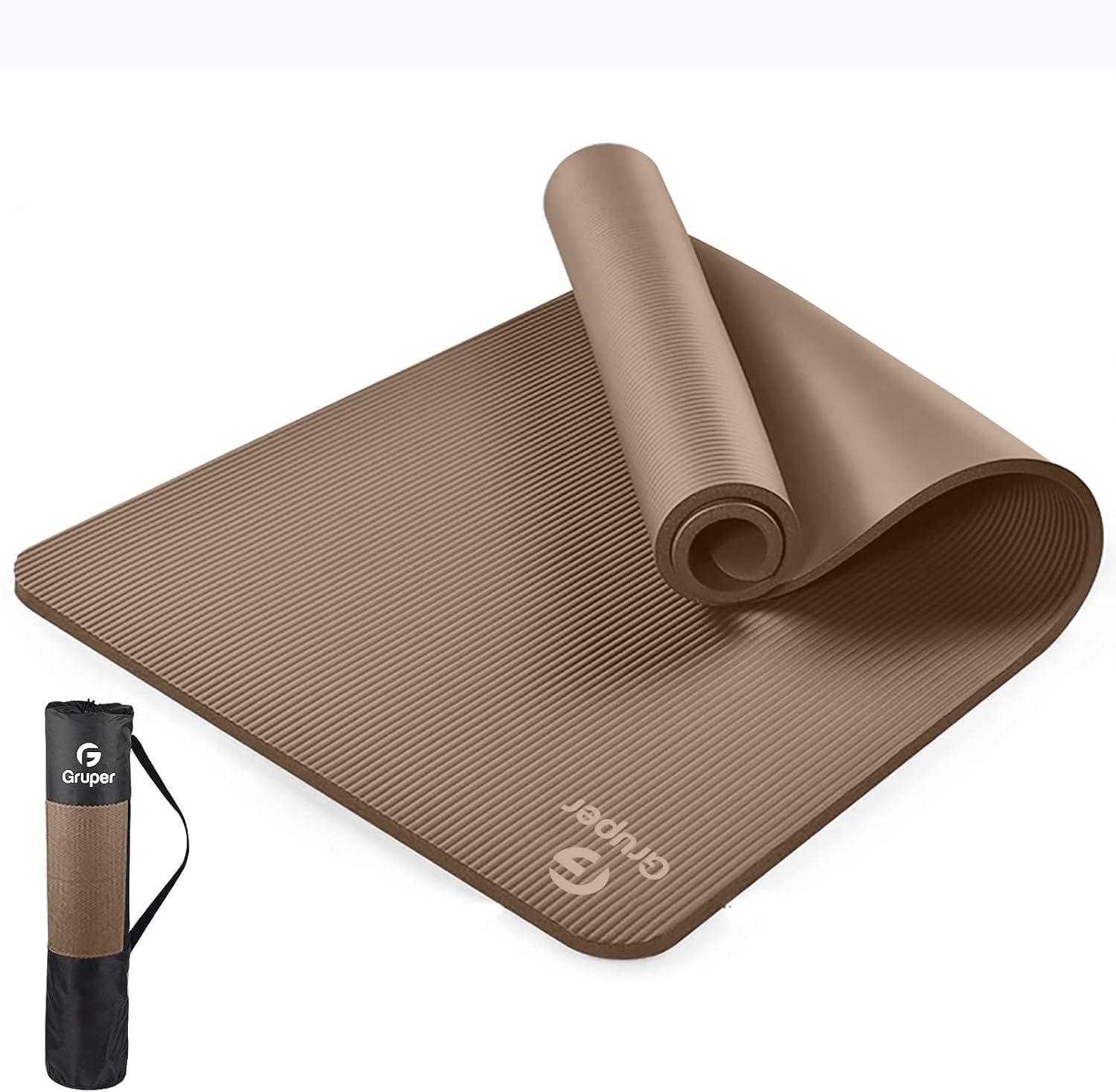
Gruper 10mm Thick Yoga Mat

Gruper

Gruper 10mm Thick Yoga Mat

  • Weight 1.8 lb
  • Includes Carry bag and strap
  • Thickness 10 mm (0.4 in)
  • Dimensions 72 x 24 inches
Check Price on Amazon

Most mats here ship with a strap; this one ships with a bag as well, a drawstring sack wide enough for the rolled mat. That is a small thing that stops being small when the mat lives in a closet and comes out twice a week, and it is the kind of inclusion that usually signals a maker cutting corners somewhere else.

Here it does not. The mat is 10mm of NBR foam, 72 x 24 inches, and about 1.8 pounds, plush enough that kneeling poses on a firm carpet stop registering at all. The softness is the point: this is a mat for stretching, pilates, and bodyweight floor work rather than for standing balance, where 10mm of foam under one foot is a liability rather than a comfort.

We rate it as a solid budget buy on one condition. The NBR underside is the smoothest of the group, so on deep, loose pile it can creep and needs resetting at the start of a session; on a low, tight carpet it behaves. If you want thickness and a bag without spending much, this is the one to look at.

Bottom Line

We rate it as the best-value way to get a thick, plush mat with a carry bag, as long as your carpet is not deep enough for the underside to creep.

Check Latest Price

How We Tested Yoga Mats on Carpeted Floors

We started with about 40 mats, including everything marketed as non-slip, extra-thick, or built for home practice, and read the specs and care instructions before ordering anything. Anything with a glass-smooth underside got cut, since that's the surface that slides on pile, as did mats that could only be cleaned in a washing machine. Price and portability narrowed it further, leaving 12 mats that we lived with for four months.

Those months looked like a normal home practice rather than a lab bench. Each mat got morning flows in a living room with medium-pile carpet, evening sessions on low-pile basement carpet, and slower weekend stretching on a plush bedroom rug. We measured thickness with calipers at the center and near the edge, because mats compress, then held a kneeling lunge for two minutes and noted whether knees and wrists felt supported or bruised. On every mat we tracked how far it crept during a 60-second downward dog and ten jump-backs, and whether carpet fibers were stuck to the underside afterward.

Durability was checked by rolling and unrolling each one 40 times, leaving a mat compressed in its strap for a week to see if it sprang back or stayed creased, and watching the edges for curling and the top surface for peeling. We weighed them and rolled each into a tote to judge whether it was genuinely something you'd carry to a class. And we smelled every mat three times: out of the box, after a week in a closed closet, and after a damp-cloth wipe, because carpet holds odor longer than a bare floor does.

How to Choose

Start With the Underside

In a studio, a mat holds a sealed floor with suction. On carpet there is nothing to seal against, so grip comes from texture and weight instead: ridges, honeycomb patterns, and foam with enough mass to press the pile down. Run a thumbnail across the back of a mat before you commit. A glossy, glassy surface has the least to grab and is the one most likely to creep toward the coffee table mid-flow.

We put more weight on this than on thickness, print, or brand. It is also why a mat that reviews well for hot yoga classes can disappoint in a living room, and the reverse.

Choose Less Thickness Than You Would on Tile

Carpet is already a cushion, so the mat does not have to be. A 5 or 6mm surface keeps you close to the floor and steady in standing poses; half an inch suits a mixed practice and spares knees in lunges; a full inch belongs with pilates, stretching, and floor work, where its depth is a gift rather than a wobble. If you want one mat that does everything, half an inch is the compromise we keep recommending.

Give the Edges Somewhere to Go

A new mat arrives with the memory of the roll it shipped in. On a hard floor that curl slides; on carpet the corners dig into the pile and catch under a foot. Unroll it face down and leave it out for a day or two, or weight the ends with books, before you judge it. Roll it loosely and evenly rather than folding it, and a mat that stays down on the floor will flatten faster than one that goes back in the closet every night.

Match Length and Width to Your Body

Length is where mats most often come up short. Standard mats run 68 inches; 71 to 72 covers more people; 84 is the answer if your hands land past the top edge in a forward fold. Width matters for wide-legged poses and broader shoulders, and 30 inches gives noticeably more room than 24.

Before you buy, measure the floor space where the mat will live and check that it fits unrolled. A 30-inch mat wedged against a wall with two feet of clearance is a daily annoyance.

Frequently Asked Questions

Final Verdict

On carpet, the mat that stays put beats the mat that feels nicest under a bare foot, and that is why the Fitvids is our overall recommendation: a textured back that settles into pile, half an inch of cushioning that does not cost you your balance, and a roll light enough to take to class.

Change one requirement and the answer changes with it. If your practice is mostly on your back and knees, the BalanceFrom's inch of foam is the more comfortable choice. If your hands keep landing off the end of a standard mat, the CAMBIVO's 84 inches is the fix, as long as you are practicing in one place.