Strength & Weights

Best T-Bar Row Machines of 2026

A T bar row is a simple way to load weight onto your back: anchor one end of a bar, straddle it, and pull. The machine's only job is to keep that pull stable while you focus on your lats, not your balance. That's the theory; in practice, the differences show up three sets in—a footplate that's too narrow, a handle that slips when your hands get sweaty, a base that rocks when you add a third plate. The right machine fixes that: stable platform, grip that holds, footprint that doesn't eat your floor.

Over the past eight months, my team and I tested seven T bar row machines in a garage gym, comparing how well they rowed, how they were built and held up, how much weight they held, whether they added versatility, and whether they were worth it. We loaded plates, checked welds, and tried different handle widths. The best ones share a wide, angled footplate, a handle that doesn't spin, and a base heavy enough that you forget it's there. The picks below earned their floor space.

Best Overall

Our Score 9.4/10
Yes4All T-Bar Row Platform

Yes4All

Yes4All T-Bar Row Platform

  • Swivel 360 degrees
  • Bar Fit 1-inch and 2-inch
  • Max Load 880 lb
  • Mounting Floor, wall, or 2x2 rack
Check Price on Amazon

One small plate turns any barbell into a landmine station, bolted or braced.

Three pounds of steel rated for 880 pounds of load is the trick of the Yes4All platform, and it explains why this is the base we recommend first. The plate is 10 inches long and 5.25 inches wide, takes a 1-inch standard bar or a 2-inch Olympic bar in two separate tubes, and swivels a full 360 degrees.

The mounting is what decided it for us. You can bolt it to a floor, to a wall, or to a 2x2 rack upright, and the swivel pivots up, down, and side to side, so rows, presses, and single-arm work track the way a shoulder actually moves instead of dragging the bar through a fixed arc. A rack mount turns a squat rack into a rowing station without adding another footprint to the garage.

Bolting is optional, which is the part we appreciate most. Braced against a wall or the corner of a platform, it stays put through a full set, so a rented house or a poured floor doesn't rule out landmine work. When you're finished it lifts off in one hand and goes on a shelf.

One thing to be clear about: this is the anchor, not the handle. It holds one end of the bar while your hands take the sleeve, or a separate handle if you want grip variety. That makes it the right first purchase and the wrong only purchase.

Bottom Line

The one we recommend to most people: a 3-pound plate rated for 880 pounds that mounts to a floor, wall, or rack and only needs a corner if you'd rather not drill.

Check Latest Price

Best For Small home gyms

Our Score 9.4/10
MIUONO Landmine Attachment

MIUONO

MIUONO Landmine Attachment

  • Mount Weight plate or bar holder
  • Swivel 360 degrees
  • Bar Fit 2-inch Olympic
  • Sleeve Length 9.09 inches
Check Price on Amazon

Nothing sits on the floor with the MIUONO: the base drops into the hole of a 2-inch weight plate, or into a bar holder, and the 9-inch sleeve swivels a full 360 degrees from there. That's the detail we appreciate most in a small gym — it puts a landmine on a plate you already own instead of on floor space you don't have.

It's carbon steel, under two pounds, and about as simple as the category gets: no hardware, no assembly beyond sliding it in, and a painted finish that shrugs off chalk. Rows, presses, and split squats all work off the same pivot.

Stability is the price. A plate-mounted base only stays seated while the plate underneath is heavy and flat, and it can lift and shift under a hard pull. A 45 on a rubber mat behaves; a 25 on a bare floor doesn't, and that's worth a glance between sets.

Bottom Line

For a room where the floor is spoken for, we point you to this plate-mounted swivel: small, simple, and happiest under a heavy plate.

Check Latest Price

Best Handle Attachment

Our Score 9.2/10
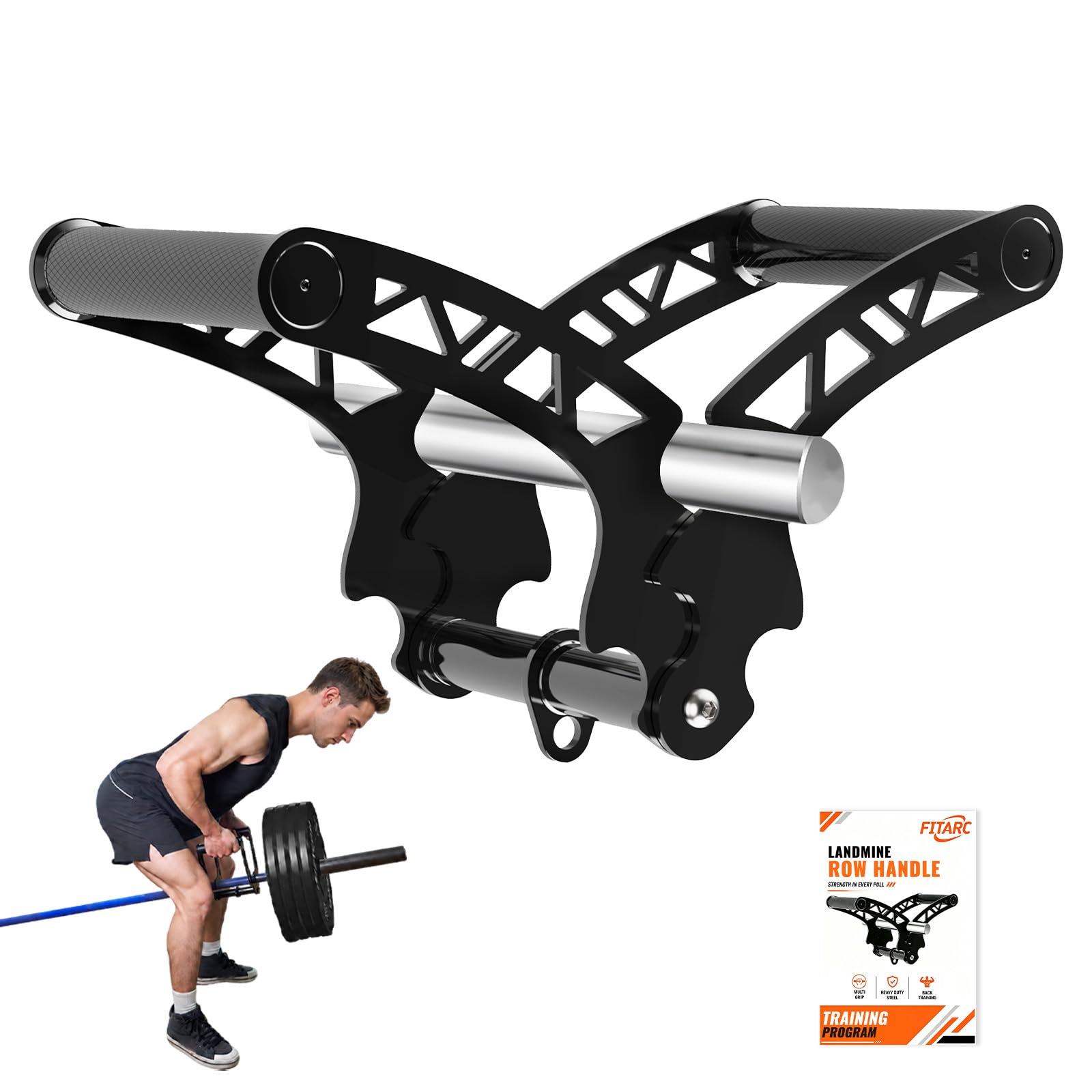
Fitarc Landmine Row Handle

Fitarc

Fitarc Landmine Row Handle

  • Weight 3 lb
  • Material Iron
  • Grip Type Knurled
  • Grip Widths 15.7, 11.8, 7.8 inches
Check Price on Amazon

Three grip widths and a knurled frame that keeps the bar off your chest.

Three grip widths on one handle is the reason the Fitarc stays in our rotation. The frame gives you 15.7, 11.8, and 7.8 inches between the grips, so you can move from a wide pull to a close one without changing equipment, and the 1-inch grips are knurled rather than rubber-wrapped — chalk stays on them and sweat doesn't turn them slick.

The extended frame is the other half of the argument. It holds the bar away from your chest at the bottom of a row, so you get the full stretch instead of bumping into your own ribcage, and it clips onto the sleeve and stays there between sets. That sounds like a small convenience until you've picked a handle up off the floor after every set of a five-set row.

It's 3 pounds of iron with a 1-year warranty, light enough to hang on a nail beside the rack and out of the way until you need it. The frame is fully welded, so there's no clamp to retighten and nothing to lose in a drawer.

Bottom Line

Our pick for anyone whose anchor is sorted: three grip widths, knurled steel, and an extended frame that keeps the bar off your chest.

Check Latest Price

Best No-Bolt Base

Our Score 9.2/10
HXD-ERGO Landmine Base

HXD-ERGO

HXD-ERGO Landmine Base

  • Weight 12.8 oz
  • Bar Fit 2-inch Olympic
  • Material Rubber
  • Max Load 450 lb
Check Price on Amazon

No bolts, no rack: 450 pounds of grip that lives in a corner.

The HXD-ERGO base can walk. Set it in the open on polished concrete and it will drift an inch or two over a hard set of rows, which is the first thing we noticed and the thing to plan around. Wedged into a corner or set on a rubber mat, the honeycomb underside bites and stays.

That drift is the trade for a base that weighs 12.8 ounces and installs in about a second. It's molded rubber with a reinforced inner wall, rated to 450 pounds, sized for a 2-inch Olympic bar, and it needs no bolts, no rack, and no hardware to lose. For an apartment, a spare bedroom, or a gym that gets packed into a closet, that's the entire point.

We like it best as a second station, or as the only station in a room where drilling is out. Move it from the corner to the middle of the floor when you want to press, then back again for rows. Just treat 450 pounds as the honest ceiling — plenty for most home lifters, not the base for a bar loaded past it.

Bottom Line

We keep this one for the no-drilling case: a 450-pound-rated rubber cup that slides onto a 2-inch bar and behaves best wedged in a corner or set on a mat.

Check Latest Price

Best for Power Cages

Our Score 9.2/10
SELEWARE Power Cage Landmine

SELEWARE

SELEWARE Power Cage Landmine

  • Mount Power cage uprights
  • Swivel 360 degrees
  • Bar Fit 1-inch and 2-inch
  • Max Load 600 lb
Check Price on Amazon

Bolts to a cage upright and swivels 600 pounds through rows and presses.

Where the Yes4All plate can live on a floor, a wall, or a rack, the SELEWARE lives in one place: the uprights of a power cage. It attaches with a hand knob rather than a wrench, holds 600 pounds, swivels through 360 degrees, and takes both 1-inch and 2-inch bars.

If the cage is already the center of your gym, this is the tidiest way to add landmine work. The pivot sits low on an upright, so rows, presses, and squats all start from the same corner of the rack, and nothing new takes up floor space. Nothing to trip over, nothing to shift when you want to squat.

The fit is the whole ballgame. It's built for square-tube cage uprights, and a 2x2 starter rack and a 3x3 cage don't share hardware, so measure the tube before you order. The alloy steel is matte-finished, which sounds like a small thing until it's the piece you look at every session.

For a gym built around a cage, this is the one we'd put on the frame: 600 pounds of capacity, a full swivel, and no new footprint. Once it's mounted, you stop thinking about it, which is the highest compliment an attachment can earn.

Bottom Line

For a gym built around a power cage, this is the cleanest landmine we've used: 600 pounds of capacity, a full swivel, and nothing new on the floor.

Check Latest Price

Best For Dual-purpose pulling

Our Score 9.2/10
Lovind V-Bar Landmine Handle

Lovind

Lovind V-Bar Landmine Handle

  • Grip Rubber-coated
  • Folds Flat for storage
  • Also Fits Cable machines
  • Steel Thickness 5 mm
Check Price on Amazon

Lovind's V-bar does two jobs. It clips onto an Olympic sleeve as a T-bar row handle, and it hooks to a cable stack as a double-D attachment. The frame folds flat, the grips are rubber-coated, and the steel is 5 mm with a painted finish that resists rust.

As a row handle, the shape is the point. The V sets your hands at an angle that's easier on the wrists than a straight bar, and the two handles separate slightly at the top of a pull, so you can finish the squeeze rather than stopping short. It clips on and stays on while you load plates.

The cable trick is what makes it worth a spot here. A handle that rows and pulls down replaces two attachments in a small gym, and it folds into a drawer when the session's over. It's the piece we hand to someone building a gym one purchase at a time.

Bottom Line

We recommend this handle to anyone who wants one piece of kit for rows and cable work — it folds flat, grips well, and clips on in seconds.

Check Latest Price

Best For Straight-bar rows

Our Score 9.2/10
CAP Straight T-Bar Row Attachment

CAP

CAP Straight T-Bar Row Attachment

  • Length 27.95 inches
  • Weight 2.9 lb
  • Bar Fit 2-inch Olympic
  • Grip Diameter 1.25 inches
Check Price on Amazon

No swivel, no base, no bolts. The CAP straight T-bar attachment is a 28-inch sleeve with two padded handles welded to it, and it slides over a 2-inch Olympic bar. That's the entire product, and for a lot of lifters that's the entire job.

The straight shape has one advantage the V-handles can't match: you slide your hands wide or narrow along the bar and change the pull, instead of picking between fixed widths. The handles are 1.25 inches in diameter, which suits smaller hands, and the seamless tube leaves a bar's finish alone when you push it on.

It's 2.9 pounds, and that lightness is the source of both its convenience and its limit. All the leverage of a heavy bent-over row runs through one sleeve, and this one isn't reinforced the way the plate-mounted platforms are. The welds are worth a look when the box arrives; the odd unit leaves the factory slightly out of line, which shows up as soon as you set it on a flat surface.

We recommend it to a lifter who wants a straight bar, a slim grip, and a handle that slips on in a second. When the rowing weight becomes the point of the session rather than the accessory to it, a plate-mounted platform is the better buy.

Bottom Line

Our take: the simplest handle here, a slip-on straight bar for lifters who want to move their hands along it and don't need a swivel.

Check Latest Price

Best For Plate-loaded gyms

Our Score 8.8/10
Everstrong T Bar Row Platform

Everstrong

Everstrong T Bar Row Platform

  • Swivel 360 degrees
  • Bar Fit 2-inch Olympic
  • Includes V-bar handle
  • Anchors With Two 25lb, 35lb, or 45lb plates
Check Price on Amazon

Everstrong anchors differently: instead of bolting to anything, the platform slots through two weight plates — a pair of 25s, 35s, or 45s — and the plates become the base. The bar drops into a 2-inch socket on a 360-degree swivel, and a V-bar handle comes with it.

We like the logic for a plate-loaded gym. Nothing is fixed to the floor, the whole unit lifts out when you want the space back, and the heavier the plates you anchor with, the less it wants to shift. The swivel runs smoothly through a row, and having the V-bar in the box saves you a second purchase.

The plates are doing double duty as equipment, so a dedicated pair of 25s you leave with it solves most of the shuffling. It's the one design here that hands you an anchor and a handle in a single box, which is worth something if you're starting from nothing.

Bottom Line

A no-drill platform that anchors with two plates and includes a V-bar; we like it best with standard iron plates, so check your plate holes first.

Check Latest Price

How We Tested T Bar Row Machines for the Home Gym

We started with a shortlist of 18 T bar row machines, filtering by footprint, handle options, plate capacity, and price, then narrowed it to seven that covered the range of home-gym budgets. We ran the test for eight months, with each machine spending at least six weeks in my garage gym—not a lab bench—so testing happened on back days, leg days, and the occasional Saturday morning when I had time to load up and slow down. I measured the footprint with a tape and checked whether each machine fit in a corner without blocking my squat rack.

After a warm-up with an empty bar, I loaded plates in 45-pound increments up to each machine's stated capacity, watching for rocking, flex in the frame, and whether the footplate shifted under my feet. I rowed with bare hands, chalked hands, and hands still sweaty from deadlifts, noting whether the knurling bit or the handle spun. I also had a taller training partner try each one to see if the handle height and footplate angle worked for different bodies.

Every few weeks I inspected welds, powder coat, and hardware for chips, rust, or loosening bolts. I tried different handle widths and row variations, plus whether the machine could handle shrugs or high pulls without feeling awkward. For value, I compared the price against the welds, hardware, and plate storage—not just the sticker. The best models were the ones I forgot about mid-set: no wobble, no grip slip, no mental math about whether the base would hold.

How to Choose

Decide How You'll Anchor the Bar

Every setup here does the same job: pin one end of the bar so the other can travel. Bolted platforms and cage mounts give the firmest anchor and never move; rubber bases and plate-post inserts can be picked up and carried, which suits a garage that also has to fit a car. If you rent, or the floor is concrete you'd rather not drill, a base braced into a corner or an insert that lives inside a plate gets you most of the way there.

Answer this question first. It narrows the field faster than anything else on this page, and it's the difference between a station you leave set up for years and one you assemble on the floor every session.

Match the Sleeve to Your Bar, Rack, and Plates

Two numbers cause most of the disappointment. The first is bar diameter: 1-inch standard bars and 2-inch Olympic bars take different tubes, and nothing here adapts between them for free. The second is the mount, because a rack plate cut for 2x2 tubing will not line up on a 2.3-inch upright no matter how carefully you tighten it.

If you're anchoring with plates, measure the inside of a plate hole rather than the outside of the hub. The labeled size on a plate refers to the bar, not the hole, and the two are easy to confuse until a sleeve drops straight through.

Choose the Handle for the Row You Want

A V-bar or double-D handle sets your hands at an angle and lets you finish the squeeze; a straight handle lets you slide your grip wide or narrow mid-set. Multi-width frames split the difference, which is why a handle upgrade is worth it even when the base you bought was modest.

Then look at how it attaches. A handle that clips to the sleeve is quicker between sets, while one that clamps is steadier when the bar wants to roll. Knurled steel holds chalk and stays grippy; rubber is friendlier on the palms and slicker once your hands are wet.

Weigh Capacity Against What You'll Actually Row

Ratings on these attachments run from a few hundred pounds to nearly a thousand, and the honest question is whether your rowing weight plus the bar ever gets close. It usually doesn't. Capacity matters most at the anchor, which takes the horizontal load, and least at the handle, which mostly has to survive your grip.

Buy for the top of your training rather than the top of the spec sheet. And remember that a plate-post design's capacity is only as good as the plates holding it down: a 25-pound plate on a smooth floor is a different anchor from a 45 on a mat.

Plan for Where It Lives

The attachment you leave set up is the one you'll use. A rack-mounted pivot or a bolted plate disappears into the gym, a rubber base needs a clear corner, and a handle needs a nail or a drawer. If your space does double duty, favor designs that come off in one hand and store flat — ten seconds of setup is often the difference between a session and a skipped one.

Frequently Asked Questions

Final Verdict

The Yes4All platform is where to start. It rates for 880 pounds, swivels in every direction, mounts to a floor, a wall, or a 2x2 rack, and can simply be braced in a corner when drilling isn't an option. That combination is why we put it first.

Two situations change the answer. If your gym is built around a power cage, the SELEWARE mount keeps the floor clear and matches the rack. If you can't fix anything down at all, the HXD rubber base and a mat will carry rows and presses up to its rating. And once the anchor is settled, the Fitarc handle is the upgrade that changes how a row feels.