Strength & Weights

Best Suspension Trainers of 2026

A suspension trainer promises a full gym in a small bag: anchor it to a door, pull-up bar, or sturdy tree, lean back, and let your body weight do the rest. The catch: everything depends on one anchor point and two straps, so a slipped buckle, a strap that won’t stay put, or flimsy stitching can turn a good workout into a negotiation. I’ve used them in living rooms, on hotel doors, and in parks, and the difference between a keeper and a hassle shows up fast: a good one takes the guesswork out of setup and lets you focus on the workout.

Over six months, we hung 12 suspension trainers from doorframes, pull-up bars, and a few trustworthy trees, putting each through rows, push-ups, lunges, and chest flyes. The keepers felt secure under load, adjusted smoothly, and packed small enough to forget in a duffel. We also tracked value, strap durability after repeated setup and takedown, and whether each kit made sense without a manual. The right pick feels stable enough to trust and simple enough to use.

Best Overall

Our Score 9.6/10
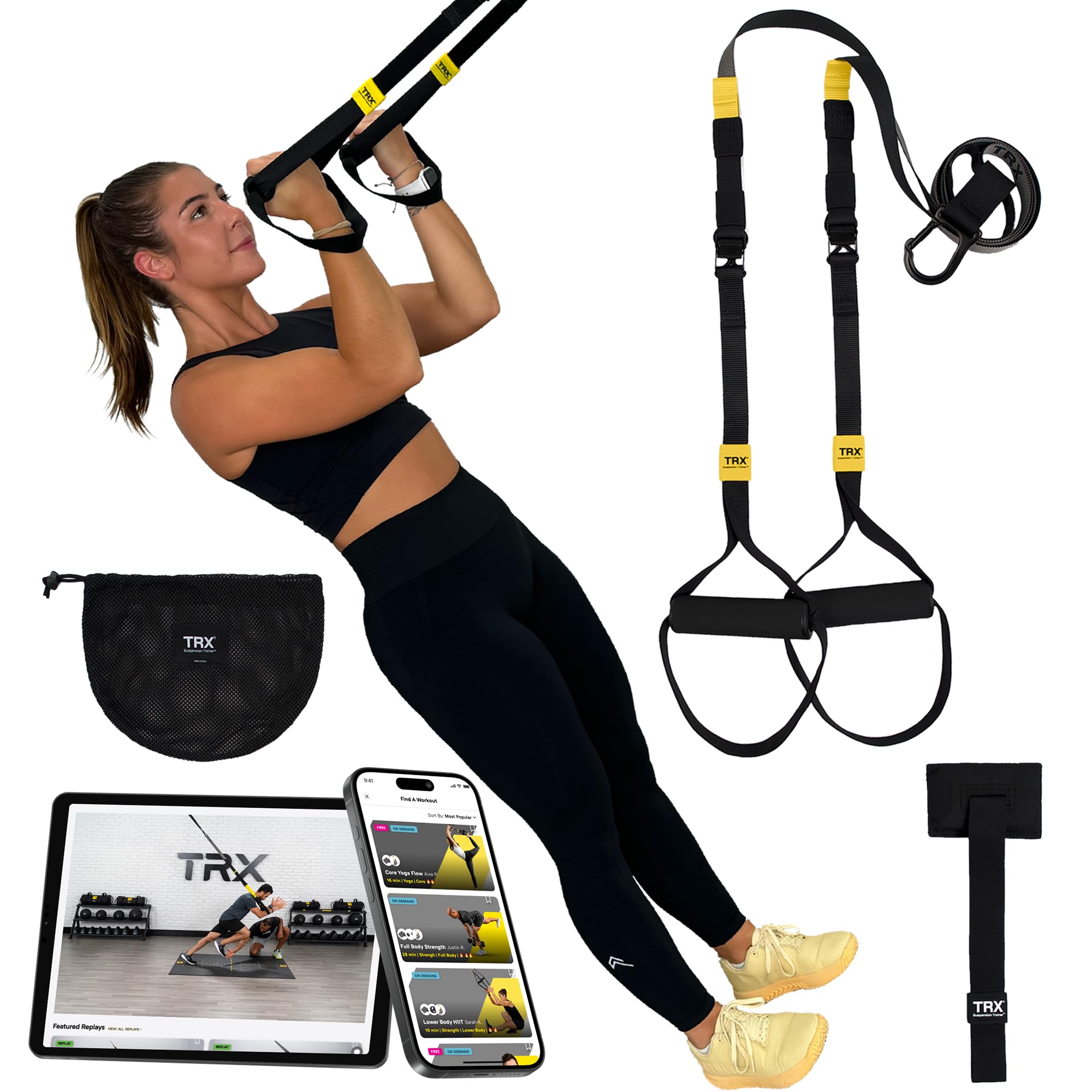
TRX All-In-One Home Gym System

TRX

TRX All-In-One Home Gym System

  • Warranty 1 year limited
  • Anchoring Indoor and outdoor
  • Packed Weight 1.7 lb
  • Max User Weight 700 lb
Check Price on Amazon

Door, beam, and tree anchoring with a 700-pound rating in one 1.7-pound kit.

Seven hundred pounds is the number that settles most of the argument. That's the load TRX says the All-In-One is safety tested to, double what the same company rates its travel trainer for, and it's why this is the kit we point most people toward: one system that hangs from a door, a rafter, or a tree branch and still has headroom when two people of very different sizes share it. Nothing else here combines that rating with anchors for indoors and out in the same bag.

What's in the bag matters nearly as much as the rating. You get the door anchor, a mesh carry bag, a 65-minute training disc and a 35-page printed guide, plus a trial of the TRX Training Club app and its 500-plus workouts. At 1.7 pounds the whole thing folds into the mesh bag and disappears into a carry-on, which is how it ends up going on trips instead of staying in the closet. We found the printed guide genuinely useful for the first few sessions; the disc less so, since the same movements are in the app.

It is, however, the priciest kit in this set, and that's the honest case against it: the webbing doesn't feel dramatically different from the cheaper kits here. What you're paying for is completeness and that rating. If you'll use the guide, hang it outdoors as often as indoors, or want one setup that works for two people, the math works. If you just want straps over a door for solo sessions, it doesn't.

Bottom Line

Buy this one if you want a single kit for the living room, the garage, and a tree branch — the 700-pound rating and both anchors make it the most complete system here.

Check Latest Price

Best for Travel

Our Score 9.4/10
TRX GO Suspension Trainer

TRX GO

TRX GO Suspension Trainer

  • Weight 1.5 lb
  • Warranty 3 years
  • Max User Weight 350 lb
  • Included Anchors Indoor and outdoor
Check Price on Amazon

Packs lighter than anything else here and hangs from a hotel door in seconds.

The GO is what's left after TRX strips the All-In-One for a suitcase: the suspension strap, a mesh bag, anchors for indoors and outdoors, and no disc and no printed booklet. It weighs 0.68 kg, light enough that we stopped noticing it in a weekender bag after the first trip, and it hangs in a hotel doorway in about the time it takes to close the door on it.

This is the one that travels with us, and it's also what we hand to anyone training in hotel rooms, rentals, or a corner of a shared apartment, because the whole kit goes up and comes down without leaving a mark. The catch is the rating: 350 pounds, half the All-In-One's, so heavier lifters and anyone sharing with a partner should spend up. Against that, the three-year warranty is the longest of any kit here, which is unusual for the model a company expects to get thrown in a bag.

Without a printed program you lean on the app and its 500-plus workouts, and the adjusters need a firm pull to break loose, which is most noticeable when you're resetting between exercises in one session. Ours has been packed for weekends and rental cabins and has come home looking the same, and it's the kit that gets unpacked first when we're away.

Bottom Line

Our pick for a trainer that lives in a bag: it hangs from any door, packs lighter than anything else here, and carries a three-year warranty, though the 350-pound limit rules out heavier users.

Check Latest Price

Best For Rental-friendly setup

Our Score 9.4/10
OUUO Suspension Straps

OUUO

OUUO Suspension Straps

  • Build Steel core, TPE shell
  • Weight 1.98 lb
  • Door Anchor Built into strap
  • Strap Length 75 inches
Check Price on Amazon

If the door belongs to a landlord, this is the design that makes sense. The anchor is built into the strap rather than being a separate loop you thread over the top, so there's one piece to hang, nothing to lose in a drawer, and a soft TPE shell that sits against the paint instead of a bare webbing edge. Setup really is a matter of draping it over the door and closing it — the quickest of anything here — and that's the reason we keep it in the conversation.

Under the rubber is a steel core and a carabiner at the bottom, which is where an extension strap or a pull-up bar attachment clips on. None is included, so out of the box this is a door trainer, not a tree trainer. Each strap mounts to the anchor separately, so adjusting one side doesn't drag the other out of position, and 75 inches of strap is enough to shorten up for presses or run long for rows. At 900 grams it's heavier than the TRX GO, which we noticed packing it, and that's the trade for the built-in hardware.

Bottom Line

Renters should start here: the built-in anchor hangs in seconds and won't mark the door, though you'll need your own strap to anchor anywhere but a door frame.

Check Latest Price

Best for Varying Resistance Angles

Our Score 9.2/10
Lifeline Jungle Gym XT

Lifeline

Lifeline Jungle Gym XT

  • Weight 16 oz
  • Warranty 90 days
  • Anchor Design Patented split anchor
  • Included Anchors Two non-scuff door anchors
Check Price on Amazon

Two independent anchors let you press and row at narrow, neutral, or wide angles.

Two anchors instead of one is the whole idea here. Each strap has its own door anchor and its own length adjustment, so the arms hang parallel, or splay wide, instead of being locked into a V by a single loop. In practice a chest press stops feeling like a cable machine and starts feeling closer to dumbbells, and you can stagger one arm for a row without fighting the other side.

At 16 ounces it packs flat in a suitcase, and the cam locks are quicker to change than the slider-style adjusters on the TRX kits — one squeeze and the strap runs through, which we appreciated most when swapping from a press to a low row mid-set. Two non-scuff door anchors come in the kit, and the straps loop over a bar or beam when you'd rather hang it that way.

The part to watch is the plastic toothed clip that locks each strap. It can creep under load, so our routine is: set the length, load the strap once with your body weight, and check it again between sets. That habit, plus a 90-day warranty that's the shortest here, is why it sits behind the TRX kits for us — but it's well below either TRX kit on price and it's the least expensive way to get genuinely independent arms. The angle changes are worth the fuss.

Bottom Line

Choose it for the split anchor: two independent arms for narrow and wide angles at a price well under the TRX kits, as long as you pull-test the clips before every set.

Check Latest Price

Best for Attachment Swaps

Our Score 9.2/10
Bodytorc Suspension Trainer

Bodytorc

Bodytorc Suspension Trainer

  • Weight 3.4 lb
  • Buckles Anodized cam buckles
  • Handles Detachable
  • Max User Weight 250 lb
Check Price on Amazon

Straps hang parallel from a rack, and the handles come off for ropes and bars.

Hang this one from a chin-up bar or a power rack and it makes more sense to us than it does on a door. The two straps loop over the bar separately, so they stay vertical and parallel rather than converging at a single point, and the detachable handles let you clip on ropes, a straight bar, or a grip set you already own. On a rack, that's a more useful arrangement than most of the door-first kits here.

Build-wise it's the kit we point at a garage gym on a budget: high-grade webbing with double stitching, anodized cam buckles that hold their setting, and 3.4 pounds of hardware that feels like it will take abuse. What it won't take is a heavy user — the stated limit is 250 pounds, the lowest here, so bigger lifters should look at the TRX kits. It's also a one-person setup rather than a shared one, for the same reason.

The foot loops are the fiddly part. They're separate straps you step into rather than cradles, which takes a couple of tries to get right for hamstring work, and the heel hook never feels quite as settled as a padded cradle. Everything else about the kit feels deliberate, down to the clips on the handles.

Bottom Line

The rack-friendly pick: straps that hang parallel, handles you can swap, and hardware built for a garage — provided you're under the 250-pound limit.

Check Latest Price

Best For Cheapest complete kit

Our Score 9.2/10
Moulyan Bodyweight Training Straps

Moulyan

Moulyan Bodyweight Training Straps

  • Weight 2.65 lb
  • Material Nylon and polyester
  • Kit Contents Two straps, door anchor, extension strap, guide
Check Price on Amazon

Two adjustable straps, a door anchor, an extension strap, and a printed guide. This is the least expensive complete kit in this set, and it works: you can run a full-body session on it in a doorway, and if the real question is whether you'll stick with suspension training, it's a low-stakes way to find out.

Expect to spend your first session figuring it out. The pieces aren't labeled, the included guide is thin, and the two straps go over the door as a pair rather than anchoring separately, so getting the lengths even takes a few tries. A ten-minute video does what the paperwork doesn't.

The handles are hard molded plastic with no padding, which you notice on long sets of rows, and the grips are one solid piece rather than a rotating sleeve. The webbing itself is nylon and polyester and the whole kit packs down to 1.2 kg, small enough for a gym bag or a suitcase.

Where it earns a place is as a second kit — one for the garage, one for the cabin, one for a teenager's first setup — rather than as the only trainer you own. There's no published weight limit on the listing at all, so if you're a heavy user or plan explosive work, ask the seller before you load it hard. The kits with a rating printed on them are worth the extra money for that reason alone.

Bottom Line

The least expensive complete kit here and a fair way to try suspension training, though hard handles and no published weight limit keep it out of the top tier.

Check Latest Price

Best For First full kit

Our Score 9.0/10
Fitense Suspension Trainer Kit

Fitense

Fitense Suspension Trainer Kit

  • Weight 2.87 lb
  • Warranty One year
  • Extension Strap 95 cm
  • Strap Adjustment 76–116 cm
Check Price on Amazon

Seven pieces arrive in the bag: two adjustable straps, a bodyweight strap, a door anchor, an outdoor anchor, a pair of combination handles and foot cradles, a training guide, and a carry bag. For a first setup that's a more complete starting point than most of the budget kits here, and the whole thing goes back into the bag without a fight.

The straps adjust from 76 to 116 cm, which is on the short side, so the 95 cm extension strap isn't an accessory — it's how you get height. Rig the extension over the door or beam with the arms hanging below it and you get a normal working range; skip it and you'll be doing presses from your knees. The reinforced cross-stitching at the load points is the sort of detail that matters more than the color.

The handles and foot cradles are one piece, so switching from a row to a hamstring curl means re-threading the strap rather than clipping something on — a minute of fiddling that gets old in a circuit. Otherwise this is the kit we suggest to someone building a first home gym or outfitting a garage bay: it covers door and tree anchoring, comes with a one-year warranty, and the parts feel reinforced where they need to be. It won't feel as refined as the TRX kits, and at this price it doesn't have to.

Bottom Line

The starter kit we suggest for a first home setup: both anchors, an extension strap for height, and a one-year warranty, though the straps are short without it.

Check Latest Price

How We Tested 12 Suspension Trainers

We started by pulling together a shortlist of suspension trainers sold as complete kits, then narrowed it by strap material, anchor style, handle and foot-cradle design, adjustment hardware, packed size, and what came in the box. We ruled out anything that looked like it would need a separate anchor purchase just to get started, and we kept a range of prices in the mix so value could be judged against real alternatives rather than in isolation.

Twelve trainers made the cut. For six months, my team and I used them in a living-room doorway, on a pull-up bar in a garage, and on a tree in the park; a few came along on weekend trips to see how they packed and whether they could be set up in a hotel room without guesswork. Every session included rows, push-ups, split squats, and chest flyes, and we repeated the same sequence on each model so the comparisons stayed fair.

We timed solo setup from bag to first set, noted whether the straps adjusted in small, predictable increments and stayed put under load, and checked the anchor and buckles after hard pulls for slipping or shifting. After each session we inspected webbing, stitching, and handles for fraying, stretching, or crushed hardware, and we packed every trainer back into its bag to judge portability. We also set up several kits without opening the instructions first, which turned out to be the quickest way to see whether the labeling and strap routing made sense on their own. The models that scored best were the ones we stopped thinking about mid-workout.

How to Choose

Split Anchor or Single Point

A single anchor gathers both straps into one loop. It's the fastest thing to hang on a door and the lightest to pack, but it fixes your geometry: the arms splay into a V, so every press and row pulls slightly inward. A split anchor gives each strap its own attachment, letting the arms hang parallel or widen on purpose, which is why a press at a narrow, neutral, or wide angle feels like three different exercises.

Choose the split design (the Lifeline is the one here) if angle variety is the point of training at home. Choose a single point if setup speed and a smaller bag matter more. On a door, a split anchor means two anchors over the same door, so allow an extra minute every time you hang it.

What the Load Rating Actually Covers

Ratings in this set run from 250 to 700 pounds, and they describe the whole system under a properly anchored load rather than the webbing on its own. If you're near a kit's ceiling, that number is a hard stop. The Bodytorc's 250 pounds is a one-person limit; the TRX GO's 350 and the All-In-One's 700 leave room to share or to train explosively.

Buy headroom if two people of different sizes will use the same setup, and treat the figure as valid only when the anchor is sound. A 700-pound system on a hollow-core door is a 700-pound system on nothing.

Anchors: Doors, Beams, and Trees

Every kit here includes a door anchor. The differences are the outdoor strap, the extension strap, and how the anchor seats. A door anchor only works when the door closes toward the direction you pull, with the strap over the top on the far side so the latched door traps it. A door that swings toward you, a hollow-core door, or one that won't latch is a no.

Outdoors, loop around a living limb or a solid post rather than a railing or a branch you can flex by hand. If you want one kit that handles a doorway and a backyard, that narrows the field quickly: the two TRX kits and the Fitense are the ones that ship with both anchors.

Adjusters, Handles, and Foot Cradles

Cam buckles and toothed clips are the parts that give trouble first. Whatever you buy, set the length, load the strap once with your body weight, and look again before your first rep; a clip that creeps shows up immediately. Match the two arms by eye at the handles rather than by printed markings, which don't always line up between straps.

Padded handles and separate foot cradles are comfort decisions you'll notice on long sets. Hard molded plastic handles are the quiet tax on a budget kit, and combination handle-cradle pieces mean re-threading the strap every time you switch from rows to hamstring work.

Packability, Guides, and Warranty

The lightest kit here weighs 0.68 kg; the heaviest, 3.4 pounds. Lighter usually means the printed program got dropped in favor of an app, which is a fine trade if the trainer lives in a bag and a poor one if it hangs in a garage where you want a booklet to follow.

Warranty is the other quiet difference: three years on the TRX GO, one year on the All-In-One and the Fitense, 90 days on the Lifeline. On a piece of equipment that takes your full body weight, that's worth weighing next to a few saved pounds.

Frequently Asked Questions

Final Verdict

The TRX All-In-One is the suspension trainer we recommend to most people. It anchors to a door, a beam, or a tree, carries a 700-pound rating that covers two users, and ships with a printed guide and an app trial to get you through the first month.

If it will live in a suitcase, take the GO: lighter, backed by a three-year warranty, and rated for half the load. And if independent arms are what you're after without paying TRX money, the Lifeline's split anchor does something neither TRX kit can.