Strength & Weights

Best Functional Trainers of 2026

A functional trainer promises gym-style cable work at home, but the gap between a great one and a frustrating one comes down to unglamorous details: whether the frame stays planted during a heavy row, whether the pulleys glide or hitch mid-set, and whether assembly eats a weekend. I spent eight months with six machines in a garage gym and a spare bedroom, and those details separated the keepers from the ones I was glad to see go. The right one turns a corner of your home into a real training space.

Instructions, fit, and value matter as much as the spec sheet: I learned to read the hardware bag before touching an Allen wrench, and to measure ceiling height before falling for a dual-pulley setup. Adjustability and smoothness are the daily pleasures—moving a pulley from high to low without wrestling a pin, pulling through a full range without a gritty catch. Our picks range from compact frames to sturdier units, all with home-gym performance in mind.

Best Overall

Our Score 9.2/10
Inspire Fitness FTX Functional Trainer

Inspire Fitness

Inspire Fitness FTX Functional Trainer

  • Footprint 54"D x 40"W x 82"H
  • Weight Stacks Two 165 lb stacks
  • Total Resistance 330 lb
  • Included Attachments Tricep rope, two D handles, curl bar, chin/dip belt
Check Price on Amazon

Two independent 165-pound stacks and a compact frame make it the complete home trainer.

Two separate 165-pound stacks are what make this a functional trainer rather than a cable machine that happens to have two handles. The arms move independently, so you can run a chest press on one side and a row on the other, load one side heavier, or work a single arm without the empty handle flying up to the top pulley. That independence is the thing we care most about in this category, and it's why the FTX is the machine we point people toward first.

In use it feels like a scaled-down version of the cable towers you find on a commercial floor. The pulleys slide through their range without a catch, the swivels rotate cleanly at the end of a rep, and the frame stayed planted through crossovers and single-arm rows — no rocking, no creak at the base. At 54 inches deep and 40 wide it fits a garage bay without claiming the whole floor, and at 82 inches tall it clears an eight-foot ceiling, though you'll want the space above the top pulley clear for overhead work.

The included kit is better than most. A tricep rope, two D handles, a dual-hook curl bar and a chin/dip belt cover the accessories you'd otherwise buy one at a time, and there's a shelf for your phone plus a rack on the back for the handles so the floor stays clear between sets. The two stacks give 330 pounds of total resistance, which is generous for cable work and light for anyone chasing a heavy lat pulldown personal best.

What tips it over the Body-Solid is the geometry: you get independent stacks and a full pulley range in 54 inches of depth rather than 62 inches of width. In a single-bay garage that's the difference between a trainer that fits and one you have to talk yourself into anyway. The FTX rewards someone who will actually use the range, though — if you mostly want to press and extend, a multi-station machine gives you more exercises for less money.

Bottom Line

We recommend the FTX to anyone who wants a genuine two-stack functional trainer and has the wall for it — it's the most complete cable machine here.

Check Latest Price

Best Heavy-Duty Build

Our Score 9.2/10
Body-Solid Powerline PFT100

Body-Solid

Body-Solid Powerline PFT100

  • Warranty 10 years frame, 1 year parts
  • Footprint 42.3"D x 62.6"W x 83"H
  • Weight Stacks Dual independent
  • Machine Weight 476 lb
Check Price on Amazon

A wide, 476-pound frame with true isolateral stacks for lifters who want crossover room.

Sixty-two inches across is a lot of machine, and the Powerline uses every one of them. The uprights sit far enough apart that a crossover gets a long, even cable path and you can step through the middle without ducking your head. If your gym is a narrow bay or a spare bedroom, this is the one that won't fit — measure the wall before you order rather than after.

What that width buys is stability. The frame is 476 pounds of steel, and it sat dead flat through everything we did on it, including single-arm rows where a lighter tower starts to lean away from you. The two stacks are independent, so unilateral work is genuinely unilateral, and the swivel handles turn without binding at the top of a press.

Where it loses ground to the FTX is in the details rather than the build. It arrives as a bare machine — no rope, no D handles, none of the small pieces — so you're buying attachments on top of the trainer. The frame goes together logically, but the pulley and cable-routing pages are dense drawings that reward a second pass and a second pair of hands. What you get for the effort is a 10-year frame warranty and a machine that feels like it belongs behind a membership desk.

For a home gym with the wall space and an appetite for heavy, planted cable work, this is the sensible alternative. The trade is straightforward: more room, more steel, fewer extras in the box. If your ceiling is finished and low, check the 83-inch height before anything else — it's the tallest machine here.

Bottom Line

Choose the Powerline if you have a wide wall and want commercial-grade steel — it's the sturdier, roomier alternative to our top pick, minus the frills.

Check Latest Price

Best Wall-Mounted

Our Score 9.0/10
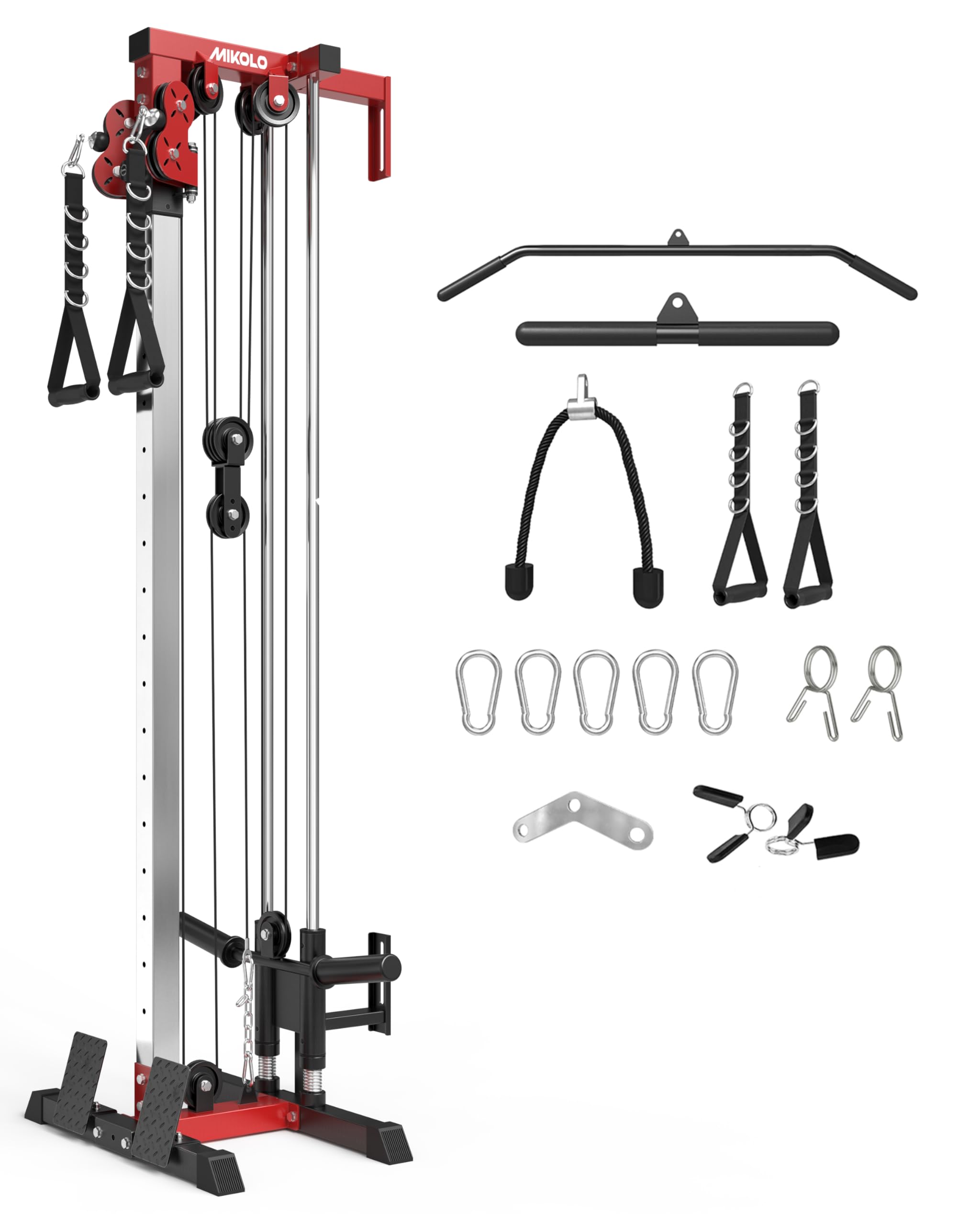
Mikolo Wall Mount Cable Station

Mikolo

Mikolo Wall Mount Cable Station

  • Footprint 25.6"D x 26.9"W x 82"H
  • Resistance 400 lb
  • Pulley Positions 19 heights
  • Included Attachments Lat bar, cable bar, tricep rope
Check Price on Amazon

Bolts to a wall, takes plates you already own, and fits a tight corner.

No weight stack is the best thing about this one. It hangs on a wall, you slide your own plates onto the sleeves, and you get two independently adjustable pulleys for a fraction of what a stacked trainer costs. If you already own plates and your floor space is spoken for, this is the pick that makes the most of what you have.

What the compromise buys you is a machine 25.6 inches deep and 26.9 wide, mounted at 82 inches high, with 19 height positions on each side — enough to run a low row on one arm and an overhead press on the other without unclipping anything. The large footboard gives your feet something to brace against for seated rows, and the weight pegs angle up 10 degrees so plates stay seated mid-set.

The details are better than the price suggests. The lat bar, cable bar and tricep rope included in the box cover most cable work out of the gate, and the cables are nylon-coated with a 2,200-pound tensile rating against a 400-pound working capacity — the frame isn't what you'll outgrow. The pulley housings are plastic rather than metal, and a little silicone lubricant on the cables makes a noticeable difference to how smooth the pull feels.

Two people can't train on it at once, and that's the honest boundary: it's a one-lifter machine that turns a wall into a cable station. Resistance tops out at whatever you can hang on the sleeves, so a strong lifter will want a plate tree nearby. For a garage that already has one, nothing else here comes close on space or money.

Bottom Line

We point budget buyers with plates and a spare wall to this one: it's the cheapest honest route to two independent adjustable pulleys.

Check Latest Price

Best For All-in-one pressing

Our Score 9.0/10
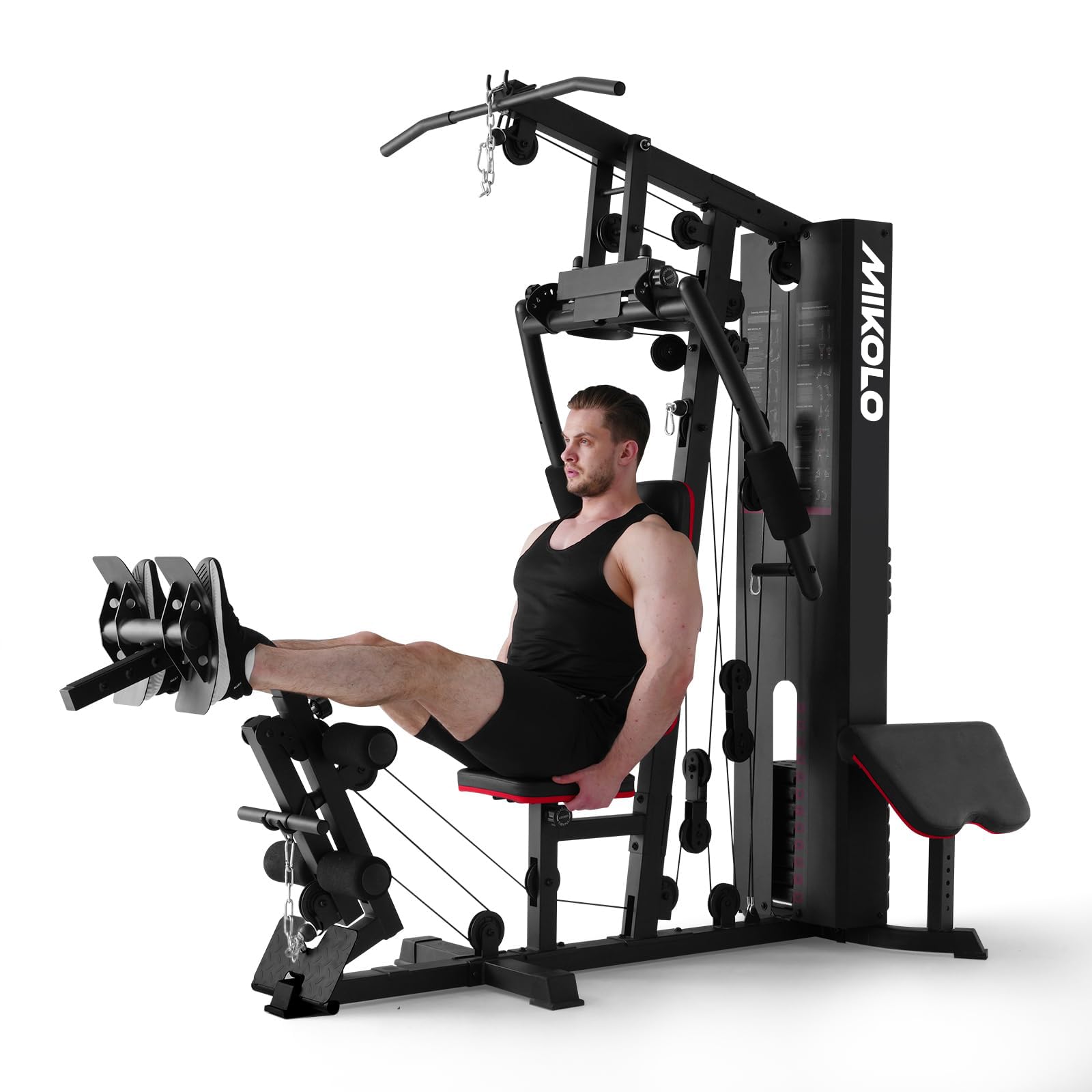
Mikolo HGS Pro Home Gym

Mikolo

Mikolo HGS Pro Home Gym

  • Warranty Lifetime frame, 1 year parts
  • Footprint 75"D x 36.3"W x 80"H
  • Machine Weight 300 lb
  • Included Attachments Two D-handles, short cable bar, lat bar, tricep rope, chain
Check Price on Amazon

If the goal is one machine that replaces a gym membership rather than a pair of pulleys, this is the one worth a look. It packs a chest press, pec fly, lat pulldown, low row, leg extension, leg press and preacher curl into a frame 36.3 inches wide — one of the narrowest here — and it does all of that convincingly for the footprint.

Where it parts ways with a true functional trainer is the cable end. One stack feeds the pulleys, so the arms don't carry independent resistance and you can't set a crossover with different weight in each hand. You still get high, mid and low pulley work; what you give up is the two-arm independence that makes a crossover worth owning in the first place. That's the trade for the press stations, and it's a fair one if variety matters more to you than cable training.

In exchange you get stations a trainer can't offer. The chest press and pec fly are the reason to pick this over a plain cable tower, and the preacher curl pad and leg press attachments come off when you want them out of the way. The 75-inch depth is the number to check against your room — this wants a wall behind it, not a corner, and the 80-inch height means measuring a low basement ceiling before anything else.

Two things we came to appreciate: the assembly video does the teaching the paper instructions don't, and the printed exercise sheet hands you a starting program instead of leaving you to invent one. The 300-pound frame doesn't budge once it's square, which also means the wall you pick is the wall it stays on for good.

Bottom Line

Buy the HGS Pro if you want one machine that presses, curls and pulls in a narrow slot — not if independent cable arms are the point.

Check Latest Price

Best For Leg press training

Our Score 8.8/10
SincMill SCM-1148L Home Gym

SincMill

SincMill SCM-1148L Home Gym

  • Warranty 10 years
  • Footprint 69"D x 40.7"W x 80"H
  • Weight Stack 148 lb
  • Included Components Curl pad, leg press pedal, two one-hand bars, ankle straps, chain, top and bottom bars
Check Price on Amazon

The leg press pedal is the reason to look at this one. No other machine here lets you sit down and drive with your legs against the stack, and if you're outfitting a home gym in a single purchase, that's a lot of lower-body work you don't have to buy separately. It's a multi-gym with a cable station attached, not a functional trainer, and it shouldn't be judged as one.

What it does well is breadth in a 40.7-inch-wide footprint. Top and bottom pulley positions, a curl pad, ankle straps, two one-hand bars and quick-release latches get you through a full session without moving to another machine, and the 148-pound stack sits in the same range as the others here — enough for isolation and accessory work, not for heavy compound pulling.

The build is sturdier than the price tier suggests. The steel is thick, nothing wobbles once everything is tightened down, and the 10-year warranty is the longest in this group. Assembly is a project rather than an evening: it arrives in several boxes and the written directions are the weak link, so the video walkthrough and a hardware sort before you start make the difference. Line up help, because the frame is awkward to handle before it's square.

Where it falls short for a cable-first program is exactly where a functional trainer shines: the pulleys play second fiddle to the stations, and you never get two independent arms. That's a fair trade for a first home gym where the goal is one machine that does everything passably. It's a poor one if you already know cable work is the training you'll stick with.

Bottom Line

A reasonable first home gym if you want a leg press and a stack in one purchase — we just wouldn't call it a functional trainer.

Check Latest Price

How We Tested Functional Trainers

We started by narrowing the field to machines with dual adjustable pulleys, published weight capacities, and enough attachment variety to handle pressing, pulling, and unilateral work. Then we filtered out anything with vague specs, a footprint that wouldn't clear a standard garage or spare-room setup, or a price that didn't match what came in the box. Six finalists made the cut.

Each unit arrived flat-packed and was assembled by one person following the manufacturer's instructions, with a timer running and a notebook open for confusing steps, missing hardware, and any point where a second set of hands felt mandatory. Once built, we measured the actual footprint and height, then lived with each machine in a garage gym and a spare bedroom for eight months, training on them three to four times a week.

During sessions we did cable flys, lat pulldowns, rows, squats, and anti-rotation presses, moving the pulleys through every height setting mid-workout to see whether the pin, trolley, or handle adjustment snagged. We loaded the stacks near their rated capacity for heavy pulls and watched for frame rock, cable rub, and base lift; we also noted whether the cable returned smoothly or felt gritty under lighter accessory work. At the end, we compared each machine's price against its included attachments, warranty, and the day-to-day functionality it actually delivered.

How to Choose

Two Pulleys, or One Stack Feeding Two Handles

The defining feature of a functional trainer is independence: each arm carries its own resistance and sets its own height. That's what lets you run a crossover, alternate a press with a row, or load one side heavier while you even out a weaker arm. Photos rarely make the difference obvious, which is why we count the stacks first — a dual-stack machine has two, and a plate-loaded unit has two separate loading arms.

On a single-stack machine both handles draw from the same weight, so the arms move together in practice. That isn't a bad machine, it's a different one. If cable-first training is the plan, pay for the second stack or the second arm; if you want pressing stations more than pulleys, spend the same money on variety instead.

Height, Footprint, and the Wall Behind It

These machines run 80 to 83 inches tall. That clears an eight-foot ceiling, but it leaves little room to reach above the top pulley, so check the clearance where you'll stand rather than over the frame. Depth matters more than width day to day: you want two or three feet in front of the pulleys to step into a crossover or kneel for a row.

Freestanding machines want a level floor you don't mind loading. Wall-mounted units need studs or structural blocking, which rules out some rentals and most drywall. When a listing calls a machine compact, it's describing the frame, not the training zone you need around it.

Resistance: What Each Side Can Hold

We look at the per-side figure rather than the total, because that's the load in your hand. A 165-pound stack per side is generous for cable flys, face pulls and rows; it runs out fast for a strong lifter on lat pulldowns. Plate-loaded machines have no ceiling except your plate collection, but loading is slower and a set of cable flys turns into a set of plate changes.

Match the number to your heaviest cable exercise, not your heaviest lift overall. For most home trainees, 150 to 165 pounds per side covers years of accessory work, and the stack isn't what limits progress.

Cables, Pulleys, and the Parts That Wear

You can't judge smoothness from a spec sheet, but you can judge what sits behind it: nylon-coated cable with a stated tensile rating, metal rather than plastic pulley housings, and a warranty that covers parts as well as the frame. Cables and pulleys are what wear, so confirm replacements are sold before you commit.

Budget for attachments too. A rope, a pair of D handles and a lat bar add up quickly, and only some machines include them — the Body-Solid arrives as a bare machine, while the Mikolo wall unit ships with three attachments in the box.

Assembly and the Room It Lives In

Every machine here ships in multiple boxes and takes an afternoon or more. Paper instructions are the usual weak point and the assembly video is often the better teacher; sorting hardware by step before you start saves most of the backtracking, and a second pair of hands saves the rest.

Settle the location first. A 300-to-550-pound machine becomes furniture once it's square, and moving it means taking it apart. Pick the wall, check the ceiling and the doorway it comes through, and order after that.

Frequently Asked Questions

Final Verdict

Buy the Inspire FTX if you want a real functional trainer and can give it a wall: two independent 165-pound stacks, a compact footprint, and the smoothest pulley travel in this group make it the machine we recommend without a caveat beyond cost. If you have more width than depth and want the heaviest frame here, the Body-Solid Powerline is the sturdier, wider alternative.

And if the budget or the floor space won't stretch, the Mikolo wall-mount station delivers genuine dual-pulley training off plates you already own. That's the whole decision: two stacks, one wide frame, or a wall.