Strength & Weights

Best Short Barbells of 2026

A short barbell promises to fit where a full-size bar won't, but the trade-offs show up fast: a cramped grip, sleeves that don't spin, a bar that feels hollow once you load it. I've lifted in a garage gym long enough to know the difference between a bar that saves space and one that just feels small. The right short barbell gives you room to squat, press, and row without turning your workout into Tetris—and it still feels solid in your hands.

Over the past six months, my team tested 12 short barbells in a garage gym and a spare-room workout corner. The best ones separated themselves through quality knurling, honest weight, and hardware that stayed tight after repeated plate changes. A shorter bar can still be balanced and grippy; the trick is checking bar length, fit, and stated weight capacity rather than assuming compact means compromised. Value matters here, too, because some bars charge full-size money for a scaled-down feel. The picks below are the ones that earned a permanent spot within reach.

Best For Small-space accessory work

Our Score 9.6/10
LIONSCOOL 4-Foot Olympic Barbell

LIONSCOOL

LIONSCOOL 4-Foot Olympic Barbell

  • Bar Weight 20 lb
  • Overall Length 47.2 in (4 ft)
  • Shaft Diameter 28 mm
  • Weight Capacity 500 lb
Check Price on Amazon

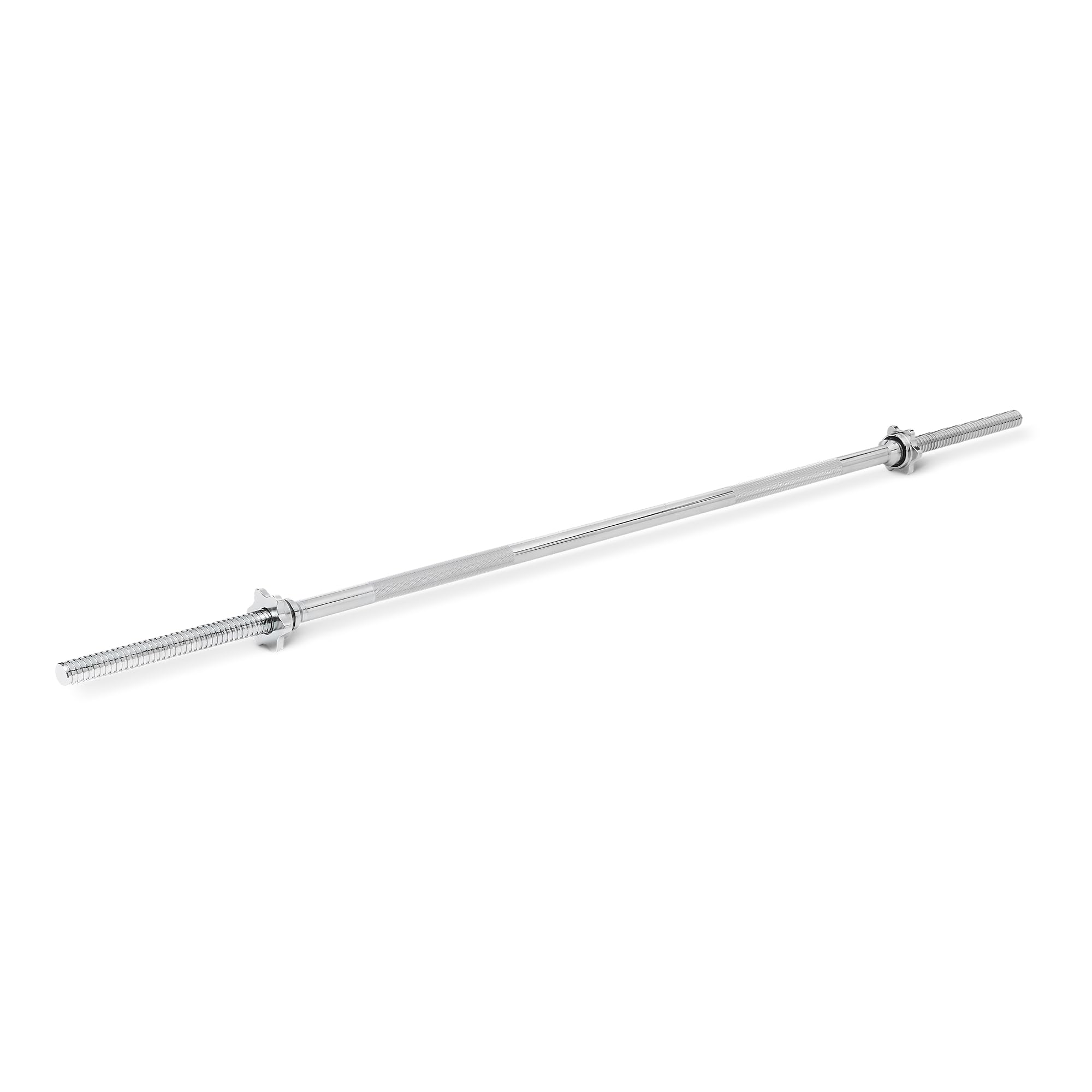
Forty-seven inches overall and 31.5 inches of shaft is the whole story: this bar will not span the hooks on a power rack, so squats and racked bench presses are out. What it does instead is everything you would otherwise need a 7-footer for in a room that cannot hold one — curls, rows, RDLs, hip thrusts, floor press, landmine work. With a 500-pound rating and a 28 mm shaft it is a scaled-down barbell rather than a gadget, and that distinction shows the moment you load it.

The knurling is the part we came back to. It is 1.5 mm diamond with the tops trimmed, which lands in the useful middle: enough bite that a sweaty hand does not slide, not so much that a set of twenty curls becomes an endurance test for your palms. On an accessory bar your hands are on the steel far longer than they are during one heavy lift, and that balance matters more than a depth number suggests.

Sleeve rotation is the pleasant surprise — brass bushings plus bearings give the bar an easy, quiet spin that makes power cleans and high pulls feel less like a wrist workout. Look over the knurling when it arrives; a bar that took a hit in transit can come with a flattened spot, and you will find that spot with your palm before you find it with your eyes.

Bottom Line

The best accessory bar here: 47 inches, 20 pounds, and a 500-pound rating that covers curls, rows, hip thrusts, and landmine work in a space too small for anything longer.

Check Latest Price

Best For Smaller hands

Our Score 9.6/10
RitFit 4-Foot Olympic Barbell

RitFit

RitFit 4-Foot Olympic Barbell

  • Bar Weight 20 lb
  • Overall Length 47.2 in (4 ft)
  • Shaft Diameter 25 mm
  • Weight Capacity 350 lb
Check Price on Amazon

Twenty-five millimeters is thin for a barbell; most Olympic bars run 28. That three-millimeter difference is the reason to choose this RitFit over the LIONSCOOL, and it is not a marketing point — if you have smaller hands, or you have found a standard bar hard to wrap for curls and rows, the thinner shaft changes how secure the grip feels from the first set.

The rest of the bar is competent rather than remarkable: 47.2 inches, 20 pounds, a 350-pound rating, needle bearings that spin quietly, and an oxide finish. RitFit is straightforward that its short bars are built for accessory work rather than the power rack, and that is the right frame — curls, rows, RDLs, hip thrusts, landmine press. It makes a good second bar and a poor only bar.

Two practical notes. The 350-pound rating is the lowest of the Olympic bars here, which costs you nothing on accessory work and everything if you want one bar to cover squats too. And put it on a scale: bar weights in this bracket do not always match the page, and if the number is off, every percentage you calculate is off with it.

Bottom Line

A 4-foot Olympic bar with a 25 mm shaft that suits smaller hands and high-rep accessory work, though its 350-pound ceiling is the lowest here.

Check Latest Price

Best Overall

Our Score 9.4/10
Titan Fitness 60-Inch Olympic Bar

Titan Fitness

Titan Fitness 60-Inch Olympic Bar

  • Bar Weight 25 lb
  • Overall Length 60 in
  • Shaft Diameter 28 mm
  • Weight Capacity 500 lb
Check Price on Amazon

Full 500-pound capacity and the most consistent build quality here at 60 inches.

Tensile strength is the number that separates a short bar you keep from one you outgrow, and this one carries 110,000 PSI alongside a 500-pound rating — the most headroom in this group. What that buys you in a garage is boring and valuable: the bar stays straight as you keep adding plates, and the sleeves turn on bronze bushings instead of grinding through a rep. At 60 inches and 25 pounds it feels like a barbell rather than a scaled-down prop, which is not something every short bar here manages.

The 28 mm shaft is the detail we appreciated most. It is the same diameter as a full-size bar, so your grip does not change when you go back to a commercial gym, and the medium knurling bites for rows and deadlifts without taking skin off during a long set of curls. Add chrome that scuffs rather than flakes and you have the bar in this group most likely to still look like itself after a couple of seasons of use.

The catch is rack geometry, and it deserves a tape measure. Sixty inches of bar leaves far less shaft between the sleeves than a 7-foot bar, and the J-hooks on a full power rack are spaced for the longer bar. Measure the gap between your hooks, and between your bench uprights, before you order. If the number comes up short, this becomes a floor bar for deadlifts, rows, and landmine work, and the Rage 6-footer further down is the one to look at for racked squats.

Bottom Line

The short bar we recommend first: 60 inches, a 500-pound rating, a 28 mm shaft, and the most consistent build quality in this group.

Check Latest Price

Best Value

Our Score 9.2/10
CAP 5-Foot Olympic Barbell

CAP

CAP 5-Foot Olympic Barbell

  • Bar Weight 25 lb
  • Overall Length 60 in
  • Weight Capacity 500 lb
  • Tensile Strength 100,000 PSI
Check Price on Amazon

A 500-pound Olympic bar at a budget price, though the black finish wears fast.

The CAP costs roughly half what our top pick does, and on paper the two are close: 60 inches overall, 25 pounds, a 500-pound rating, a 28 mm shaft, 100,000 PSI steel. If you want a genuine Olympic bar in a small space and the budget is fixed, this is the one to buy, and it handles squats, presses, rows, and deadlifts at the loads most home lifters actually train.

Two differences show up once you are using it. The knurling is the first: CAP's hill-style pattern is milder than the diamond cut on the Titan, comfortable for high-rep sets and less locked-in when you are pulling heavy. The second is the finish. The black E-coat wears at the rack contact points and along the sleeves where plates slide on, and it looks tired well before the steel does. Neither changes how the bar lifts; one of them changes how you feel about it.

Check the sleeves when the box arrives. A bar whose sleeves slide lengthwise on the shaft should go straight back rather than into your rack, and that is a two-minute inspection. The 60-inch rack question applies here exactly as it does to the top pick, so measure your J-hooks first.

Bottom Line

The budget pick: a 25-pound Olympic bar rated to 500 pounds that covers squats, rows, and presses, provided you can live with a finish that wears.

Check Latest Price

Best for Light Technique Work

Our Score 9.2/10
Rage Fitness 6-Foot Training Bar

Rage Fitness

Rage Fitness 6-Foot Training Bar

  • Material Aluminum
  • Bar Weight 15 lb
  • Overall Length 72 in (6 ft)
  • Weight Capacity 300 lb
Check Price on Amazon

The 6-foot bar that still racks, built light for warm-ups and drill work.

Fifteen pounds is the entire argument. An aluminum bar that light lets a beginner learn a squat or a clean without the empty bar already being too much, and it is why bars like this turn up in coaching setups for warm-ups and position drills. At 72 inches with a 49-inch grip area it spans a standard rack and takes 2-inch plates like a full-size bar, so it does the one thing neither 4-foot option here can.

Capacity is where we part ways with the 300-pound rating. A 15-pound aluminum bar is a technique tool, and the sensible reading is to keep it to light and moderate loads and move to steel when the numbers climb. If you are already squatting your bodyweight, this is not the bar you want under you. The 1.5 mm diamond knurl is on the sharp side too — secure in the hands, unforgiving on a painted rack.

Two smaller things we noticed. The light baseline changes your warm-up math, so log the empty bar honestly or your percentages drift. And availability on this one moves around, so check the ship date before you build a program around it. Neither is a dealbreaker for a bar meant to teach positions rather than set records.

Bottom Line

A 15-pound technique bar for warm-ups, drills, and light rack work: the 6-foot length fits most racks, but keep the plates modest.

Check Latest Price

Best For 1-inch plate sets

Our Score 9.2/10
LAVVON 55-Inch Standard Barbell

LAVVON

LAVVON 55-Inch Standard Barbell

  • Bar Weight 12 lb
  • Overall Length 55 in
  • Weight Capacity 480 lb
  • Plate Compatibility 1 in standard
Check Price on Amazon

One-inch sleeves decide this bar's audience before anything else does. If your plates are the inexpensive cast-iron kind with 1-inch holes, a 2-inch Olympic bar is useless without a whole new plate set, and this is the shortest sensible way to use what you already own. At 55 inches and 12 pounds it covers bench, rows, curls, and hip thrusts in a corner of a room, and the 480-pound rating is well beyond what most standard-plate collections will ever total.

The knurling stops short of the weight stops, and that is the detail we noticed first. Load plates tight against the collars and your outer hand ends up on smooth steel; leave a little gap or accept a narrower grip. The diamond pattern itself is decent for the money, and the nickel plating resists rust better than the painted bars at this end of the market.

The collars are the weak point. The spin-lock nuts work, but they are slow between sets, and the threaded ends are where this bar is most likely to work loose. Check them before every set and buy a pair of spring collars if you change plates often — a small expense that removes the annoyance entirely.

Bottom Line

The pick if you already own 1-inch standard plates: a 55-inch, 12-pound bar with plenty of claimed capacity and a price that leaves room for weights.

Check Latest Price

Best For Light standard-plate lifts

Our Score 9.2/10
Amazon Basics 60-Inch Standard Barbell

Amazon Basics

Amazon Basics 60-Inch Standard Barbell

  • Bar Weight 13.4 lb
  • Overall Length 60 in
  • Weight Capacity 250 lb
  • Plate Compatibility 1 in standard
Check Price on Amazon

Two hundred fifty pounds is the number that defines this bar, and it is worth being honest about what that covers. If your training tops out well under it — bench press, rows, curls, and a few sets of deadlifts with plates you already own — the bar does the job. It is 60 inches, 13.4 pounds, with knurled grip zones, a chrome finish, and star locks in the box.

Plain is the appeal. There is nothing to configure, the chrome wipes clean, and for a beginner working in a spare room it is a low-stakes way to start pulling and pressing. The trade is the one every bar at this end makes: cosmetic wear shows up early and the sleeve hardware is basic. A scuffed chrome bar still lifts, so none of that changes the recommendation at this price.

Where it stops is load and ceiling. Anything that needs a rack, or plates past the 250-pound rating, or a later move to Olympic plates, is a different purchase. If there is any real chance you will outgrow it, spend once on a 2-inch bar — the plates are the expensive half of the decision either way.

Bottom Line

A simple 1-inch standard bar for light bench, rows, and curls at home; the 250-pound ceiling is the whole story.

Check Latest Price

Best For Tight floor space

Our Score 9.0/10
LAVVON 57-Inch Olympic Barbell

LAVVON

LAVVON 57-Inch Olympic Barbell

  • Bar Weight 12 lb
  • Overall Length 57 in
  • Weight Capacity 500 lb
  • Plate Compatibility 2 in Olympic
Check Price on Amazon

Fifty-seven inches is an odd number until you are the one measuring a wall. It sits between the 4-foot accessory bars and the 60-inch all-rounders, and it takes 2-inch Olympic plates with a 500-pound rating and needle bearings in the sleeves — hardware usually reserved for bars that cost more.

The listed 12-pound weight is the figure to check yourself. Bars in this bracket frequently come in lighter or heavier than the page claims, and a couple of pounds either way changes your warm-up math and how the bar sits on your back for squats. Weigh it once and write the number at the front of your log.

Nickel plating over steel holds up better than paint, and the diamond knurl is mild enough for high-rep rows and presses, a little under-gripped for a heavy pull at the top of the bar's range. What it does not solve is the rack question: 57 inches leaves even less shaft than the 60-inch bars, so the J-hook measurement matters more here, not less.

Bottom Line

A cheap 57-inch Olympic bar with smooth needle-bearing sleeves: a good second bar for a tight room, provided you weigh it and keep loads sensible.

Check Latest Price

How We Tested the Best Short Barbells

We started with a longer list of more than 40 short bars sold for home gyms, then narrowed it by bar length, sleeve diameter, loadable sleeve length, stated weight capacity, knurling pattern, and price. We weighed each of the 12 finalists ourselves, because shipping weight and product-page weight don't always agree, and measured overall length plus the distance between sleeves so we could tell which bars fit common rack hooks and standard plate collars. Value was part of the cut: a bar had to justify its price against the feel and hardware of the others in the group.

Testing ran for six months in a garage gym and a spare-room workout corner. We squatted, pressed, rowed, and deadlifted with each bar, loading and unloading plates several times per session and noting whether the bar felt balanced, whether the knurl bit through chalk or chewed up bare hands, and whether the finish scuffed at the contact points. We also stored each bar on a rack and on the floor, moved it around a small training space, and checked for sleeve play, loose collars, and flex under load.

Where a maker published a weight capacity, we loaded toward that limit with matched plates and stopped there, watching for bend or sleeve movement rather than exceeding the rating. Grip got a separate pass: bare-handed sets, chalked sets, and high-rep rows to see if the knurling stayed consistent from center to sleeve. By the end, the bars that held up were the ones that felt solid on the first rep and still felt solid after six months of regular use.

How to Choose

Length Is Really a Question About Your Rack

Overall length is the headline, but the shaft between the sleeves decides whether a bar works. The 4-foot LIONSCOOL here lists 31.5 inches of shaft — plenty for curls and rows, useless for racking a squat. A 60-inch bar adds several inches; a 6-foot bar adds about ten more and is the shortest length that reliably spans a full power rack.

Measure the gap between your J-hooks and between your bench uprights before ordering. If the bar cannot sit on the hooks, you have bought a floor bar for deadlifts, rows, and landmine work rather than a squat bar. That is the trap in this category: the letters 'Olympic' tell you what plates fit, not what the bar can rack.

Olympic or Standard: Decide With Your Plates

The sleeves settle this faster than any other specification. Two-inch Olympic sleeves take the plates sold everywhere and most of what turns up secondhand; 1-inch standard sleeves take the cheaper cast-iron sets. If you are starting from nothing, buy Olympic and do not look back — plates, collars, and resale all favor it.

Buy a 1-inch bar only when the plates are already in your garage. Capacity follows the same line: the standard bars in this group are rated from 250 to 480 pounds, while the Olympic bars run from 350 to 500. Mixing the two means buying plates twice.

What a Weight Rating Actually Tells You

A rating is a ceiling, not a description of how a bar behaves. A 15-pound aluminum bar and a 25-pound steel bar can carry similar numbers on paper and feel nothing alike under a squat. What matters is the combination: 500 pounds of capacity on 25 pounds of steel with 100,000 PSI or better is more bar than most home lifters outgrow, while 300 pounds on aluminum is a technique tool with a hard limit.

Buy one step above where you train now. Buying three steps up usually buys weight and price you did not need.

Shaft Diameter and Knurling: Match Your Hands

Twenty-eight millimeters is the standard shaft; 25 mm feels noticeably thinner in the hand, which is a real advantage if you have smaller hands and a drawback if you are used to a thicker bar. Knurling matters just as much. Aggressive diamond knurl holds a heavy pull and takes skin off during a set of twenty curls; mild hill-style knurl is the reverse.

For a bar that will live on rows, curls, and presses, mild knurl is the better trade. Check whether the bar carries a center knurl: it helps a heavy back squat stay put, and many short bars leave it off.

Finish and Sleeve Rotation: What Ages Well

Finishes are not cosmetic on a bar that lives in a garage. E-coat and paint look sharp new and wear at the two places a bar touches anything: the rack contact points and the sleeves where plates slide. Chrome and nickel scuff rather than flake, which is the difference between a bar that ages and one that peels.

Rotation separates the cheap bars too. Brass bushings are durable and quiet, needle bearings spin more freely, and both are fine at home. What you do not want is a sleeve with side-to-side play — check that before the return window closes.

Frequently Asked Questions

Final Verdict

Buy the Titan Fitness 60-inch bar unless price is the deciding factor, in which case the CAP 5-footer does the same job with a finish that shows its age faster. Both are 25-pound Olympic bars with 500-pound ratings, and both need one check before you commit: measure the span between your J-hooks, because 60 inches of bar leaves far less shaft than a 7-footer and that is the difference between a squat bar and a floor bar.

If your room tops out at 47 inches, get the LIONSCOOL 4-foot bar and plan around what it cannot do — it is the best accessory bar here, and it will not rack.