Accessories

Best Running Insoles of 2026

The first time I felt it, I was 14 miles into a long run and my right arch had started up a complaint I couldn't ignore. The shoes had maybe 200 miles on them — not dead, just not what they used to be — and I remember thinking there had to be a cheaper fix than a new pair. A running insole puts back the cushioning and arch support a factory sockliner never really had, and it quiets the aches that show up in your feet and knees late in a run.

Over the past four months, my team and I have run in 14 pairs, from flimsy drugstore slabs to molded inserts that cost nearly as much as the shoes. The thing nobody warns you about is thickness — a plush insole eats volume, so a snug trainer can start pinching across the toes even though nothing about the shoe changed. Insoles also pack down long before your shoes do. If your feet are the thing giving out at mile 10, the picks below should sort it.

Best Overall

Our Score 9.0/10
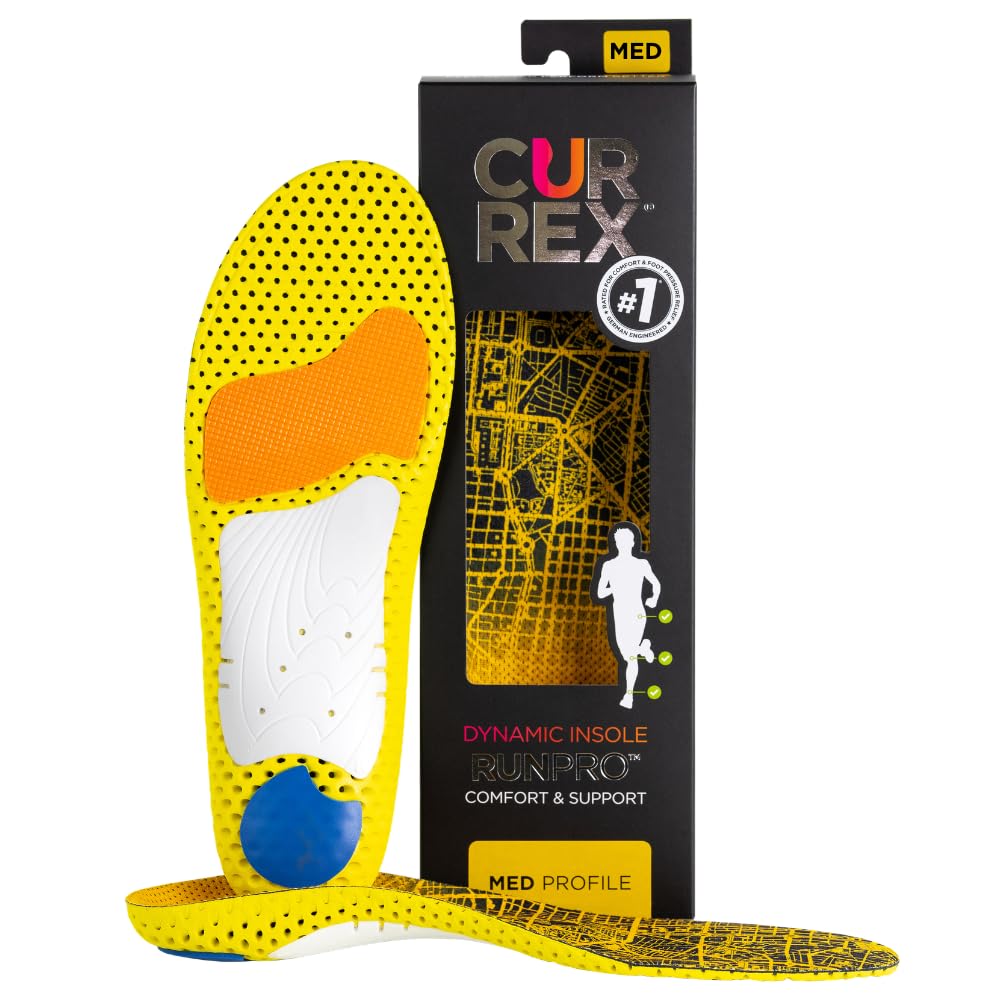
CURREX RunPro Insoles

CURREX

CURREX RunPro Insoles

  • Model RunPro, medium arch, size large
  • Top Layer Breathable mesh
  • Cushioning PORON foam with rebound
  • Arch Profiles Low, medium, and high
Check Price on Amazon

Three arch profiles and the strongest arch support in this set, built for running.

Three arch profiles is what sold us on the RunPro. Every other insole here arrives in a single shape and asks your foot to adapt; this one is ordered in low, medium, or high, so the curve under your midfoot lands where your own arch does. We tested the medium-arch pair in a size large, and that fit is the reason it sits at the top of this list — nothing about the support feels generic.

The build backs the idea up. PORON foam takes the sting out of the heel strike without turning mushy, a deep heel cup keeps your foot centered when you pick up the pace, and the mesh top layer stays reasonably dry. What we watched for was collapse — whether the arch would flatten after a few long runs — and it held its shape better than the softer pairs in this set. Arch support is where the RunPro separates itself most clearly, and it is also sold for both men and women, which makes sizing one less thing to think about.

Ordering takes thirty seconds of thought, but they are the right thirty seconds: the profile is the real decision, and a medium arch in the correct size beats a high arch that digs in. If you have never checked which you are, the wet-foot test in our buying guide settles it in under a minute. After that there is very little to complain about beyond what you pay at checkout.

Bottom Line

For runners who want support shaped to their arch instead of a one-shape pad, the RunPro is the pair we recommend — order the right profile and you get the most support in this set.

Check Latest Price

Best for High Impact

Our Score 8.8/10
Superfeet Women's High Impact

Superfeet

Superfeet Women's High Impact

  • Model Berry Premium-W
  • Sizing Women's
  • Support Firm, high-impact arch
Check Price on Amazon

Firm, structured support for women logging high-impact miles, not a plush pad.

Firm is the word. The Women's High Impact does not try to be a soft insole, and if you have been shopping for something pillow-like, this is not it — the arch is structured, the platform is stiff, and that is exactly why we rate it the best choice here for high-impact running.

What the firmness buys you is control. Under the midfoot the pair settles and stays put, and the shoe stops rolling inward at the end of a long run — the kind of thing you notice the day after a hard session. It is also the pair we point to first when plantar fasciitis or an angry Achilles is part of why someone is shopping: a structured insole that holds the arch up makes more sense for that foot than a soft one that lets it drop.

Break-in is short. The arch feels pronounced for the first run or two, then it stops announcing itself and the insole disappears into the shoe. One thing worth knowing before you order: this is a women's-specific fit, so men should look at a different pair entirely rather than sizing up in this one.

Bottom Line

If you want firm, structured support under high-impact miles and you are not chasing a plush ride, this is the pair we point women toward first.

Check Latest Price

Best Value for Men

Our Score 8.8/10
Sof Sole Athlete Insoles

Sof

Sof Sole Athlete Insoles

  • Sizing Men's
  • Coverage Heel to toe
  • Moisture Moisture control top cover
  • Cushioning PU foam and gel
Check Price on Amazon

Heel-to-toe cushioning and moisture control for men at a mid-range price.

Two things decide whether the Athlete works for you: what you want to spend, and how much room your running shoe has inside. On the first, it is the value play here — a full-length PU foam and gel insole with heel-to-toe cushioning for a fraction of what the premium pairs cost.

On the second, it is a substantial insole. Ours filled out a daily trainer nicely and cushioned a long, easy run without going flat under the heel, and the top cover kept the shoe drier than the stock sockliner did — a small thing that stops being small in July. What it does not do is squeeze into a snug racing shoe; there simply is not the room. Give it a trainer with a removable sockliner, or a work boot, and it behaves.

For everyone else, this is the pair to buy if you want premium-feeling cushioning without the premium price, and the one we are happiest to buy again. It is also the sort of insole that ends up in walking shoes and work boots rather than staying in one pair of runners.

Bottom Line

For men who want heel-to-toe cushioning and a drier shoe without paying premium prices, the Athlete is the value pick in this set.

Check Latest Price

Best Budget Pick

Our Score 8.8/10
Dr. Scholl's Run Active Insoles

Dr.

Dr. Scholl's Run Active Insoles

  • Fit Trim to fit
  • Design 3-zone heel to toe
  • Arch Support Reinforced
  • Odor Control Polygiene StayFresh
Check Price on Amazon

A women's running insole with three-zone cushioning and odor control for very little.

Dr. Scholl's built this one around three zones — heel, arch, forefoot — with a reinforced arch and a Polygiene top cover meant to keep odor down between washes. It is a women's insole, it is trim-to-fit, and it is the least expensive running-specific pair here.

What we noticed in testing is how little it changes the shoe. There is no break-in, no pressure point under the arch, and the heel-to-toe transition stays smooth — the kind of insole you put in and forget about, which is the highest compliment a budget insert can get. It is also the pair we are most likely to buy a second of, so one set of shoes does not have to give up its insole every time we rotate.

Because it is trim-to-fit, cut against the shoe's stock insole rather than eyeballing it, and start slightly wide of the outline — you can take more off the toe, and you cannot put it back. That is a minute's work for an insole that will otherwise disappear into the shoe.

Bottom Line

If you want a women's running insole that disappears into the shoe and costs almost nothing, this is the one we hand people first.

Check Latest Price

Best For Cushioned cross-training

Our Score 8.8/10
Spenco Polysorb Cross Trainer

Spenco

Spenco Polysorb Cross Trainer

  • Arch Soft arch support
  • Heel SpenCore heel pad
  • Forefoot Crash pad
  • Cushioning Polysorb foam
Check Price on Amazon

The heel is where the Polysorb does its work. A SpenCore pad sits under the heel bone, a crash pad runs under the forefoot, and the heel cup is deep enough that your foot sits down inside it rather than on top. For a cross-trainer it is a surprisingly plush piece of kit.

Softness is the point. We appreciated it on treadmill days and on gym floors, and the metatarsal padding earns its keep when the ball of your foot is what aches at the end of a session. It is a comfort insole first, the kind of thing that makes a stiff cross-trainer feel forgiving.

Fitting it is the one place to be deliberate. Between the heel pad and the foam it takes up more room than a stock sockliner, so it wants a shoe with a removable liner and a little depth; a racing flat will feel crowded. Used that way it is a comfortable option for mixed training rather than a replacement for a running-specific support insole.

Bottom Line

For cushioned comfort in the gym and on the treadmill, the Polysorb is the pair we reach for — just give it a shoe with room to spare.

Check Latest Price

Best For Low-cost multi-sport

Our Score 8.8/10
Dr. Scholl's Sport Insoles

Dr.

Dr. Scholl's Sport Insoles

  • Arch Arch support insert
  • Sizing Men's
  • Support Flexible side-to-side
Check Price on Amazon

Cheapest in this set, and it does not pretend otherwise. Dr. Scholl's Sport is a shock-absorbing insert with flexible side-to-side support, sold for men across multiple sports — gym shoes, golf shoes, hiking boots, and the walking you do the rest of the day.

That breadth is the appeal. As a running insole it is basic: the arch is a firm shell rather than a shaped support, and you can feel it under the midfoot when you are pushing the pace. As an insole for everything else — the gym bag, the boots you wear on a muddy trail, the shoes you stand in all day — it is a cheap way to make a disappointing pair of shoes wearable again.

So this is a utility pick rather than a running upgrade. If you log real miles, spend more; if you want one cheap pair to rescue three pairs of shoes, this is the one we grab.

Bottom Line

If you want to rescue a few pairs of everyday shoes for the least money here, the Sport is the sensible buy — it just is not a running upgrade.

Check Latest Price

How We Tested Running Insoles on the Road, the Treadmill, and the Trail

We started with research: spec sheets, arch-height and thickness numbers, materials, and return policies, then narrowed to pairs that would realistically sit inside a standard running shoe without crowding the toes. That cut the list to 14 pairs, weighted toward options sold in multiple arch profiles and sizes rather than one-size-fits-all trims.

Every pair got four months of actual running. Testers logged easy jogs, long runs, and treadmill sessions, took a few pairs out on trail days, and left them in for the standing-around parts of the day. We trimmed each pair to fit per the instructions, then noted whether the shoe felt tight across the instep afterward, whether the heel slipped, and whether the insole crept forward mid-run.

Comfort and cushioning were judged at mile one and again past mile 50 — we wrote down which ones felt dead underfoot after a few weeks and which still had spring. For arch support, we paid attention to how the arch felt late in a long run rather than during a walkaround, and whether the shape was aggressive enough to notice. We kept a log of hot spots, plantar ache, and knee complaints, checked durability by watching for compressed foam and worn top fabric, and weighed all of it against what each pair cost.

How to Choose

Fit the arch before anything else

An insole is only as good as the shape under your midfoot. Too high and it presses; too low and your arch drops onto a flat pad, which is where the ache at mile five comes from. If you have never checked, wet your foot and stand on a piece of paper: a narrow band means a high arch, a wide smear means a low one, and something in between is medium.

That check is what decides which CURREX RunPro profile you order, and it is the reason a single-shape insole is always a small gamble. If your arch is pronounced, pay for the shape; if it is flat, a soft insole will feel better than a structured one.

Choose cushioning or structure

Every pair here sits somewhere between soft foam and a firm platform, and neither end is better — they solve different problems. Soft insoles like the Spenco Polysorb soak up impact and suit treadmill miles, gym floors, and feet that ache from standing. Firm ones like the Superfeet put a structured arch under you and hold it through a long run, which is what you want if your foot rolls or your arch gives out late in a session.

If you run more than a couple of times a week, we lean firm. If you are cross-training or walking more than running, soft is the better spend.

Mind the volume inside your shoe

Thickness is the most common reason an insole ends up in a drawer. A full-length insert with a deep heel cup adds stack height, and a snug racing shoe has nothing to give. Take the stock sockliner out before you fit the new one — most running shoes have a removable one, and the insole is meant to replace it, not sit on top of it.

If your heel starts slipping or your toes feel pinched, the insole is too thick for that shoe. Move it to a roomier trainer rather than forcing it into your race-day pair.

Trim once, carefully

Trim-to-fit insoles are cut to a generic shape, and the result is only as good as your scissors work. Pull the shoe's stock insole out, trace it onto the new one, and cut just outside the line; then test, trim again, and repeat until it drops in without curling at the edges.

Take material off the toe end rather than the heel, because the heel cup needs its full shape to hold your foot. Do one shoe at a time and check the second against the first before you cut it.

Know when to replace them

Insoles die quietly. The foam packs down long before the top cover wears through, and the support goes with it. Press the heel pad with your thumb; if it stays compressed, or the arch no longer feels distinct under your hand, the pair is finished.

Odor control fades as well, which is why a treated top cover like the Polygiene one on the Dr. Scholl's Run Active is worth having in a rotation. Insoles tend to need replacing on roughly the same rhythm as your shoes, so buy them for the pairs you actually run in.

Frequently Asked Questions

Final Verdict

The CURREX RunPro is our pick because it removes the guesswork: three arch profiles mean the support is shaped to your foot rather than averaged across everyone, and it held its shape through testing better than the softer pairs here.

If a firm, structured platform is what your foot wants — and especially if plantar fasciitis is part of the picture — the Superfeet Women's High Impact is the pair we point women toward instead. On a budget, the Dr. Scholl's Run Active covers women's running and the Sof Sole Athlete covers men, and neither asks you to give up much.