Accessories

Best Running Belts of 2026

The worst running belt is the one you notice three miles in—hiking up, bouncing against your hip, or sawing at your waist. A good one should disappear: your phone, keys, and a gel stay put, the fit stays flat under a shirt, and you forget it’s there until you need something. Fit and stability matter more than cramming in extra pockets, and capacity only counts if the belt still feels comfortable when it’s loaded.

I’ve had belts that felt fine for the first mile and then turned into a tug-of-war with my waistband, so I pay attention to the details that show up later. Over five months, we ran with 14 belts, loading each with a phone, keys, and a gel to see how fit, stability, and comfort held up once we were sweaty. The difference between a belt that lasts and one that doesn’t often comes down to stitching, elastic recovery, and whether the zipper works one-handed and stays shut. The picks below are the ones that earned a place on repeat runs.

Best Overall

Our Score 9.2/10
Fitgriff Running Belt

Fitgriff

Fitgriff Running Belt

  • Closure Zipper
  • Strap Length 35 inches
  • Water Resistance Water repellent
  • Reflective Detail Two strips along the zip
Check Price on Amazon

Secure at speed, reflective, and roomy enough for a phone, keys and a gel.

Two pockets, sensibly placed, and that's most of the case for this belt: a zippered main compartment that takes a phone in a case, and a small front pocket sized for a key, a card and a note. Keys stay off the screen, which sounds trivial until you've pulled a phone out with a scratch across it. It's sold in sizes rather than one-size stretch, and that's part of why the band sits flat instead of bunching.

Pace is where it earns the recommendation. The band is wide and the profile thin, so the load sits against the hip rather than swinging out, and we never found ourselves hitching it up mid-run. The two reflector strips run along either side of the zip, which makes this the belt we reach for on dark mornings; only some of the belts here bother with reflectivity at all. Water repellent, not waterproof — a steady downpour will eventually work through the fabric, so bag the phone if the forecast is grim.

Weight is the quiet pleasure here: at 85 grams it's lighter than the phone it's carrying, and you stop noticing it before the end of the block. The FlipBelt is softer against bare skin and the SPIbelt swallows a bigger handset, but neither includes reflectors, and that's the detail that keeps this one by the door.

Bottom Line

The belt we point almost everyone to: secure at pace, reflective, and roomy enough for a phone and keys without a second thought.

Check Latest Price

Best For Light carry

Our Score 9.2/10
U·LANARO Slim Running Belt

U·LANARO

U·LANARO Slim Running Belt

  • Weight 2.4 oz
  • Pockets 1 zippered
  • Waist Range 27 to 46 inches
  • Water Resistance Water resistant
Check Price on Amazon

For very little money you get a single zippered pocket, a stretch band covering 27 to 46 inches, reflective strips on the front and a TPU layer behind the fabric so sweat doesn't wick straight onto the phone. That's most of what a running belt needs to be.

We recommend it to people who aren't yet sure they want to run with a belt. The stretch hugs the body, the phone stays quiet against the hip, and the whole thing disappears under a T-shirt; there's no learning curve and nothing to adjust mid-run. It's the belt we hand a friend training for a first 5K.

Durability is the open question. The zip and the buckle clip are the parts that show age first on a belt worn every day, and nothing has come apart on us yet, but this is a belt to think of as replaceable rather than lifelong.

Bottom Line

A cheap, stretchy belt that hugs the body quietly — the low-risk way to find out whether you like running with one.

Check Latest Price

Best Buckle-Free

Our Score 9.0/10
FlipBelt Classic

FlipBelt

FlipBelt Classic

  • Care Machine wash
  • Closure No buckle, pull-on
  • Pocket Openings 4
  • Water Resistance Not water resistant
Check Price on Amazon

No buckle, no chafe: a flat pull-on band you forget you're wearing.

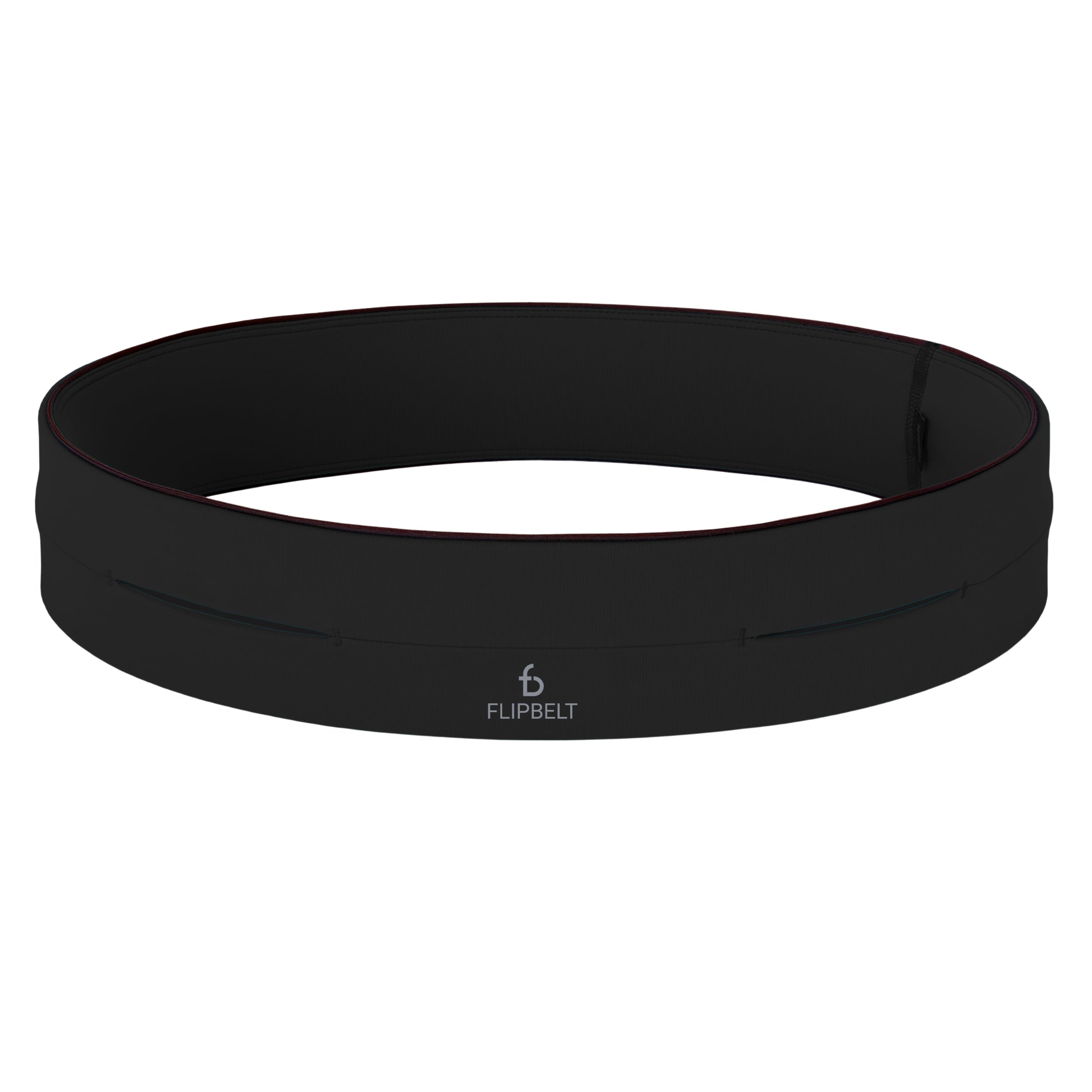
There's no buckle, no adjuster and no zip: it's a tube of stretch fabric you pull on over your hips, with four slotted openings and an internal key hook. That sounds primitive next to the zippered belts here, and it's exactly why the FlipBelt is the most comfortable thing in this guide to wear for two hours. Under a shirt it reads as nothing at all.

We keep it for long, easy runs and for thin summer clothing, because the band doesn't chafe and the openings let you slide the phone around to the small of your back once it starts to feel heavy. With no buckle, though, there's nothing to tighten if it begins to climb: on a body where the hips are noticeably wider than the waist it can creep upward, and wearing it higher — on the waist rather than the hips — is what settles it.

The fabric is moisture-wicking and goes in the washing machine, which is rarer here than it should be, but it isn't water resistant: an hour of hard sweating leaves the phone damp, and a small zip bag is the simple answer. For everything else — chafe, bulk, getting it on and off in a hurry — it's the nicest belt here to live with.

Bottom Line

The comfort pick: no buckle, no chafe, and it disappears under a shirt, worth the premium for long, easy miles.

Check Latest Price

Best for Large Phones

Our Score 9.0/10
SPIbelt Original

SPIbelt

SPIbelt Original

  • Weight 1.6 oz
  • Closure Zipper
  • Pouch Size Expands to 9 x 4 x 2 inches
  • Waist Range 25 to 47 inches
Check Price on Amazon

An expanding pouch that swallows a cased handset on the lightest band here.

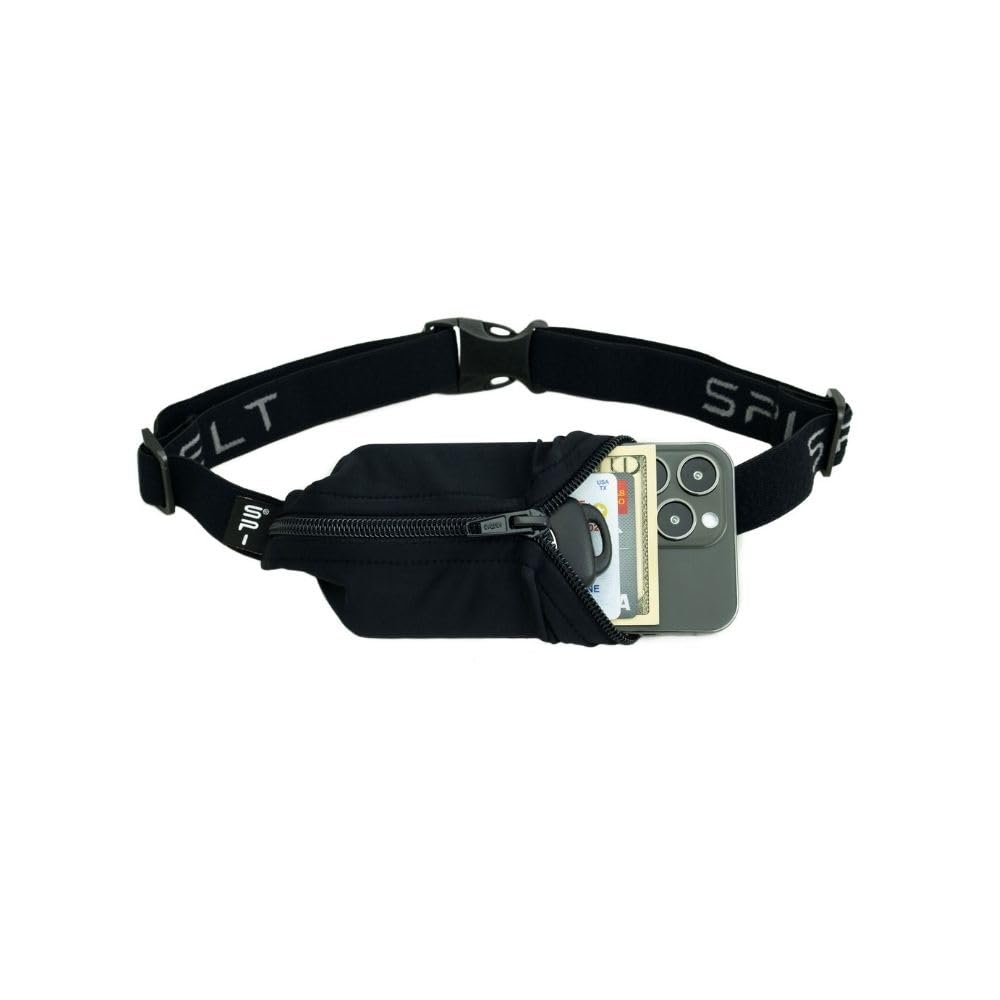
A single expandable pouch on a one-inch elastic band, and at 1.6 ounces it's the lightest belt in this guide. The pouch pulls out to roughly nine by four by two inches — enough for a passport, or a phone plus a couple of gels — and collapses flat against the hip when all you're carrying is a key.

The buckle is why some people choose it over the pull-on styles. You can clip it on over shorts without stepping through anything, loosen it at a stoplight and take it off one-handed. It rides high and flat, and because the pouch expands rather than being a fixed sleeve, a large phone doesn't press a corner into your hip the way a tight stretch pocket can.

What holds us back from putting it first is the fabric: the pouch is thin, and the zip is the part that would show age first on a belt worn every day. Neither stops us taking it when the phone is big and the shorts have useless pockets.

Bottom Line

Our pick for big phones and bad pockets: an expanding pouch that swallows a cased handset, on the lightest band here.

Check Latest Price

Best Budget

Our Score 9.0/10
Molarun Slim Running Belt

Molarun

Molarun Slim Running Belt

  • Weight 3 oz
  • Pockets 3
  • Waist Range 24 to 46 inches
  • Water Resistance Water resistant
Check Price on Amazon

Three pockets and reflective trim for the least money in this group.

The cheapest belt in this guide, and it doesn't read that way on the waist: a stretch spandex band, three pockets, a reflective strip across the front and an earphone hole. It weighs three ounces, about the same as the Fitgriff.

The layout is the appeal. A main compartment takes a phone — a big one in a thin case fits without a fight — and the two side slots handle a key, a card and a note, so nothing shares space with the screen. The water-resistant fabric shrugs off sweat and drizzle.

Where the money shows is in the structure: the band is thinner than the Fitgriff's and can ride up on a longer run, though a tug downward settles it for the next stretch. It's also a belt that wants to sit snug — worn loose, the load starts to swing.

For a first belt, a walking commute or a spare that lives in a gym bag, this is the one we point to. It does what the expensive ones do — phone secure, key separate, reflectors on the front — for the least money in this group, and being cheap enough to buy a second one for the car is its own argument.

Bottom Line

The best value here: three pockets, reflective trim and a stretch band that does the job on shorter runs and commutes.

Check Latest Price

Best for Extra Gear

Our Score 8.8/10
WATERFLY Running Belt

WATERFLY

WATERFLY Running Belt

  • Weight 3.35 oz
  • Pockets 3
  • Waist Range 27 to 48 inches
  • Water Resistance Water resistant
Check Price on Amazon

Three pockets keep a phone, keys and gels apart without a bouncing load.

Three separate compartments and a proper buckle: this is the belt for the runner whose pockets are already full. The main pocket takes a phone in a case, and the two smaller ones let keys, cards and gels travel separately instead of grinding against the screen — more organization than most of the belts here offer.

The shell is a technical spandex that wicks and dries quickly, and there's a headphone port at the top corner for anyone still running wired. It's one of the heavier belts here at 3.35 ounces — a difference you notice in the hand and not on the hip — and the wide band spreads a full load better than the slim ones do.

The extras cost a little bulk. Three pockets of fabric sit further off the body than the SPIbelt's single pouch, and a full belt is a visible lump under a thin shirt. Past an hour, or on any run where you're carrying food, that's a trade we make happily — the alternative is a gel in your hand for the last few miles.

Bottom Line

For long runs with gels: three compartments keep keys, cards and food apart, and the wide band carries the weight comfortably.

Check Latest Price

Best For Quick access

Our Score 8.8/10
CrosFace Waist Pack

CrosFace

CrosFace Waist Pack

  • Care Machine wash
  • Weight 2.12 oz
  • Pockets 3
Check Price on Amazon

The main pocket has no zip: the phone slides under an overlapping flap and the fabric closes over it, with two smaller side slots for a key and a card. There's no hardware on the front at all, which makes this the quickest belt here to get a phone into with cold hands.

That also means nothing to break. Zips are the component that fails first on a belt, which is the whole argument for a design without one, and here you also get a belt that goes in the washing machine — rarer in this group than it should be. It weighs 60 grams.

We reach for it on short, fast runs and for errands where the phone needs to come out at a traffic light, and it's the one we suggest to anyone who has already lost a belt to a zip. It costs about what the WATERFLY does and less than the SPIbelt, and there's simply less of it to go wrong.

Bottom Line

For anyone who has killed a belt with a broken zip: nothing to break, the fastest access here, and machine washable.

Check Latest Price

Best For Smaller frames

Our Score 8.8/10
USHAKE Slim Running Belt

USHAKE

USHAKE Slim Running Belt

  • Pockets 3 zippered
  • Waist Range 24 to 42 inches
  • Water Resistance Water resistant
Check Price on Amazon

Three zipped pockets on one elastic band, a stated fit of 24 to 42 inches and no second size. Inside that range the band is soft, the pockets sit flat, and there's a reflective strip across the front plus an ear-bud hole at the top.

The layout is the reason to consider it: a main pocket for a phone in a case, plus two side zips for a key, a card and a note. It's one of the few belts here with a zip on every pocket, and the nylon-lycra shell is water resistant rather than merely repellent.

In use it's quiet and unremarkable, which is what you want: the elastic holds its shape, the phone doesn't shift when you pick up the pace, and the zips stay where you left them. The reflective strip is a modest one — a stripe across the front rather than strips on both sides.

Our reservation is the range. Past the top of those 42 inches there's nothing to loosen into, so bigger runners should look at the WATERFLY or a larger Fitgriff. Within the range, this is a well-organized belt for shorter runs.

Bottom Line

A tidy, well-zipped belt for smaller frames — three pockets, water-resistant fabric and a snug hold at speed.

Check Latest Price

How We Tested the Best Running Belts

We started by narrowing a long list of running belts by pouch size, strap style, and price, then ruled out designs that couldn’t hold a current phone or felt overbuilt for shorter runs. We ended up with 14 belts and wore them for five months.

Testing happened on easy neighborhood loops, treadmill intervals, longer weekend runs, and a few gym sessions, with each belt loaded with a phone, keys, a card, and a gel. We adjusted every belt over both leggings and shorts, then checked whether it sat flat, rode up, bounced, or needed tugging mid-run. To judge capacity, we packed the pockets until the belt bulged or the phone pressed against us, and we practiced pulling items out while walking. Comfort came down to whether seams rubbed, straps dug in, or the fabric turned clammy after an hour.

After each run we rinsed and air-dried the belts, then looked at stitching, buckles, and elastic recovery; a belt that curled or frayed moved down our list. We also opened and closed every zipper one-handed, watched for snags, and checked whether pulls stayed put with a phone inside. The belts that made the cut kept their shape and stayed quiet on repeat runs.

How to Choose

Start with the waist, not the features

Belts solve fit two ways. A pull-on band like the FlipBelt depends on you ordering the right size, while a buckle belt like the SPIbelt adjusts across 25 to 47 inches and can be tightened mid-run. Sized bands tend to sit flatter; adjustable ones forgive a bad guess.

Measure at the height you'll actually wear the belt, because high on the waist and low on the hips are different numbers. If you're between sizes on a pull-on style, take the larger one.

Bounce is a positioning problem

Most of the movement people blame on a belt comes from a loose band or weight sitting out from the body. A phone flat against the small of your back or the front of a hip barely registers; the same phone pushed out by a stuffed pocket swings with every stride.

Before you head out, jump twice and bend to touch your knees. If the phone swings, tighten the band or move the load around the back. If the belt rides up, wear it lower on the hips.

Pockets: phone first, then keys, then gels

Give your keys their own home. A key sharing a compartment with a phone is how screens get scratched, and an internal hook or a second pocket fixes it for good.

After that it's a question of volume. One phone-and-keys compartment covers most runs; gels or a soft flask want a wider pocket, which is where the WATERFLY's three compartments or the SPIbelt's expanding pouch earn their keep.

Closures fail before fabric does

The zip is what ends a belt's useful life, and it tends to go at the worst possible moment. Look for a zip that runs over the phone rather than beside it, so the pull isn't pressing into the screen, and treat a paper-thin zip on a very cheap belt as a wear item.

A zip-free design like the CrosFace removes the failure point entirely, at the cost of a pocket you can't lock shut.

Sweat, rain and being seen

Water resistant means sweat and drizzle, not a downpour. If you run in real rain, put the phone in a small zip bag inside the belt and stop worrying about the fabric.

Reflectivity is worth having, and about half the belts here carry some, but it supplements lights and bright clothing on an unlit road rather than replacing them.

Frequently Asked Questions

Final Verdict

When the question is simply which running belt to buy, the Fitgriff is the answer: two well-placed pockets, reflective strips most belts here skip, water-repellent fabric, and a band that stays where you put it.

Spend more only for a specific reason. The FlipBelt earns its premium if chafe and bulk bother you more than anything else, and the SPIbelt is the one for a phone in a bulky case. If you're buying a first belt just to find out whether you like running with one, the Molarun does the job for the least money here.