Accessories

Best Running Headlamps of 2026

The first time I ran a dark trail before sunrise, I held my phone in one hand and squinted at roots with the other — which is how I learned that a headlamp is less about seeing than about running normally. A good one throws light where your eyes already are, stays put when you glance down at your watch, and holds its brightness for the whole loop instead of fading two miles in. What it fixes is simple: both hands, a normal stride, and no surprises underfoot.

Lumens get all the attention, but that number tells you almost nothing about beam shape — a tight spot that lights up a sign a quarter mile away can leave the root at your feet invisible. We've spent five months running in 14 headlamps, from bare-bones to rechargeable with more modes than I'd ever use, and the keepers got the basics right: comfortable against a bare forehead for an hour, adjustable one-handed mid-run, and bright on the setting you'll actually run in rather than the one you'd demo. The picks below earned a place in my running bag, and I've noted which suits which kind of runner.

Best Overall

Our Score 9.4/10
Klarus HM1

Klarus

Klarus HM1

  • Weight 2.47 oz
  • Runtime 70 hours low
  • Max Output 440 lumens
  • Water Resistance IPX6
Check Price on Amazon

A light, weather-sealed 440-lumen runner with long runtime and hands-free control.

A 440-lumen headlamp with a light body and an IPX6 rating is the balance we want for night running, and the Klarus HM1 gets all three right. The beam is strong enough to read a rooty path, the body is light enough that the band does not need to be cranked down, and the sealing makes heavy rain a non-event. The 440 lumens are consistent rather than a brief turbo burst, and the 60-degree tilt lets us aim the light from our feet to the trail ahead without moving our whole head.

The controls are unusually considered for a running light. The HM1 defaults to medium, which is where we spent most of our miles, and a long press shuts it off without cycling through every mode. The motion sensor is genuinely useful at a gate, a map check, or when you need light now and your hands are full. Klarus also includes a spare headband and quotes a 2.5-hour charge; both are the kind of practical extras that keep a lamp in service instead of in a drawer.

The runtime figures need context: 70 hours is the low-mode claim, and the medium setting we used is closer to an eight-hour light. That is still enough for a week of evening runs or a long night out, but it is why the HM1 rewards a charging routine. For technical routes, doubtful weather, or runs that finish after dark, it is the one we reach for.

Bottom Line

The HM1 is our top pick for road and trail runners because it combines a 440-lumen beam, IPX6 sealing, and a light build with long low-mode runtime and hands-free control.

Check Latest Price

Best Budget

Our Score 9.4/10
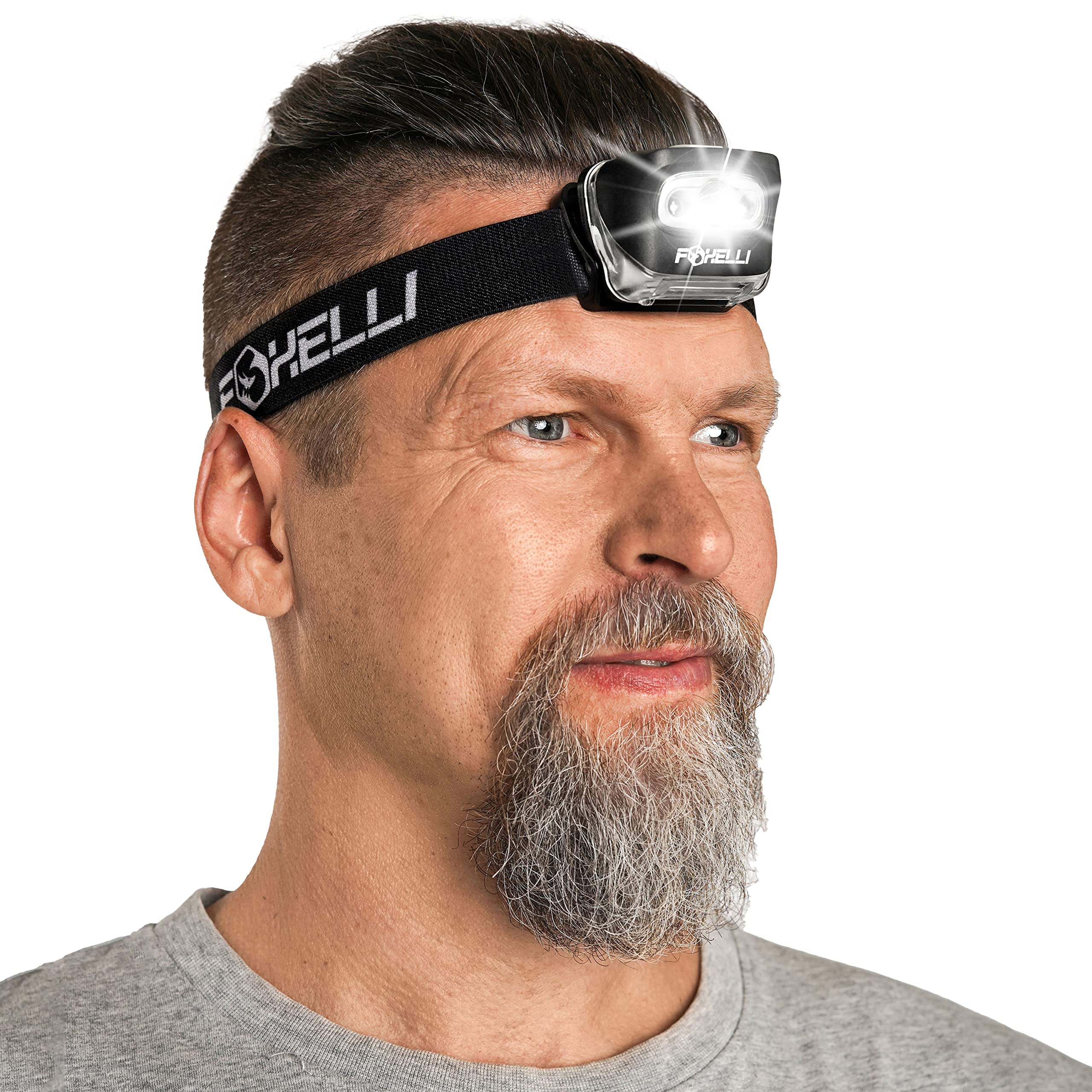
Foxelli MX20

Foxelli

Foxelli MX20

  • Weight 3.2 oz with batteries
  • Runtime 45 hours
  • Max Output 165 lumens
  • Water Resistance IPX5
Check Price on Amazon

A budget AAA headlamp that stays light and comes ready to run.

The Foxelli MX20 arrives with three AAA batteries, which tells you most of what it is: a simple, light, battery-powered lamp you can put on and forget. It weighs 3.2 ounces with those cells, throws a 165-lumen beam rated to 165 feet, and tilts through 45 degrees. On a familiar road loop or a pre-dawn sidewalk run, that is enough light to see the pavement, the curb, and the dog ahead. It is not a lamp for picking apart a technical descent at speed.

What sells it is the balance of weight, price, and fuss. At 3.2 ounces, the band sits close without needing to be cinched; the single glove-friendly button cycles five modes, and the red light is there for camp or a dark doorway. We liked that the batteries are included, because a budget lamp that needs a separate shopping trip is not much of a bargain. The 45-hour runtime is a low-mode figure; treat high mode as the setting that asks for spare cells.

The MX20 is the lamp we leave in the running bag for everyday dark miles. It is inexpensive enough to own as a second light, and the AAA power means a spare set in the pack gets you home. The trade-off is beam quality: 165 lumens is modest for fast trail running, and the beam does not reach as far as the 440-lumen Klarus. If your runs are mostly road, that is a fair exchange for the lower weight and simpler power.

Bottom Line

The MX20 is our budget pick for road runners who want a light, fuss-free lamp with batteries in the box and a beam that handles familiar paths.

Check Latest Price

Best Battery-Powered

Our Score 9.4/10
Energizer PRO-360

Energizer

Energizer PRO-360

  • Weight 3.52 oz
  • Runtime 50 hours
  • Max Output 360 lumens
  • Water Resistance IPX4
Check Price on Amazon

Bright AAA power and dimming for runners who skip charging cables.

The PRO-360 opens with a feature that is easy to miss on a spec sheet: the light ramps up gradually instead of hitting full brightness the instant you press the button. Energizer calls it VisionGuard, and it is the sort of detail that makes a headlamp friendlier at 5 a.m. The rest of the package is straightforward: 360 lumens, an 85-meter beam, seven modes including red and green, and dimming from 10 to 100 percent. It runs on three AAAs and weighs 3.52 ounces.

We liked the dimming more than the mode count. Instead of stepping through a sequence to find a comfortable level, you can tune the output to the path, which matters when you move from open road into tree cover. The red and green settings are for camp, map checks, and preserving night vision, not for running; the white beam is the one that does the work. The included batteries and a simple battery door make it an easy lamp to live with.

The catch is that 50-hour runtime is a low-mode figure. High output will drain AAA cells faster, so a long night means carrying spares. For a road runner who wants a bright, simple lamp and does not mind feeding it batteries, those are acceptable trade-offs. This is the one we hand to someone who wants a headlamp that works without a charging ritual.

Bottom Line

The PRO-360 is our pick for runners who want a bright, battery-powered lamp they can feed with AAAs, with dimming that makes it easy to live with.

Check Latest Price

Best Value Rechargeable

Our Score 9.0/10
Lepro Rechargeable Headlamp

Lepro

Lepro Rechargeable Headlamp

  • Weight 2.86 oz
  • Runtime 30 hours
  • Max Output 300 lumens
  • Water Resistance IPX4
Check Price on Amazon

A budget rechargeable that tops up by USB-C and runs light.

There is a particular convenience in a headlamp you can top up from the same battery bank as your phone, and the Lepro rechargeable makes that its main appeal. It weighs 2.86 ounces, puts out up to 300 lumens, and reaches a claimed 500 feet. The 45-degree tilt and the sweat-proof band are the right ingredients for running; the red mode is a useful extra for camp and dark doorways. For the money, it is the rechargeable we recommend first.

The USB-C charging is the part we appreciated most. A cable in the car or a power bank on the kitchen counter is enough to keep it ready, and there are no AAA cells to buy. Three white brightness levels cover a dark sidewalk, a bike path, and the bright setting you want when a car is coming. The single-button control is easy to find by feel, even with a light glove.

The runtime rating is the compromise. Thirty hours is a low-mode figure, and a long night on high will use it up much sooner. For the short evening runs and early mornings most of us do, that is a fair trade. The 45-degree tilt also has enough range to move the beam from your feet to the horizon, which is more useful on rolling paths than a fixed head.

Bottom Line

The Lepro rechargeable is the easiest budget lamp to live with: USB-C charging, a 2.86-ounce body, and enough light for dark sidewalks and paths.

Check Latest Price

Best For Backup and travel

Our Score 9.0/10
Lepro Battery Headlamp 2-Pack

Lepro

Lepro Battery Headlamp 2-Pack

  • Weight 1.94 oz
  • Runtime 22 hours
  • Max Output 200 lumens
  • Water Resistance IPX4
Check Price on Amazon

At 1.94 ounces, the Lepro 320015-2 is the lightest lamp in this group, and that is the reason to pay attention. It is a two-pack of AAA-powered headlamps with a 200-lumen beam, six modes, a 45-degree tilt, and an IPX4 rating. The lamp sits on a thin elastic band and almost disappears on your head, which is exactly what you want when the goal is to see the pavement without feeling every step in your forehead.

We kept one in the running bag and one in the car, and the second lamp is the real advantage. A 200-lumen beam is enough for a familiar road loop, a hotel corridor, or an early walk before the streetlights come on; it is not the beam for a fast technical descent. The 22-hour runtime is on low, so plan on shorter high-mode stretches. What we liked most is the lack of fuss: three AAAs, one button, and a band that does not need constant adjustment.

The lamp is a spare rather than a primary trail light. If you want one headlamp to do everything, spend more for the Klarus or the Lepro rechargeable. If you want a barely-there backup and a second light for the car, this pair is easy to justify.

Bottom Line

The Lepro 320015-2 is the ultralight two-pack we recommend for a running bag and a car kit, with a modest beam that suits familiar roads.

Check Latest Price

Best For Wide trail visibility

Our Score 8.8/10
BIAT Wide-Beam Headlamp

BIAT

BIAT Wide-Beam Headlamp

  • Power Rechargeable
  • Beam Angle 230 degrees
  • Max Output 350 lumens
  • Water Resistance IPX4
Check Price on Amazon

The BIAT LX200 is the odd one out in this group because its beam is 230 degrees wide. Instead of a hot spot at the end of the trail, it lays a broad wash of light across the path, the shoulder, and whatever is moving at the edge of your vision. That is a real advantage on a twisty greenway or a dark street with driveways. The lamp uses a soft silicone band, has a motion sensor, and comes as a two-pack.

We liked the wide beam more than we expected. On a path with roots and curbs, seeing the edges matters as much as seeing far ahead, and the LX200 makes that easy without turning your head. The motion sensor is handy when your hands are full, though it is more of a convenience than a reason to buy. The silicone band sits softly and does not dig in, and the 350-lumen output is bright enough for a suburban run.

The catch is efficiency. A 230-degree wash at 350 lumens asks more of the built-in battery than a focused spot. For a short evening run, that is fine; for an all-night relay, choose the Klarus. The two-pack also means you can keep one charged while the other is in use. We keep the BIAT for the runs where seeing the edges matters more than seeing the far end of the trail.

Bottom Line

The BIAT LX200 is our wide-beam pick for runners who want to see the edges of a path, with a motion sensor and a two-pack that makes charging easier.

Check Latest Price

How We Tested the Best Running Headlamps

I started by pulling every running-specific headlamp I could find and reading the spec sheets for claimed brightness, weight, battery type, water rating, and whether the strap tightens at the back or only at the sides. I cut anything that would only take a proprietary charging cable, anything heavy enough to feel like a hat, and anything whose lowest setting was still too bright to glance at a map with. That left 14 headlamps, which I ran with for five months.

Testing happened where headlamps actually live: a 5:30 a.m. road loop with no streetlights, after-work trail runs that finished in full dark, one overnight relay where I wore a different lamp on each leg, and a few treadmill sessions with the lights off to see how much glare bounced off the console. I weighed each one on a kitchen scale instead of trusting the listed number, then wore it over a bare forehead, a thin beanie, and a cap to find where the strap dug in.

For brightness, I ran each lamp on its highest setting until output visibly dropped and timed it, and I judged the beam by whether I could see roots and rocks at my feet, not by the claimed figure. Comfort got rechecked at mile six, when straps that felt fine at the start began to slip or press. Durability meant rain, a hose spray, a waist-high drop onto pavement, and a few weeks of riding home in a vest pocket next to keys. Finally, I weighed what each lamp cost against what it gave me: a lock mode so it doesn't switch on in a pack, a spare battery or a standard cable, a buckle I could work with gloves on.

How to Choose

Start With Weight and Fit

A headlamp that feels fine in the package can feel like a brick at mile five. We look for a lamp that sits close to the forehead and a band that stays put without being cranked tight; a tighter band can cause pressure points. The lightest picks here, the Lepro 320015-2 and the Klarus HM1, are easier to forget than the 3.5-ounce Energizer. Before you commit, wear the lamp for 20 minutes indoors, look down, and shake your head. If it slides, the fit is wrong for running.

Match the Beam to Your Route

Lumens tell you how much light a lamp can make, not how useful the shape is. A focused spot is better for speed and distance; a wide beam is better for peripheral awareness on streets and twisting paths. The BIAT's 230-degree beam is the widest here, while the Klarus and Foxelli are more traditional spots. For familiar roads, 165 to 200 lumens can be enough. For technical trails, look for 350 lumens or more and a beam that reaches beyond your feet. A bright hotspot with no spill is hard to run behind.

Choose a Power Source You Will Actually Manage

AAA and rechargeable lamps ask different habits. AAA models such as the Foxelli and Energizer are easy to revive with a spare set, which is useful on cold nights and long outings; the trade-off is buying cells and carrying them. Rechargeable models such as the Lepro and Klarus are lighter to run with and cheaper to feed, but a built-in battery cannot be swapped mid-run. Runtime ratings usually describe the lowest mode, so check the mode you will use. If your longest run is under two hours, a rechargeable lamp is the simpler choice.

Check Sealing and Controls

Rain and sweat are different problems. An IPX4 lamp handles splashes and ordinary rain; an IPX6 lamp such as the Klarus is the better choice for heavy, sustained rain. Whichever you choose, let the lamp and its charging port dry before you plug it in. Controls matter just as much in the dark: you should be able to find the button with a glove on and turn the lamp off without cycling through every mode. A motion sensor is handy at a gate or a map check, but it is not a substitute for a button you can operate by feel.

Treat Reliability as a Feature

Most headlamps are bright on day one; the difference shows up in the switch, battery door, and charging port. We prefer a lamp with a simple control and a sealed battery compartment, and we test the button before trusting a new light on a dark trail. A two-pack is useful because you can carry a spare, but check both units before a trip. If a lamp flickers or shuts off when you move, return it rather than taping over the problem.

Frequently Asked Questions

Final Verdict

For most runners, the Klarus HM1 is the one we point to: 440 lumens, IPX6 sealing, a light build, and long low-mode runtime make it the most complete running lamp here. If you want to avoid charging entirely, the Energizer PRO-360 is the better fit, and the Foxelli MX20 is the budget choice for road runners. Start with the HM1 unless AAA power is a requirement.