Cardio Machines

Best Recumbent Exercise Bikes of 2026

A recumbent bike is the rare piece of home cardio gear you can climb onto without a plan: no balance to find, no wrists taking the load, just a wide seat and pedals out front. That's the promise. What arrives instead, more often than it should, is a machine that shudders when you raise the resistance, a seat that's comfortable for ten minutes and not thirty, and a console whose numbers don't match the effort. None of that is about the feature list; it comes down to how solidly the bike is built and how well it fits you.

Fit is where the difference between a bike you ride and a bike you drape laundry over lives, which is why my team and I spent six months on eight of them. The ones that won us over were quiet enough for a 6 a.m. ride, went together with the tools in the box, and still felt worth the money in month four. The single number worth checking before you buy is the shortest seat-to-pedal setting — a bike that's an inch too long will nag your knees all season. The ones below got that right.

Best for Small Spaces

Our Score 9.6/10
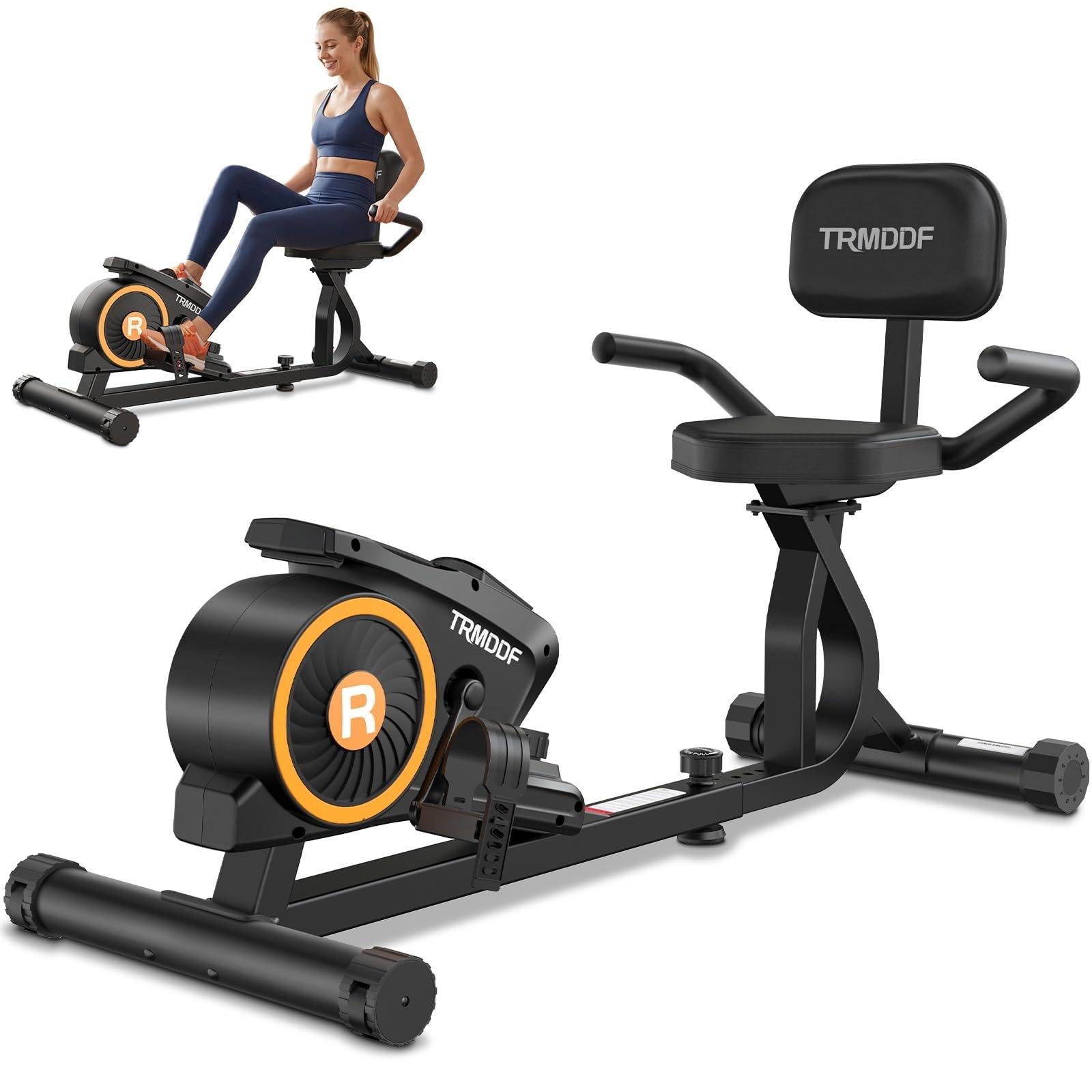
TRMDDF W356 Recumbent Bike

TRMDDF

TRMDDF W356 Recumbent Bike

  • Footprint 47.1"D x 20.4"W x 31"H
  • Item Weight 35 lb
  • Weight Capacity 400 lb
  • Resistance Levels 16
Check Price on Amazon

Light enough to roll into a closet, and nearly assembled out of the box.

Thirty-five pounds is the number that sells this bike. It's the lightest recumbent here by a wide margin, narrow enough to tuck beside a dresser, and the one we point to when a bike has to live in a closet between rides rather than claim permanent floor space.

You give up the extras for that. The console is a plain LCD with time, speed, distance, calories, and pulse, and there's no Bluetooth or app pairing to be found. What you keep is the part that matters: 16 magnetic resistance levels, pedal straps, and a 400-pound rating. That rating on a 35-pound frame is worth confirming in writing with the seller if you ride anywhere near the top of it.

The bike arrives 90% assembled and the listed setup time is 20 minutes, most of which is unwrapping. For a first bike, a guest-room bike, or an apartment where floor space is borrowed rather than owned, that combination is hard to argue with. Just don't expect the seat to feel like a lounge chair — it's a padded saddle, and an hour is a long session on it. Heavier frames also feel more planted under a hard effort, so if you plan to grind big resistance daily, pay for the weight.

Bottom Line

Buy this one if the bike has to disappear between sessions — it's the lightest here, ships nearly assembled, and still gives you 16 magnetic levels.

Check Latest Price

Best for Upper-Body Work

Our Score 9.6/10
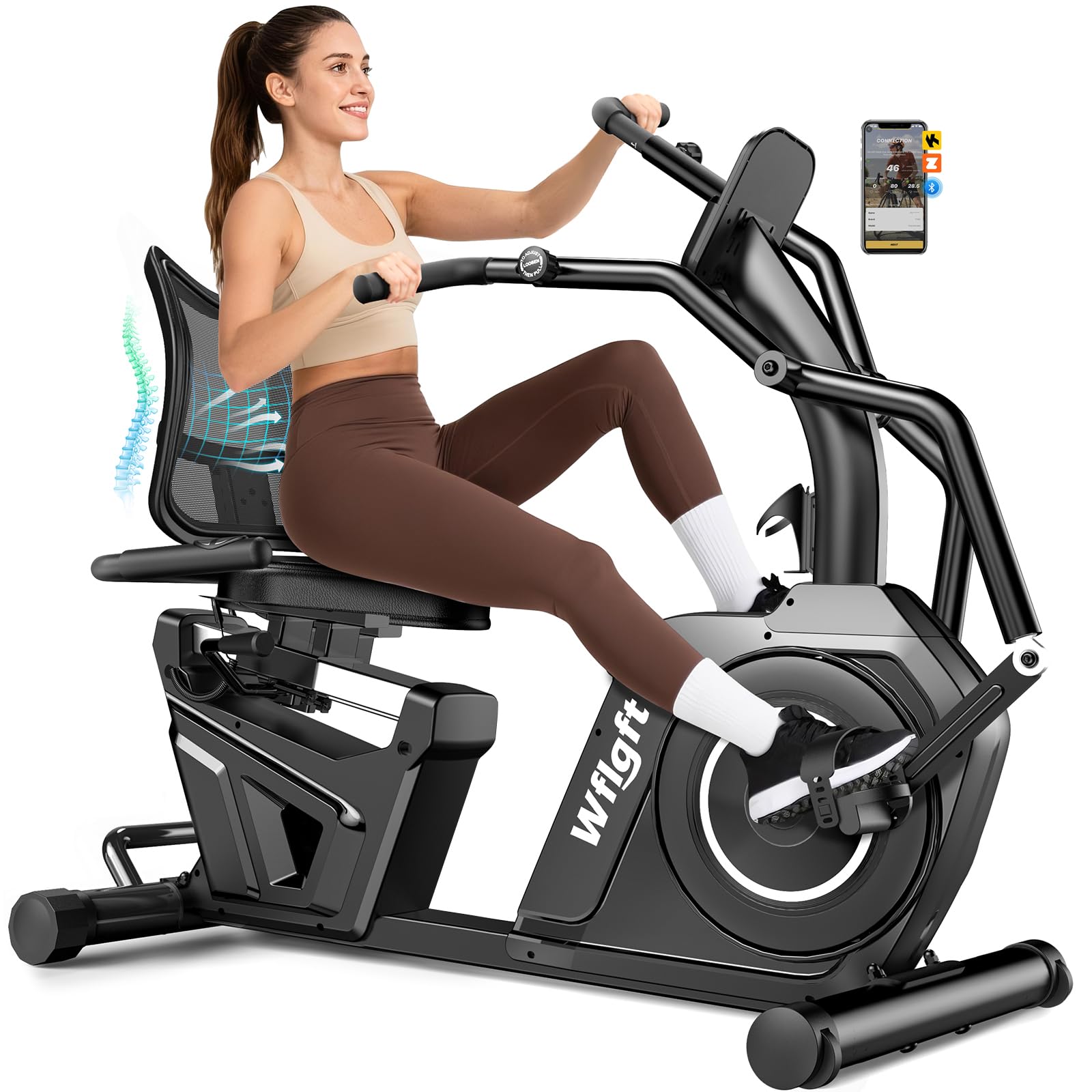
WFLGFT W80601 Recumbent Bike

WFLGFT

WFLGFT W80601 Recumbent Bike

  • Item Weight 87 lb
  • Arm Exerciser Included
  • Weight Capacity 450 lb
  • Resistance Levels 16
Check Price on Amazon

The highest weight rating here, plus arm handles that move with your legs.

Handles that move with the pedals are the reason to look at this one. The arm exerciser works in sync with the legs, so a 20-minute session hits your upper body without a second machine, and the frame underneath carries a 450-pound rating — the highest capacity in this guide.

We like it for anyone rehabbing a shoulder alongside a knee, or for a household where one rider wants more than legs out of a workout. Sixteen magnetic levels give you room to progress, the belt drive keeps it quiet enough for a shared room, and at 87 pounds the frame is the most planted thing here short of the premium pick. Give it side clearance for the arm handles; this is a wider machine than a plain recumbent.

That weight is also the catch. It doesn't fold and it doesn't tuck, and getting it up a flight of stairs is a two-person job, so once it's in place, plan on leaving it there. Assembly runs about an hour with the included tools, and the console pairs with a phone app when you want your numbers logged.

Bottom Line

Choose it when you want arms and legs in one session, or when the household runs heavy — 450 pounds is the highest rating in this guide.

Check Latest Price

Best Premium

Our Score 9.4/10
3G Cardio Elite RB

3G

3G Cardio Elite RB

  • Warranty Lifetime frame, 7-year parts
  • Item Weight 115 lb
  • Seat Positions 25 fore/aft, 5 tilt
  • Weight Capacity 350 lb
Check Price on Amazon

Commercial-grade frame, 25 fore-and-aft seat positions, and a lifetime frame warranty.

This is the most expensive bike in the guide by a wide margin, and the only one built to gym standards. Whether that is worth it comes down to one question: are you buying a bike for a year, or for a decade?

The seat answers a lot of that. It moves through 25 forward-and-back positions and tilts through five, the mesh backrest flexes instead of pushing you forward, and the listed fit range runs from five feet to 6'5" — the widest here. For a tall rider, or a household of two very differently built people, that adjustability is the entire argument.

The frame is 115 pounds of commercial-grade steel, and it rolls through a standard doorway on its own wheels, which is unusual for something this heavy. FreeSync Bluetooth connects to third-party fitness apps, a chest strap comes in the box, and the warranty runs a lifetime on the frame with seven years on parts.

We recommend it for the rider who has already worn out one budget bike and doesn't want to do it twice. The seat is what you're really paying for: 25 fore-and-aft positions plus tilt mean a long-torsoed rider and a short-legged one can both find their setup on the same machine. If that price is out of reach, the VANSWE gets most households most of the way there.

Bottom Line

We recommend it for the rider who is done replacing budget bikes: a 25-position seat, a gym-grade frame, and lifetime coverage on that frame.

Check Latest Price

Best Value

Our Score 9.2/10
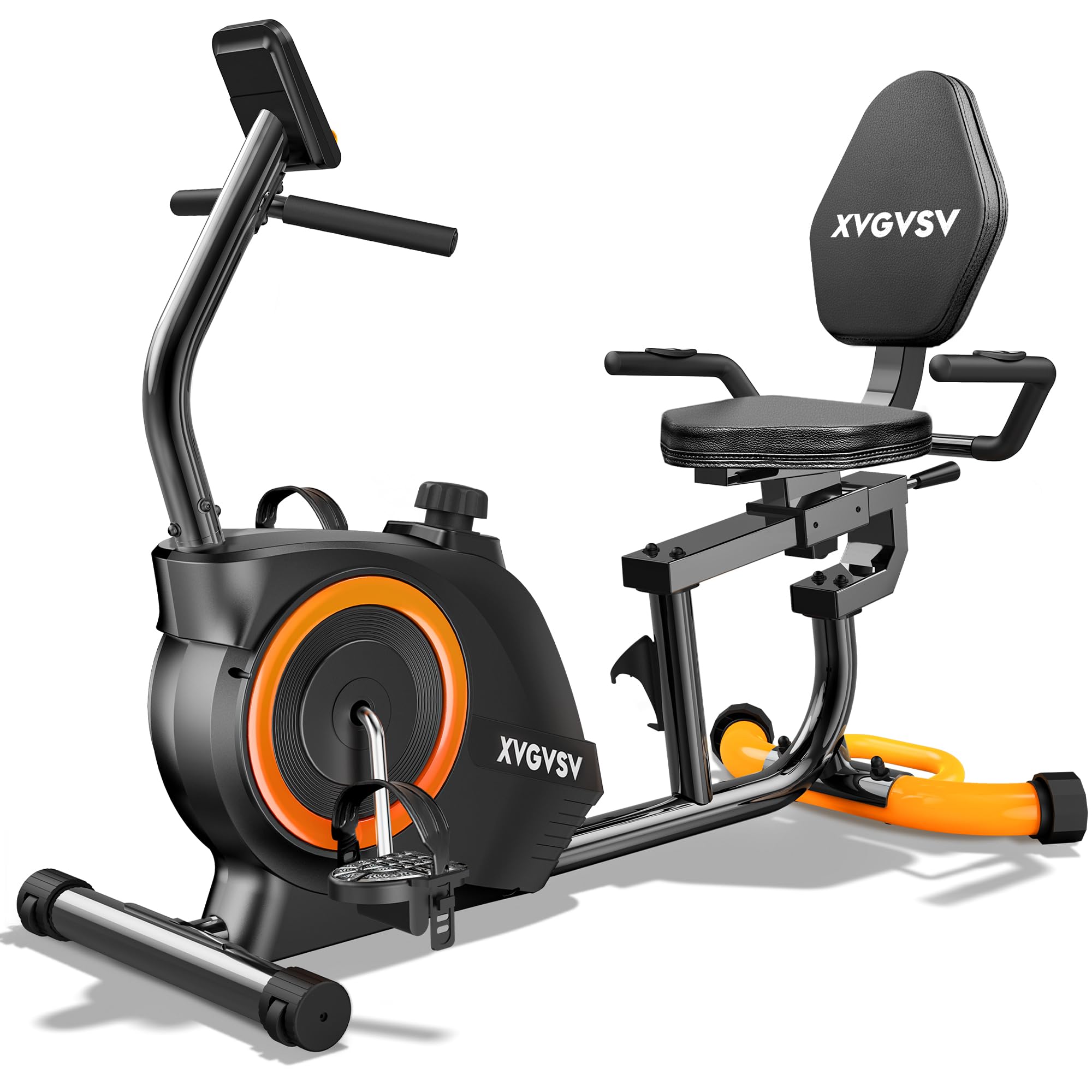
XVGVSV W239 Recumbent Bike

XVGVSV

XVGVSV W239 Recumbent Bike

  • Item Weight 66 lb
  • Pre-Assembled 85%
  • Weight Capacity 400 lb
  • Resistance Levels 16
Check Price on Amazon

A 400-pound frame and 16 levels for less money than most bikes here.

A 400-pound user rating is the second-highest in this guide, and this bike does it for less money than most of the group. The frame is commercial-grade steel at 66 pounds — the kind of heft that keeps a recumbent from rocking when you push the pace.

We rate it the value pick for reasons that have nothing to do with the sticker. Sixteen resistance levels, a belt-driven magnetic unit, and a seat that adjusts on a lever rather than a pull-pin are the things that keep a cheaper bike usable after the novelty wears off. Set it against our top pick and the trade is simple: the VANSWE adds the sliding rail and a backlit screen, while this one gives you more capacity for less.

Setup is the least painful here. The bike arrives 85% assembled, the remaining work bolts on with the included tools, and the listed time is half an hour — realistic if you lay the hardware out by step first. Front transport wheels make it a one-person move from room to room. The saddle is firm rather than plush, which is fine for twenty minutes and less fine at an hour; a gel cover is the cheap fix.

Bottom Line

We rate it the value pick: 400 pounds of capacity, 16 quiet levels, and a lever-adjusted seat for less money than most bikes in this guide.

Check Latest Price

Best Overall

Our Score 9.0/10
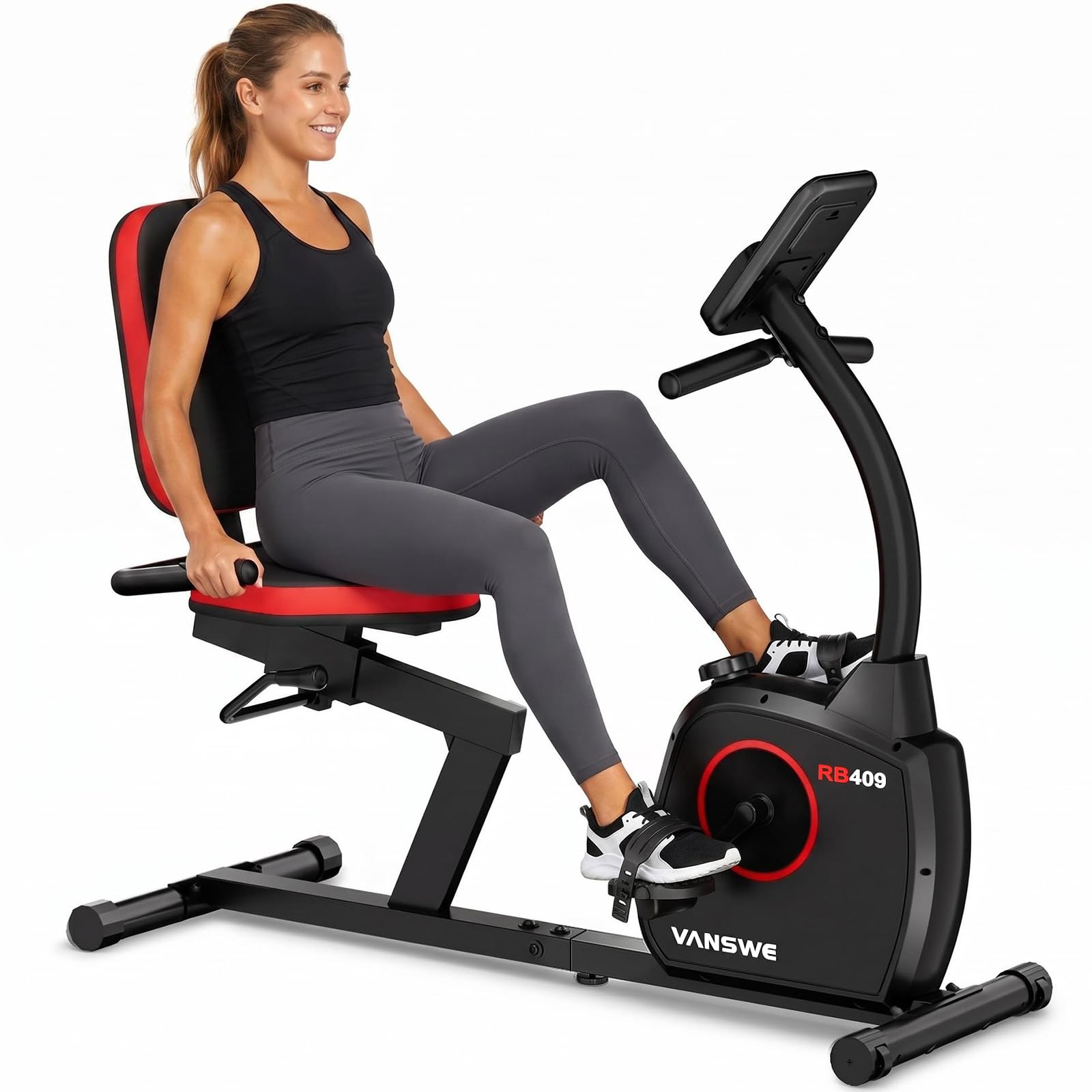
VANSWE RB2518 Recumbent Bike

VANSWE

VANSWE RB2518 Recumbent Bike

  • Seat Fit 5'1" to 6'1"
  • Item Weight 53 lb
  • Weight Capacity 380 lb
  • Resistance Levels 16
Check Price on Amazon

A sliding seat that fits most households, 16 quiet magnetic levels, and a backlit console.

A sliding seat rail, rather than a post with fixed holes, is the detail that makes this our top pick. VANSWE lists the fit range as 5'1" to 6'1", and the rail moves in fine increments, so two people of different heights can share one bike without claiming a hole as their own. Add a 380-pound capacity, 16 magnetic resistance levels, and a backlit console, and you have the bike we point most people toward.

The resistance unit is magnetic and belt-driven, which is the quiet combination — the loudest thing in the room is usually whatever you're watching. Sixteen levels is more than most riders ever use, but the spacing is even enough that there's a setting between too easy and my knee disagrees. The console covers time, speed, distance, calories, and pulse, and it pairs over Bluetooth with apps like Kinomap and Zwift if you want company on a longer ride.

At 53 pounds it's light for a recumbent, and the front transport wheels mean one person can push it back against the wall after a session. Setup is the usual hour with an Allen key: the bike arrives mostly built, so you're attaching stabilizers, console, and the seat rail. The seat clamp is the one part that wants a firm hand — push it home until it clicks instead of snugging it, or the seat creeps back mid-ride.

Bottom Line

For most homes this is the recumbent we point to: the sliding seat spans 5'1" to 6'1", the 16 magnetic levels run quiet, and the backlit console is a real upgrade at this level.

Check Latest Price

Best with a Free Trainer App

Our Score 9.0/10
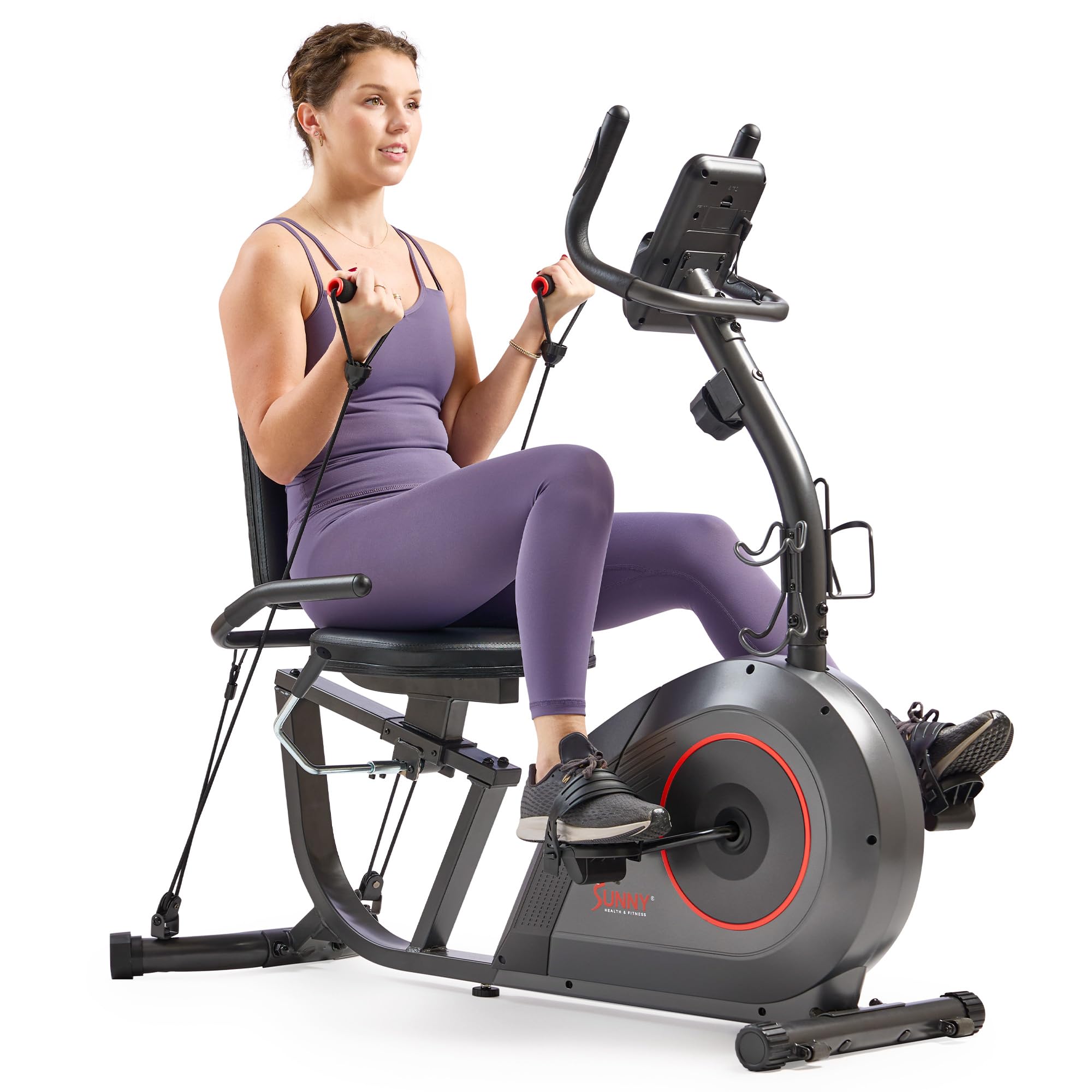
Sunny Health & Fitness SF-RB424006

Sunny

Sunny Health & Fitness SF-RB424006

  • Item Weight 63.9 lb
  • Inseam Range 27.2 to 35.8 in
  • Weight Capacity 300 lb
  • Resistance Levels 16
Check Price on Amazon

Guided workouts with no membership fee, plus flip-away handles for easy mounting.

A side handle that flips out of the way is a small thing until you're the one swinging a leg over a recumbent with a sore hip. Sunny puts one on the frame, and with the low step-through it makes this the easiest bike here to get on and off.

The seat and backrest are wide and cushioned, the resistance runs 16 magnetic levels on a belt drive, and the pedals sit forward enough that your knees stay low through the stroke. SunnyFit is free and needs no membership, which is what separates this from a plain bike: trainer-led sessions and virtual routes give a 20-minute ride some shape. Two 20-pound resistance bands hang off the frame if you want arm work in the same sitting.

We like it for someone who wants company while they pedal and doesn't want another subscription to get it. The bands are a genuine bonus rather than a gimmick, and the flip-away handles matter when two people of different mobility share one bike. The trade is money: this costs more than our top pick while doing less on paper, and the free trainer library is what you're paying for.

Assembly is straightforward and the frame is stable once it's built; at 29 kg it moves when you want it to and stays put when you don't. Give it a little clearance on the handle side, since the flip handles need room to swing.

Bottom Line

We like it for riders who want a trainer talking them through the session without a subscription, and the flip-away handles make mounting genuinely easy.

Check Latest Price

Best For Compact spaces

Our Score 9.0/10
MERACH S08 Recumbent Bike

MERACH

MERACH S08 Recumbent Bike

  • Item Weight 57 lb
  • Connectivity Bluetooth app
  • Weight Capacity 300 lb
  • Resistance Levels 8
Check Price on Amazon

Under 52 inches long and 25 wide, this is the bike for the corner of a bedroom. MERACH builds a 14-by-10-inch saddle with a padded backrest, and the whole thing weighs 57 pounds, so it moves without a second pair of hands.

Eight magnetic levels is half what most bikes here offer, and for gentle cardio that is plenty; the gaps between settings are what you notice when you want a hard session. The resistance is smooth and quiet enough for a shared wall, the console tracks the basics, and it pairs with MERACH's free app over Bluetooth. Put a mat under the stabilizers — on polished hardwood this bike can creep while you pedal.

Where it lands depends on your height. At 5'8" the seat sits near the back of its travel, and taller riders run out of room, so measure your inseam before you commit. For a shorter rider in a small apartment, we think the footprint and the price make it the sensible buy, and 300 pounds of capacity covers most households.

Bottom Line

For a shorter rider in a small apartment, this is the sensible buy — compact, quiet, and app-connected, with a seat that slides on a rail.

Check Latest Price

Best For App-guided workouts

Our Score 8.4/10
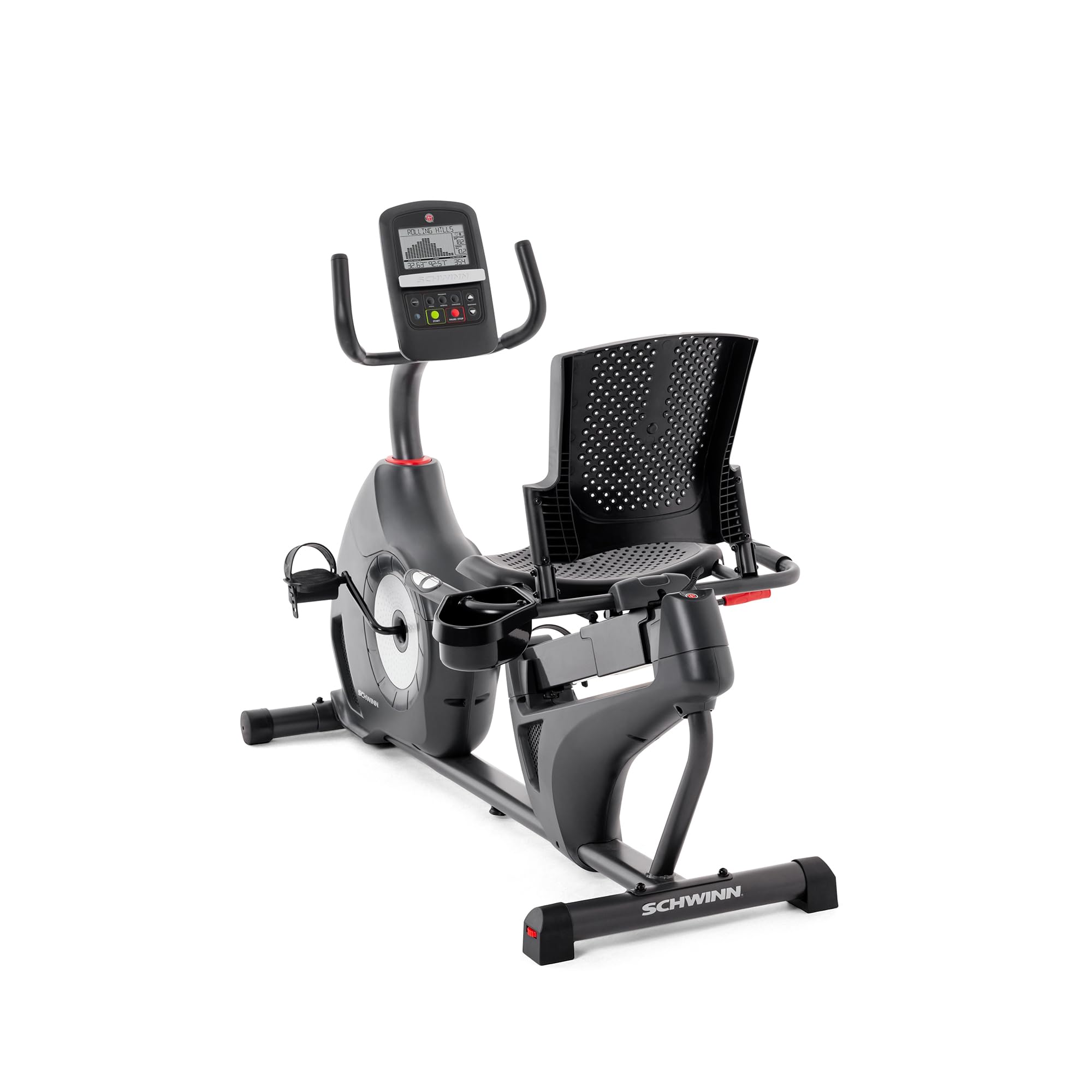
Schwinn 230 Recumbent Bike

Schwinn

Schwinn 230 Recumbent Bike

  • Programs 13
  • Warranty 10-year frame, 2-year parts
  • Weight Capacity 300 lb
  • Resistance Levels 16
Check Price on Amazon

Ten years on the frame, two on parts, one on electronics — this is the most complete coverage in the guide short of the premium bike's lifetime frame, and it is a large part of why the 230 stays on the list.

It is also the connected one. Bluetooth pairs with Schwinn's apps and with Zwift, there are 13 built-in programs if you prefer not to fuss with a phone, and the 16 magnetic levels are changed from the console rather than a knob between your knees — a real improvement in the middle of an interval.

The seat is flat and firm rather than padded and contoured, which suits riders who want support over cushioning and less so anyone hoping for a lounge chair; a gel cover is a cheap experiment. At 80 pounds and 64 inches long, it also takes the most floor space here, so measure the wall before you commit.

We recommend it to the rider who wants structured, app-guided workouts and frame coverage from a company that will still be answering the phone in five years. If you ride in a bright room and like a console that keeps score without a subscription, it is the last bike standing.

Bottom Line

Our pick for app-connected workouts and the most complete warranty here short of the premium bike's lifetime frame.

Check Latest Price

How We Tested the Best Recumbent Exercise Bikes

We started by gathering every recumbent bike from brands that actually service what they sell, then cut the list on the things you can check before buying: seat-to-pedal range, weight limit, warranty, and whether the console needs a subscription to be useful. From roughly thirty candidates we bought eight and built them ourselves, stopwatch running, instructions open. Assembly ran from twenty minutes to most of an afternoon, and that spread told us plenty about the quality of everything that followed.

Each bike then lived where a bike actually lives — a spare room, a finished basement, the corner of a living room — for six months. I rode every one first thing in the morning and again after work, in twenty-minute spins and forty-five-minute sessions, and two riders of different heights used each bike so we could catch seats that only fit one inseam.

Noise we measured the low-tech way: a decibel app on a stool three feet away, plus a podcast at normal volume to see whether we had to turn it up. We rocked the handlebars mid-ride to check for sway and listened for frame creaks under hard resistance. Comfort got judged at the thirty-minute mark and again at forty-five, since a padded seat can fool you for half an hour. We also compared the display's distance and calorie readings against a chest strap and a measured route.

Value came last, on purpose. After six months we asked whether each bike was still worth what it cost and whether the warranty covered the parts that actually wear. The ones still plugged in are the ones below.

How to Choose

Start With the Height Range

Listed height and inseam ranges are the fastest filter. The VANSWE's sliding rail covers 5'1" to 6'1" in small increments, the 3G Cardio reaches 6'5", and the MERACH S08 runs out of travel well short of that. Treat the ends of a range as real limits rather than suggestions: manufacturers quote the extremes, and the last inch of travel is where a seat post starts to flex.

A notched post with fixed holes is fine for one rider. A sliding rail, or an infinite one, is what makes a shared bike actually shareable — without it, two people of different heights spend the first minute of every ride hunting for their hole. Check the step-through height as well; a flip-away side handle, like the one on the Sunny bike, is easier on a hip than a fixed bar.

Seat and Backrest Comfort

Padding density matters more than thickness. A wide, soft saddle feels wonderful for ten minutes and turns into a pressure point at forty; a firmer seat with a contoured shape usually holds up better over a full session. A gel cover is the cheapest experiment in this category, and worth trying before you decide a bike is wrong for you.

The backrest is the other half of the equation. Fixed backs suit short, upright sessions; a backrest that tilts and flexes, as the 3G's does, lets you lean further back as your hips loosen and keeps air moving behind you. On any bike, set the back so your shoulders rest against it rather than so you're stretching to reach the handles.

Resistance Type and the Console

Magnetic resistance on a belt drive is the standard here, and it is why these bikes are quiet enough for an apartment. The number of levels is less telling than how they are spaced: 16 levels where the first five feel the same are really 11 levels and a long warm-up. Budget bikes tend to bunch the easy end, so if you plan to progress, look for a bike where the low settings already feel distinct.

How you change resistance matters more than you expect. A knob between your knees is a reach in the middle of an interval, while console buttons, as on the Schwinn, are a finger tap. A backlit or LED display earns its keep if you ride in a dim room or early in the morning — several bikes here do without.

Frame Weight, Capacity, and Floor Space

User weight capacity and bike weight are two different numbers, and shoppers routinely mix them up. A 400-pound rating does not mean the machine weighs 400 pounds: the TRMDDF carries that rating on a 35-pound frame, while the 3G weighs 115 pounds and is rated to 350. Heavy frames feel planted when you push hard; light ones are easier to live with in a small room.

Measure front to back, not just across. These bikes run from roughly 45 to 64 inches deep, and the longest one here needs a genuine wall rather than a gap. If the bike is going on hardwood, a mat under the stabilizers stops it walking; if it is going on carpet, re-check the leveling feet after the first week.

Assembly, Warranty, and Who Fixes It

Pre-assembly percentages are a rough guide rather than a promise. Somewhere between 85 and 95 percent usually means stabilizers, console, and seat — call it 30 to 60 minutes with the included tools if you lay the hardware out by step first. Clear an evening the first time and keep the manual; the cable connections are the part people redo.

Warranty is where the tiers separate. The Schwinn covers its frame for ten years and its electronics for one; the 3G runs a lifetime on the frame and seven years on parts. On cheaper bikes the practical question is whether a replacement part arrives at all, so buy from a seller who answers messages before you order, not after.

Frequently Asked Questions

Final Verdict

The VANSWE RB2518 is the bike we recommend to most people. The sliding seat covers a mixed-height household, 16 magnetic levels run quiet, and the backlit console is the sort of detail budget bikes usually skip. Spend more only for a specific reason.

The 3G Cardio Elite RB is that reason if you want a gym-grade seat and a lifetime frame. The TRMDDF makes the opposite case: when the bike has to disappear into a closet between rides, 35 pounds beats every feature on this page.