Strength & Weights

Best Power Racks of 2026

The first time I dumped a failed squat onto the safeties in my garage, I stood there breathing. That's the promise of a power rack: train heavy alone, no spotter, and still bench, press, and pull in the same square of floor. The wrong one announces itself — it walks across the concrete when you rack a heavy bar, eats a weekend and two people to assemble, or measures wider than the corner you cleared. My team and I spent eight months assembling and training on six racks, from two-post stands to four-post cages; the keepers were planted, buildable, and sized to the room.

The spec sheet pushes you toward thicker steel and a bigger weight rating, but bracing and footprint matter more — a well-braced two-post rack can feel steadier than a flexy four-post cage. The safeties and pull-up bar are what you touch every session, so judge those before the paint. Value isn't the sticker: a rack that includes j-hooks, safeties, and a usable bar often beats a cheaper frame you have to outfit yourself. The six below held up.

Best Overall

Our Score 9.4/10
Sunny SF-XF9925 Power Zone Rack

Sunny

Sunny SF-XF9925 Power Zone Rack

  • Frame 14-gauge steel
  • Included Reversible pull-up bar, plate storage, 6 band pegs
  • Footprint 50.4"D x 65.1"W x 82.9"H
  • Combined Capacity 2130 lb
Check Price on Amazon

Widest cage here, with 14-gauge steel, plate storage and band pegs on the frame.

Sunny rates the Power Zone at 2,130 pounds, and the first thing to understand about that number is what it counts. It is a combined figure across the whole rack, bar catches, safety arms and storage pegs together, rather than a single bar-catch limit. Read it as headroom spread around the frame instead of a promise that a fully loaded bar can be dropped onto the catches from the top.

What earns it the top spot here is the interior. At 65.1 inches wide and 50.4 inches deep it is the roomiest cage in this guide, and the difference shows up when you are setting a bench up inside it and still have room to load plates without barking a knuckle on an upright. The 82.9-inch height clears an eight-foot ceiling with about a foot to spare. If you are tall, measure your overhead reach against that before you commit, because a pull-up with straight legs needs the clearance.

The frame is 14-gauge steel at roughly 133 pounds, which feels planted on a controlled squat and light enough that a hard re-rack can set it rocking side to side. Loading the plate pegs settles it, and bolting the feet down settles it completely. We ran through the numbered uprights and the J-hook range first, because numbering is either useful in practice or a marketing line, and here it is the former: matching left and right hook heights without counting holes is the difference between a two-minute change and a five-minute one between sets.

You also get a reversible pull-up bar and six band pegs without buying anything extra, and the warranty runs a year on the frame with six months on everything else. The catch is floor space. Sixty-five inches across is a real wall commitment, and it is the main reason to look at the smaller Sunny rack in this guide instead.

Bottom Line

For most home gyms we point to the Power Zone: the roomiest interior here, 14-gauge steel, and the pull-up bar and plate storage already on the frame.

Check Latest Price

Best for Small Rooms

Our Score 9.4/10
Sunny SF-XF9931 Full Size Rack

Sunny

Sunny SF-XF9931 Full Size Rack

  • Warranty 1 year frame, 180 days parts
  • Footprint 38 x 53 x 87 inches
  • Adjustment 18-point J-hooks, 8-position pull-up bar
  • Rack Weight 83 lb
Check Price on Amazon

Smallest full-size footprint here, light enough to shift and quick to build.

At 83 pounds, this Sunny ships lighter than any other full-size rack in this guide, and that is the whole point: 38 inches of depth and 53 inches of width will sit in a bedroom, a spare room or the end of a garage without swallowing the floor. If your constraint is space rather than budget, this is the one.

It is still a stand-inside frame. The J-hooks adjust across 18 positions, safety lock spotter arms sit where you set them under the bar, and an eight-position angled pull-up bar spans the top. Check the 87-inch height first: it clears an eight-foot ceiling, but only by nine inches, and the pull-up bar sits right up there.

Alloy steel, a one-year structural warranty, and the basics done without drama: squats, bench, overhead press, rack pulls. There is no plate storage and no band pegs, so plates live on the floor or on a tree, and at 83 pounds the whole frame can be shifted across a room by one person when you need the floor back.

Bottom Line

The rack we point at for a bedroom or narrow garage: small, light and quick to build, as long as you buy it for the attachments it ships with.

Check Latest Price

Best with Cable Work

Our Score 9.2/10
Ultra Fuego UF-896 Power Cage

Ultra

Ultra Fuego UF-896 Power Cage

  • Included Pulley system, landmine, dip handles, safety bars
  • Uprights 50mm x 50mm, 1.5mm steel
  • Footprint 63"D x 47"W x 82.7"H
  • Max Capacity 1000 lb
Check Price on Amazon

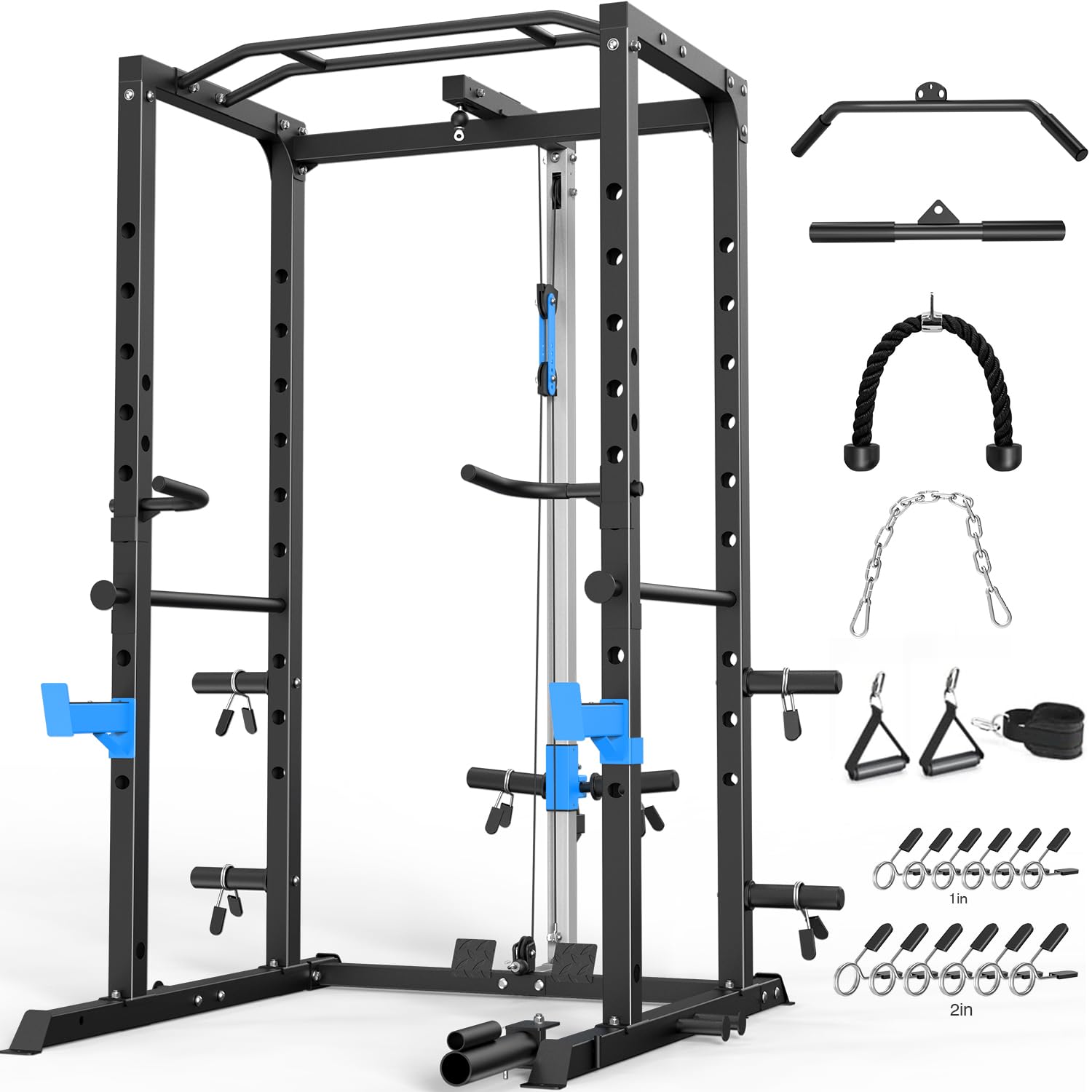
Cable pulley, landmine and dip handles turn one cage into most of a gym.

Most cages at this level hand you a frame and a pull-up bar. The UF-896 adds a lat pulldown with a tricep rope, ankle strap and T-bar, plus a landmine, dip handles, J-hooks and a set of safety bars, so one order covers cable work, pressing and rows without a second machine on the floor.

The cable runs on the outside of the uprights, which is the right call: you squat inside the cage with the pulley frame beside you instead of in your way. The trade is proportion. At 63 inches front to back this is the deepest rack in the guide, and 47 inches across makes it the narrowest, so it wants a long wall rather than a wide one. Measure the width against your bench grip, because a very wide grip will feel those uprights.

Where it lands for us is value: you are paying about what a bare cage costs and getting most of a cable station with it. The frame does walk a little during pull-ups until you put plates on the side storage or bolt the feet down, and once you do, squats and bench feel settled. Threading the cable is the one job worth doing twice slowly.

Bottom Line

Our value pick: a cage with a lat pulldown, landmine and dip handles for about what a bare cage costs elsewhere in this guide.

Check Latest Price

Best Adjustable-Width Rack

Our Score 9.2/10
Flybird SR1 Squat Rack

Flybird

Flybird SR1 Squat Rack

  • Bar Fit Fits most 6 ft and 7 ft barbells
  • Footprint 42 x 51 x 83 inches
  • Max Capacity 950 lb
  • Height Settings 22 at 1-inch spacing
Check Price on Amazon

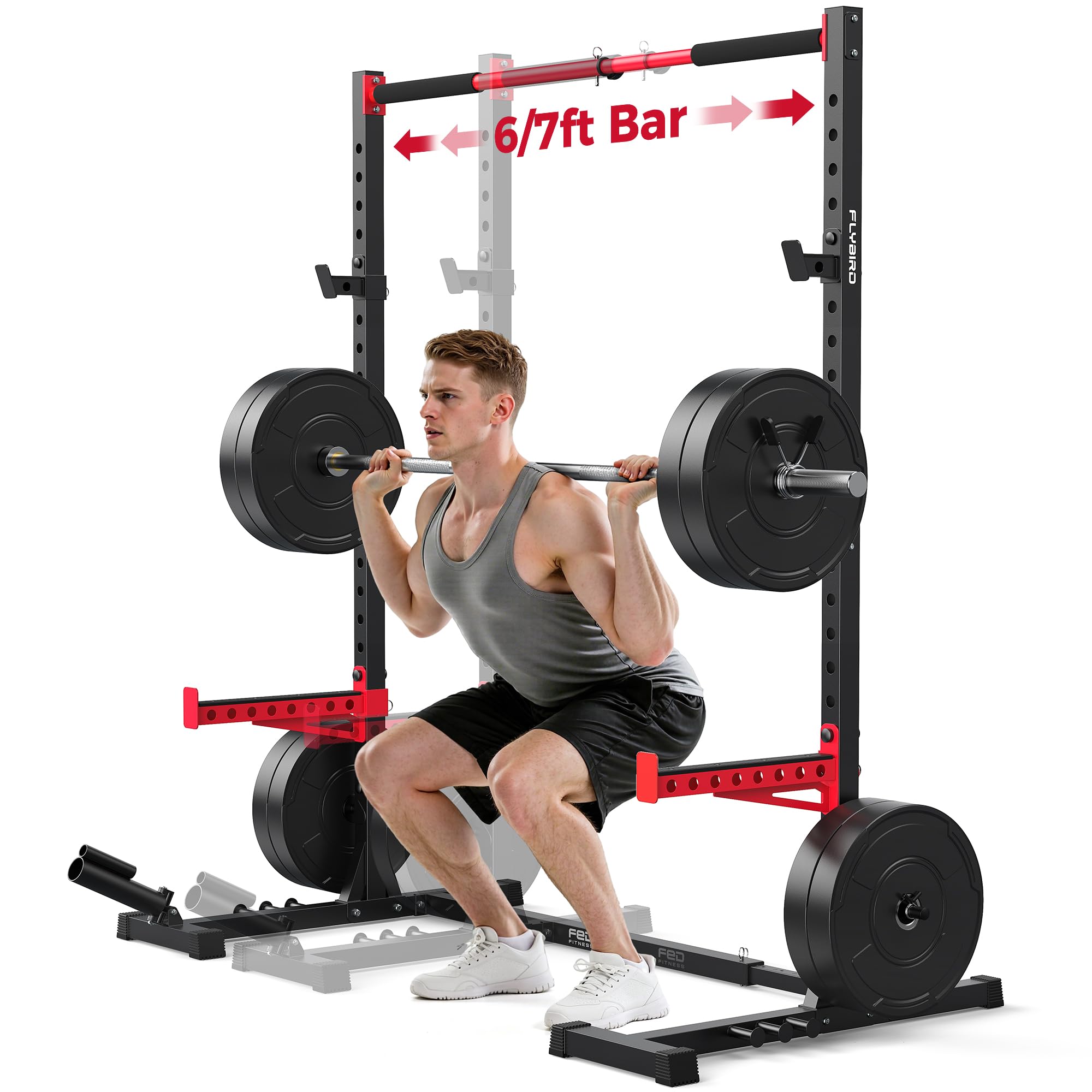
Widens or narrows to suit a 6- or 7-foot bar, with 22 height settings.

Barbells are not all the same length, and the SR1 is built around that. The uprights widen or narrow to suit most 6-foot and 7-foot bars, which matters more than it sounds if you are working in a space that was laid out around one bar length and you own the other.

At this price the SR1 is the half rack we point at first. Twenty-two height settings on one-inch spacing give genuinely fine adjustment for bench and squat, and the 16.7-inch safety arms reach further forward than the stubby catches on most racks at this level, with liners that take some of the clang out of a missed rep.

It is a half rack and not a cage, so there is no enclosed interior to press inside and nothing behind you but open floor. That is fine for squats and bench and less so if you like a bar in front and behind. The landmine, six band pegs and foam-padded pull-up bar round it out, and the 950-pound rating sits well beyond what most home lifters will load.

Bottom Line

A half rack that adapts to the bar you own, with fine height adjustment and long safety arms: our pick where a full cage will not fit.

Check Latest Price

Best Space-Saving

Our Score 9.2/10
Mikolo Folding Wall Rack

Mikolo

Mikolo Folding Wall Rack

  • Mounting Wall mount, stringer and studs included
  • Uprights 2" x 2" 13-gauge steel
  • Max Capacity 1000 lb
  • Pull-Up Bar Height 89 inches
Check Price on Amazon

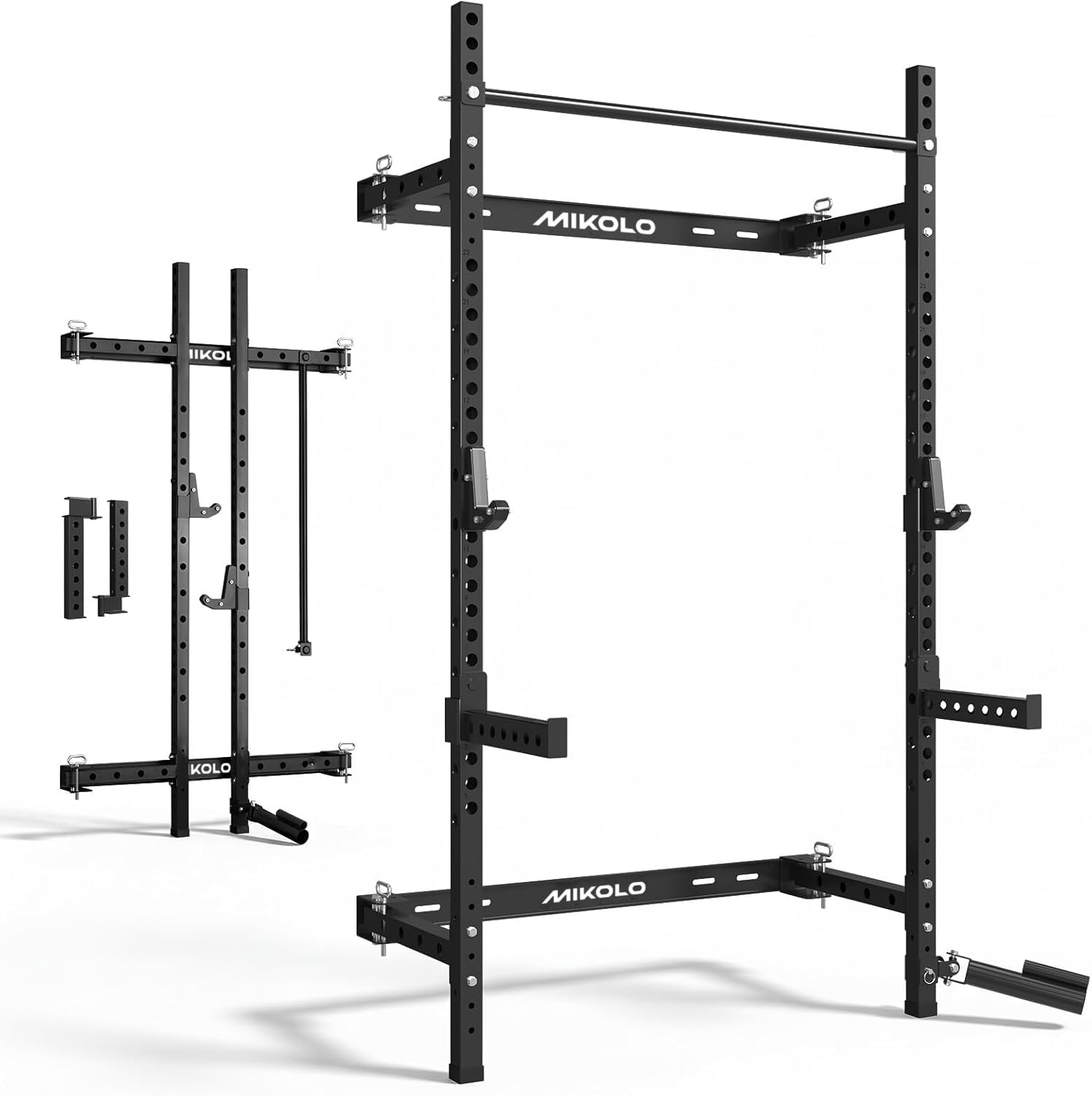
Folds flat to the wall, so the car still fits in the garage.

The test for a folding rack is not whether it folds. It is whether the thing you park in that bay still fits afterward. Folded, the Mikolo sits a few inches off the wall, which is the difference between a garage gym and a garage that happens to have a gym in it.

It hangs on a wall, and that is the whole installation. Mikolo ships a stringer and metal studs, and the bracket wants studs where it was drilled; if yours are at odd spacing, sort that out before the box arrives, because a 1,000-pound rating is only as good as what you bolted it to. Budget for a stud finder and a second pair of hands, since hanging 80 pounds of steel squarely is not a one-person job.

Once it is up you get a pair of J-hooks, safety catches and a quick-attach pull-up bar reaching 89 inches off the floor, which is high enough for a full hang and a stretch at the bottom and more clearance than most of the cages here offer. The uprights are 2-inch by 2-inch 13-gauge steel. We folded and unfolded it more than we needed to, and the swing stays smooth, which is the test any folding rack has to pass.

For a garage that has to hold a car, or a spare wall in a small house, this is the pick: the foldability is the feature and everything else is competent rather than generous. If you have permanent floor to give a rack, a freestanding cage gives you more for similar money.

Bottom Line

Our space-saving pick: a genuine 1,000-pound rack that folds back to the wall so the car still fits in the garage.

Check Latest Price

Best Premium Pick

Our Score 9.2/10
Mikolo HR05 Power Cage

Mikolo

Mikolo HR05 Power Cage

  • Footprint 53.4"D x 46"W x 86"H
  • Rack Weight 205 lb
  • Max Capacity 2000 lb
  • Pulley System Independent dual, 1:1 ratio
Check Price on Amazon

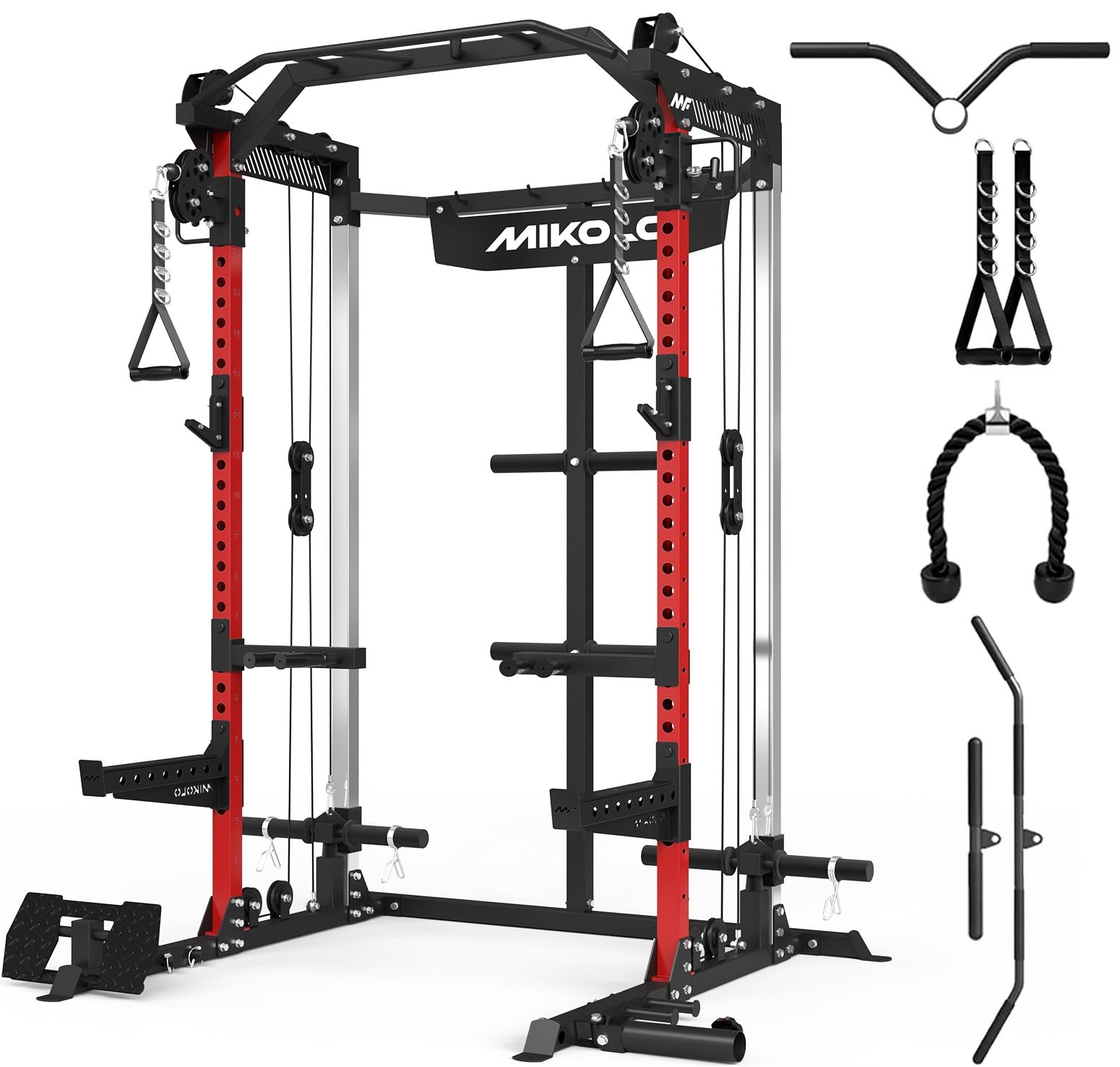
Two independent 1:1 cables give real crossover work beside squat and bench.

Two independent cables at a 1:1 ratio are the reason the HR05 costs what it does, and the reason we point people at it when they want cable work without a second machine. At 1:1, a plate on the carriage is a plate in your hand with no halving, and because the sides run independently, a crossover or a single-arm row does not drag the other cable along with it.

The frame is 205 pounds with a 2,000-pound rating, and the uprights are drilled at one-inch spacing with 30 height options and numbered markers down the side, so setting the J-hooks for a bench press takes seconds and no counting.

It is a half-rack layout: 53.4 inches deep, 46 inches wide and 86 inches tall, which clears a standard ceiling and leaves the front open for cable work. The width is the thing to think about, because 46 inches across the outside means a narrow interior, and a broad lifter will feel those uprights during close-grip work.

Also in the box: a multi-grip pull-up bar, dip bars, spotter arms and a 360-degree landmine, with a two-year warranty behind the frame. The cable is the part that will want attention first. If it starts to drag or rub, that is a sheave alignment job rather than a frame problem.

Bottom Line

The one we point at for cable work: independent 1:1 pulleys turn one frame into a crossover, a lat pulldown and a rack.

Check Latest Price

Best For Light-duty first rack

Our Score 9.0/10
CAP FM-CS7000F Power Rack

CAP

CAP FM-CS7000F Power Rack

  • Steel 11- and 12-gauge tubing
  • Footprint 45.67 x 50.79 x 85.43 inches
  • Rack Weight 54 lb
  • Max Capacity 500 lb
Check Price on Amazon

The CS7000F is the cheapest rack in this guide and it is rated to 500 pounds, which tells you most of what you need to know. Both are the lowest numbers here and they are related: a 54-pound frame built from 11- and 12-gauge tubing is a light-duty rack, and CAP rates it that way rather than pretending otherwise.

For what it is, it works. The uprights are double-gusseted, the J-cup catches hold a bar, and there is a built-in pull-up bar and a weight storage post. The 85-inch height clears a garage ceiling, the powder coat and zinc hardware are a sensible spec at this price, and assembly is about as simple as a rack gets.

Where it stops being enough is heavy squatting. At 500 pounds for the whole rack, this is the pick for pull-ups, pressing and squats up to a couple of plates a side, not for the lifter chasing a 400-pound squat, and not for anyone who wants to add a cable or landmine later. For a garage where the bar rarely gets past two plates, it does everything a rack needs to do.

Bottom Line

The budget rack we point at for pull-ups, pressing and light squats: a first rack that stays well inside its 500-pound rating.

Check Latest Price

Best For Attachment-heavy setups

Our Score 9.0/10
Sportsroyals RK2 Power Cage

Sportsroyals

Sportsroyals RK2 Power Cage

  • Footprint 59.6"D x 59.6"W x 82.6"H
  • Rack Weight 150 lb
  • Max Capacity 1200 lb
  • Height Positions 14 levels
Check Price on Amazon

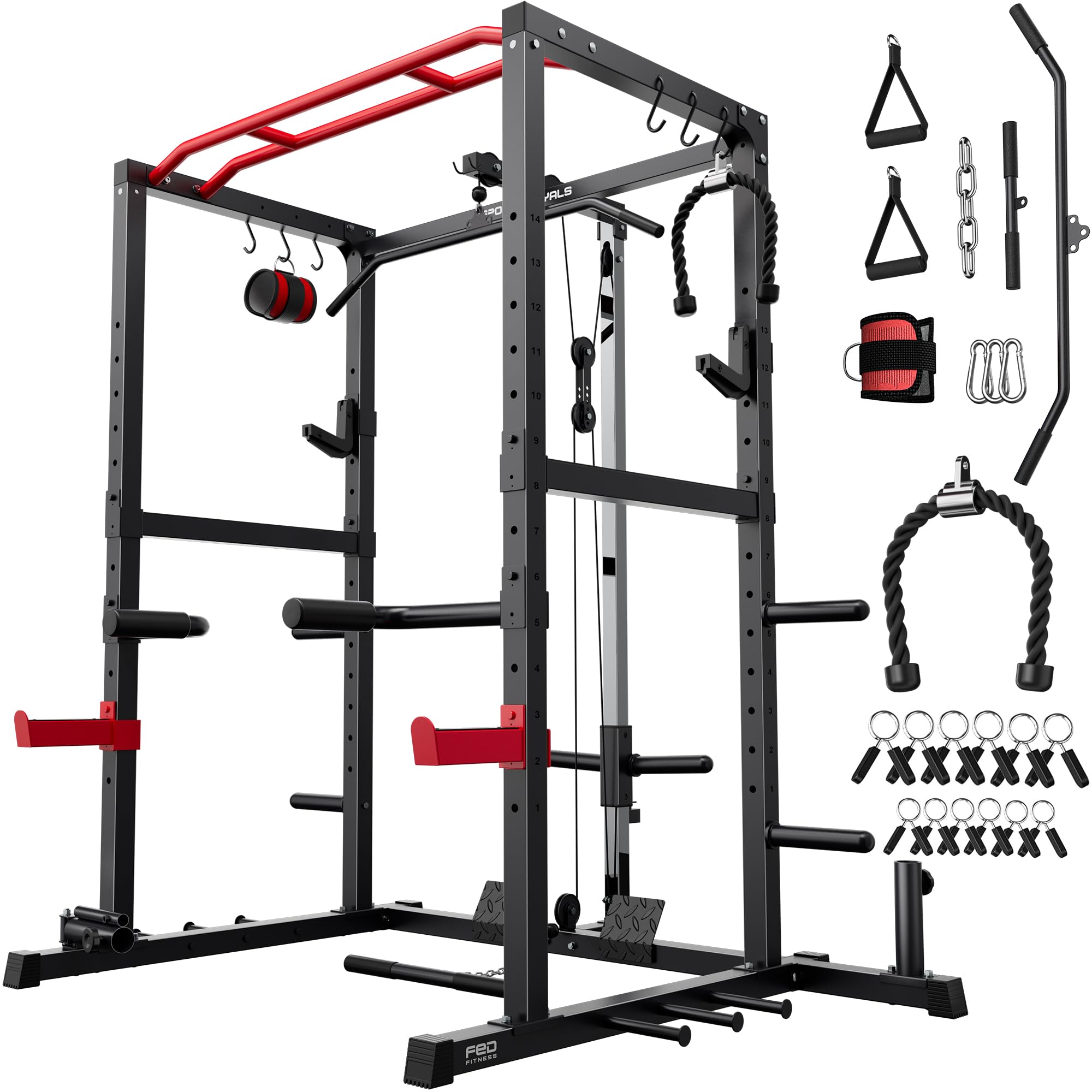
The RK2 is rated to 1,200 pounds and weighs 150, and the gap between those two numbers is the conversation. A 59.6-inch square footprint gives it a broad base, but a rack this light at this rating leans on how you load it, which is what the four plate storage pegs are for.

What you are buying is the attachment list: an upper and lower pulley system, a landmine, dip stands, six band pegs, a rowing bar, J-hooks, safety arms and 14 height positions. As one order for a home gym that has to cover everything, it is a lot of machine for the money.

The frame wiggles slightly when it is standing empty, and putting plates on the storage pegs takes most of that away. Setting the safety arms deserves a second look too, because you want them at the same hole height on both sides before you trust them with a missed rep.

For an intermediate lifter who wants cables, a landmine and a pull-up bar without buying three machines, this is a sensible buy. If your training is built around heavy squats and you want a frame that does not move, the money is better spent on the Sunny Power Zone or the Mikolo HR05.

Bottom Line

We rate it for the attachment list: cable, landmine, dip bars, band pegs and plate storage on one frame for less than the premium cages.

Check Latest Price

How We Tested (and Assembled) Six Power Racks

We started with a list of 30-plus racks sold in the U.S. and narrowed it by footprint, ceiling height, steel gauge, hole spacing, included accessories, and price, aiming for a mix of two-post and four-post designs that a real home gym could accommodate. That left six. Each one lived in a garage or basement for eight months, used at least twice a week for squats, bench, overhead press, rack pulls, and pull-ups.

On delivery, we timed assembly with a stopwatch — first as a two-person job, then solo — and noted where the instructions stalled, which bolts needed a second pair of hands, and how many times we had to re-read a step. We measured the actual footprint and upright height against the specs and checked each rack against a standard garage bay and an 8-foot ceiling. Stability got the least gentle test: we racked a loaded bar from the front and the side and watched for walk, dumped failed squats onto the safeties, and did strict and kipping pull-ups to see how much the bar and uprights moved.

We noted each rack's rated capacity, then loaded it to our own working weights — 300-plus pounds on the bar for squats and rack pulls — watching for sway, creaking, and flex at the joints. After eight months we checked welds for rust, paint wear where the j-hooks slide, and whether bolts had loosened. Squat performance came down to small things: whether the safeties caught the bar at the right height, whether the j-hooks let us unrack without stepping forward, and whether the pull-up bar had enough clearance for a full dead hang. Value got the final say — we added up what each rack included, because a bare frame that needs a cart of add-ons isn't the bargain it looks like.

How to Choose Power Racks

Start with the ceiling, not the price

An eight-foot ceiling gives you 96 inches. The cages here run 82.6 to 87 inches tall, which leaves between nine and thirteen inches above the frame. That is enough for the bar to travel; it is not always enough for a tall lifter to hang from the pull-up bar with straight legs. Put your arm overhead, measure to the top of your reach, and compare that with the top of the rack.

Depth catches people out as well. These racks run from 38 inches front to back up to 63, and the deep ones want a long wall rather than a wide one. Walk the room with a tape before you order and check the swing of any door behind the rack.

Read what the load rating counts

The numbers on these racks are not the same measurement. Some are a combined figure across bar catches, safety arms and storage pegs; some are a single recommended maximum for the whole frame; the bargains sit at 500 pounds total. Do not line them up as though they are equivalent.

What you want is a figure that clears your heaviest bar weight with room to spare, plus an idea of whether it describes one catch or the entire rack. Where a rating is very high against a light frame, the plate pegs are doing part of the structural work, so plan to keep them loaded.

Hole size decides what you can add later

Attachments are sold to fit a hole diameter, and a rack with undersized upright holes will not take the aftermarket J-cups, landmine or dip bars that fit a standard cage. That is a five-minute check that saves a return, and it decides the rack for anyone who already owns attachments.

Measure the hole on the rack you are considering and compare it with the pin on the accessory before you buy both. If you plan to stay with the manufacturer's own parts, hole size matters far less.

Cage, half rack or folding rack

A full cage gives you four posts, a top frame and a pull-up bar, and it is the most forgiving thing to train in on your own. A half rack drops the rear posts and uses long safety arms instead: less to walk around, less to store, and fine for squats and bench.

A folding wall rack leaves the floor completely clear between sessions, which is the only answer when the garage has to hold a car. Decide by what the room does when you are not training in it, not by which frame looks strongest.

What cable attachments are worth

A lat pulldown or crossover adds genuine training to a rack, but the pulley ratio changes what you get. At 1:1, a plate on the carriage is a plate in your hand. At 2:1, the resistance halves and the cable travel doubles, which suits some movements and not others.

Ask which ratio the system runs before you pay for it, and check that the cable runs outside the cage rather than through your squat position. A pulley that sits in the middle of the frame is a pulley you stop using.

Frequently Asked Questions

Final Verdict

Our pick for a typical home gym is the Sunny Power Zone: 65 inches of interior width, a 14-gauge frame, and a pull-up bar, plate storage and band pegs already on it for mid-range money. It is the rack we would put in a garage with a wall to spare.

Two situations change the answer. If floor space is the real constraint, the Mikolo folding rack gives you a genuine 1,000-pound rack that disappears against the wall. If cable work is the point of the purchase, the Ultra Fuego bundles a lat pulldown and landmine for about what a bare cage costs.