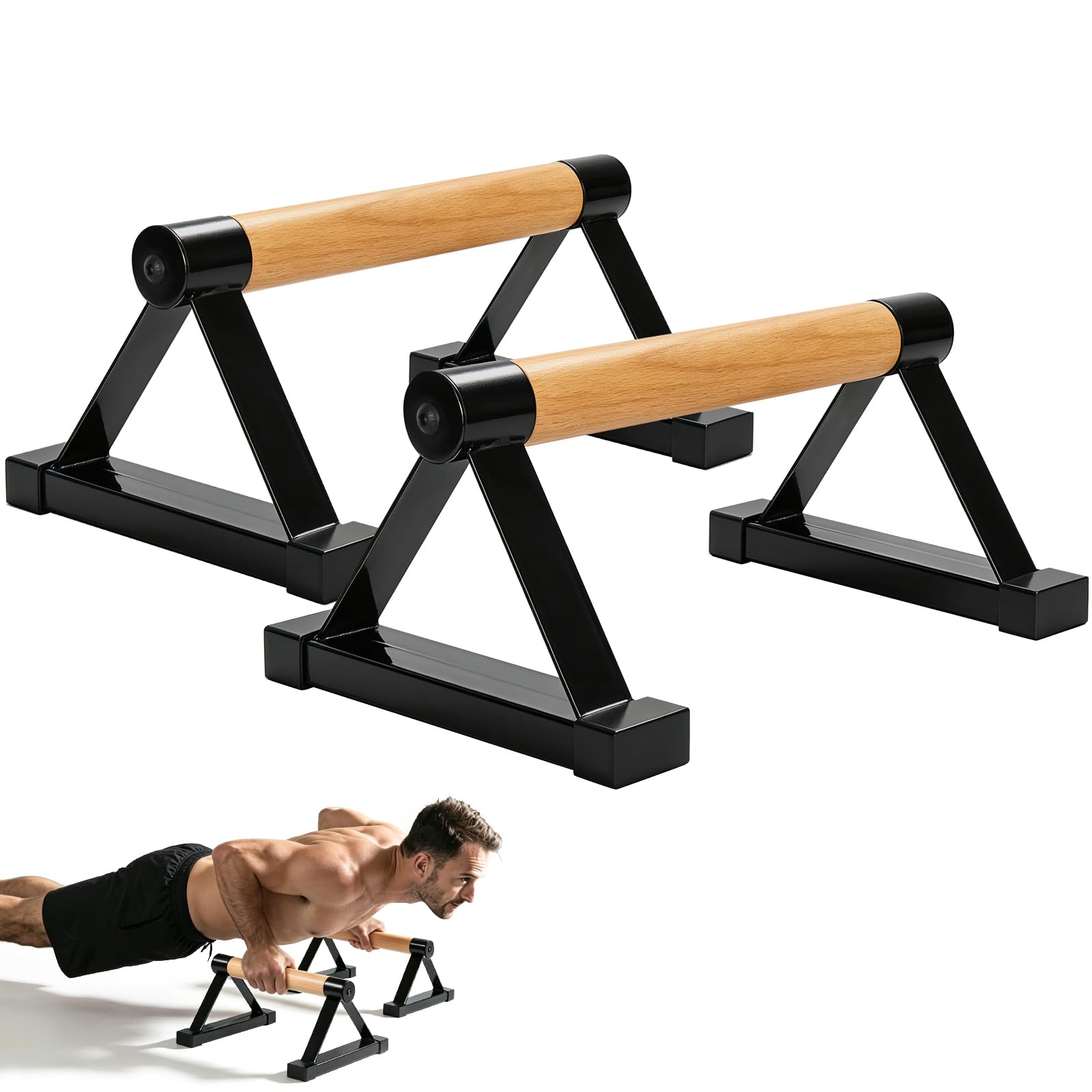
Strength & Weights

Best Parallettes of 2026

My wrists used to be the reason I skipped handstand practice — twenty minutes on the floor and they'd ache for the rest of the day. Parallettes fix that: raising your hands a few inches takes the extreme bend out of the wrist and puts the load back where it belongs, and the clearance underneath is what makes L-sits and deficit push-ups possible. The catch is that the wrong pair creates new problems — bars that flex under bodyweight, bases that skate across hardwood, bolts that start creaking by week three.

Over six months, my team and I worked through 14 pairs, from budget bolt-together sets to heavy welded steel, and the gaps between them showed up fast. Something first-time buyers rarely think about: height and grip diameter decide what a pair is actually good for, since short bars suit push-ups and L-sits while tall ones are built for handstands. The picks below are organized around exactly that.

Best Overall

Our Score 9.6/10
Lebert Parallettes

Lebert

Lebert Parallettes

  • Height 12 in
  • Assembly Required
  • Max Load 400 lb
  • Footprint 25 x 16 in
Check Price on Amazon

12 inches of clearance and a long, wide base for dips, L-sits, and handstands.

Twelve inches is the number that decides it. Almost every other pair here sits under 10 inches off the floor, which is fine for push-ups but leaves your heels skimming the ground in an L-sit and turns dips into a crouch. The Leberts give you real clearance, and the rails run 25 inches inside a 16-inch footprint, so there is room to shift your weight forward into a planche lean without the whole thing tipping.

The frame is the other half of the case: reinforced welds, locking washers, and a 400-pound rating, with high-density neoprene on the grips that stays put once your hands are warm. Assembly is required, which puts it behind the wooden pairs that arrive ready to use, but the directions are clear and the locking washers mean you are not chasing loose bolts a month in.

Two things to know before you buy. The 400-pound rating is the lowest of the tall pairs we cover, and the rubber feet will slide if you set the bars wide on a polished hardwood floor. Both caveats land on a specific buyer: if you are heavy, or you train wide handstand stances on smooth floors, a steel pair with a broader, grippier base is the better fit.

What none of the others here offers is the workout support. The pair ships with two training guides and app access, and if you have never programmed L-sit or planche progressions, having someone lay out the sequence is worth more than another half inch of foam.

Bottom Line

Our default recommendation: 12 inches of clearance and a long, wide base make this the pair that covers push-ups, dips, L-sits, and handstands without a compromise.

Check Latest Price

Best for Travel

Our Score 9.6/10
WOODPOWER PowerBars

WOODPOWER

WOODPOWER PowerBars

  • Height 3.94 in
  • Weight 2.9 lb
  • Material Beech wood
  • Max Load 551.2 lb
Check Price on Amazon

2.9 pounds of solid beech that disappears into a gym bag.

At 2.9 pounds for the pair, these are the ones that go in a bag without a second thought. They weigh less than most pairs of shoes and run only about 9 inches along the rail, so they slide into a drawer, a duffel, or the bottom of a closet without a struggle.

The build is wood end to end, with no steel bracket anywhere, and it is rated to 250 kg, which is the highest of the all-wood pairs we cover. Beech is dense and dry, so the grip improves as your hands warm rather than going slick, and the silicon pads underneath keep them from skating on a smooth floor.

What you give up is height. At 3.94 inches these sit among the lowest bars here, which is exactly right for handstands, since you are close to the floor and the bail is less frightening, but L-sits turn into a knuckle-dragger and full dips are out of the question. We think of them as a specialist's tool rather than an only pair, unless handstands and push-up variations are the whole program.

Where they win is portability and upkeep: two pieces of wood, no hardware, nothing to tighten, and no foam to replace when it compresses. That is a long way from a steel pair with eight screws and four rubber feet to keep track of.

Bottom Line

The pair that lives in a duffel: 2.9 pounds, a 250 kg rating, and dry beech handles that grip better as your hands get sweatier.

Check Latest Price

Best Wooden Pair for Heavier Users

Our Score 9.6/10
airogym Wood and Steel Parallettes

airogym

airogym Wood and Steel Parallettes

  • Height 5.9 in
  • Weight 5.47 lb
  • Max Load 600 lb
  • Handle Diameter 1.5 in
Check Price on Amazon

Beech handles in a welded steel bracket, rated to 600 pounds.

Most wooden parallettes here top out between 150 and 250 kg. This pair is rated to 600 pounds, and the reason is visible: the beech handles sit in a welded iron bracket rather than being glued into a wooden frame, so the load path runs through steel the whole way down.

In the hand it is the nicest compromise we found. The handles are 1.5 inches of sanded beech, warm where the steel pairs run cold, and they do not go slick the way foam does once a session gets long. The pair weighs about 5.5 pounds, assembles with the included tools in a few minutes, and comes apart again when you need the shelf space, which the one-piece wooden bars simply cannot do.

Setup is straightforward and the bracket sits flat enough that the bars stay quiet once the screws are snug. If dips are the center of your training, look at the taller steel picks, because 5.9 inches of clearance is a pressing and handstand height. For planche leans and handstand work with a heavier athlete, it is the wood option that lets you stop thinking about the rating.

Bottom Line

Wood handles on a welded steel bracket, rated to 600 pounds: the pair we point heavier lifters to when they want the wood feel without the wood ceiling.

Check Latest Price

Best Wooden Handles

Our Score 9.4/10
PULLUP & DIP Parallettes

PULLUP & DIP

PULLUP & DIP Parallettes

  • Height 4.9 in
  • Weight 4.2 lb
  • Assembly None required
  • Max Load 440.9 lb
Check Price on Amazon

Contoured beech handles that take the pressure off sore wrists.

The handles are the reason to buy these, and one session explains it: the beech is shaped rather than round, so the heel of your palm rests on a flat instead of wrapping a cylinder. That is the difference between finishing a set of push-ups and shaking out a sore wrist, and unlike foam there is nothing to go flat or hold onto sweat.

Everything above the handles is steel, rated to 200 kg, with anti-slip pads at the base and no assembly at all, so they come out of the box ready. At 4.2 pounds for the pair they disappear into a gym bag, and 4.9 inches of height is genuinely useful for handstand drills and pike push-ups, where a taller bar just gets in the way.

Five years of warranty on a pair of bars is unusual at this level, and it tells you what the maker expects of the joints. The exercise guide in the box is basic, but the handle shape is the feature you are paying for, and it earns its keep on the twentieth set rather than the first.

Bottom Line

If push-ups leave your wrists aching, start here: the contoured beech handles are the most comfortable thing we gripped in this group, and there is nothing to assemble.

Check Latest Price

Best for Beginners

Our Score 9.4/10
AmazeFan Parallettes

AmazeFan

AmazeFan Parallettes

  • Height 10 in
  • Weight 3.5 lb
  • Assembly Required, tools included
  • Footprint 16.6 x 10 in
Check Price on Amazon

A 10-inch steel pair that is easy to assemble and easy to store.

Most people do not need the best parallettes. They need a pair that is tall enough to be useful and cheap enough that a month off does not feel like wasted money. That is this pair.

Ten inches is the sensible middle of the range: high enough for an L-sit that clears the floor, low enough that getting into a handstand does not feel like a commitment. The frame is carbon steel pipe with a 16.6 by 10-inch footprint, and it comes apart with a screwdriver into flat pieces that store under a bed.

The adjustable feet are the detail that surprised us. Rotate the off-centre corners and you can level the bars on a garage floor that has seen better decades, which is more than most pairs at this end bother with. Add 3.5 pounds of weight and a footprint small enough for a hallway, and it is the pair that gets someone training this week instead of researching for another month.

Bottom Line

A sensible first pair: 10 inches of height, 3.5 pounds, and enough steel to learn handstands and L-sits on without spending much.

Check Latest Price

Best For Budget wooden pair

Our Score 9.4/10
airogym Pine Push-Up Bars

airogym

airogym Pine Push-Up Bars

  • Height 3.9 in
  • Material Pine wood
  • Max Load 500 lb
  • Handle Diameter 1.57 in
Check Price on Amazon

Wood parallettes usually sit near the top of the price range. This pair does not, and it is the one to look at if you want to find out whether a wooden handle suits you before spending beech money on the question.

The wood is pine rather than the beech used elsewhere here, sanded smooth enough that the grip feels broken-in from the first session, and the 1.57-inch diameter sits well in average-to-large hands. The base does not slide on tile or on carpet in our experience, and at 11.8 inches long the bars tuck into a corner when you are done.

At 3.9 inches high, they are a handstand and push-up tool. L-sits are possible but tight, and full dips are not happening. That is the height this price buys, and it is the right one if handstands are what you are chasing rather than dips.

For the money, we have not seen a better first wooden pair: 500 pounds of rated capacity, a genuine wood grip, and none of the foam that goes slick on the steel bars. If you are unsure whether wood is for you, this is the cheapest way to find out.

Bottom Line

The least expensive wooden pair here, and still rated to 500 pounds: a low-risk way to find out whether a wood grip suits you.

Check Latest Price

Best Tall Pair on a Budget

Our Score 9.2/10
TABEKE 14-Inch Parallettes

TABEKE

TABEKE 14-Inch Parallettes

  • Height 14 in
  • Material Alloy steel
  • Max Load 660 lb
  • Footprint 14 x 14 in
Check Price on Amazon

14 inches of steel for full dip range at home.

Fourteen inches is more than it sounds. It is the difference between an L-sit where your legs hang free and one where your heels scrape, and it is enough height to do an actual dip between the bars rather than a bent-knee approximation. Nothing else here goes that high.

Underneath, it is 1.8 mm steel rated to 660 pounds on a 14-inch square footprint, the widest steel stance here after the Lebert. Assembly takes a couple of minutes with the screwdriver in the box, and the bars break down flat, which is the thing that decides whether a pair gets stored properly or stays out collecting dust in the corner of a room.

The press-on rubber feet are the soft spot: they can work their way off in a bag or across a gym floor, so push them back on and give them a check before each session. Otherwise the frame is the least fussy thing here, with no wood to maintain and no joint to inspect beyond the bolts you just tightened.

Bottom Line

The tallest pair here, and the simplest way to get full dip range at home without committing to a dip station.

Check Latest Price

Best For Ready out of the box

Our Score 9.2/10
CALI SPORTS Parallettes

CALI SPORTS

CALI SPORTS Parallettes

  • Height 3.94 in
  • Weight 3.31 lb
  • Includes Wrist wraps
  • Max Load 330.7 lb
Check Price on Amazon

There is nothing to put together. The joints are glued and screwed at the factory and the pair arrives ready to use, which is rarer in this category than it should be, and it means no washers to lose and no bolts working loose in month three.

The base is the reason it earns a place. It is wide for a low wooden bar, 5.9 inches across an 11.8-inch rail, with full-length rubber strips underneath that keep it planted on hardwood. On a smooth floor that is worth more than an extra inch of height.

At 3.94 inches it is a handstand and push-up bar first. L-sits work but sit close to the floor, and the finish is a step above the painted steel pairs, with sealed wood and rounded edges instead of a coat of paint over a weld.

The wrist wraps in the box are a thoughtful extra rather than a substitute for proper wrist prep; ours went into a gym bag and stayed there. What earns the spot is the combination of a ready-to-use build, a wide base, and a finish that looks better than most of what sits next to it.

Bottom Line

Ready to use straight out of the box, with a wide wooden base that stays planted on hardwood: the pair for someone who wants to start training today.

Check Latest Price

How We Tested (and Narrowed Down) the Parallettes

We built the shortlist from spec sheets first: bar diameter, height, base footprint, stated weight capacity, and whether the frame was welded or bolted together. Anything with plastic joints, an unlisted weight limit, or a base narrower than the bars themselves got cut before it ever reached the floor. That left 14 pairs, ranging from budget sets to welded steel, which we used for six months.

Assembly was the first test. We unboxed each pair with a stopwatch running, counted how many tools were needed, then re-checked every bolt after two weeks of daily use to see which frames had started to loosen or shift. For sturdiness, we loaded the bars with stacked plates well past bodyweight and watched for flex at the center and rock at the feet, then repeated the check during handstand holds against a wall, noting any side-to-side sway.

Stability was judged on the surfaces people actually train on — hardwood, low carpet, and a rubber gym mat — with a look at sliding and floor marks after each session. We measured bar height and grip circumference with a tape, then held 30-second supports to see where the wrist sat and whether chalk or sweat turned the grip slick. Last, we weighed the price against the frame style and hardware each pair came with, and how easily it moved from room to room.

How to Choose

Start with height, because it decides the exercise

Under 6 inches you get push-ups, handstand drills, planche leans, and a lot of wrist relief, and the bars barely change your floor plan. Around 10 inches an L-sit clears the ground. At 12 inches and above, full dips and pass-throughs come into range. The trap is a low bar marketed for L-sits and handstands: you can do both on 4 inches, but the L-sit is a knuckle-dragger and the dips are not dips.

Write down the two moves you care about most and buy the height that serves them. The WOODPOWER bars at 3.94 inches are a handstand specialist; the Lebert at 12 inches and the TABEKE at 14 cover everything else. We would rather own one pair that clears the floor than two that do not.

Stability comes from the footprint, not the load rating

Almost every steel pair here claims 600 pounds or more, and almost nobody needs it. What you feel under your hands is how far apart the feet sit and how long the rail is. A 14-inch square footprint resists a forward lean better than an 8-inch-wide base, and a 25-inch rail gives your hands somewhere to go when you press wide.

Rubber pads grip hardwood but can skate when you set the bars wide and shift your weight; carpet and mats are more forgiving. Check the footprint numbers before the weight rating, because the rating is the figure sellers put in the headline and the base width is the one buried in the details.

Handle material changes more than comfort

Wood absorbs sweat and gets tackier as your hands warm up. Foam feels soft on day one and compresses into a slick sleeve long before the frame gives out. Bare steel wants chalk. Diameter matters too: around 1.5 inches suits most hands, and anything much thinner concentrates pressure on the palm.

If you train bare-handed and sweat heavily, wood earns its upkeep. The shaped beech on the PULLUP & DIP bars shows what a contoured handle does for wrist position, and the pine on the airogym bars proves you do not have to spend much to get a wood grip at all.

Portability, storage, and assembly

This group runs from 2.9 pounds of solid beech to steel pairs that break down with a screwdriver. Weight matters less than length: a 25-inch rail will not fit on a closet shelf or in a small duffel, while 9- to 13-inch bars will. Screw-together frames store flat, but the fasteners need a look every few weeks and the press-on feet can walk off in a bag.

If the bars live in a living room, buy for the footprint and leave them out. If they travel, buy for the weight and expect to check the hardware before you train.

Frequently Asked Questions

Final Verdict

The Lebert pair is the one we recommend first: 12 inches of clearance, a long rail, and a footprint wide enough that you stop thinking about the bars and start thinking about the set. It is the only pick here that handles push-ups, L-sits, dips, and handstands without asking you to compromise on any of them.

If dips are the center of your training, the TABEKE 14-inch pair goes higher. If your wrists are what hurt, the PULLUP & DIP handles are the fix. Everyone else can buy the Leberts and get on with training.