Strength & Weights

Best Boxing Headgear of 2026

Good boxing headgear is a negotiation between protection and vision. Add padding and you feel safer, but the best models keep your eyes clear enough to see the next shot coming; skimp on it and you notice every cheek and temple impact the next morning. I've worn enough loose chin straps and sweat-soaked liners to know the difference between gear that disappears into the round and gear you fight as much as your partner. The right headgear protects your brow, cheeks, and ears without turning your head into a blind spot.

We put 14 models through eight months of sparring, partner drills, and bag work, paying close attention to fit, padding, comfort, and field of view. What separated the top picks was not just how much foam they carried but how well that foam stayed where it belonged after a hard round. A few also proved that value isn't about the lowest price; it's about straps that hold, liners that dry, and stitching that doesn't give out. The options below are the ones my team and I kept reaching for.

Best Overall

Our Score 9.4/10
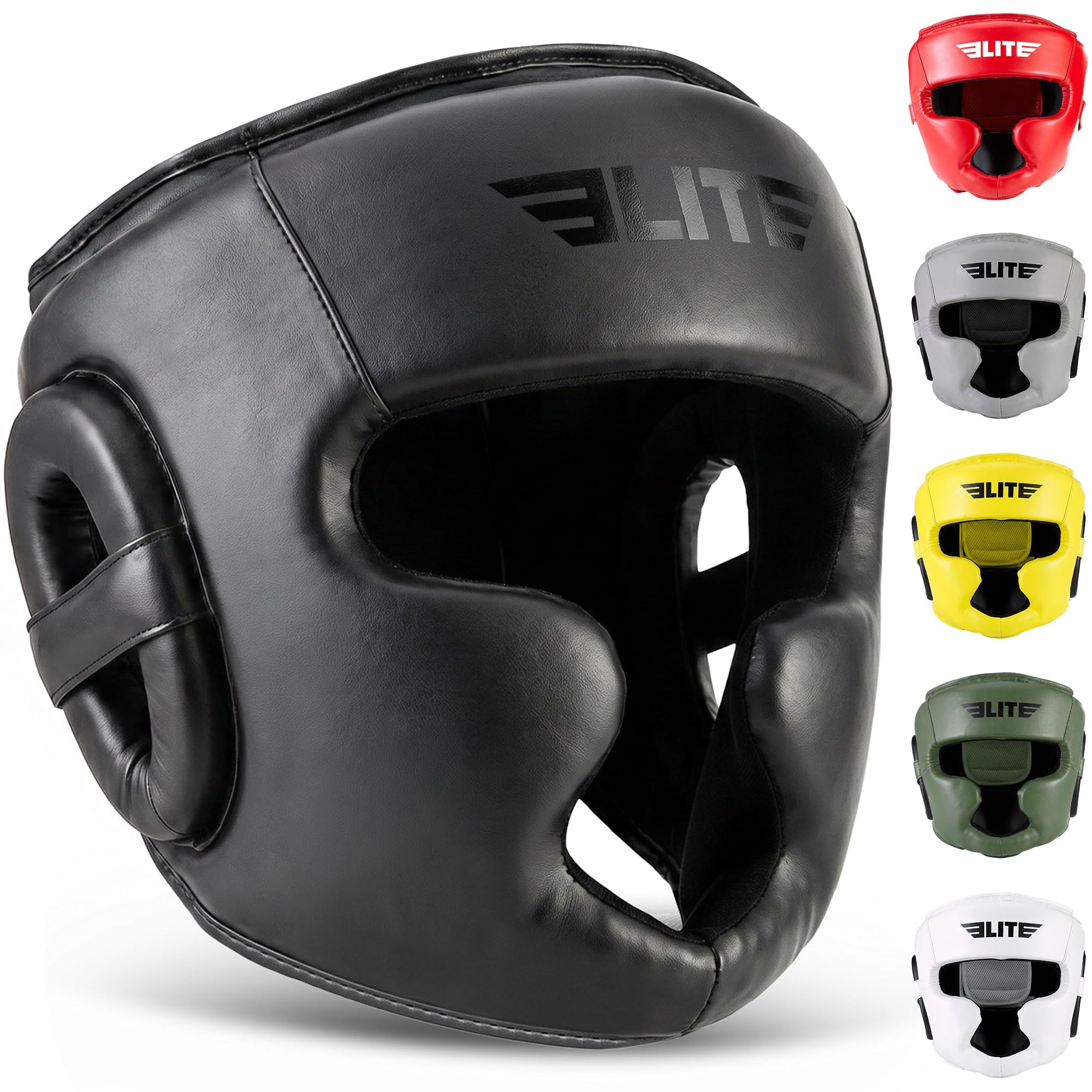
Elite Sports Boxing Head Guard

Elite

Elite Sports Boxing Head Guard

  • Sizes One size
  • Adjustment Chin strap, head cap, head height
  • Field Of View 180 degrees
  • Listed Weight 8 oz
Check Price on Amazon

The best balance of cheek coverage, clear sight lines, and low weight for sparring.

Plenty of headgear makes you choose between protecting your face and being able to see out of it. This Elite Sports guard is the pick in our set that mostly refuses the trade: the eye opening is listed at a 180-degree field of view, the foam still wraps the forehead, temples, and cheeks, and at a listed 8 ounces it's among the lightest shells here. That combination — coverage without a letterbox view — is why it ended up at the top of this guide rather than the middle of it.

Three straps set the fit: a chin strap, a cap strap over the crown, and one that controls how low the shell sits. Set all three properly and the helmet stays where you put it through a round, which is the part that matters more than any measurement on a spec sheet. It's easy to get on and off between drills, and the straps sit flat enough that you're not fiddling with them mid-session.

What keeps us coming back is how little it interferes. There's no bar or grill in front of your mouth to fog up or catch a glove, your chin can still tuck, and nothing about the shell blocks your read on an opponent's chest — the cue most of us actually use before a shot comes. For gym sparring, kickboxing, and Muay Thai, that's the version of protection that lets you work on technique instead of fighting your equipment.

Bottom Line

We tell most people to start here: wide eye opening, light shell, and real cheek and forehead coverage for boxing, Muay Thai, and kickboxing rounds.

Check Latest Price

Best Ventilation

Our Score 9.4/10
RDX HGR-F6 Boxing Headgear

RDX

RDX HGR-F6 Boxing Headgear

  • Entry Rear pull-over
  • Padding Three foam layers
  • Ventilation Open top and sides
  • Listed Weight 12.7 oz
Check Price on Amazon

Open panels at the top and sides dump heat; the pull-on shell stays put.

There's no rear strap to fumble with — you pull this RDX helmet on over your head like a swim cap and tighten a buckle and two hook-and-loop tabs once. That rear-entry design is the first thing you notice, and it changes how the fit feels: the shell has to come down over the widest part of your skull, so it sits locked in rather than cinched in.

The ventilation is what sold us. The top and sides are open, which is exactly where a helmet turns into a sauna three rounds in, and the triple-layer padding — Polygonal Fusion foam over two EVA sheets — is concentrated at the forehead, temples, and cheeks where shots actually land. There's a tab at the back and one across the top, so you can balance the fit front to back instead of just tightening the whole thing down.

The trade for that convenience comes at setup. The buckle and the two tabs get set once, and getting them right takes a session or two of fiddling — do it properly and the shell sits snug from then on. Skip it and the helmet floats, which is the failure mode with any pull-on design.

Bottom Line

Buy it for a hot gym: the crown and sides are cut open, and the pull-on shell stays put once you've set the straps.

Check Latest Price

Best for Competition

Our Score 9.4/10
Ringside Competition Headgear with Cheeks

Ringside

Ringside Competition Headgear with Cheeks

  • Size Large
  • Shell Leather with suede lining
  • Closure Lace top, rear hook-and-loop, chin buckle
  • Approval USA Boxing approved
Check Price on Amazon

USA Boxing approved, with extended cheek guards and a leather-and-suede build.

Sanctioned boxing comes with a rulebook, and the rulebook has opinions about what goes on your head. This Ringside model is sold as USA Boxing approved, which is the line that matters when you're entering an amateur bout, and it keeps extended cheek guards in place while it does it — something an open-face competition guard can't offer.

The build is why it sits in our premium tier: leather outside, a suede lining against your forehead, a lace-up crown, a hook-and-loop closure at the back, and a buckle chin strap. Suede against skin grips better than a nylon liner once you're sweating, and the shell stays where you set it instead of creeping forward every time a jab lands upstairs.

The lace top is the detail that earns its place. Laces spread tension across the crown instead of pinching at two strap points, so the helmet sits flat and stays flat, and once it's set you leave it alone and live on the rear closure for daily on-and-off. That's the arrangement competition boxers have used for decades, and putting it on makes the reason obvious.

Bottom Line

If you're stepping into sanctioned amateur bouts, this is the helmet in our guide that pairs approval with extended cheek coverage — and the leather to last.

Check Latest Price

Best Low-Bulk

Our Score 9.2/10
Hayabusa T3 MMA Headgear

Hayabusa

Hayabusa T3 MMA Headgear

  • Size Medium
  • Shell Vylar engineered leather
  • Closure T-Cross
  • Listed Weight 6.88 oz
Check Price on Amazon

A compact, lightweight shell for fighters who feel boxed in by full padding.

The T3 is the smallest shell in this guide, and that's the point of it. Listed at 6.88 ounces and cut close to the skull rather than ballooning out past the ears, it feels less like a helmet and more like something you put on and forget. We rate it the low-bulk pick here for exactly that reason — not because it's the most protective thing on this page, but because it's the one that doesn't get in the way of moving your head.

The closure is where Hayabusa spent the money. The T-Cross system pulls from four directions at the back instead of two, so the shell settles onto your head rather than clamping around it, and it resists the slow rotation that turns a good guard into a crooked one halfway through a round. Mesh over the ears and an open top handle heat, and the Vylar engineered leather outer is a step up from the plain synthetics in the budget tier.

It runs snug, which is the trade for all that stability — if you're between sizes, take the larger one, and measure rather than guess. The shape also suits a fighter who's already comfortable in the pocket. Beginners usually want more wall in front of their face, and there are fuller picks in this guide for that.

Bottom Line

For anyone who feels boxed in by a full guard, this compact shell is the one we hand over: minimal bulk, a closure that resists spinning, and coverage that beats its size.

Check Latest Price

Best Midrange

Our Score 9.2/10
Venum Challenger 2.0 Headgear

Venum

Venum Challenger 2.0 Headgear

  • Size One size
  • Closure Two-way hook-and-loop
  • Padding Triple-density contoured foam
  • Listed Weight 9.88 oz
Check Price on Amazon

Triple-density foam and clear sight lines for less than the premium picks.

If our top pick is the sensible default, the Challenger 2.0 is what you buy when you want a name-brand build and don't need the lightest shell in the room. The layout is familiar — foam across the forehead, temples, and cheeks, a closure at the back — but the padding is listed as triple-density contoured foam, which is a step up from the single-layer shells at the budget end of this guide.

What we like is that it doesn't pay for protection with visibility. The cheek pads stop short of the nose, so your read on an opponent's shoulders stays open, and the two-way hook-and-loop closure pulls from both sides rather than torquing the shell around your head. Coverage runs across the cheeks, jaw, and ears without any of it sitting in your sight line.

The one thing to check is the padding itself. Before your first session, make sure the cheek pads sit level on both sides and that the mouth opening is symmetrical — an uneven pair is worth exchanging while the box is still open rather than living with for a year. That check takes thirty seconds and saves a lot of squinting in the mirror later.

Bottom Line

A sensible midrange buy: triple-density foam, a two-way closure that pulls evenly, and cheek protection that leaves your sight lines alone.

Check Latest Price

Best For Open-face competition

Our Score 9.2/10
Contender Open Face Headgear

Contender

Contender Open Face Headgear

  • Face Open, no cheek pads
  • Shell Leather
  • Approval USA Boxing approved
  • Listed Weight 9.44 oz
Check Price on Amazon

There are no cheek pads here, and that's the whole design argument. The Contender is an open-face competition guard: foam across the forehead, sides, and back of the head, an opening from cheekbone to cheekbone, and nothing between your eyes and your opponent. If you've only sparred in a full guard, the first round in this feels like someone took a window out.

It's sold as USA Boxing approved, and the fittings are the traditional competition arrangement — a lace-up top and back, a buckle chin strap, and a smooth synthetic liner that doesn't grab at your hair. Lacing takes a few minutes to set and then you leave it alone; the buckle handles the on-and-off. The leather outer is what separates it from the budget guards here.

We wondered whether missing cheek pads would feel like a downgrade in sparring, and the answer depends entirely on the room. Under rules that require an open face, nothing in this guide suits the job better. In a Muay Thai clinch, an MMA round, or hard gym sparring where hooks come inside, the cheekless profile leaves you open in a way the fuller guards here don't. Buy it for the bout, not for the hard sparring session.

Bottom Line

The one to buy when the rulebook requires an open face: approved, leather, and completely unobstructed — just don't ask it to protect your cheeks.

Check Latest Price

Best For Beginner hard sparring

Our Score 9.2/10
RDX Headgear with Face Grill

RDX

RDX Headgear with Face Grill

  • Size Medium
  • Padding Three foam layers
  • Face Guard Removable PVC grill
  • Listed Weight 1.1 lb
Check Price on Amazon

There's a specific stretch of training this helmet is built for: the first months of hard sparring, when your defense isn't there yet and your nose is absorbing the difference. The PVC grill sits across the front and gives you a buffer that no open-face guard in this guide offers, and it comes off quickly, without tools.

Pull the grill and you're left with a conventional sparring helmet: three slabs of attenuating foam, a Quick EZ hook-and-loop strap that holds the fit, and a shell that covers the forehead, temples, and back of the head. That's the appeal for us — one purchase covers the beginner phase and the ordinary sparring that follows, without buying a second helmet when your defense catches up.

The trade is peripheral vision, and it's a real one. With the grill in place you lose the low sight lines you'd use to spot a hook starting, and the bars sit about where an opponent's lead shoulder lives. It's a helmet for the sessions where you'd rather not eat a straight right than watch it arrive — and for the rounds where you can take it off, you should.

Our verdict: it earns its place as a training-stage helmet, not a forever one. Fit it, learn your range behind it, and pull the grill once the drill turns into stand-up sparring. What it doesn't do is replace a proper sparring helmet for work on counters and head movement — that's the point where the grill starts costing you more than it gives.

Bottom Line

With the grill fitted it's the closest thing here to a face shield; with it off it's a normal sparring helmet, and that two-in-one is the reason to buy.

Check Latest Price

Best For Budget backup

Our Score 9.0/10
MaxxMMA Headgear

MaxxMMA

MaxxMMA Headgear

  • Size L/XL
  • Shell PVC over foam
  • Listed Weight 14.1 oz
Check Price on Amazon

It's sold in L/XL only and listed at 0.4 kg, with a PVC outer over foam. On paper it's the plainest helmet in this guide, and it's also the least expensive. What that buys you is a padded shell with a chin strap and a shape built around a larger head — nothing decorative, nothing you have to learn to use.

Comfort is where it holds up better than its position suggests. It's easy to wear through a full class without your neck complaining, the liner doesn't grab at your hair, and it goes on and comes off between drills without a fight. For a Tuesday-night Muay Thai class or a beginner's boxing course, that's most of what you need from a helmet.

Where it belongs is light and technical rounds — the ones where you're working footwork, range, and combinations at half speed. It's not the helmet for hard sparring, and it's not the one to hand a partner who's going to test your defense. Keep it as a first helmet, a spare in the bag, or the one you lend to a friend who wants to try a class.

Our verdict: at the bottom of the price range, this is the helmet to buy when you don't yet know whether you'll stick with the sport. It's comfortable, it covers the head, and for controlled rounds it does the job. When you start sparring properly you'll want one of the fuller picks here, and this becomes the spare you keep in the car.

Bottom Line

A comfortable, low-cost spare for light rounds and classes — provided your head fills the L/XL shell and you're not relying on it for hard sparring.

Check Latest Price

How We Tested Boxing Headgear

We started by pulling together a shortlist from gym recommendations, coach input, and specs that matter in sparring: padding coverage around the brow and cheeks, closure systems, liner materials, and replacement-pad availability. From that list, we narrowed to 14 models that covered a range of head shapes and budgets, then put each one into rotation for eight months. They went through live sparring rounds, partner drills, and heavy bag sessions three to four times a week, plus the less glamorous work of drying out between sessions.

Fit and adjustability got checked before every round. We strapped each model on with and without gloves, asked training partners with different head shapes to tighten and loosen them, and noted whether the chin strap stayed put or needed rethreading mid-session. During sparring, we paid attention to field of view: whether the top edge dropped into our line of sight, whether cheek pads blocked peripheral vision, and whether we could see low shots without lifting our chin.

Protection and padding were judged by where impacts landed and what happened after. We logged shots to the forehead, temple, cheek, and ear, then checked whether the foam bottomed out, shifted, or left a hard edge. Comfort came down to pressure points at the brow and ears, heat buildup over 45-minute sessions, and whether the liner stayed dry enough to pull back on. Quality and value showed up later: we looked at stitching, strap fraying, liner wear, and whether a model still felt secure after months of use.

How to Choose

Decide how much face you want covered

Cheek pads and face bars buy protection with sight lines. If you're sparring boxing rounds where hooks come inside, extended cheek coverage earns its keep; if you're working Muay Thai clinch or need to see kicks start, an open face keeps your eyes clear. Most gym sparring lands between those two, which is why our top pick and the Ringside competition helmet both cover the cheeks without walling off the view.

Work out which shots you're actually worried about — the hook that catches your cheekbone, the straight that finds your nose, the shin that arrives when you drop your eyes — and buy for those. A helmet that covers everything else at the cost of seeing the shot coming is not more protective, it's just heavier.

Fit and stability beat one more layer of foam

A helmet that rotates is worse than one with slightly less padding, because a guard that slips covers your eyes and takes your hands with it. Look for three points of adjustment: a chin strap, a strap over the crown, and a closure at the back. Lace-up crowns give the most precise fit and stay set; hook-and-loop is quicker to live with between rounds.

Measure your head above the eyebrows and buy from the maker's chart rather than your hat size. The trap here is the one-size shell: it genuinely spans a range, but the same shell that fits a large head on its loosest setting will swim on a small one, and no amount of extra strap fixes a shape that's too big.

Check the rulebook if you plan to compete

Competition headgear usually has to be approved for the event, and approved shapes differ — some amateur rules require an open face, others allow cheek guards. Both the Ringside competition helmet and the Contender in this guide are sold as USA Boxing approved, and they sit on opposite sides of that divide.

If you're only training and sparring, approval adds nothing to the helmet you're wearing. Put that money into fit, padding, and a better closure instead, and revisit it the week you enter your first bout.

Weight and heat decide the last round

Two things make a helmet feel heavy in the fourth round: the shell and the sweat inside it. Open tops and cut-away sides, like the RDX pull-on here, let heat out where a closed leather shell traps it, and a lighter build is easier on your neck across a long session.

Don't chase grams at the expense of padding over the temples and jaw, though. The lightest helmet here is also the one with the least bulk, and it suits a fighter who's already comfortable in the pocket rather than a beginner who wants a wall in front of their face.

Materials and upkeep

Leather shells and suede linings cost more and last longer, and they wipe down instead of soaking up whatever is in the air at your gym — the Ringside competition helmet is the clearest example in this guide. Synthetic shells are perfectly serviceable and easier on the budget, but they hold odor sooner.

Whatever you buy, open the straps and air it out after every session, and wipe the liner with a damp cloth before it goes back in the bag. A helmet that lives at the bottom of a gym bag develops a smell you will not get out of foam.

Frequently Asked Questions

Final Verdict

The Elite Sports head guard is the one we point most people to. It covers the cheeks and forehead, keeps a wide eye opening, and weighs little enough that you stop noticing it — and nothing else in this guide balances those three as well.

If you compete under USA Boxing rules, the Ringside is the upgrade worth making. If you're buying a first helmet for light rounds and the budget is tight, the MaxxMMA will do the job, provided your head fills the L/XL shell.