Strength & Weights

Best Kick Pads of 2026

A flimsy kick pad announces itself on the first hard roundhouse: the foam bottoms out, the cover twists, and the person holding it starts looking for a reason to stop. I have held pads that felt like a phone book and others that slid across the mat, and the difference rarely shows up in a product photo. What you want is a pad that absorbs impact, keeps its shape, and feels secure for both the kicker and the holder—but uneven construction, odd sizing, and rock-hard foam can turn a routine drill into a punishment.

Over the past six months, my team and I cycled through 14 kick pads, trading them between drills, holding for each other, and letting a few get stuffed into gym bags overnight. Price turned out to be a weak guide; the useful distinctions were weight, firmness, cover material, and whether the pad smelled like a chemical factory after a sweaty session. The picks below are the ones that held their shape, stayed comfortable on the forearm, and made you want to keep drilling rather than check the clock.

Best Overall

Our Score 9.6/10
Fairtex Curved Muay Thai Pads

Fairtex

Fairtex Curved Muay Thai Pads

  • Cover Genuine cowhide leather
  • Pad Type Curved forearm Thai pad
  • In The Box Pair of pads
  • Listed Weight 4 lb
Check Price on Amazon

Cowhide, curved, sold as a pair: the pad we trust for hard rounds.

The curve does more than look the part. On the Fairtex STPAD4 a round kick lands across a broad, gently bowed face instead of clipping an edge, and the thick cowhide behind that face takes what is left. We held these for hard round kicks and knees across a run of sessions, and the holder's forearms were the thing we watched most closely. On this pair, nobody had to shake one out.

Cowhide is where the money goes, and it earns it in a gym bag: it wipes clean, it resists the cracking that ends the life of synthetic covers, and the stitching holds where the pad flexes most. The leather also settles into the shape of your forearm after a few weeks rather than going slack the way cheaper padding does. Of everything here, this is the pair we hand to a serious Muay Thai or kickboxing student first.

The one thing to plan for is how firm they arrive. Out of the box these pads are hard, genuinely stiff for the first several sessions, and they soften only with steady work. For a strong kicker that firmness is the point, because a soft pad folds under a hard shin and puts the holder's arms in the way. For a beginner, or anyone holding for a child, start with something more forgiving and come back to these.

Bottom Line

If you train Muay Thai or kickboxing seriously and want one pair of pads to last, this is what we buy: real cowhide, a curved face that swallows hard kicks, and padding thick enough to protect whoever holds.

Check Latest Price

Best for Coaches

Our Score 9.6/10
Fairtex KPLC5 Lightweight Pads

Fairtex

Fairtex KPLC5 Lightweight Pads

  • Cover Syntek leather
  • Padding Multi-layer foam
  • Pad Type Lightweight curved Thai pad
  • In The Box One pad
Check Price on Amazon

Light enough to hold all class, with extra padding on the forearm.

Round five is where pads get judged. Hold heavy leather Thai pads through a full hour of class and your shoulders file a complaint the next morning; the Fairtex KPLC5 is built for the people on the holding end. It is the light version of the same curved design, and we were surprised by how little it weighs when you pick it up.

The extra padding along the forearm is the detail we appreciate most. It sits where the pad meets your arm and takes the sting out of a hard shin, and the striking face is smooth enough that no hard ridge of stitching catches your foot on the way through. Syntek leather over multi-layer foam, curved for accurate kick placement, and it does everything the heavier pad does with less to carry.

If you hold more than you hit, this is the pad we point you toward. The trade-off is material: Syntek is not cowhide, and it lands at about the same money as the leather STPAD4, so you are buying lightness and forearm comfort rather than the longest possible lifespan. For a coach or a training partner on the pads three nights a week, that is the right trade.

Bottom Line

Coaches and training partners who hold for hours feel the difference in the first round: light in the hands, padded where your forearm needs it, and shaped to keep your shoulders fresh.

Check Latest Price

Best for Hard Kickers

Our Score 9.6/10
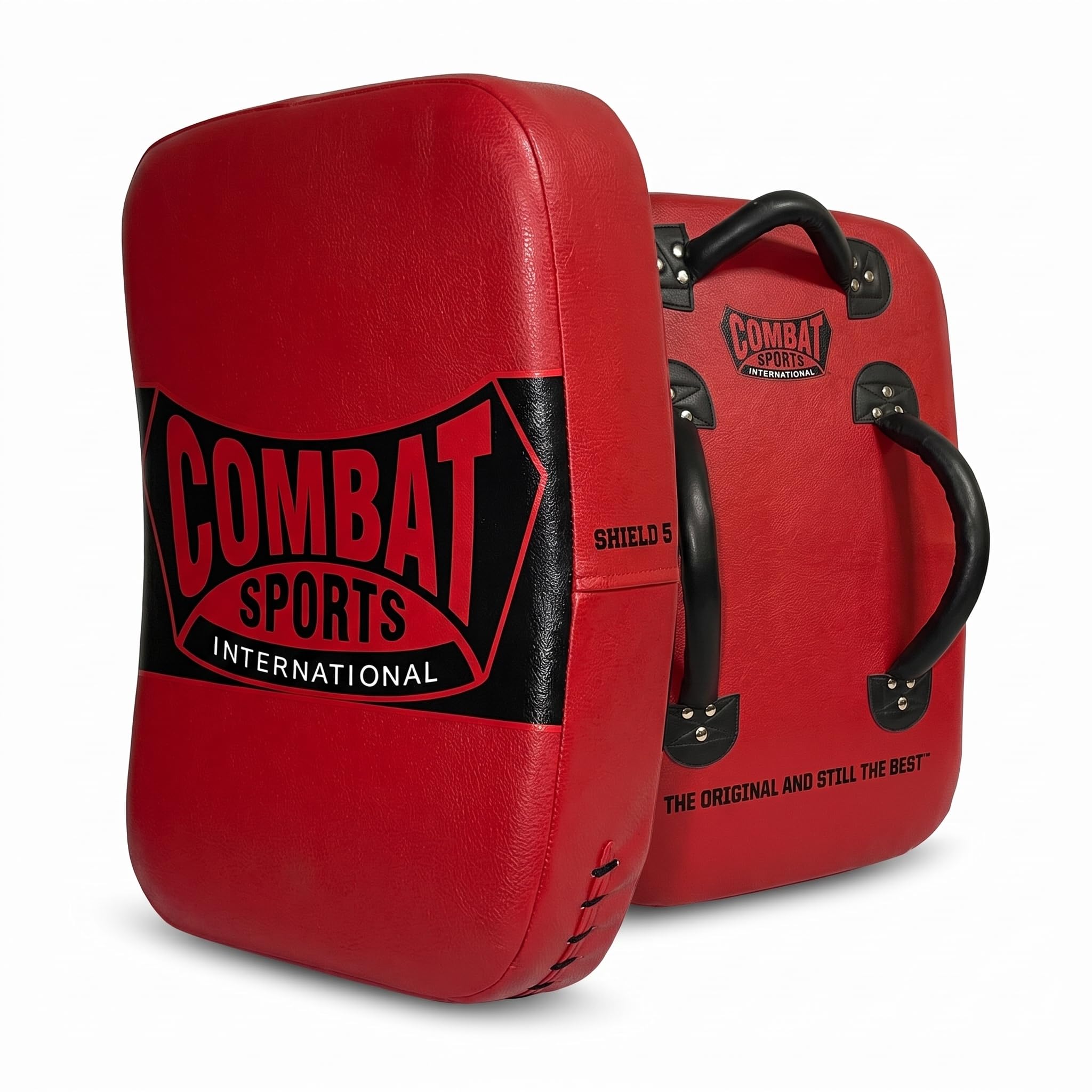
Combat Sports Big Kick Shield

Combat

Combat Sports Big Kick Shield

  • Handles Multiple reinforced handles
  • Pad Type Flat kick shield
  • Dimensions 24 x 17 x 5.5 in
  • Listed Weight 5 lb
Check Price on Amazon

Five and a half inches of foam behind riveted handles that hold.

Five and a half inches of foam is the number that matters here. The Combat Sports Big Kick Shield is 24 inches tall and 17 wide, thick enough that a full-force round kick disappears into it rather than traveling through to the person on the other side.

The back is where the design earns its keep. The handles are riveted rather than stitched, so they stay put when someone braces the shield against a hip and leans into a kick, and the faux leather front wipes down after a sweaty session. Every one of these we have handled has kept its shape, and the stitching has not been the part that failed.

For a coach working with adults who kick hard, this is the shield we pick. It is not the one to hand a child: the density that makes it last also means a hard kick carries into the holder, and a small frame cannot brace against that. If the person holding is much smaller than the person kicking, the lighter RDX shield is the kinder choice.

Bottom Line

If you hold for adults who kick hard and want a shield that is still intact next season, this is the one we buy.

Check Latest Price

Best for Home Taekwondo

Our Score 9.4/10
Juvale Taekwondo Kick Pads

Juvale

Juvale Taekwondo Kick Pads

  • Cover PU
  • Pad Type Rectangular TKD target
  • Dimensions 15 x 2.5 x 7.5 in
  • In The Box 2 pads
Check Price on Amazon

Two light targets whose built-in boards snap on clean contact.

The first thing you notice is the crack. Juvale builds a board into each of these targets, and a clean roundhouse makes a sharp snap you can hear from the other end of a yard. That sound is the whole point: it tells a beginner immediately whether the kick landed with the instep or the toes, at speed or at half effort.

For home Taekwondo practice, with a parent holding for a kid or an older sibling holding for a younger one, this is the pair we recommend first, and it is not close on value. You get two pads, wrist straps so they do not drop between kicks, 15 by 2.5 by 7.5 inches of PU-covered target, and a weight light enough that a child can hold one up through a whole session without complaining.

The snap has a condition attached. It comes on crisp contact, and a lazy tap gets a dull thud, which is either the best feedback tool you can hand a kid or a small daily frustration depending on whether they are chasing the sound or just swinging. That is the design working as intended rather than a defect, but it is worth knowing before you promise a five-year-old a bang on every kick.

Bottom Line

For a parent holding for a kid at home, this pair is the easy answer: two light targets, a snap that teaches timing, at a fraction of what a leather Thai pad costs.

Check Latest Price

Best Large Kick Shield

Our Score 9.4/10
RDX 60cm Kick Shield

RDX

RDX 60cm Kick Shield

  • Cover Leather and PVC
  • Handles 3 padded handles
  • Pad Type Curved kick shield
  • Dimensions 60cm x 36cm x 13cm
Check Price on Amazon

A wide, thick shield that keeps its shape through heavy round kicks.

A kick shield is a different job from a Thai pad. Where a forearm pad asks the holder to catch your kick, the RDX shield asks them to stand behind 60 by 36 centimeters of curved foam and let you unload. That width is why we put it at the top of the shields here for teep and push-kick work: there is somewhere to land even when your aim drifts.

Three padded handles let the holder change the angle between rounds, low for a body kick and higher for a head kick, and the hook-and-loop fastenings keep the shield from twisting on a combination. The 13 cm of padding takes heavy round kicks without the holder stepping back, and it is light enough to follow a moving student across a gym floor.

Two things to plan around. It is one shield, so a two-sided drill needs a second one. And the height that makes it forgiving for round kicks works against you on low kicks, which land near the bottom edge where there is less between your shin and the holder's knee. For pure leg-kick rounds, a forearm Thai pad sits lower and catches them better.

Bottom Line

For teeps, push kicks, and coach-led drills where you need a big landing zone, this is the shield we hand over: wide, thick, and light enough to keep moving for a full session.

Check Latest Price

Best Single Pad

Our Score 9.2/10
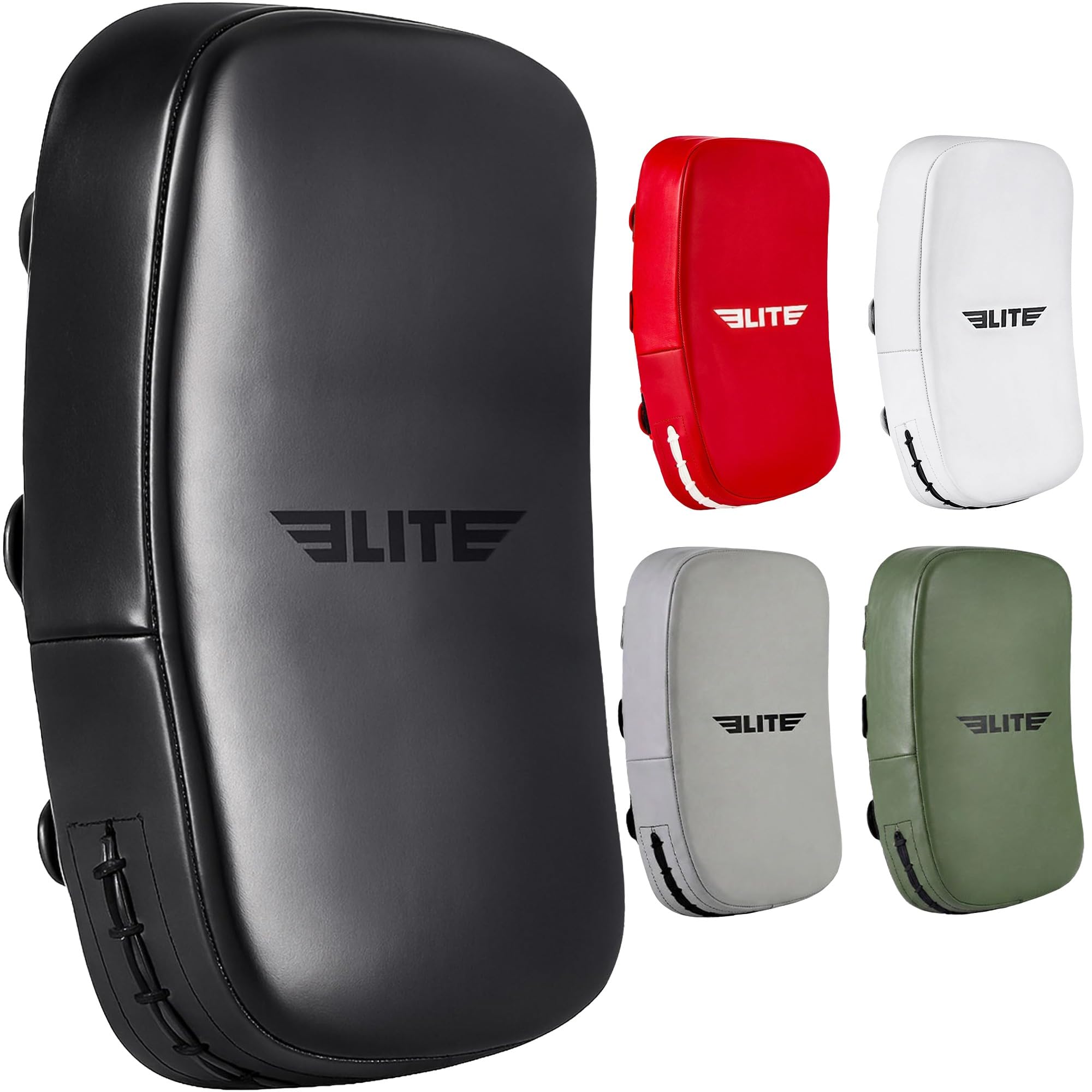
Elite Sports Pre-Curved Pad

Elite

Elite Sports Pre-Curved Pad

  • Straps 2 hook-and-loop
  • Pad Type Pre-curved forearm pad
  • In The Box One pad
  • Construction Quad-layer with gel foam
Check Price on Amazon

Gel-foam curved pad that moves as fast as your combination does.

Four layers, gel foam, a Nylex cover: the Elite pad reads like a spec sheet, and for once the numbers translate. The face is firm without being brick-hard, the gel layer takes the sting out of a misplaced shin, and the whole thing is light enough that it does not lag behind your foot when you fire a combination.

This is the one we keep in the bag for partner drills. The two hook-and-loop straps hold it flat against the forearm through hooks and elbows as well as kicks, and the extra cushioning where the arm rests is the sort of detail you notice in round three rather than round one. It is the pad we hand to whoever is holding for the round, because holding with it does not take a toll.

Bottom Line

For home partner drills and fast combination work, this is the pad we reach for: firm, well cushioned, and stable on the arm without any bulk fighting you.

Check Latest Price

Best For Two-pad drills

Our Score 9.2/10
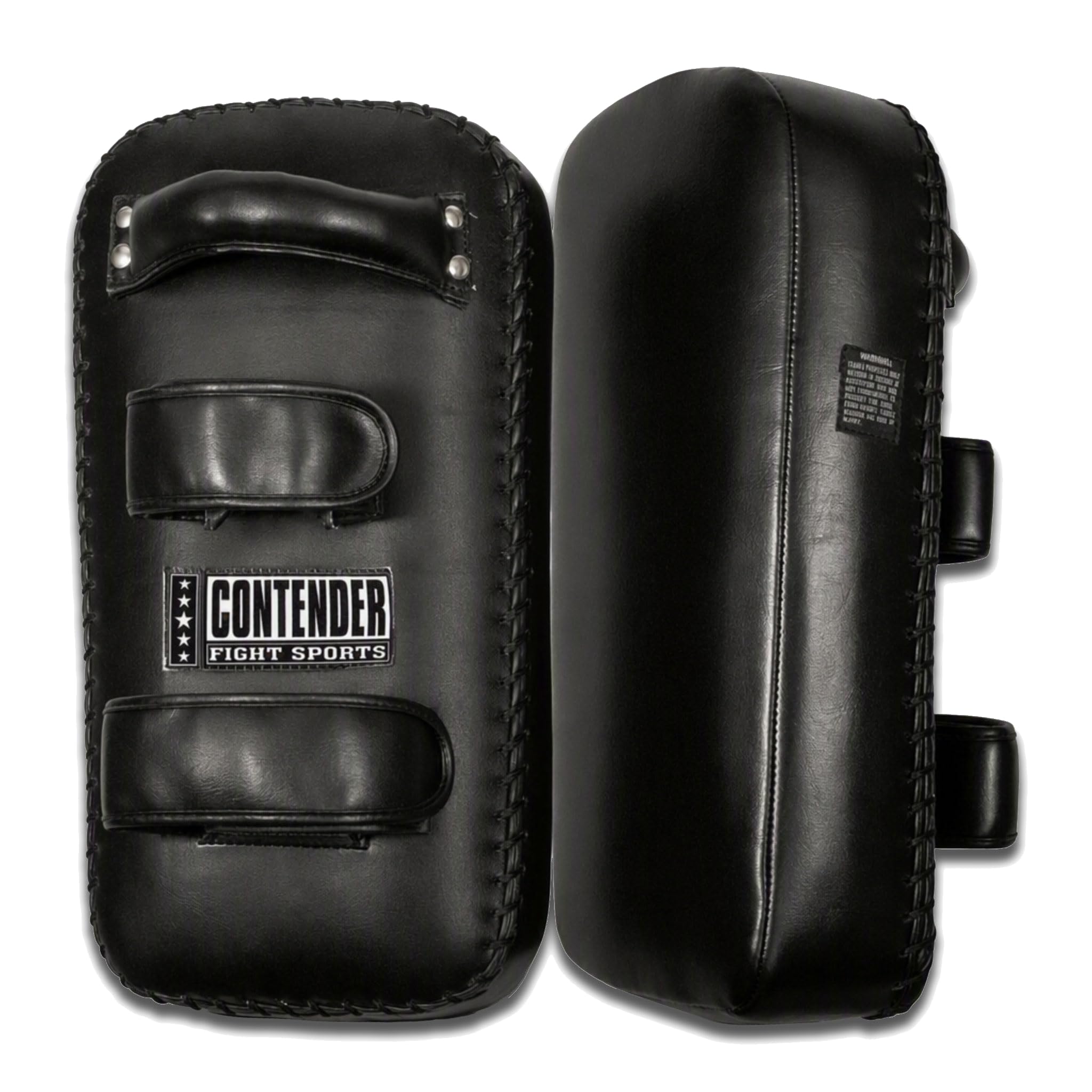
Contender Muay Thai Pads

Contender

Contender Muay Thai Pads

  • Cover Vinyl
  • Pad Type Curved forearm Thai pad
  • Dimensions 16 x 8 x 3.5 in
  • In The Box Pair of pads
Check Price on Amazon

Open the box outside. The Contender pads have a vinyl smell that is genuinely strong for the first week, the kind that takes over a garage, and it fades over months rather than days. That is the honest cost of the least expensive full pair of Thai-style pads here, and it is worth knowing before they come indoors.

What is inside is a proper pair of working pads: 16 by 8 by 3.5 inches, a riveted top handle plus two thick hook-and-loop forearm straps, and a vinyl cover that shrugs off sweat and wipes clean in a second. There is enough mass behind the face that a hard kick does not simply spin them, and the straps cinch down tight enough to stop the rotation that makes holding miserable.

The seams are what usually fail on a pad at this level, and these hold up: stitched edges, a reinforced handle, and covers that survive months of class work without splitting. They take elbows and knees as readily as kicks, which is more than the rectangular Taekwondo targets here can say.

If you can air them out on a porch or in a garage for a week, this is the most pad you get for the money here: a full pair, thick, and built for hard strikes. If they have to live in a closet beside your clothes, pay more and buy leather.

Bottom Line

If you want a full pair of Thai pads without the leather price, these do the job, as long as you plan a week of airing them out before they come inside.

Check Latest Price

Best For Budget Thai pad

Our Score 9.0/10
Farabi Curved Thai Pad

Farabi

Farabi Curved Thai Pad

  • Padding 6 layers
  • Pad Type Curved forearm Thai pad
  • Dimensions 14 x 7.5 x 3.5 in
  • Listed Weight 1.5 lb
Check Price on Amazon

This is the least expensive curved Thai pad in the group, and it shows in exactly one place: the size of the striking face.

Fourteen inches tall, 7.5 wide, 3.5 thick, one pad, synthetic leather over six layers of foam, with a grip handle and two hook-and-loop straps. At a listed 1.5 lb it is the lightest forearm pad here, which cuts both ways: easy to hold through a long session, and easier for a hard kick to move off the line.

The durability is the surprise. Synthetic covers usually give out at the seams first, and these hold together through months of steady work; the cover wipes clean and the straps keep their grip. It is the pad you can leave at a friend's house or in the trunk and not fuss over.

As a first curved pad, or a spare to round out a home setup, it earns its place: the shape is right for round kicks, the padding does its job, and you are not paying leather money for something that might spend the winter in a closet. It is what we hand a beginner who is not sure yet whether they will stick with it.

Bottom Line

If you want to try a curved Thai pad without spending leather money, this is where we start: the right shape, honest padding, and a weight that will not wear out a beginner's arms.

Check Latest Price

How We Tested Kick Pads (and What We Listened For)

We started with a shortlist of about 30 kick pads from established brands and a few newcomers, then narrowed it by size, cover material, foam thickness, and price tier. We ended up with 14 and rotated them through six months of regular training—bag rounds, partner drills, and a weekly class where nobody is gentle. Each pad saw front kicks, roundhouses, and knee strikes from different training partners, not one tester with one favorite leg.

Fresh out of the box, we pressed a thumb into each foam face to judge firmness and rebound, measured length and width against a standard target area, and sniffed the cover before and after a sweaty session; then we left it in a gym bag overnight to see if odor stuck. During drills we noted whether the pad stayed put on the holder’s forearm, whether the straps bit in or felt comfortable, and how the weight hung after several minutes of holding. We also paid attention to sound—a hollow slap usually meant the foam was compressing too fast, while a dull thud suggested better absorption.

After each session we checked seams, cover stitching, and strap elasticity, and at the six-month mark we compared the pads side by side for foam compression and surface cracking. The value question came down to construction, not price: a pad with clean seams, dense foam, and a cover that did not slick up with sweat was worth more than a cheaper one that needed replacing.

How to Choose

Match the pad to the strike you are training

A Thai pad is the curved, forearm-strapped pad used in Muay Thai and kickboxing gyms, and it catches kicks, knees, and punches. A rectangular Taekwondo target is lighter, held in one hand by a wrist loop, and built for accuracy and speed rather than absorbing power. A kick shield is the big curved slab a coach braces against the body for full-power kicks. Buy for the art you actually train: a Taekwondo target will not survive heavy low kicks, and a shield is clumsy equipment for teaching a child a front kick.

Count the pads before you order

A listing can show two pads in the photo and ship one in the box. The Fairtex curved pads here are single units, and so is the Elite; the Contender set and the Juvale targets arrive as pairs. Two-pad drills, one high and one low in alternation, need two pads. A single is fine for one-arm feeding, where a coach holds one pad and calls the strike, so decide which of those is your actual training before you click.

Firmness protects the holder, softness protects the striker

The padding does two jobs at once: it protects the person holding and gives the person kicking something to land on. Dense foam and thick leather protect the holder but arrive stiff and stay stiff for a while; softer foam is friendlier on a beginner's shin and folds under a hard kick. Leather breaks in and settles somewhere in the middle, which is why we prefer it for adults training weekly. For a child's home target, PU is the sensible, cheaper call.

Match the weight to the person holding

A pad is only as good as the person holding it, and tired hands hold badly. The cowhide Fairtex pair lists at 4 lb, the lightest curved pad here is 1.5 lb, and the big shields run to 5 lb. Hold for a strong adult kicker and you want mass plus something to brace against; hold for a nine-year-old and you want a pad you can keep up for twenty minutes. Match the pad to the smaller of the two people in the drill.

Straps, handles, and keeping the pad on the arm

Two forearm straps beat a single wrist loop for anything thrown with power: a loop keeps a target from dropping, but it will not stop the pad rotating when a round kick lands. On a shield, look for handles set at different angles so the holder can move from body kicks to head kicks without regripping. Whatever you choose, test the straps over a bare forearm, because a loose pad on a sweaty arm is where most near-misses start.

Frequently Asked Questions

Final Verdict

If you want one pair of Thai pads to grow into, the Fairtex STPAD4 is the pick: cowhide that wipes clean, a curved face that swallows hard round kicks, and a full pair in the box. It is the most expensive way to start and the cheapest way to finish, which is the whole argument for buying once.

Change the requirement and the answer changes. Hold for hours every week and the lighter Fairtex KPLC5 saves your shoulders. Outfit a child for home Taekwondo and the Juvale pair does more for less.