Cardio Machines

Best Incline Treadmills of 2026

An incline treadmill promises to turn a flat walk into a hill workout without leaving the house. The catch is that adding a grade puts more stress on the frame, the motor, and your floor—and cheap models often answer with a wobble you can feel in your teeth. I've tested home fitness gear for years, and the incline number on the console matters less than how stable the deck feels when you're actually climbing. A good one gives you low-impact cardio that fits in a spare room; a bad one just takes up space.

Over eight months, we lived with six incline treadmills, from compact to full-size. We assembled each one, measured footprint and deck length, and tracked the stuff that surfaces later: noise at 6 a.m., belt drift, console glitches, and whether moving it takes two people. The best earned their price by staying solid at a 10 percent grade, keeping the belt centered, and making daily walks easy to start. The picks below are the ones I'd hand to a friend, not the longest spec sheet.

Best Compact Auto Incline

Our Score 9.6/10
WELLFIT TM037PRO

WELLFIT

WELLFIT TM037PRO

  • Motor 3.5 HP brushless
  • Incline 12% automatic
  • Weight Capacity 375 lb
  • Folded Thickness 5.5 in
Check Price on Amazon

Folds to 5.5 inches with 12% auto incline and a 3.5 HP motor.

Folded, the deck is 5.5 inches thick and the whole machine weighs 57 pounds, which is the shape of the promise here: an automatic-incline treadmill you can stand against a wall when the room needs to be a living room again.

The rest of the specification backs it up. Twelve percent of automatic incline, a 3.5 HP brushless motor, a 375-pound capacity, a 40-by-16-inch belt, and a 10-inch display; speed runs to 7.6 MPH and you can control it from the console, the remote, or the app. That is a lot of treadmill in something that stores flat.

What sold us is the coverage: three years, full, plus lifetime technical support — twice the Merach's term, and the kind of warranty that matters on a machine with a motor. The 40-inch belt is the compromise: plenty for walking and light jogging, tight if your stride is long or you want to run.

Bottom Line

The best auto-incline treadmill here for a small room: 12% on demand, a 3.5 HP motor, and three years of coverage in a machine that folds to 5.5 inches.

Check Latest Price

Best Walking Pad With Auto Incline

Our Score 9.4/10
TRAILVIBER X01 Walking Pad

TRAILVIBER

TRAILVIBER X01 Walking Pad

  • Incline 12% automatic, 9 levels
  • Belt Size 41" x 16.5"
  • Top Speed 4 MPH
  • Weight Capacity 450 lb
Check Price on Amazon

One-button 12% incline, a 450-pound capacity, and it stores under a bed.

A 450-pound capacity on something that slides under a bed is unusual, and it is the first thing we check on a walking pad because it says a lot about how the frame is built. The Trailviber's steel frame, double-deck structure, and four silicone absorbers put it at the stout end of this group despite a 44-pound body.

What we like better than the capacity figure is the incline: 12% across nine levels, changed with a button rather than by stepping off. Automatic incline on a pad this small is rare, and it changes how the machine gets used — you can bump the grade two minutes into a walk because you are bored, which is exactly the moment a manual design gets ignored. The four-mile-an-hour ceiling is the honest boundary: this is a walking machine, and a very good one.

The three-year warranty is the longest here, the wheels make it easy to shift between rooms, and the Bluetooth speaker with the app is a bonus rather than the reason to buy. What it does not give you is anything to hold: there are no handrails, and at 12% you feel that in your ankles for the first week.

Bottom Line

Incline walking without a gym-sized machine: 12% on a button, a 450-pound frame, and a three-year warranty, all light enough to move between rooms.

Check Latest Price

Best for Runners

Our Score 8.8/10
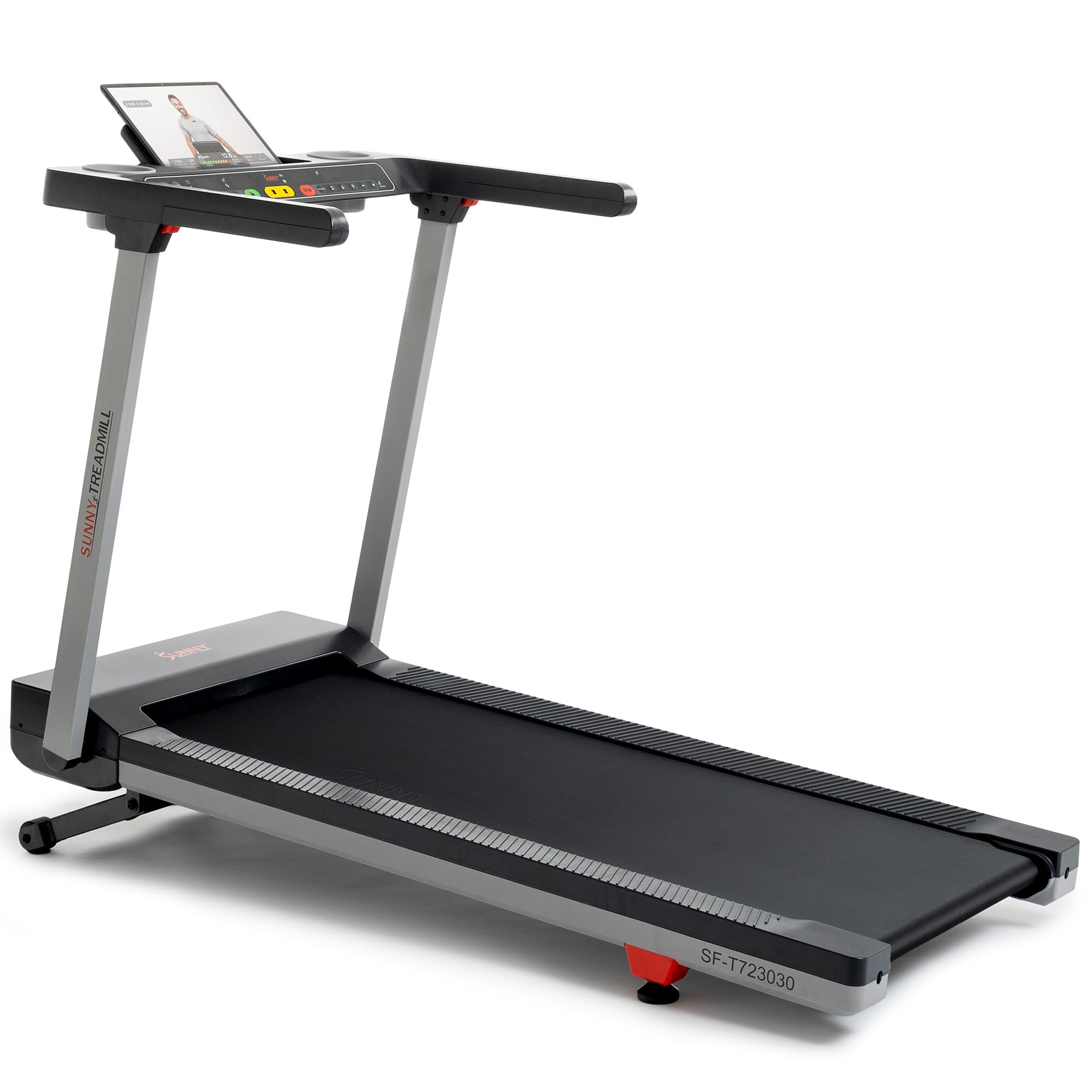
Sunny Health & Fitness SF-T723030

Sunny

Sunny Health & Fitness SF-T723030

  • Incline 15% automatic, 15 levels
  • Top Speed 10 MPH
  • Running Surface 20" x 53"
  • Weight Capacity 300 lb
Check Price on Amazon

A 20-inch-wide deck, 10 MPH, and it arrives fully assembled.

Nothing here is as easy to live with on day one. The Sunny arrives fully assembled: raise the handlebar, lock it, plug it in, and you are walking. Anyone who has spent an evening cross-legged on the floor with a bolt bag and a diagram will understand why we start there.

The belt is what keeps it near the top, though. Twenty inches wide and 53 long, it is the roomiest running surface in this group, and if you have ever clipped a heel on an 18-inch belt at speed you know why that matters. Fifteen levels of automatic incline reach 15%, the quick keys sit within reach, and the 2.5 HP brushless motor runs to 10 MPH — a real running machine rather than a walker with ambitions.

The warranty math is the catch. The frame gets three years, but the motor, belt, electronics, and labor get 180 days. On a machine that costs this much to service, that is the difference between a low-stress purchase and a bet, and it is the reason the Merach edges it out for most people.

Noise is the other thing to know: quiet and smooth when it is new, with squeaks that arrive as the belt and deck wear in. Keep the belt lubricated and the deck wiped down and you push that out. It is also around 130 pounds, so wherever you put it is where it stays.

Bottom Line

The widest running surface in this group and the only one that arrives assembled — our pick for runners who would rather not spend an evening with a bolt bag.

Check Latest Price

Best for Steep Hill Training

Our Score 8.8/10
CURSOR X5FD

CURSOR

CURSOR X5FD

  • Motor 3 HP brushless
  • Incline 40% manual, 5 levels
  • Handrail Height 51 in
  • Weight Capacity 350 lb
Check Price on Amazon

Five manual grades to 40%, with 51-inch handrails made for tall users.

Forty percent is not a bigger version of fifteen. At full slope the deck sits 15 inches off the floor and you are climbing rather than walking, which makes this the only machine here built for genuine hill work — and our pick when the goal is legs and lungs rather than step count.

Five settings — 0, 10, 20, 30, and 40% — and you choose one before you start; the legs flip out at the front and lock into a stable triangle. That is deliberate training rather than interval play, and it suits the machine's other strength: 51-inch dual handrails tall enough for a six-foot user to stand upright and hold on, with a 38.6-by-15.4-inch belt underfoot.

Three horsepower, a 350-pound capacity, and a 57-pound frame that folds at the front feet. It runs quietly enough for an apartment, and the layered cushioning takes some of the sting out of walking back down.

The practical catch is headroom: at 40% you are stepping up onto a knee-high deck, so check what is above the machine and not just around it. The one-year warranty is short for something this specialized, which is why we see it as a second machine or a dedicated hill trainer rather than an all-rounder.

Bottom Line

The steepest machine here and the only one with rails tall enough for taller users — a hiking trainer for steady climbing, not for intervals.

Check Latest Price

Best For App-led intervals

Our Score 8.8/10
KALWOL Walking Pad

KALWOL

KALWOL Walking Pad

  • Motor 2.75 HP brushless
  • Incline Manual, 10%
  • Belt Size 40" x 16"
  • Weight Capacity 350 lb
Check Price on Amazon

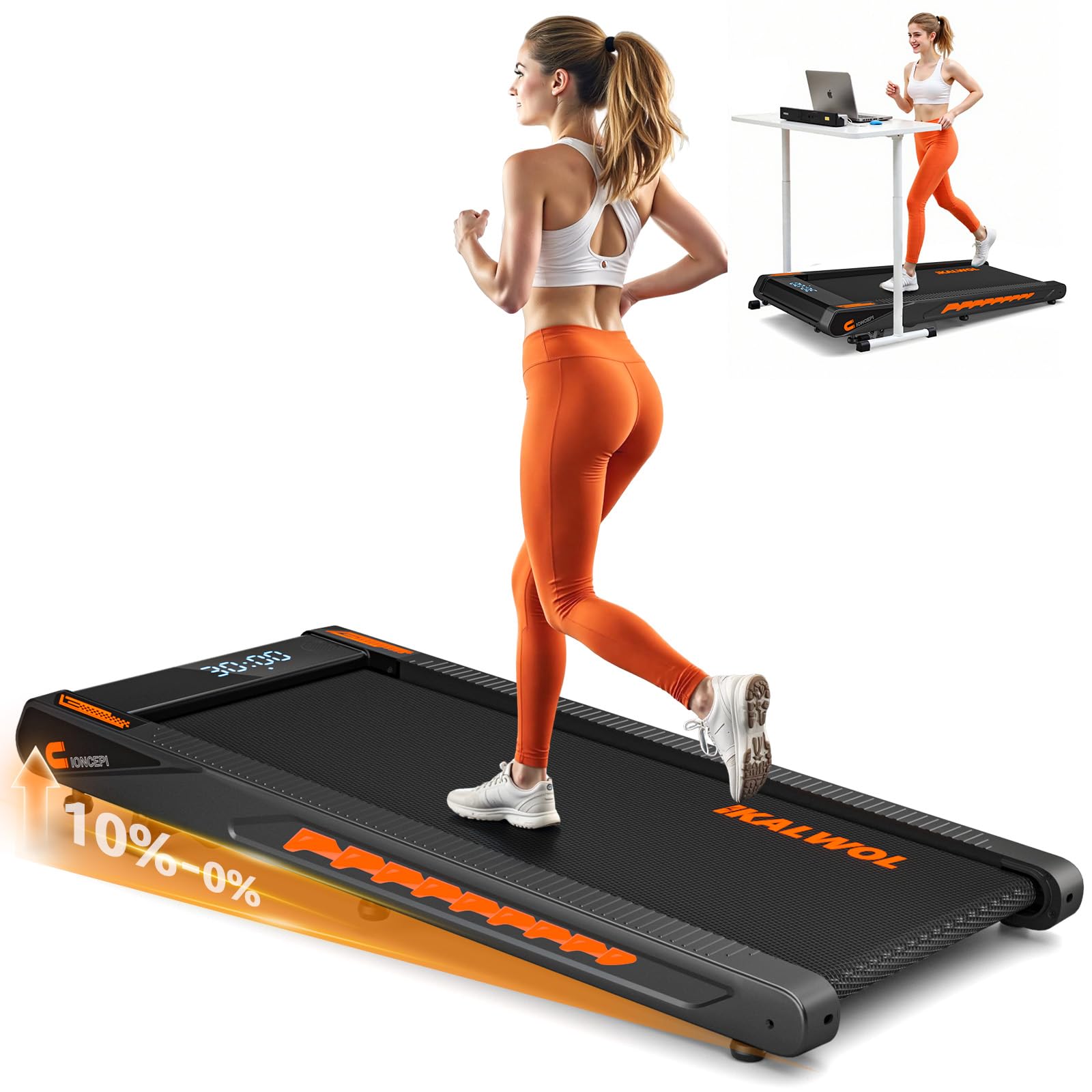
A speaker on a walking pad reads as a gimmick until you are forty minutes into a Zwift session and do not want to hold a phone. The Kalwol is the only pad here with built-in audio, and it pairs with Fitshow, Kinomap, and Zwift — an odd set of priorities for a walking pad, and a sensible one for anyone who trains with an app.

The incline is a 10% manual lever you move in about a second, no screws and no kneeling on the floor. That is a better system than the flip-out legs on the Lontek and the Cursor, and it means you can change grade between walks without hunting for a wrench.

Around it sits competitive hardware: a 2.75 HP brushless motor, 6.2 MPH, a 350-pound capacity, a 40-by-16-inch belt with ten shock columns, and twelve HIIT programs with time, distance, and calorie countdowns. Most pads at this size give you a speed dial and nothing else.

For app-led interval walking, this is the pad we like best here; for pure grade, the Lontek goes steeper. What you give up is something to hold — there is no handrail — and 10% is the ceiling, which is enough to make a walk harder and not enough to feel like a climb.

Bottom Line

The pad to buy if you train with an app: built-in audio, Zwift and Kinomap pairing, twelve HIIT programs, and a 10% grade you set by hand.

Check Latest Price

Best For Budget incline walking

Our Score 8.6/10
LONTEK U20F-1 Walking Pad

LONTEK

LONTEK U20F-1 Walking Pad

  • Motor 3 HP brushless
  • Incline Manual, 3 levels to 15%
  • Belt Size 37.4" x 15"
  • Weight Capacity 350 lb
Check Price on Amazon

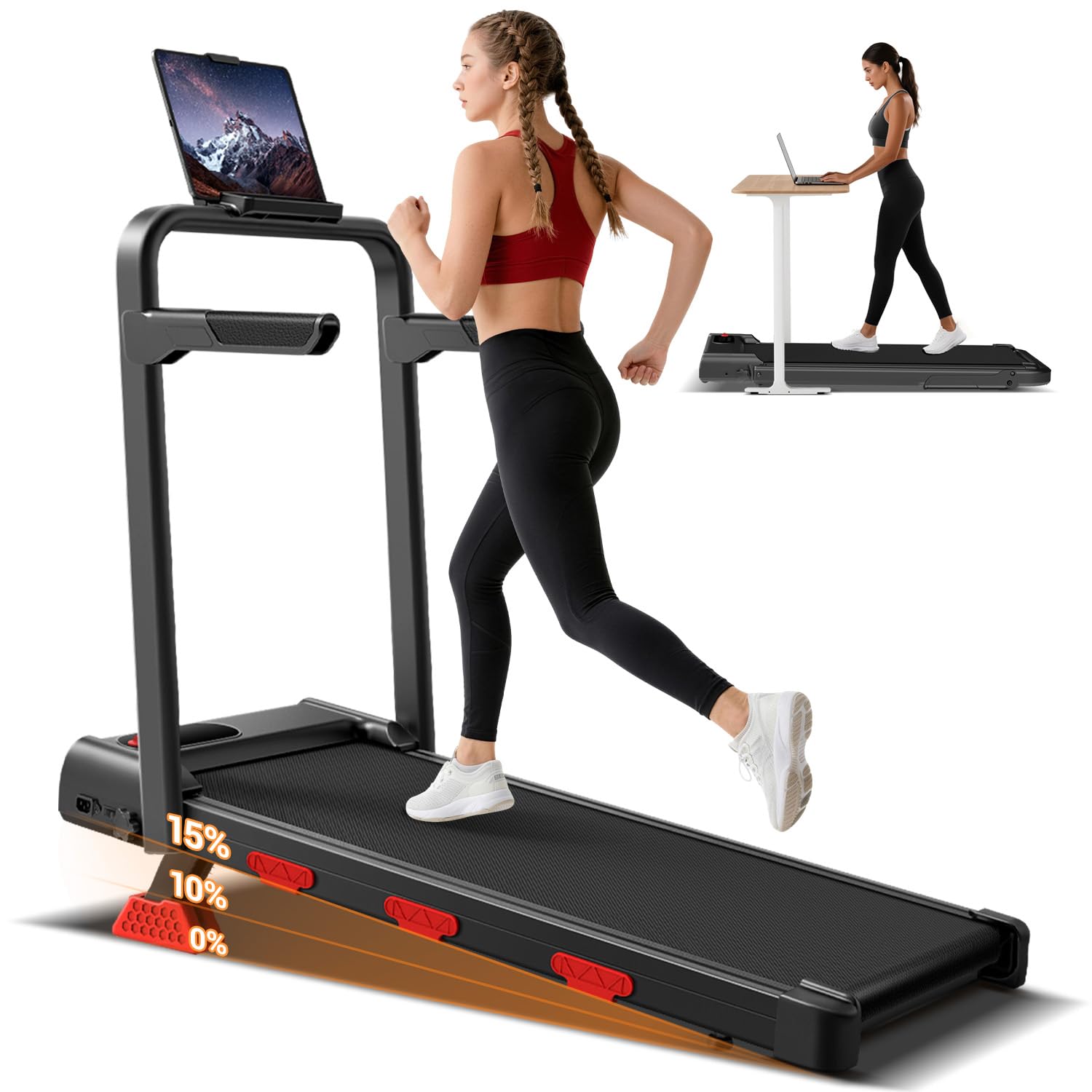
Three grades — flat, 10%, and 15% — set by flipping out a pair of legs at the front of the deck. You do it standing beside the machine, so it is a decision you make before a walk rather than during one. For the money, it is the most incline you can get in a folding pad.

The rest is sensible: a 3 HP brushless motor that stays quiet, a 350-pound capacity, speeds to 6.2 MPH, a 37.4-by-15-inch belt, and a detachable phone cradle. The body is slim, and the shock strips along the belt edges take some of the edge off a long walk.

What earns it a place is the combination: 15% of grade, a 3 HP brushless motor, and a 350-pound rating for about what the Viamotion asks, which nothing else in this group matches. It is the budget incline pick, and it makes the case that you do not need automatic adjustment to train on a slope.

The trade is size. A 37.4-inch belt is the shortest here — fine at a stroll, cramped the moment you push past a couple of miles an hour — and the handrail is set low enough that taller walkers hunch over it. Think of it as a walking machine with a slope, not a jogging pad.

Bottom Line

The most incline you can get on a budget: 15% on flip-out legs, a 350-pound frame, and a belt short enough that you will want to keep it to walking.

Check Latest Price

Best Overall

Our Score 8.4/10
MERACH T31 Incline Treadmill

MERACH

MERACH T31 Incline Treadmill

  • Motor 3.5 HP brushless
  • Incline 18% automatic
  • Top Speed 8.7 MPH
  • Weight Capacity 350 lb
Check Price on Amazon

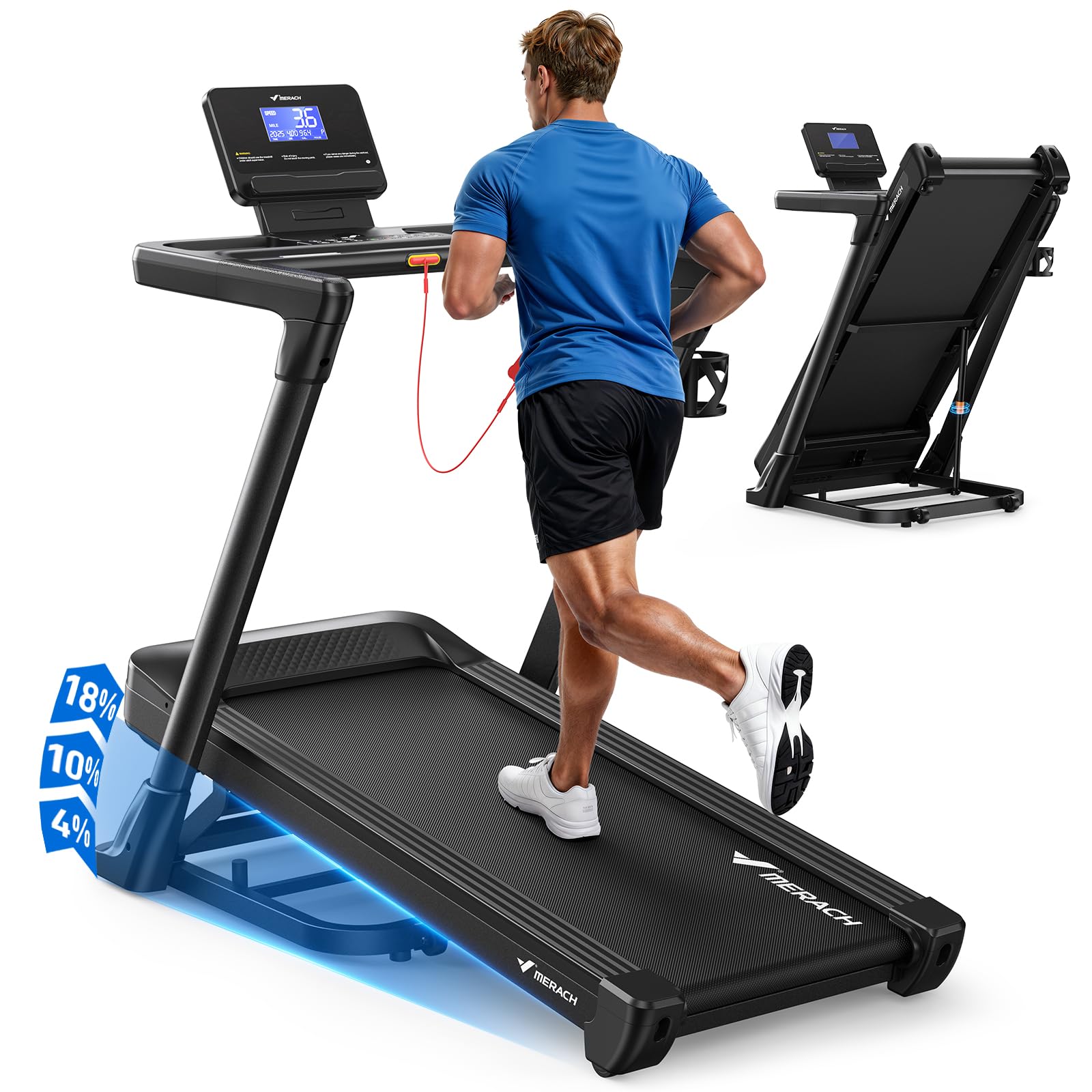
Auto incline to 18% with a 3.5 HP motor built for walking and jogging.

Eighteen percent is the number that puts this one first, and it earns it in use rather than on paper. Press the incline control mid-walk and the deck climbs without you breaking stride, which is the whole point of buying an incline machine: a three-mile-an-hour walk turns into hill work instead of a flat trudge. The 3.5 HP brushless motor holds the belt steady as the grade rises, and with 8.7 MPH on tap there is room for jogging and intervals too.

Stability is the other half of it. The frame is steel, the deck is cushioned, and the machine feels planted when you lean into a climb — the sort of thing that matters more at 18% than at 3. Incline responds quickly enough to follow an interval timer without you standing on the button, and the 350-pound capacity covers most households.

It folds, and the fold is a real one, but this is a substantial machine that wants a permanent corner rather than a closet shelf. Setup is the usual hour with bolts, and the console is a plain LED readout rather than a screen. Neither is a dealbreaker at this price.

Where it stops: this is the priciest machine here short of the Sunny, and if you only ever walk on the flat, you are paying for a grade you will not use. For anyone who will use the climb, it is the easiest recommendation on the page.

Bottom Line

Eighteen percent of automatic incline, a 3.5 HP brushless motor, and a 350-pound frame make this the most complete incline treadmill here for walking, jogging, and hill work.

Check Latest Price

Best Budget

Our Score 8.2/10
Viamotion Walking Pad with Handle

Viamotion

Viamotion Walking Pad with Handle

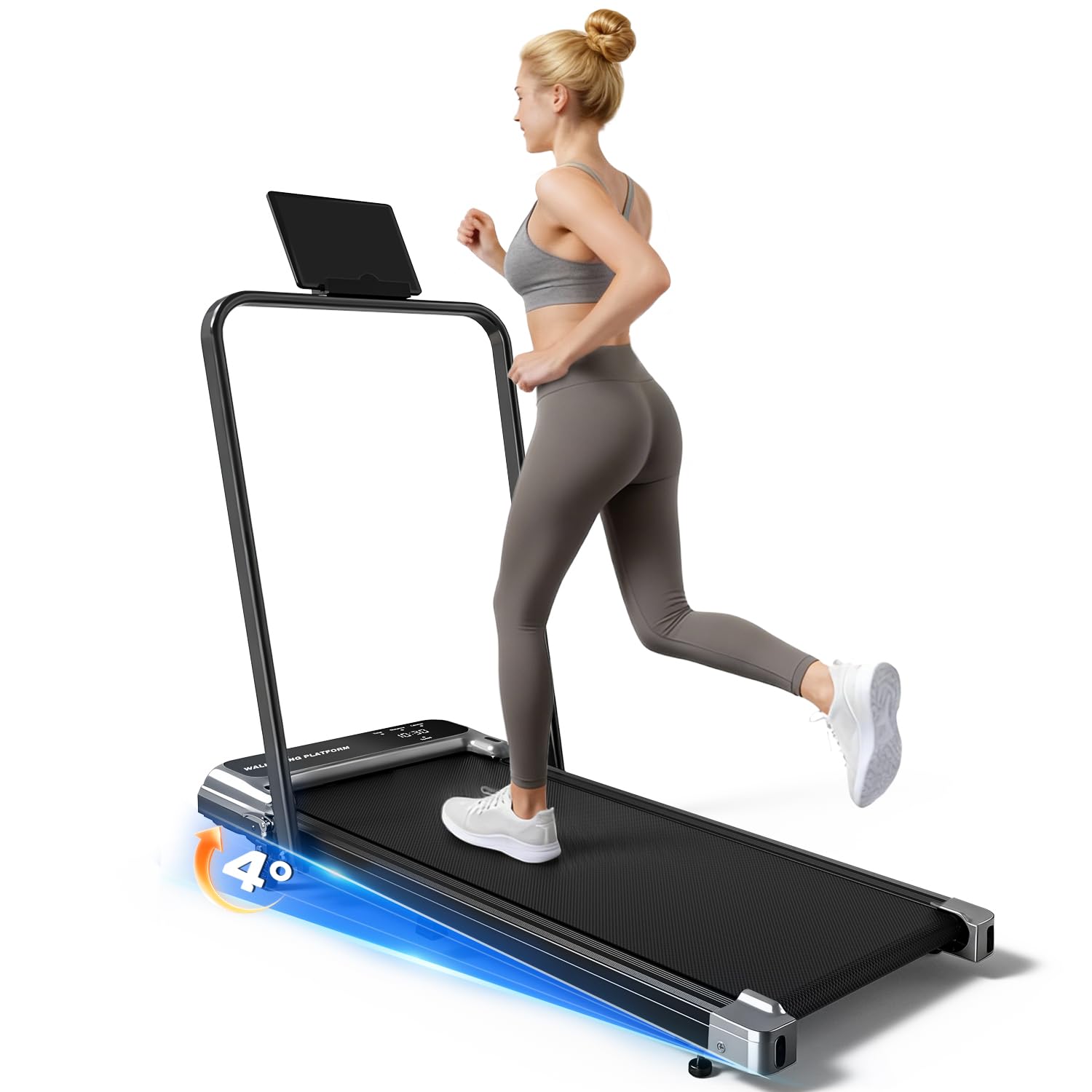
  • Incline Manual, 4 degrees
  • Top Speed 3.8 MPH
  • Item Weight 39.7 lb
  • Weight Capacity 265 lb
Check Price on Amazon

The least expensive way here to get a moving belt and a handle.

This is the least expensive way here to get a moving belt with something to hold on to, and in a small apartment that is most of the argument. It folds upright against a wall or slides under a bed, and setup is close to nothing — unbox it, plug it in, walk.

The incline is the modest part: four degrees, set by hand, enough to take the flatness out of a walk and nowhere near the 12% machines. Speed tops out at 3.8 MPH and capacity at 265 pounds, and the frame is plastic rather than steel. For walking while the television is on, none of that gets in the way.

Two things show up in use. The handle is fixed and sits forward, so taller walkers end up leaning into it instead of standing upright, and the belt can drift off center and need re-tracking — check that the machine sits level and the rear feet are down before you touch the adjustment bolts.

Buy it for steady walking in a small room, on a small budget, with no ambitions about grade. If you want an incline you can feel, or you are tall enough that the fixed bar leaves you stooping, the Lontek asks about the same money and gives you 15% and a 350-pound frame.

Bottom Line

A small, light walking pad for a small budget: fine for steady walking in a tight room, short of the grade and speed the next step up buys you.

Check Latest Price

How We Tested the Best Incline Treadmills

We began by pulling more than 40 incline treadmills from established fitness brands, then narrowed the field to six using specs and owner feedback: footprint, incline range, motor power, deck length, warranty, and price. We ruled out models with a top grade below 10 percent or a deck shorter than 50 inches, since those tend to feel cramped for taller walkers and runners.

Each of the six went into a real home—a spare bedroom, a finished basement, and an apartment living room with neighbors below. We assembled every treadmill solo, timing from box opening to first walk and noting which steps really needed a second person. For eight months, testers used them for daily walks, incline intervals, and the occasional run, logging noise with a phone decibel meter at three feet, checking belt alignment after each session, and measuring footprint, folded depth, and deck length with a tape. We also weighed each unit and rolled it across carpet and hardwood to judge how hard it was to move.

At a 10 percent grade and 6 mph, we noted whether the frame shook, the belt slipped, or the motor lagged. We ran every console through its presets and Bluetooth pairing, and watched whether incline changes felt smooth or jerky. By month eight, we knew which machines stayed quiet, which needed belt adjustments, and which felt like a fair trade for the money. Reliability showed up in small ways: a console that forgot its settings, a belt that drifted right, a folding latch that loosened.

How to Choose

Automatic or Manual Incline

Automatic incline moves the deck from the console or a handrail button, so the grade changes while you keep walking. Manual incline means stopping, stepping off, and either flipping out a set of legs or moving a lever. If you follow intervals or a class, automatic is worth paying for; if you set one grade and walk for forty minutes, manual costs you nothing but a pause at the start.

The Merach, Sunny, Wellfit, and Trailviber are all automatic. The Cursor, Lontek, Kalwol, and Viamotion are manual, and the difference shows up in how often you actually use the slope.

How Much Incline You Actually Need

Most home incline training happens between 5% and 15%, which is where the automatic machines here top out. That is enough to make a three-mile-an-hour walk genuinely hard work. Past 15% the workout changes from walking to climbing: the Cursor's 40% setting is a hiking tool, and you will be moving slowly on it.

Check the space above the machine, not just around it, because the deck rises with the grade — the Cursor's deck sits 15 inches off the floor at full slope. Walking while you work at a desk wants 0% to 12%; training for a trip with real elevation is where steeper earns its place.

Match the Motor and Speed to How You Move

Walking pads here top out between 3.8 and 6.2 MPH; the full-size machines run to 8.7 or 10 MPH. That ceiling tells you what the machine is for. A 2.5 to 3 HP brushless motor is plenty for walking and light jogging; running wants 3.5 HP and a top speed near 8 MPH or more, because a motor working at its limit gets loud and hot.

Watch for speed a short belt cannot support. A 7 MPH figure on a 40-inch deck is a number you will not use comfortably, and the same money buys a sturdier walking machine instead.

Deck Length, Handrails, and Your Height

Belt length decides whether you can run. The pads here measure 37 to 41 inches; the full-size machines run 53 to 55. At walking pace a short belt is fine; as you push past a couple of miles an hour, 37 inches starts to feel like a plank.

Handrail height matters just as much if you plan to hold on. The Cursor's rails stand 51 inches and suit taller users, while the fixed handle on the Viamotion sits forward and low enough that taller walkers lean into it. Compare those two numbers with your own height before ordering.

Footprint, Weight, and Noise

Ask where the machine lives when it is not running. The Wellfit folds to a 5.5-inch profile, the Trailviber weighs 44 pounds and has wheels, and the lighter a machine is the more often you will actually stow it. Full-size treadmills are another category: the Sunny runs around 130 pounds and stays where you put it.

Noise is worth planning for as well. Belt hum and footfall carry through floors, and squeaks tend to arrive with wear rather than out of the box, so a mat over a hard floor does more than any quiet-motor claim.

Frequently Asked Questions

Final Verdict

For most homes, the Merach T31 is the incline treadmill to buy. Eighteen percent of automatic incline covers everything from a flat walk to a real climb, the 3.5 HP motor has headroom for jogging, and the frame stays planted as the deck rises — which is the part cheap incline machines get wrong.

Two alternatives change the decision. If you run and want a 20-inch deck without assembling anything, the Sunny SF-T723030 is the better machine despite its skimpy parts warranty. If the treadmill has to live under a bed, the Trailviber gives you one-button 12% incline in a 44-pound pad.