Home Gym

Best Home Gym Flooring Over Carpet of 2026

Carpet is kind to bare feet and brutal on a home gym. A squat stance sinks in, the bench wobbles, and within a week there's a permanent footprint pressed into the pile. What you need is a layer that spreads the load, grips the carpet instead of skating across it, and comes back up when you move — but the wrong one either crushes the carpet underneath or curls at the edges the first time you set a dumbbell down.

The number most shoppers fixate on is thickness, and it's the number that lies: a half-inch foam tile feels wonderful underfoot and turns a kettlebell into a balance test. I've spent eight months living with 12 of these in a carpeted spare room, and the keepers were firm enough to bridge the pile, sized to cover a real training area, and priced so a worn tile could be swapped without wincing. Grip, stability, and how the edges behaved after a month of lunges did the rest of the sorting — the picks below are the ones I'd lay down again.

Best Value for a Large Area

Our Score 9.6/10
CAP 1-Inch Puzzle Mat

CAP

CAP 1-Inch Puzzle Mat

  • Coverage 48 sq ft (12 tiles)
  • Material EVA foam
  • Thickness 1 inch
  • Tile Size 24 x 24 inches
Check Price on Amazon

A full inch of cushioning across 48 square feet without a premium price.

The CAP set is aimed at the carpeted room where the workout happens on the floor: stretching, core work, and moderate weights. Twelve 24-inch tiles cover 48 square feet at a full inch thick, which is twice the depth of many puzzle mats here. That extra depth is the point over carpet: it bridges the pile and gives knees, elbows, and bare feet a softer landing.

We like it for that job. The 1-inch EVA is firm enough to support a bench or a set of dumbbells, but it is still a foam tile, so it feels more forgiving than a rubber-top surface. The T-pattern texture adds some traction, and the tiles are water-resistant enough to wipe clean after a sweaty session. The 15-pound set is light enough to move alone, and the border pieces give the layout a finished edge.

The boundary is heavy equipment. Under a loaded rack or a dropped barbell, the foam can compress and the floor stops feeling planted; if that is your training, a rubber-top tile is the better choice. For a larger area of floor work and moderate weight, this is the value pick in this group.

Bottom Line

Choose the CAP set if you want the most cushioned floor for bodyweight work and moderate weights across a full 48 square feet, and you do not need a rubber-top surface.

Check Latest Price

Best for Extra-Thick Comfort

Our Score 9.4/10
Xspec 1-Inch Foam Tiles

Xspec

Xspec 1-Inch Foam Tiles

  • Coverage 48 sq ft (12 tiles)
  • Material EVA foam
  • Thickness 1 inch
  • Tile Size 24 x 24 inches
Check Price on Amazon

A plush 1-inch surface for yoga, stretching, and joint-friendly floor work.

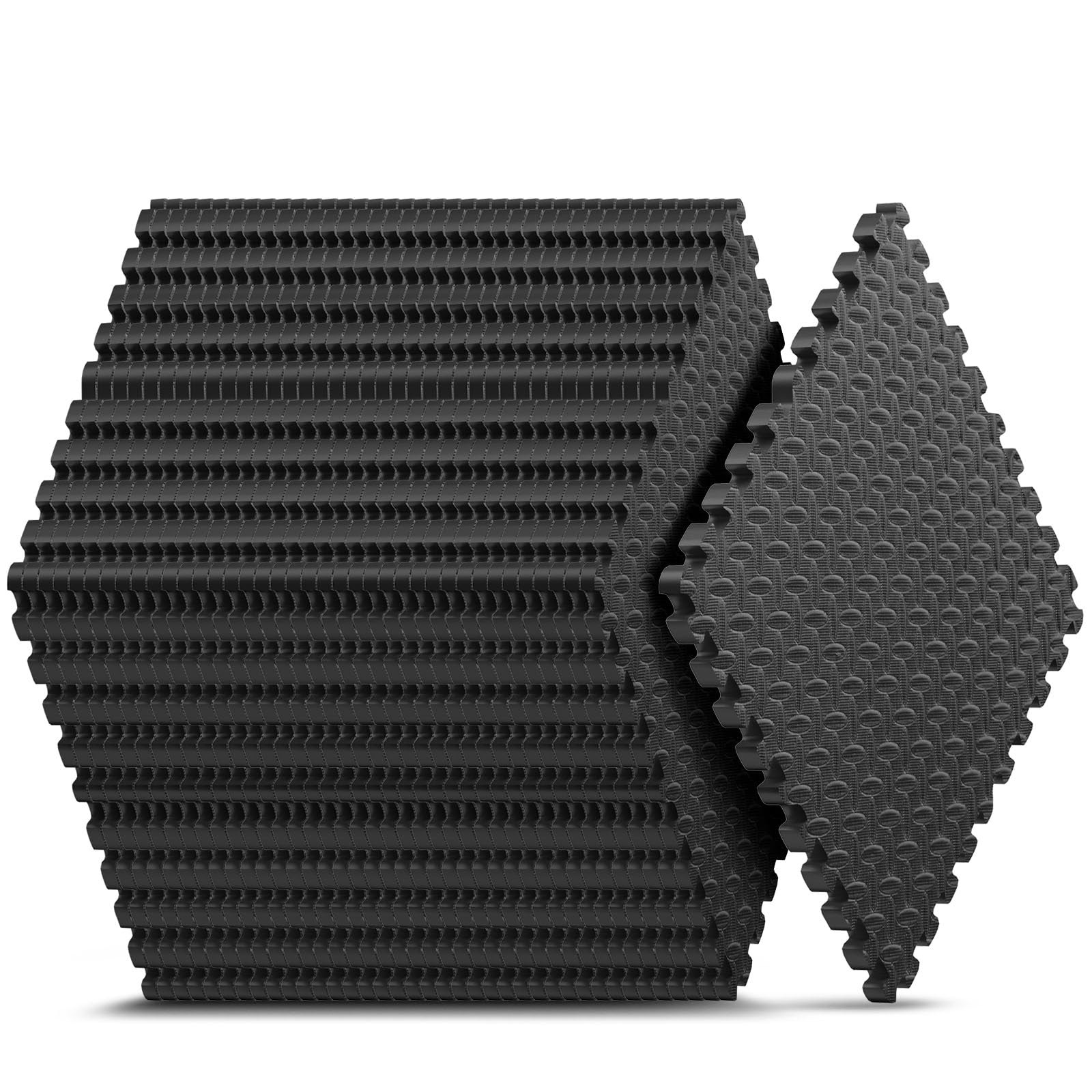
A full inch of EVA is the reason the Xspec set stands out here. Twelve 24-inch tiles cover 48 square feet, and the reversible steel pattern gives the surface more texture than a smooth foam mat. The 1-inch thickness is the plushest surface in this group, which is exactly what some carpeted rooms need.

The tiles are 15 pounds for the set, light enough to move and reconfigure, and the interlocking edges click together without tools. The reversible design gives you two color options, and the water-resistant surface wipes clean. For yoga, stretching, and floor work, the extra depth is a real comfort advantage over a half-inch tile.

We like it for comfort, not for a heavy rack. Xspec's own note warns that excessive weight can indent the tiles and recommends carpet tape or a wall-to-wall layout if they slide, which is the right way to think about it: use it as a comfortable training surface, not a bombproof platform. If you need a dead-flat surface for loaded lifts, choose a rubber-top tile instead.

Bottom Line

Pick the Xspec set for the plushest 1-inch surface here, especially for yoga, stretching, and joint-friendly floor work; it is not the tile for a heavy rack.

Check Latest Price

Best Overall

Our Score 9.2/10
AIRHOP Rubber-Top Gym Tiles

AIRHOP

AIRHOP Rubber-Top Gym Tiles

  • Coverage 24 sq ft (6 tiles)
  • Material EVA foam with rubber top
  • Thickness 0.56 inches
  • Tile Size 24 x 24 inches
Check Price on Amazon

A firmer rubber-top surface that handles carpet, weights, and floor work.

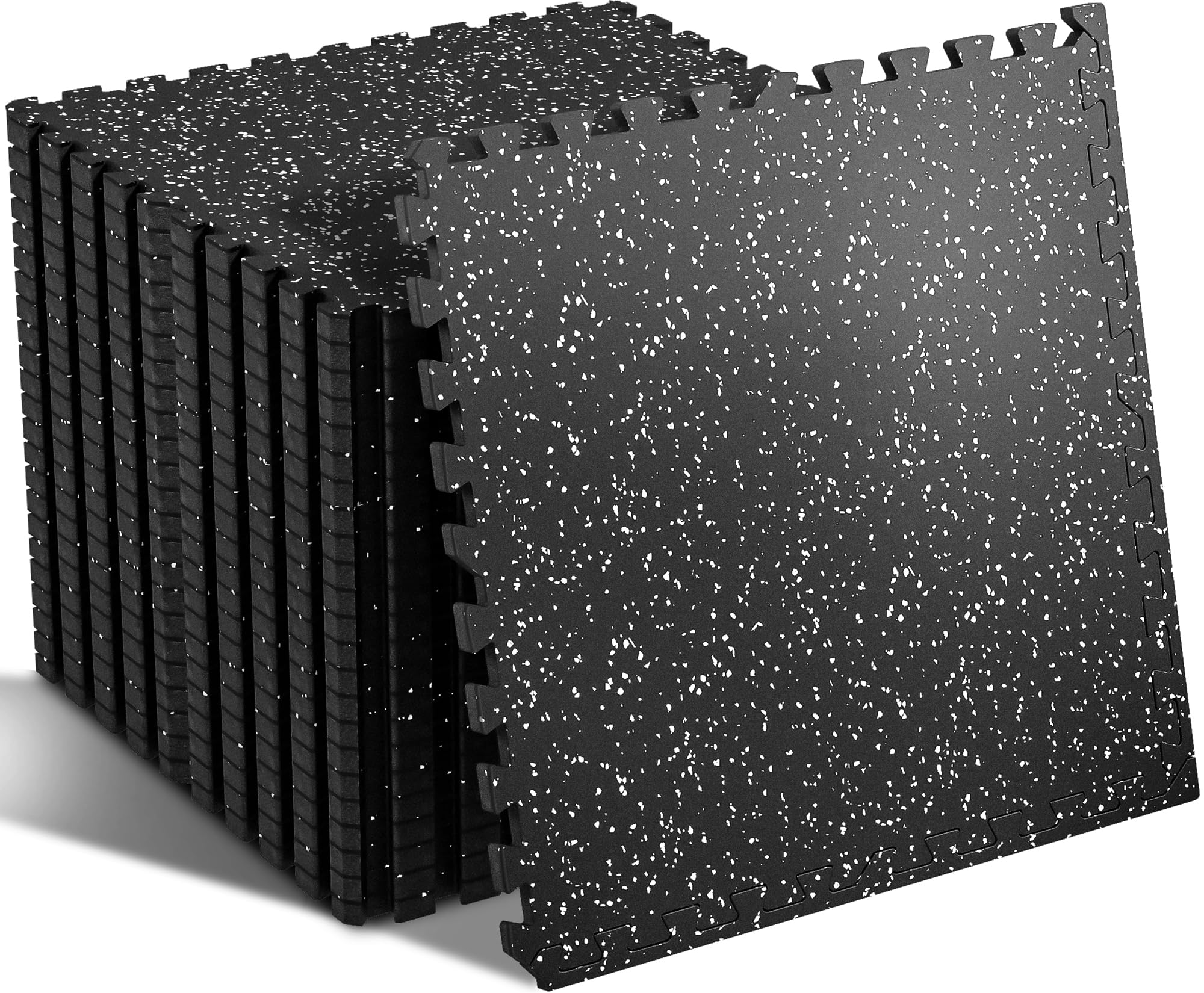
The AIRHOP set puts a rubber top over a high-density EVA foam base, and that two-layer build is the first thing we look at for a carpeted room. Carpet gives underfoot, so a plain foam tile can feel like a sponge; the rubber layer gives the surface a firmer, more gym-like feel while the foam underneath takes the edge off. Six tiles cover 24 square feet, or a 6-by-4-foot area, which is enough for a rack, a bench, or a small mat zone.

We put it at the top of this list because it solves the over-carpet problem better than a single-layer foam tile. The 0.56-inch thickness is substantial without turning into a trampoline, and the set is listed at 6.55 kg, or about 14.4 pounds, for six tiles. That weight is a useful buffer against the light, skittery feel of thin foam, and the larger interlocking locks hold the layout together when you move from the bench to the floor.

The trade-off is coverage: one set is 24 square feet, so a full room takes two or more. We also like that the waterproof surface wipes clean without soaking into the carpet, and the rubber top does not collect dust the way a textured foam tile can. For a compact home gym that needs a firmer surface, this is the one we choose first.

Bottom Line

For a carpeted room that needs a firmer, more planted surface, the AIRHOP set is our default: the rubber top and 0.56-inch foam base handle weights and floor work without feeling like a play mat.

Check Latest Price

Best for Equipment

Our Score 9.2/10
Marcy MAT-20 Flooring Mat

Marcy

Marcy MAT-20 Flooring Mat

  • Coverage 24 sq ft (6 tiles)
  • Warranty 2-year limited
  • Thickness 0.5 inch
  • Tile Size 24 x 24 inches
Check Price on Amazon

A simple 24-square-foot pad for a treadmill, bike, or bench on carpet.

Marcy's MAT-20 is the least complicated way to put a barrier between a treadmill and a carpeted floor. Six 24-inch tiles cover 24 square feet at half an inch thick, and the pieces interlock with border strips for a finished edge. We like it for equipment because the footprint fits under a single machine without swallowing the room.

The 0.5-inch EVA is firm enough to keep a treadmill, bike, or bench from digging into the carpet, and it is light enough to lift and reconfigure alone. The two-year limited warranty is a useful bit of backup for a foam mat, and the closed-cell surface wipes clean without soaking through.

The trade-off is that light tiles can creep on plush carpet. Run the border pieces around the perimeter and keep the layout tight; if the mat still walks, a couple of strips of carpet tape at the edges are the simple fix. It is not the set for a full room, but for one machine it is the straightforward choice.

Bottom Line

Marcy's MAT-20 is the straightforward pick for putting a treadmill, bike, or bench over carpet without covering the whole room.

Check Latest Price

Best Budget Coverage

Our Score 9.2/10
Nazhura 12-Pack Gym Mat

Nazhura

Nazhura 12-Pack Gym Mat

  • Coverage 48 sq ft (12 tiles)
  • Material EVA foam
  • Thickness 0.5 inches
  • Tile Size 24 x 24 inches
Check Price on Amazon

Half-inch foam across a full 48 square feet for light training and floor work.

The Nazhura set is the budget way to cover a full 48 square feet with half-inch tiles. Twelve 24-inch squares lock together into an 8-by-6-foot area, and the textured surface gives bare feet and shoes something to push against. For a carpeted room that needs more coverage than a single equipment pad, that is a lot of floor for the money.

The EVA foam is water-resistant and wipes clean, which matters over carpet because you cannot hose the carpet down if a drink spills. The tiles are light and easy to seat, and the border pieces finish the outside edge. The texture is not just cosmetic; it helps the surface feel less slick than a smooth foam tile.

The limit is fast, lateral work. This is still a foam surface, and quick changes of direction can get away from it; keep the layout tight and the seams fully seated, and it is fine for lifting, floor work, and steady cardio. It is not the tile we choose for a heavy rack or a sprint session.

Bottom Line

The Nazhura set is the budget route to a full 48-square-foot foam floor, best for light training and floor work rather than fast, heavy sessions.

Check Latest Price

Best For Small budget corners

Our Score 9.2/10
We Sell Mats EVA Tiles

We

We Sell Mats EVA Tiles

  • Coverage 16 sq ft
  • Material EVA foam
  • Thickness 0.38 inches
  • Tile Size 24 x 24 inches
Check Price on Amazon

Sixteen square feet is not a gym floor; it is a corner. The We Sell Mats set covers 16 square feet with 24-inch tiles at 3/8 inch thick, enough to soften a small patch of carpet in front of a TV, a desk, or a narrow workout spot. The set is listed at 3 pounds, so it is easy to move with one hand.

The interlocking edges and border pieces give a small setup a finished look, and the EVA surface wipes clean. It is thin enough to roll out over a flat carpet without building a noticeable step, which is useful in a rental or a room that has to switch back to living space.

That small footprint is the point, and it is also the limitation. The tiles are light, and on plush carpet they can slide apart under fast movement; a tight layout and the border pieces help, but this is not the set for a treadmill or a rack. It is a starter mat, not a room-sized floor.

We see it as a low-cost way to test whether a carpeted corner can work for you before committing to a larger set. If you need coverage for equipment or a full workout area, go bigger.

Bottom Line

The We Sell Mats set is a small-space starter mat: enough to soften a corner or protect a light workout spot, not enough for a full home gym.

Check Latest Price

Best Large Rubber-Top Set

Our Score 9.0/10
SUPERJARE Rubber-Top Gym Flooring

SUPERJARE

SUPERJARE Rubber-Top Gym Flooring

  • Coverage 48 sq ft (12 tiles)
  • Material EVA foam with EPDM rubber top
  • Thickness 0.56 inches
  • Tile Size 24 x 24 inches
Check Price on Amazon

A room-sized rubber-top floor in one 48-square-foot purchase.

The SUPERJARE set is the large-area version of the rubber-top idea: 12 tiles, 48 square feet, and a speckled EPDM surface that looks more like a gym floor than a play mat. The dual-layer construction pairs a high-density EVA foam base with a rubber top, so it has the same basic advantage as our top pick in a bigger footprint.

A 48-square-foot set is 8 by 6 feet, which is enough to cover a rack, a bench, and the floor between them. The tiles interlock and detach, so you can extend the layout or take it apart when you move. The foam base takes the shock of landmine work and kettlebells, while the rubber top gives you a firmer surface than foam alone.

We like it for a larger carpeted room where you want the rubber-top feel without piecing together several small sets. The catch is the bond between the rubber and the foam; that is the wear point, and heavy traffic is where it shows. The rubber also has a strong initial odor, so plan to air the tiles out before locking them down in a closed room.

If you need a full room and you are not dragging sharp equipment across the surface daily, this is a sensible way to get there. It is a bigger commitment than a foam-only set, and it asks for a little patience at the start.

Bottom Line

The SUPERJARE set makes sense when you want a large rubber-top area in one purchase and can accept a bonded top that needs care with heavy traffic.

Check Latest Price

Best For Compact puzzle layouts

Our Score 8.8/10
BeMaxx Gym Mats Set

BeMaxx

BeMaxx Gym Mats Set

  • Coverage 17.98 sq ft (18 tiles)
  • Material EVA foam
  • Thickness 0.40 inches
  • Tile Size 12.6 x 12.6 inches
Check Price on Amazon

BeMaxx's set is built from 12.6-inch squares, which is the detail that decides whether it suits your room. Eighteen tiles cover 17.98 square feet, and the smaller size is genuinely useful around a corner, a doorway, or a piece of equipment that breaks up a straight run.

The edges are finished with border pieces, and the 0.40-inch foam is light enough to lift and reconfigure. If you have a tight or awkward footprint, the small tiles can snake around it with less cutting than a 24-inch tile needs. That is the reason to consider this set over a larger-format mat.

The trade-off is seams. More tiles mean more joints, and on carpet those joints are where movement starts; the same small squares that flex around a corner can work loose under fast feet. The 17.98-square-foot coverage is also easy to overestimate.

We like it for a compact, irregular layout where a full-size tile would be mostly waste. For a full room or a heavy training area, a larger-tile set is the better buy.

Bottom Line

BeMaxx is the set for an irregular or tiny layout where small tiles can flex around obstacles, as long as you accept more seams and a small coverage area.

Check Latest Price

How We Tested Home Gym Flooring Over Carpet

We started with the formats that actually make sense on carpet — interlocking foam tiles, rubber rolls, and folding mats with a firm backing — then narrowed by stated thickness, tile size, edge style, and cost per square foot. Anything that needed adhesive, tools, or a permanent subfloor was out. That left 12 options, which we lived with for eight months across a carpeted spare bedroom, a low-pile living room, and a finished basement.

Assembly came first: I laid each one down alone, timed it, and noted whether the edges lined up without a fight, then taped the corners with painter's tape to see whether the whole floor crept after a week of lunges. Stated thickness was checked against a caliper instead of trusted from the box, since a tile that reads plush can flatten into a wobble board under load. Each floor got a 25-pound plate dropped from waist height, a bench setup, and a spin bike parked on it for a month, and I walked, lunged, and pressed on it in bare feet, socks, and sweaty hands to see how much grip the surface gave back.

Every four weeks I lifted a corner to look at what was happening underneath — crushed pile, dye transfer, or a seam that had opened ruled a unit out. Then I pulled each floor apart, carried it to a different room, and put it back down to see whether the edges still locked and whether the surface had scuffed, faded, or shown every footprint. The floors still in place today earned it on cushioning that didn't bottom out, dimensions that matched the listing, and a per-square-foot price that made sense for the area they covered.

How to Choose

Start With the Carpet, Not the Tile

Carpet pile and padding compress, so a thin foam tile can sink into the surface and rock at the seams. A denser tile or a dual-layer rubber-top design holds its shape better, while a very thick foam tile can feel plush but less planted. Before you buy, press a sample tile into the carpet and watch the edges: if the corners lift or the seams open, the floor is too soft for that tile.

The practical choice is to match the tile to the carpet, not the other way around. Low-pile carpet can take a half-inch foam tile; plush carpet usually wants a firmer surface or a rubber-top layer. If the carpet is loose or heavily padded, expect more movement no matter which tile you choose.

Thickness Is a Trade-Off, Not a Score

Thicker tiles are more comfortable for knees, elbows, and bare feet, but they are not automatically better for a home gym. A 1-inch EVA tile is lovely for yoga and floor work; under a loaded rack, the same foam can compress and make the floor feel unstable. For weights, a 0.5- to 0.56-inch tile with a rubber top is usually the better balance.

Choose by the work you do most: plush for floor work, firmer for lifting. In this group, the CAP and Xspec sets are the thick foam options, while the AIRHOP and SUPERJARE sets add a rubber top for a more planted feel.

Coverage and Tile Size

Coverage is where a good-looking set can fall short. A 24-square-foot set is 6 by 4 feet, which is enough for a rack or a single machine; a 48-square-foot set is 8 by 6 feet, which feels like a real workout area. Measure the equipment footprint and add a foot or two around it.

Larger 24-inch tiles mean fewer seams and a more stable layout; smaller 12.6-inch tiles are easier to fit around obstacles but create more joints that can move. Buy enough tiles for the perimeter, not just the machine.

Grip, Edges, and Care

Textured surfaces help, but no foam tile is as grippy as rubber. Use the border pieces to finish the perimeter, and keep the seams fully seated; if the layout creeps on carpet, tape the edges rather than the middle. Wipe spills promptly, air out new tiles before using them in a closed room, and lift the floor occasionally to let the carpet breathe.

A gym floor over carpet is a layer you maintain, not a permanent installation. That is especially true in a rental or a room that has to switch back to living space.

Frequently Asked Questions

Final Verdict

For most carpeted home gyms, we recommend starting with the AIRHOP set. The rubber top gives you a firmer, more planted surface than plain foam, and the 0.56-inch base still cushions floor work; one set covers a compact 24 square feet, so a larger room takes two.

If you need to cover a full 48-square-foot area and do not need the rubber surface, the CAP 1-inch set is the better value. If a single treadmill or bench is the job, the Marcy MAT-20 is the simpler fit.