Home Gym

Best Garage Gym Heaters of 2026

A garage gym in January has a way of making a warm-up feel like a negotiation: you want to deadlift, but your hands want mittens. The right heater does not turn the whole garage into a sauna; it takes the bite out of the air and keeps the bar, bench, and floor tolerable long enough to get a real session in. That distinction matters because a gym heater has to warm people and equipment, not just a patch of ceiling.

I have tested space heaters in plenty of rooms, but a garage is different: concrete holds cold, doors leak, and you move between stations instead of sitting still. Over eight months, my team and I ran 12 garage-gym heaters through early-morning lifts and evening sessions, paying attention to how fast they took the edge off, how loud they were between sets, and whether the thermostat held a steady temperature or let the space swing. We also hauled the portable ones to a campsite to see if the camping-friendly claim survived real use, and the picks below are the ones I would plug in again without thinking twice.

Best Portable

Our Score 9.4/10
Mr. Heater Portable Buddy

Mr.

Mr. Heater Portable Buddy

  • Fuel 1 lb canister or 20 lb cylinder
  • Weight 7.1 lb
  • Coverage Up to 225 sq ft
  • Heat Output 4,000 or 9,000 BTU
Check Price on Amazon

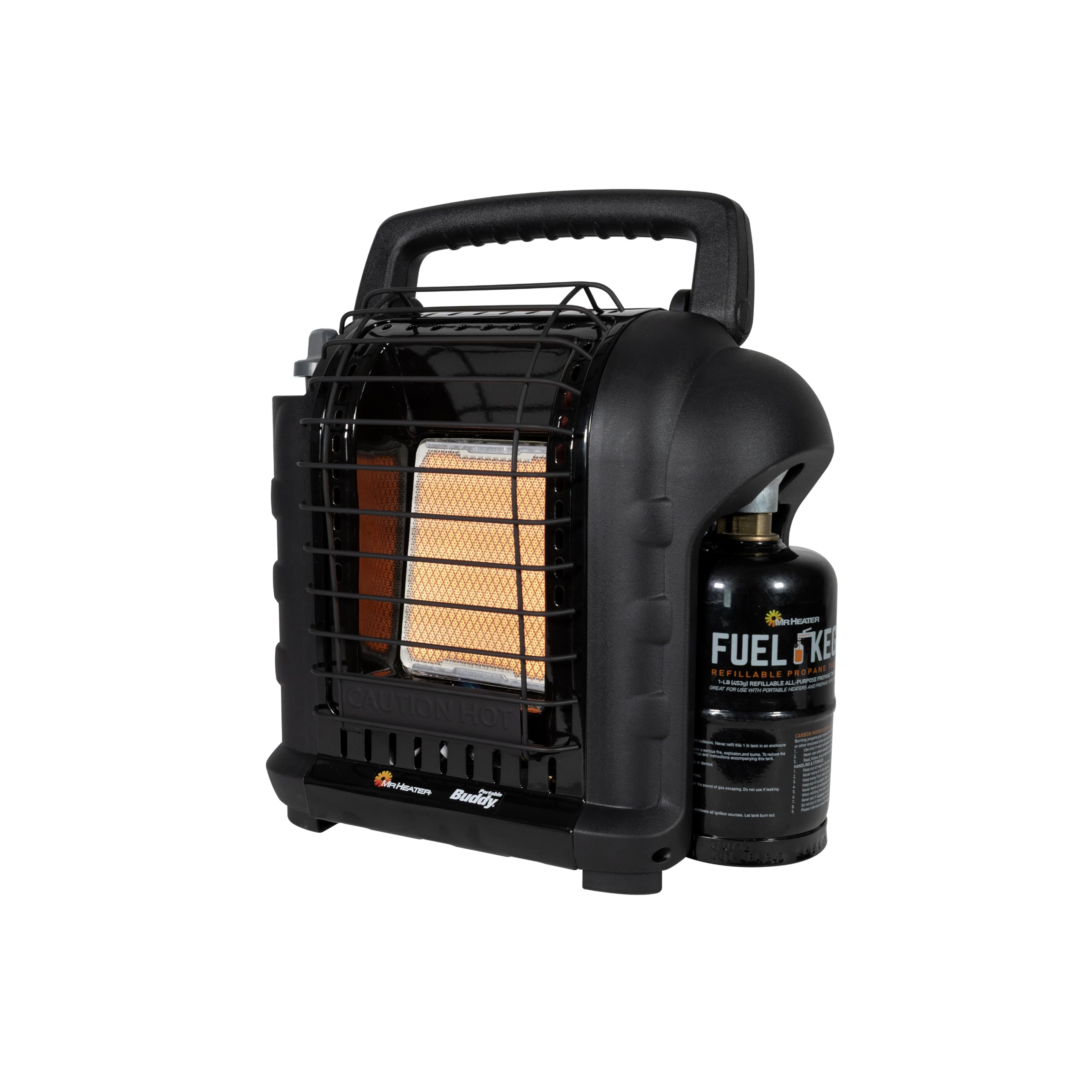
No wiring, no noise: 9,000 BTUs of radiant heat wherever you set it.

Every other heater here assumes something — a circuit, a gas line, a ceiling height. This one assumes a propane canister and nothing else, which makes it the pick for a detached garage with one outlet, a rented place you can't rewire, or the afternoon the power goes out mid-session. At 7.1 pounds with a carry handle, it moves to wherever you're working.

Radiant heat is a different experience from the forced-air units. It warms what's in front of it — you, your clothes, the wall behind you — rather than the air, so the effect arrives in seconds and doesn't vanish the moment someone opens the door. On the 9,000 BTU setting it's a serious little heater for a one- or two-car space; drop it to 4,000 and it's pleasant rather than assertive. The tip-over shutoff means a knocked unit stops instead of lying there lit.

Two things to know before you buy. Indoor approval here excludes Canada and Massachusetts, and any propane burner needs air regardless of what the label allows — crack a door, and put a CO alarm on the wall. Storage matters more than people expect, too: a Buddy that spends the summer in a damp garage is the one that won't spark in November, so bring it inside between winters.

Bottom Line

We keep this one for small, cold garages and power cuts: 9,000 BTUs of radiant heat, no wiring, and it follows you to the bench.

Check Latest Price

Best for Big, Tall Garages

Our Score 8.8/10
Mr. Heater 50,000 BTU Unit Heater

Mr.

Mr. Heater 50,000 BTU Unit Heater

  • Fuel Propane or natural gas
  • Coverage Up to 1,667 sq ft
  • Heat Output 50,000 BTU
  • Ceiling Height 10 ft minimum
Check Price on Amazon

50,000 BTUs for a three-car shop, hung overhead and out of the way.

Ten feet of ceiling and eight feet of clearance from the base of the heater to the floor — check those first, because they rule out most attached garages before anything else about this Mr. Heater matters. Clear that bar and you're looking at the highest output on this page: 50,000 BTUs, rated for about 1,667 square feet, roughly a three-car garage.

The part we appreciate most is where it puts the heat. Hung from the ceiling, it discharges warm air from above shoulder height, so it mixes in the space where you're actually lifting instead of stratifying in the trusses the way a floor-standing torpedo heater does. It burns propane or natural gas — the conversion kit is in the box — and it accepts a standard 24-volt thermostat, which is the difference between walking into a cold garage and walking into a warm one. The thermostat is sold separately, and at 60 pounds the hang is a two-person job.

Fuel is the other half of the decision. A propane cylinder and a hose get you running without trenching a line, but you're then hauling tanks; natural gas is the better long-term answer if the line already reaches the building. The blower is not silent — in a small, hard-walled shop it becomes the background noise of the whole session — and that's the trade for moving 50,000 BTUs around a room this size.

Bottom Line

We think this is the heater that makes a three-car garage usable in January — as long as your shop has ten feet of ceiling and a gas supply.

Check Latest Price

Best for Small Garages

Our Score 8.8/10
Heat Storm HS-1500-PHX-WIFI

Heat

Heat Storm HS-1500-PHX-WIFI

  • Power 120V, 12.5A plug-in
  • Controls Wi-Fi, remote, digital thermostat
  • Coverage 150 sq ft primary, 750 sq ft secondary
  • Heat Output 1,500 W
Check Price on Amazon

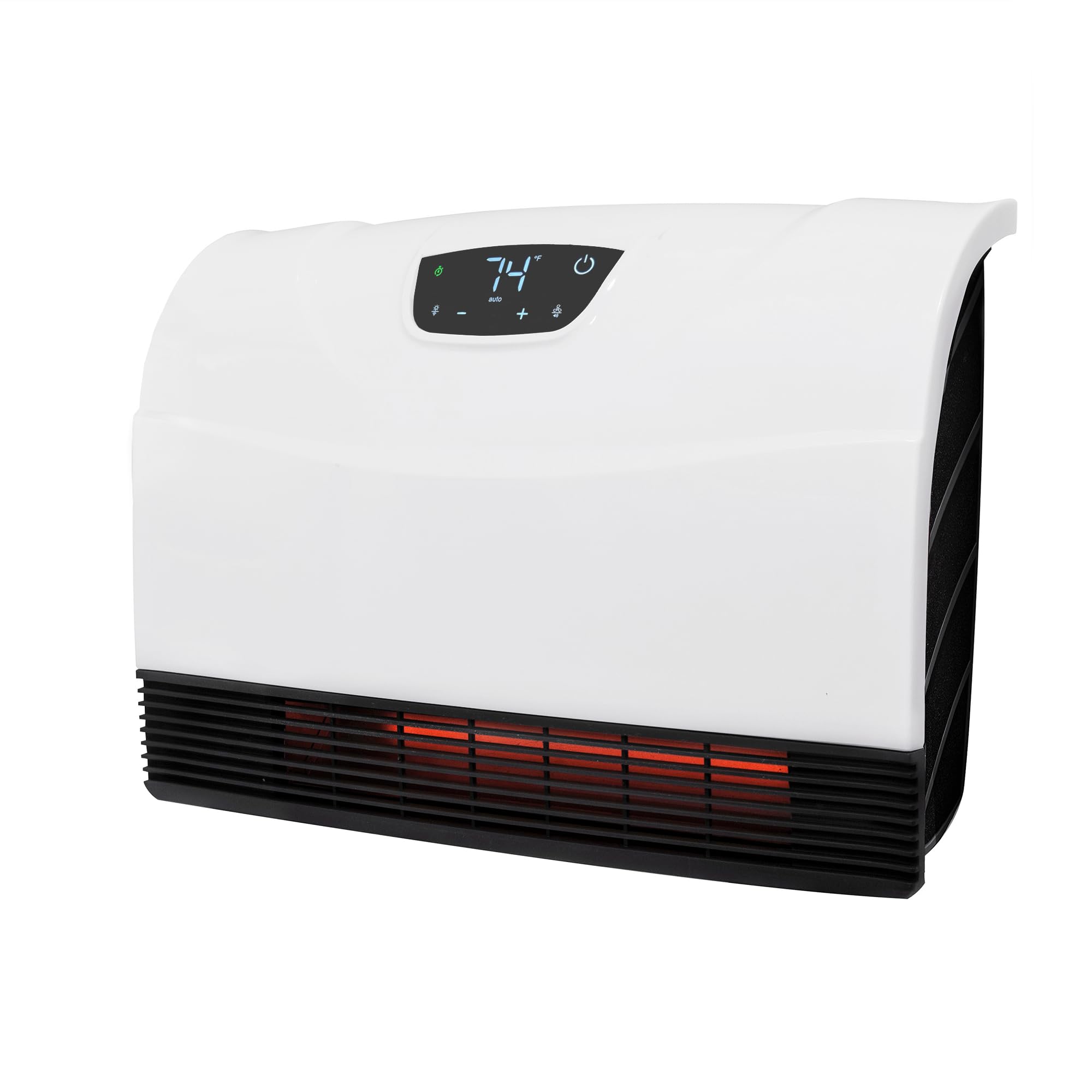
A 120-volt wall unit with Wi-Fi, so the room is warm before you walk out.

The trick with a 1,500-watt heater in a garage is timing: it can't overhaul a cold room, but it can take the edge off one that's been running a while. That's the case for the Heat Storm. The Wi-Fi module means you can switch it on from the kitchen before you head out and walk into a garage that has lost its bite, and the touchscreen thermostat and remote cover the times the app is more trouble than the walk.

Mounting is genuinely easy, and the detail we appreciated is the paper template with a level printed into it — tape it up, drill four holes, and the bracket lands where it should. Hang the unit over the outlet and the cord tucks inside the housing, which gives you a clean wall instead of a loop of cable beside the rack. At nine pounds it stays where you put it, the sides and back run cool, and the grill over the element is safe to brush against in a narrow bay.

Longevity is the weak point: units that quit tend to quit inside the first year, so keep the receipt. Against that, this heater does the one thing a small garage gym actually needs — it takes the shock out of the room before you start — and it does it quietly, from the wall, without ever being underfoot.

Bottom Line

We point single-bay garage owners here: it hangs on the wall, plugs into a normal outlet, and can have the room warm before you've laced up.

Check Latest Price

Best Overall

Our Score 8.6/10
Dr. Infrared DR-966

Dr.

Dr. Infrared DR-966

  • Power 240V, 25A, hardwired
  • Coverage 600 sq ft
  • Mounting Wall or ceiling
  • Heat Output 6,000 W
Check Price on Amazon

Real 6,000-watt output, aimable louvers, and a thermostat for a two-car garage gym.

Six thousand watts is the number that decides this one. That's roughly 20,500 BTUs — more than any plug-in space heater can make — and it's why Dr. Heater can rate the DR-966 for 600 square feet of garage instead of a warm circle around your ankles. We think the louvers earn their keep, too: five adjustable ones across the front let you aim the stream at the rack, the bench, or the corner where you warm up, instead of baking the ceiling above your head.

The install is the part to plan around. There's no cord in the box — this is a hardwired 240-volt unit pulling 25 amps, so the job starts with a breaker and an electrician. Once the circuit exists, 27 pounds and the included bracket make it a wall or ceiling hang, and the payoff is a heater that never eats floor space you'd rather use for a mat. The thermostat is a plain dial running from 37 to 104 degrees with high and low settings, so it's a set-and-leave control rather than a scheduler.

Two things come with the design. The fan is the loudest object in a garage gym — you'll hear it between sets, and on high it competes with a podcast. Longevity is the other compromise: when one of these goes, the fan or the control board is usually what goes, which makes a straightforward return window worth more than a sixth louver. In an attached, small garage where you train with headphones anyway, neither point really lands; if what you want is silence and a decade of service, this isn't that heater.

Bottom Line

We recommend the DR-966 to anyone with a two-car garage and a 240-volt circuit: it delivers forced-air heat on a thermostat without gas, venting, or overhead clearance.

Check Latest Price

How We Tested Garage Gym Heaters

We started by gathering heaters that made sense for a garage gym: electric and propane models, radiant and forced-air designs, small floor units and wall-mounted options. We filtered out anything with vague safety claims, flimsy stands, or a price that did not match its build, then brought in 12 units.

Testing happened in my unheated garage gym, mostly before work and after dinner, with the doors closed and each heater set to low, medium, and high. We set each unit in the same corner, ran it for 30 minutes, and checked a thermometer at floor level, bench height, and rack height; the good ones warmed the lifter zone quickly, while others cooked the ceiling and left toes cold. We walked between stations to see if airflow followed us or stayed in one lane, and we watched whether the thermostat cycled smoothly or let the space go hot-cold-hot. We adjusted controls with gym chalk on our hands, moved units with one hand, and timed setup from box to first warm minute.

We also loaded the portable models into a truck for a weekend campsite test, checking handles, cords, and stability on uneven ground. After each session we noted rattles, loose knobs, scorched cords, or smells, and over eight months we kept track of which units needed a reset or replacement part. At the end, we compared what each heater cost against its warm-up speed, noise, and build, not just its top heat setting.

How to Choose

Size the heater to the room, not the sticker

The two forced-air units here give you a usable yardstick. Dr. Heater rates 6,000 watts across 600 square feet; Mr. Heater rates 50,000 BTUs across 1,667 — both land near 10 watts or 30 BTUs per square foot, and both assume walls and a ceiling. An uninsulated detached garage or a single-skin door needs more, or an honest acceptance that the heater's job is making training possible rather than making the room comfortable.

Radiant heaters advertise differently. The Heat Storm's 150-square-foot primary rating sits beside a 750-square-foot secondary one, which tells you how elastic those figures get — treat secondary numbers as spot warmth, not heated space.

Radiant heats the lifter, forced air heats the room

When you're only out there for 45 minutes, warming the air is mostly wasted effort: the door opens, the air leaves, and the slab gives nothing back. Radiant panels and the Buddy warm whatever sits in front of them, so the effect arrives in seconds and stays on you between sets. Forced air is the better answer when the garage doubles as a workshop, when you want to start in a T-shirt, or when you want a thermostat doing the thinking. Forced air for a room you use for hours, radiant for a body that's in and out.

Check the circuit before the BTU rating

One outlet sets your ceiling: a 120-volt circuit comfortably carries 1,500 watts, which is the Heat Storm's entire output. Anything beyond that means 240 volts — the DR-966 is hardwired at 25 amps and needs a breaker and an electrician — or gas, with the clearance and venting that come attached. Budget the install as part of the purchase, and don't plan on an extension cord; a high-wattage heater on a household cord is the one shortcut worth refusing.

Mount it out of the bar's path

Floor area in a garage gym is training area, so wall and ceiling mounts earn their keep. Two measurements decide placement: the unit heater wants a 10-foot ceiling and 8 feet from its base to the floor, while a wall unit belongs above head height and outside the arc of an overhead press or a swinging door. Aim matters as much as height — the DR-966's five louvers exist to put warm air at shoulder level instead of in the rafters. Keep everything clear of the clearances on the label.

Noise, moisture, and the air you're breathing

Forced air is loud; radiant and the small wall units are close to silent. If you train to a timer or a class on a speaker, that gap matters more than a few hundred BTUs. Propane brings a second consideration: burning it adds water vapor to the room, and a closed garage in January is exactly where that vapor condenses on cold plates, bars, and tools. Ventilate the space and put a CO alarm in it. The Buddy is approved for indoor use in most states, but approval isn't the same thing as a sealed room.

Frequently Asked Questions

Final Verdict

Permanent heat, no fuel, no ceiling-height problem: the DR-966 is what we recommend for the typical two-car garage gym, provided you can get a 240-volt circuit to the wall. It's the pick that turns a cold slab room into a room you can train in, and the louvers are what make it feel aimed at you rather than at the rafters.

If your ceiling runs ten feet and you have gas or a tank, the Mr. Heater unit is a class above it for a big shop. If you have one bay and one outlet, the Heat Storm does more than 1,500 watts suggests. And if there's no power at all, the Buddy is the one that still works.